
Many adjectives in English are formed from verbs. These words describe a quality, state, or result of an action. For example, “bored,” “interesting,” and “broken” all come from verbs. They help us give more details about people, things, and situations. In this blog post, you will learn how to form, recognize, and use adjectives formed from verbs in sentences. Understanding these word forms will help you build stronger vocabulary and improve your speaking and writing skills step by step.
What Are Adjectives Formed from Verbs?
Adjectives formed from verbs are words that come from action words (verbs) but act as describing words (adjectives). They tell us how someone feels or what condition something is in after an action.
Example:
- Interest → interested, interesting
- Excite → excited, exciting
- Bore → bored, boring
These adjectives often end with -ed or -ing.
Formation of Adjectives from Verbs
| Verb | Adjective (-ed) | Adjective (-ing) |
|---|---|---|
| amaze | amazed | amazing |
| confuse | confused | confusing |
| tire | tired | tiring |
| surprise | surprised | surprising |
| disappoint | disappointed | disappointing |
Note:
- -ed adjectives describe feelings.
- -ing adjectives describe things or situations that cause feelings.

Difference Between -ed and -ing Adjectives
-ed adjectives → Show how a person feels
-ing adjectives → Show the thing or situation causing the feeling
| Example Sentence | Meaning |
|---|---|
| I am bored. | I feel bored. |
| The movie is boring. | The movie makes me feel bored. |
| She is excited. | She feels excited. |
| The game is exciting. | The game makes her excited. |
Examples of Adjectives Formed from Verbs
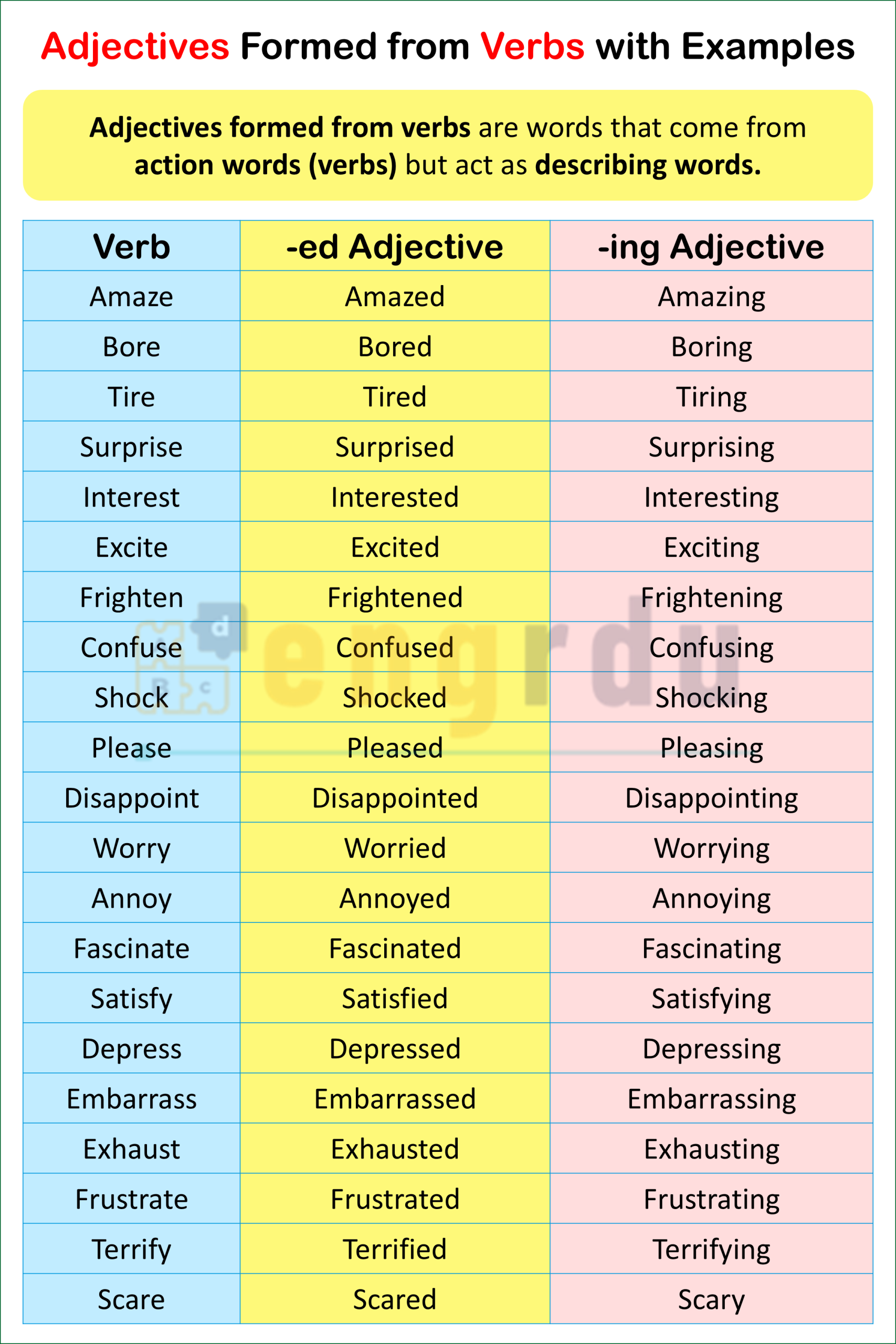
Here’s a complete list of examples of adjectives formed from verbs. Each pair includes the verb, the -ed adjective, and the -ing adjective.

| No. | Verb | -ed Adjective | -ing Adjective |
|---|---|---|---|
| 1 | amaze | amazed | amazing |
| 2 | bore | bored | boring |
| 3 | tire | tired | tiring |
| 4 | surprise | surprised | surprising |
| 5 | interest | interested | interesting |
| 6 | excite | excited | exciting |
| 7 | frighten | frightened | frightening |
| 8 | confuse | confused | confusing |
| 9 | shock | shocked | shocking |
| 10 | please | pleased | pleasing |
| 11 | disappoint | disappointed | disappointing |
| 12 | worry | worried | worrying |
| 13 | annoy | annoyed | annoying |
| 14 | fascinate | fascinated | fascinating |
| 15 | satisfy | satisfied | satisfying |
| 16 | depress | depressed | depressing |
| 17 | embarrass | embarrassed | embarrassing |
| 18 | exhaust | exhausted | exhausting |
| 19 | frustrate | frustrated | frustrating |
| 20 | terrify | terrified | terrifying |
| 21 | scare | scared | scary |
| 22 | relax | relaxed | relaxing |
| 23 | confuse | confused | confusing |
| 24 | puzzle | puzzled | puzzling |
| 25 | charm | charmed | charming |
| 26 | move | moved | moving |
| 27 | astonish | astonished | astonishing |
| 28 | encourage | encouraged | encouraging |
| 29 | discourage | discouraged | discouraging |
| 30 | satisfy | satisfied | satisfying |
| 31 | amuse | amused | amusing |
| 32 | inspire | inspired | inspiring |
| 33 | alarm | alarmed | alarming |
| 34 | shock | shocked | shocking |
| 35 | delight | delighted | delightful |
| 36 | relax | relaxed | relaxing |
| 37 | amuse | amused | amusing |
| 38 | disappoint | disappointed | disappointing |
| 39 | surprise | surprised | surprising |
| 40 | exhaust | exhausted | exhausting |
| 41 | disgust | disgusted | disgusting |
| 42 | tire | tired | tiring |
| 43 | thrill | thrilled | thrilling |
| 44 | excite | excited | exciting |
| 45 | fascinate | fascinated | fascinating |
| 46 | confuse | confused | confusing |
| 47 | bore | bored | boring |
| 48 | worry | worried | worrying |
| 49 | amaze | amazed | amazing |
| 50 | frighten | frightened | frightening |
| 51 | shock | shocked | shocking |
| 52 | delight | delighted | delightful |
| 53 | amuse | amused | amusing |
| 54 | relax | relaxed | relaxing |
| 55 | discourage | discouraged | discouraging |
| 56 | embarrass | embarrassed | embarrassing |
| 57 | astonish | astonished | astonishing |
| 58 | move | moved | moving |
| 59 | encourage | encouraged | encouraging |
| 60 | please | pleased | pleasing |
| 61 | alarm | alarmed | alarming |
| 62 | terrify | terrified | terrifying |
| 63 | confuse | confused | confusing |
| 64 | excite | excited | exciting |
| 65 | bore | bored | boring |
| 66 | annoy | annoyed | annoying |
| 67 | interest | interested | interesting |
| 68 | amaze | amazed | amazing |
| 69 | depress | depressed | depressing |
| 70 | tire | tired | tiring |
| 71 | shock | shocked | shocking |
| 72 | worry | worried | worrying |
| 73 | disgust | disgusted | disgusting |
| 74 | thrill | thrilled | thrilling |
| 75 | encourage | encouraged | encouraging |
How to Use Them Correctly
1. When talking about people’s feelings → use -ed adjectives
- I am confused about the test.
- They were bored during the class.
2. When talking about things or events → use -ing adjectives
- The test was confusing.
- That movie is boring.
Quick Tips to Remember
- -ed → how someone feels
- -ing → what is causing the feeling
- Use them to make your sentences more natural and descriptive
Practise Exercise
Try to fill in the blanks with the correct adjective:
- The lesson was very __________. (bore)
- I am __________ because the weather is bad. (disappoint)
- The journey was long and __________. (tire)
- They were __________ by the magician’s trick. (amaze)
- This news is really __________. (shock)
FAQs
What are adjectives formed from verbs?
Adjectives formed from verbs are words that come from action verbs but describe a state, feeling, or quality. For example, from the verb excite, we get the adjectives excited and exciting.
What is the difference between -ed and -ing adjectives?
-ed adjectives describe how a person feels, while -ing adjectives describe the thing or situation causing the feeling.
Example: I am bored. (feeling) / The movie is boring. (cause)
How are adjectives formed from verbs?
Adjectives are often formed by adding -ed or -ing to a verb.
Example: amaze → amazed / amazing, tire → tired / tiring.
-ed adjectives talk about feelings, and -ing adjectives talk about the cause.
What are some common examples of adjectives formed from verbs?
Some common examples include:
amazed / amazing, bored / boring, interested / interesting, excited / exciting, confused / confusing, frightened / frightening, and tired / tiring.
How can I use adjectives formed from verbs in sentences?
Use -ed adjectives for people’s emotions and -ing adjectives for things or situations.
Example: She was surprised by the news. / The news was surprising.
Read More