An abstract noun is a word that names an idea, quality, or feeling that cannot be seen or touched, such as freedom, happiness, or courage. In this Grammar lesson, learning abstract nouns helps you speak, write, and understand English more effectively. Using them correctly makes your sentences expressive and meaningful. In this blog post, you will explore the definition, uses, and examples of abstract nouns to practice and use confidently in everyday English.
Abstract Nouns Definition and Examples
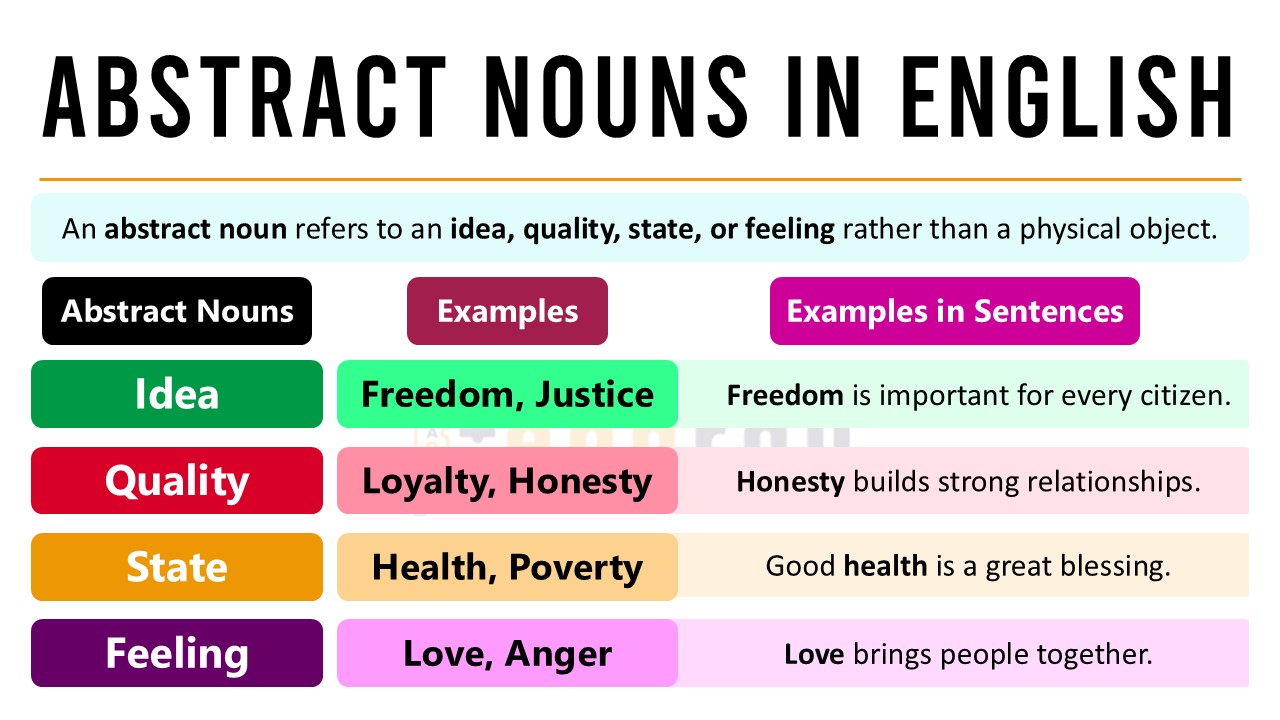
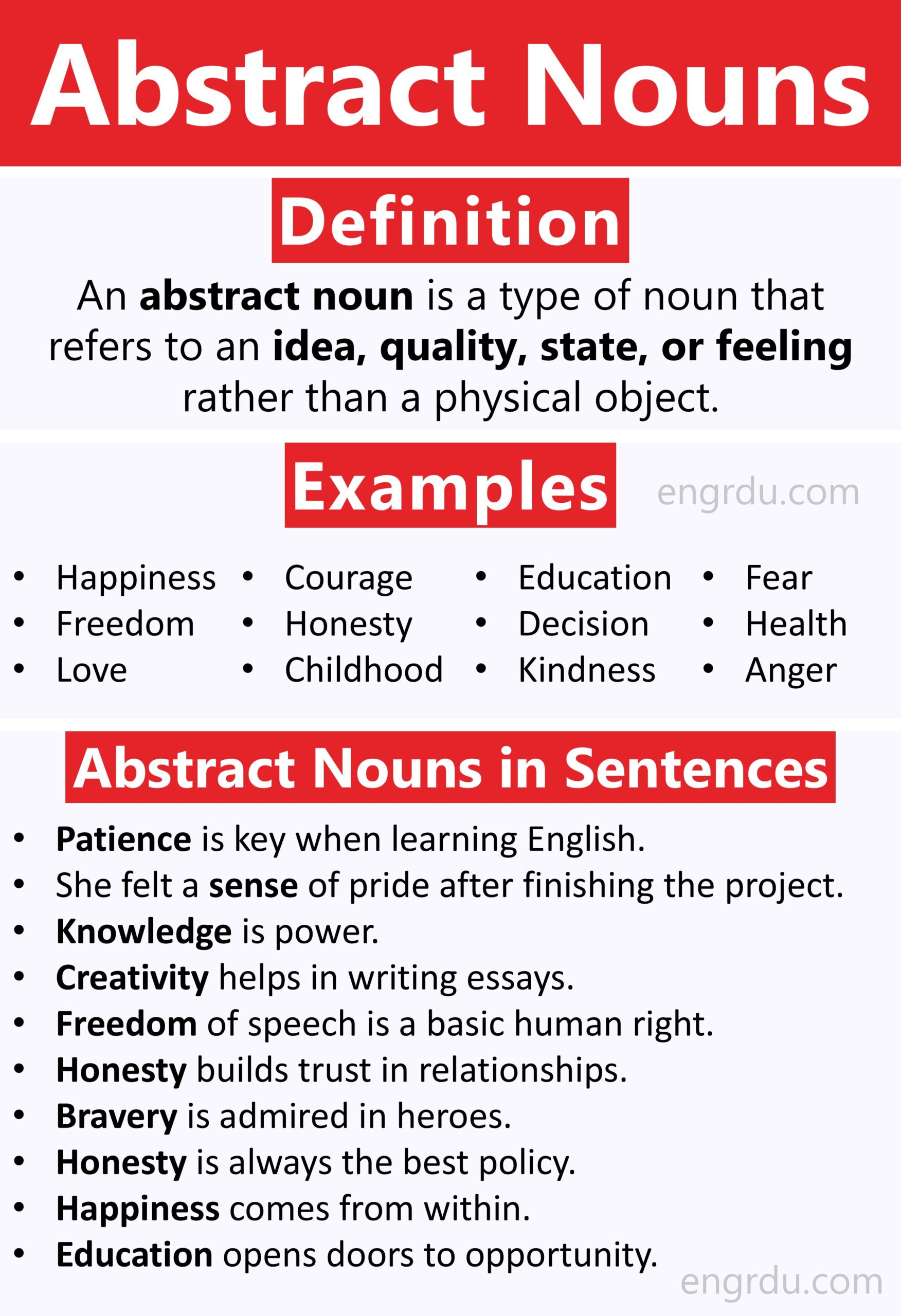
An abstract noun is a type of noun that refers to an idea, quality, state, or feeling rather than a physical object. Unlike concrete nouns, abstract nouns cannot be experienced through the five senses.
Examples:
- Happiness
- Freedom
- Love
- Courage
- Honesty
Here, you cannot touch or see “happiness” or “freedom,” but you can understand and feel them.
Rules and Structure of Abstract Nouns
Formation:
Many abstract nouns are formed from adjectives, verbs, or other nouns. Common endings include:
- -ness → happiness, kindness
- -ity → responsibility, creativity
- -tion / -sion → education, decision
- -hood → childhood, adulthood
- -ship → friendship, leadership
Usage:
Abstract nouns can be subjects or objects in a sentence.
- Happiness is important in life.
- She values honesty above all.
Countable vs. Uncountable:
Most abstract nouns are uncountable (cannot be pluralized), but some can be countable:
- Uncountable: love, courage, information
- Countable: idea, opinion, decision
Types of Abstract Nouns
Abstract nouns can be categorized by the type of concept they represent:
| Type | Definition | Examples |
|---|---|---|
| Emotions and Feelings | Nouns representing emotional states | love, anger, fear, joy |
| Qualities and Traits | Nouns representing personal or moral qualities | honesty, bravery, patience |
| Ideas and Concepts | Nouns representing thoughts or concepts | freedom, democracy, knowledge |
| States and Conditions | Nouns representing states of being | childhood, health, poverty |
Abstract Nouns vs. Concrete Nouns
| Feature | Abstract Noun | Concrete Noun |
|---|---|---|
| Definition | Idea, quality, or feeling | Physical object |
| Can be sensed | No | Yes (seen, touched, heard) |
| Examples | happiness, freedom | book, chair, apple |
If you cannot touch, see, smell, hear, or taste it, it’s likely an abstract noun.
Common Mistakes and How to Avoid Them
Using abstract nouns as countable incorrectly
❌ I have many happinesses.
✅ I have a lot of happiness.
Confusing abstract with concrete nouns
❌ Courage is on the table.
✅ The book shows courage.
Overusing abstract nouns in writing
Make sentences natural by combining abstract nouns with verbs, adjectives, and concrete nouns.
Examples of Abstract Nouns
Daily Life:
- Patience is key when learning English.
- She felt a sense of pride after finishing the project.
School and Study:
- Knowledge is power.
- Creativity helps in writing essays.
Writing and Speaking:
- Freedom of speech is a basic human right.
- Honesty builds trust in relationships.
Table for Quick Reference
Common Abstract Nouns and Their Forms:
| Base Word | Abstract Noun Form | Example Sentence |
|---|---|---|
| Brave | Bravery | Bravery is admired in heroes. |
| Honest | Honesty | Honesty is always the best policy. |
| Happy | Happiness | Happiness comes from within. |
| Educate | Education | Education opens doors to opportunity. |
Practice Exercises
Exercise 1: Identify the Abstract Noun (Circle the abstract noun in each sentence)
- She showed great courage in the competition.
- I feel happiness when I help others.
- Freedom is a basic right of every citizen.
- His kindness touched everyone.
- Knowledge can change your life.
- Anger can lead to bad decisions.
- Patience is important in learning.
- Love is stronger than fear.
- Her creativity shines in art class.
- Honesty is the best policy.
Answers: 1.courage, 2.happiness, 3.freedom, 4.kindness, 5.Knowledge, 6.Anger, 7.Patience, 8.Love, 9.Creativity, 10.Honesty
Exercise 2: Use Abstract Nouns in Sentences
Write a sentence using the following abstract nouns:
- Happiness
- Bravery
- Knowledge
- Friendship
- Freedom
- Love
- Honesty
- Patience
- Creativity
- Courage
Example Answers:
- Happiness comes from helping others.
- Bravery is admired in soldiers.
- Knowledge helps us make better decisions.
- Friendship brings joy to life.
- Freedom allows people to express themselves.
- Love can heal emotional wounds.
- Honesty builds strong relationships.
- Patience is necessary for learning a new skill.
- Creativity makes art unique.
- Courage helps us face challenges.
FAQs About Abstract Nouns
What is an abstract noun in simple words?
An abstract noun is a word that names an idea, feeling, quality, or concept you cannot touch or see.
Can abstract nouns be plural?
Most abstract nouns are uncountable and do not have a plural form, but some like “idea” or “opinion” can be plural.
How do I identify an abstract noun?
If you cannot experience it with your five senses, it is likely an abstract noun.
Are emotions abstract nouns?
Yes, emotions like happiness, anger, and fear are all abstract nouns.
Can abstract nouns be used as subjects in sentences?
Yes, abstract nouns often serve as subjects: Happiness is important.
Conclusion
Abstract nouns are a key part of English grammar that allow learners to express complex ideas, feelings, and qualities. By understanding their definitions, rules, types, and common mistakes, learners can confidently use abstract nouns in writing and speaking. Practice exercises and real-life examples help reinforce knowledge, making abstract nouns easier to recognize and use effectively.
Read More