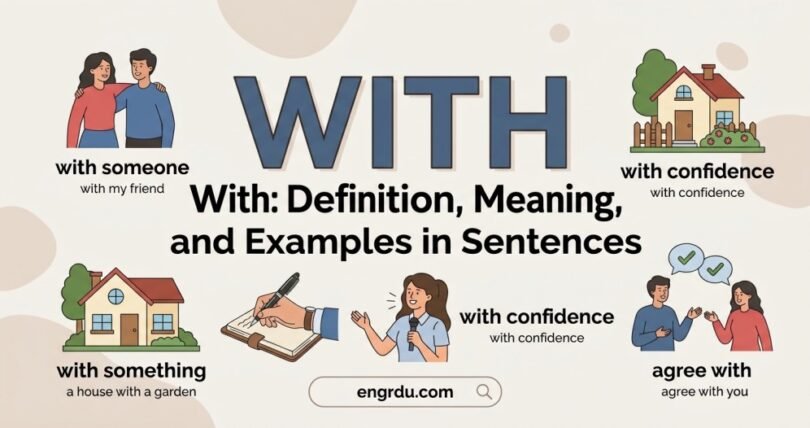

With is a common English word used to show connection, company, possession, tools, and manner. It usually works as a preposition and helps explain how people, things, or actions are related. Understanding its different meanings makes everyday English sentences easier to read and write.
What Does With Mean?
With is mainly a preposition that shows a relationship between two people, things, actions, or ideas.
- It can mean together with someone or something.
- It can show possession or a feature.
- It can identify the tool or instrument used for an action.
- It can describe the way an action happens.
- It can show connection, agreement, or association.
Example:
- I went to school with my brother.
Here, with shows that the speaker and the brother were together.
With: Definition and Part of Speech
With is primarily a preposition. A preposition connects a noun or pronoun to another part of a sentence.
Definition of With
- Word: With
- Part of speech: Preposition
- Basic meaning: Together, accompanied by, using, having, or connected to
- Pronunciation: /wɪð/ or /wɪθ/
- Common use: Before a noun, pronoun, or noun phrase
Examples:
- She came with her sister.
- He cut the paper with scissors.
- The man with a blue shirt is my teacher.
- I agree with you.
How to Pronounce With
The word with has two common pronunciations in English.
- /wɪð/ — the final sound is similar to the th sound in this.
- /wɪθ/ — the final sound is similar to the th sound in think.
Both pronunciations are used in English, and pronunciation can vary by speaker and region.
Example:
- I went with them.
With Definition and Examples
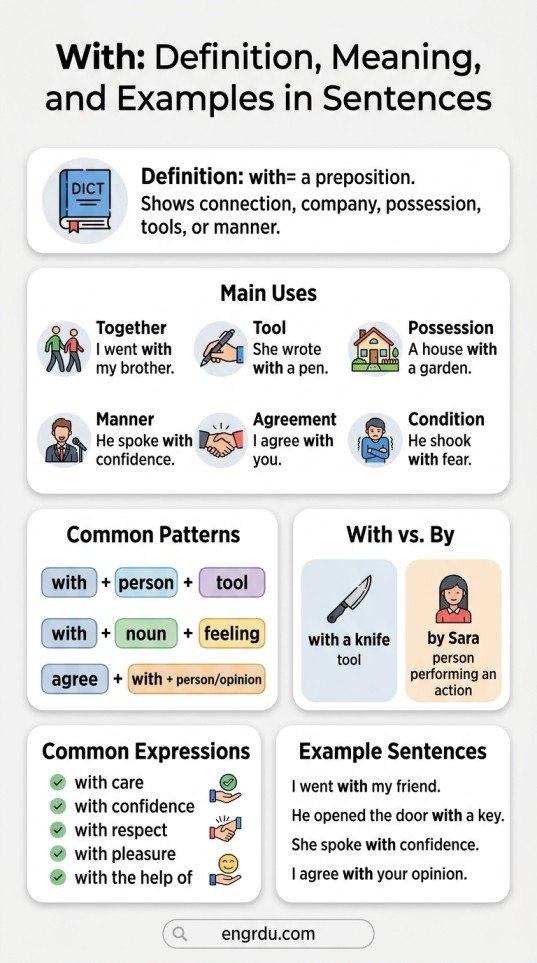
Main Uses of With
The meaning of with changes slightly according to the context.
| Use | Meaning | Example |
|---|---|---|
| Company | Together with someone | I went with Ali. |
| Possession | Having something | A girl with a red bag |
| Tool | Using something | Cut it with a knife. |
| Manner | Showing how something happens | He spoke with confidence. |
| Connection | Relationship or association | I work with her. |
| Agreement | Supporting an opinion | I agree with you. |
| Cause | Showing a condition or feeling | His hands shook with fear. |
With for Being Together or Accompanying
With can show that someone or something is together with another person or thing.
- She went shopping with her mother.
- I played football with my friends.
- He lives with his parents.
- The teacher came with her students.
- We traveled with our neighbors.
Pattern:
Subject + verb + with + person
Example:
- Sarah went with her brother.
With for Possession or Description
With can describe a person or thing by showing what they have or what feature they possess.
- The boy with glasses is my cousin.
- I saw a house with a large garden.
- She bought a dress with long sleeves.
- The man with a beard is my uncle.
- We need a room with two windows.
Here, with is close in meaning to having.
Example:
- A girl with curly hair entered the room.
- A girl having curly hair entered the room.
The first sentence sounds more natural in everyday English.
With for Tools and Instruments
With shows the tool, object, or instrument used to perform an action.
- He cut the bread with a knife.
- She wrote the letter with a pen.
- I opened the box with a key.
- They painted the wall with a brush.
- He ate the soup with a spoon.
Common Pattern
Verb + with + tool or instrument
Examples:
- Write with a pencil.
- Cut with scissors.
- Open it with a key.
- Mix the ingredients with a spoon.
With for Manner or Behavior
With can describe the way someone performs an action or expresses a feeling.
- She spoke with confidence.
- He answered with patience.
- They listened with attention.
- The child looked at me with surprise.
- She treated everyone with kindness.
Common nouns used after with include:
- confidence
- patience
- care
- respect
- kindness
- attention
- interest
- excitement
- concern
Example:
- Please handle the glass with care.
With for Relationships and Connection
With can describe a relationship, association, or connection between people or organizations.
- I work with my brother.
- She is talking with her teacher.
- He has a problem with his computer.
- We have an agreement with the company.
- They are friends with our neighbors.
With can also describe employment or association:
- She works with a local organization.
- He is with the sales department.
With for Agreement or Support
The expression agree with means to share the same opinion as another person or to accept that an idea is correct.
- I agree with you.
- She agrees with her teacher.
- We agree with this decision.
- They do not agree with the proposal.
Important Difference
Use agree with for a person, opinion, or idea.
- I agree with Ali.
- I agree with your opinion.
Use agree to for a suggestion, request, plan, or arrangement.
- She agreed to the plan.
- He agreed to the terms.
With for Causes and Conditions
With can sometimes describe the physical or emotional condition that accompanies an action.
- His hands were shaking with fear.
- She was crying with happiness.
- The child was trembling with cold.
- His face turned red with anger.
- The room was filled with smoke.
In these sentences, with connects an action, condition, or result with the feeling or substance associated with it.
With in Common English Expressions
Many common English expressions use with.
| Expression | Meaning | Example |
|---|---|---|
| With care | Carefully | Handle it with care. |
| With confidence | Confidently | Speak with confidence. |
| With pleasure | Happily or willingly | I will help you with pleasure. |
| With respect | Politely | She spoke with respect. |
| With luck | If things go well | With luck, we will arrive early. |
| With permission | After receiving permission | He entered with permission. |
| With the help of | Using someone’s help | We finished it with the help of our teacher. |
| With regard to | About or concerning | With regard to your request, we will reply soon. |
With vs. Other Similar Words
Some learners confuse with with other prepositions because their meanings can overlap.
| Word | Main Use | Example |
|---|---|---|
| With | Together, using, having | I went with my friend. |
| By | Method, agent, or transport | I traveled by bus. |
| To | Direction or destination | I went to school. |
| For | Purpose or benefit | This gift is for you. |
| From | Source or starting point | I received it from Ali. |
With vs. By
- I cut the paper with scissors. → The tool is scissors.
- The letter was written by Sara. → Sara performed the action.
With vs. To
- I went with Ahmed. → Ahmed accompanied me.
- I went to Lahore. → Lahore was my destination.
With vs. For
- I bought a gift for my sister. → My sister will receive it.
- I went shopping with my sister. → My sister accompanied me.
Common Mistakes With With
- Incorrect: I went with to my friend.
Correct: I went with my friend. - Incorrect: I agree to you.
Correct: I agree with you. - Incorrect: She cut it by a knife.
Correct: She cut it with a knife. - Incorrect: He came with me to?
Correct: He came with me. - Incorrect: I discussed with about the problem.
Correct: I discussed the problem.
Examples of With in Sentences
Here are useful examples showing different meanings of with.
- I went to the market with my father.
- She is studying with her friends.
- He opened the door with a key.
- Write your name with a pencil.
- The woman with the red bag is my aunt.
- We stayed in a hotel with a swimming pool.
- He spoke with confidence.
- She treated the child with kindness.
- I agree with your opinion.
- He works with a small team.
- The boy was shaking with fear.
- She was crying with happiness.
- Please handle the glass with care.
- I am happy with the results.
- They provided us with useful information.
Practice Exercise
Choose the correct word or phrase to complete each sentence.
- I went to the park ___ my brother.
a) with
b) to
c) from - She cut the cake ___ a knife.
a) by
b) with
c) for - The boy ___ the blue shirt is my friend.
a) with
b) to
c) by - I agree ___ your opinion.
a) to
b) with
c) from - He wrote the answer ___ a pencil.
a) with
b) for
c) from - She spoke ___ confidence during the presentation.
a) with
b) to
c) by - We traveled ___ our teacher.
a) with
b) from
c) for - Please treat the equipment ___ care.
a) by
b) with
c) to
Answers
- 1. a) with
- 2. b) with
- 3. a) with
- 4. b) with
- 5. a) with
- 6. a) with
- 7. a) with
- 8. b) with
FAQs
What is the meaning of with in English?
With usually means together with, accompanied by, using, having, or being connected to someone or something.
What part of speech is with?
With is mainly a preposition. It connects a noun or pronoun to another part of a sentence.
How is with used in a sentence?
With can show company, possession, tools, manner, relationships, agreement, or an accompanying condition.
What is an example of with for a tool?
A common example is “She cut the paper with scissors.” Here, with identifies the tool used for cutting.
What is the difference between with and by?
With commonly identifies a tool, while by can identify the person who performs an action or the method used.
Can with mean having?
Yes. With can describe possession or a feature, as in “a house with a large garden,” meaning a house that has one.
What is an example of agree with?
“I agree with your opinion.” Here, with connects the speaker to the person or opinion they support.
What does with mean in “with care”?
In “with care,” with describes the manner of an action. It means doing something carefully and attentively.
Conclusion
With is a versatile English preposition with several common uses. It can show company, possession, tools, manner, relationships, agreement, and associated conditions. Learning these patterns helps you use the word naturally in everyday speaking and writing.