
How to Write an Intro About Yourself can be easier when you know what information to include and how to put it in the right order. A good self-introduction usually covers your name, background, interests, education, work, or goals.
Whether you are introducing yourself in class, writing a short profile, meeting someone new, or starting an interview, the same basic structure can help you speak and write naturally.
What Is an Intro About Yourself?
An intro about yourself is a short introduction that tells other people who you are. It normally includes your name and a few relevant details about your background, interests, education, work, or purpose.
The information should match the situation. A classroom introduction can mention your grade and hobbies, while a professional introduction may focus on your experience and skills.
How to Write an Intro About Yourself
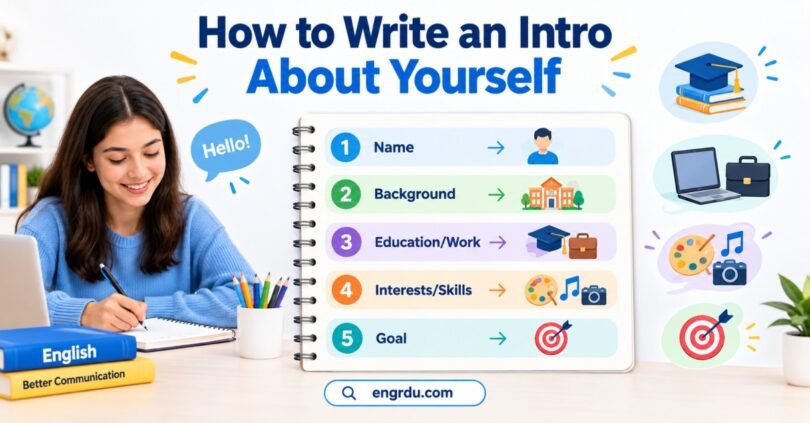
A strong introduction can follow this order:
Name → Background → Education or Work → Interests or Skills → Goal
You do not need to include every detail. Choose information that helps the listener or reader know you.
Basic Structure
Hello, my name is [Name]. I am from [Place]. I am a [student/job/profession]. I am interested in [interest]. I have experience in [skill or field]. My goal is to [goal].
Example
Hello, my name is Ali. I am from Lahore. I am a college student studying computer science. I enjoy reading and playing cricket. I am interested in web development, and I hope to become a professional software developer.
This structure can be shortened or expanded depending on the situation.
What to Include in Your Introduction
Choose details that are relevant to the person or situation.
| Information | Example |
|---|---|
| Name | My name is Sara. |
| Place | I am from Multan. |
| Education | I am studying English at college. |
| Job | I work as a graphic designer. |
| Experience | I have three years of teaching experience. |
| Skills | I am good at writing and communication. |
| Interests | I enjoy reading books. |
| Goal | I want to improve my English. |
1. Start With Your Name
Use a natural opening.
- My name is Ahmed.
- I’m Ahmed.
- Hello, I’m Ahmed.
- My name is Ahmed Khan.
For formal situations, “My name is…” is a safe choice.
2. Add Your Background
You can mention your city, country, school, college, or professional background.
- I am from Karachi.
- I live in Islamabad.
- I am a student at City School.
- I recently graduated from college.
3. Mention Your Education or Job
Give information that fits your purpose.
Student:
I am a Grade 8 student.
College student:
I am studying business administration.
Professional:
I work as a graphic designer.
Job seeker:
I recently graduated with a degree in computer science.
4. Add Relevant Interests or Skills
Choose one or two points rather than listing everything.
- I enjoy reading English books.
- I am interested in photography.
- I have good communication skills.
- I enjoy learning new languages.
5. End With Your Goal When Useful
A goal can make your introduction more meaningful.
- I want to improve my speaking skills.
- I hope to become a teacher.
- My goal is to work in software development.
- I am looking forward to learning new skills.
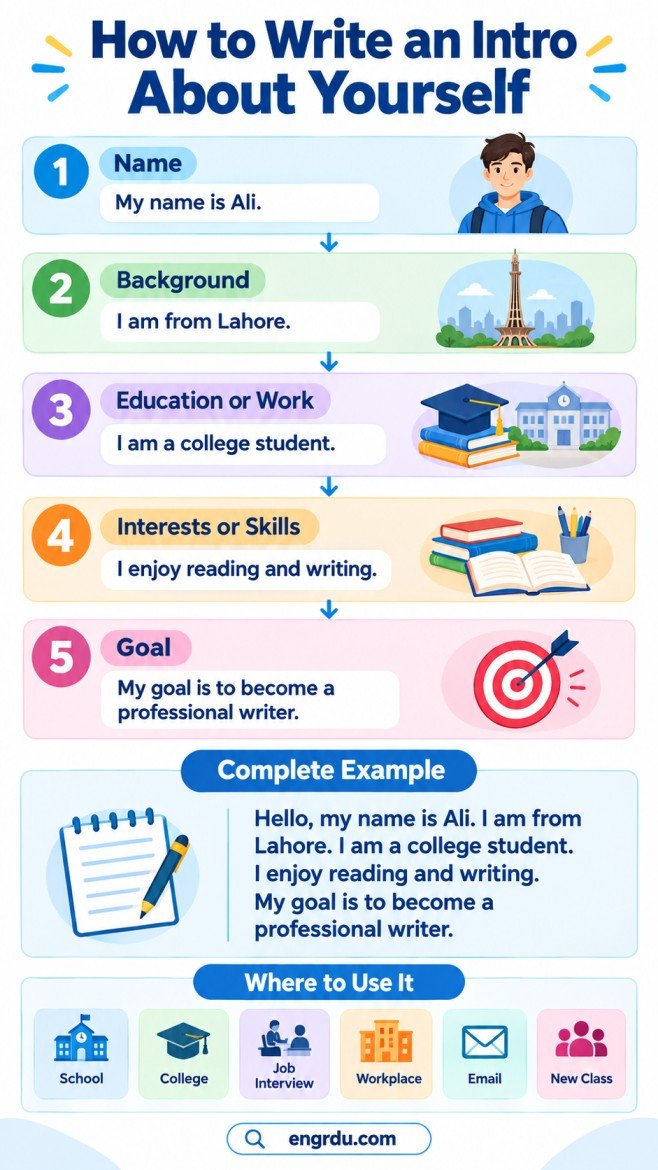
How to Write an Intro About Yourself Guide with Examples
Self-Introduction Examples
Short Intro About Yourself
Hello, my name is Hamza. I am from Faisalabad. I am a student, and I enjoy reading and playing football. I am interested in improving my English.
Intro About Yourself for School
Hello everyone. My name is Ayesha. I am in Grade 7. I live in Lahore with my family. My favorite subjects are English and science. I enjoy drawing and reading books. I am happy to be part of this class.
Intro About Yourself for College
Hi, I’m Bilal. I am studying computer science at university. I am interested in programming and technology. In my free time, I enjoy playing cricket and watching documentaries. I hope to develop my technical skills during my studies.
Intro About Yourself for a Job Interview
Good morning. My name is Sara Ahmed. I recently graduated with a degree in business administration. I have experience working on university projects involving marketing and communication. I am organized, interested in digital marketing, and looking forward to developing my professional skills.
Intro About Yourself in a New Class
Hi, everyone. My name is Zain. I am from Rawalpindi, and I am in Grade 9. I enjoy science, football, and computer games. I look forward to getting to know everyone.
Intro About Yourself in an Email
A written introduction should be brief and connected to the purpose of the email.
My name is Ahmed Khan, and I am a final-year business student at ABC University. I am contacting you regarding the internship opportunity advertised on your website.
Here’s a complete guide on introducing yourself in an email.
How to Introduce Yourself in Different Situations
The best introduction changes according to the situation.
| Situation | Focus On |
|---|---|
| School | Name, grade, interests |
| College | Course, interests, goals |
| New class | Name, studies, hobbies |
| Job interview | Education, experience, skills |
| Workplace | Role, experience, responsibilities |
| Name, role, reason for writing | |
| Social situation | Name, background, interests |
| Online profile | Skills, work, interests, goals |
Formal vs. Informal Introductions
| Formal | Informal |
|---|---|
| Good morning. My name is Ahmed. | Hi, I’m Ahmed. |
| I am currently studying medicine. | I’m studying medicine. |
| I work as a teacher. | I’m a teacher. |
| It is a pleasure to meet you. | Nice to meet you. |
Use formal language for interviews, professional meetings, applications, and official communication. Informal language works well with classmates, friends, and casual conversations.
Useful Sentences for a Self-Introduction
Talking About Yourself
- My name is ___.
- I’m ___.
- I am from ___.
- I live in ___.
- I am a student at ___.
- I work as a ___.
- I am currently studying ___.
- I have experience in ___.
- I am interested in ___.
- I enjoy ___.
- My main skill is ___.
- My goal is to ___.
Talking About Hobbies
Use “I enjoy + noun/verb-ing”:
I enjoy reading books.
I enjoy playing football.
You can also say:
My favorite hobby is painting.
In my free time, I like watching movies.
Talking About Goals
Use “I want to…”, “I hope to…”, or “My goal is to…”.
I want to improve my English.
I hope to become a doctor.
My goal is to start my own business.
How Long Should an Intro About Yourself Be?
The length depends on the situation.
- Casual introduction: 1–3 sentences
- Classroom introduction: 3–6 sentences
- Professional introduction: 4–7 sentences
- Job interview introduction: about 30–60 seconds
- Written profile: one short paragraph
A longer introduction is not always better. Include information that has a purpose.
Common Mistakes to Avoid
- Giving unnecessary personal information.
- Listing too many hobbies or skills.
- Using very long sentences.
- Memorizing an introduction word for word.
- Using informal language in a formal situation.
- Saying the same information more than once.
Practice: Write Your Own Introduction
Complete these sentences:
- My name is __________.
- I am from __________.
- I am a __________.
- I study/work at __________.
- I am interested in __________.
- I enjoy __________.
- My goal is to __________.
Practice Example
My name is Hassan. I am from Bahawalpur. I am a university student. I study English literature. I am interested in writing and communication. I enjoy reading novels. My goal is to become a professional writer.
Quick Check
Before using your introduction, check:
- Did I say my name?
- Did I include information relevant to the situation?
- Are my sentences grammatically correct?
- Did I avoid unnecessary details?
- Does the introduction have a natural ending?
FAQs
How do I write an intro about myself?
Start with your name, then mention your background, education or job, interests or skills, and goal when relevant.
What should I say first in a self-introduction?
Usually, begin with your name. For example, “Hello, my name is Ahmed” or “Hi, I’m Ahmed.”
How long should a self-introduction be?
A short introduction can take 20–30 seconds, while a professional introduction may take about 30–60 seconds.
How do I introduce myself as a student?
Mention your name, grade or course, school or college, interests, and an appropriate academic or personal goal.
How do I introduce myself in an interview?
Mention your name, education, relevant experience, important skills, and professional interests without giving unrelated personal details.
How can I introduce myself in English confidently?
Prepare a few key points, use short sentences, speak naturally, and focus on information relevant to the situation.
What is the difference between a formal and informal introduction?
A formal introduction uses polite professional language, while an informal introduction uses more relaxed language for friends, classmates, or casual situations.
Can I include hobbies in my self-introduction?
Yes. Mention one or two relevant hobbies when they help others learn about your interests or when the situation is informal.
Conclusion
Learning how to write an intro about yourself becomes easier when you organize your information before writing. Start with your name, add relevant background details, mention your education, work, interests, or skills, and finish with a goal when appropriate.
Keep the introduction focused on the situation. A few well-chosen sentences are usually more effective than a long list of personal details.