
What does “by way of introduction” mean, and when should you use it? The phrase is a formal way to introduce yourself, another person, or some background information before continuing with the main subject.
It is common in formal English, speeches, presentations, emails, meetings, and professional communication. In most situations, it means “as an introduction” or “to introduce.”
What Does By Way of Introduction Mean?
“By way of introduction” means “as an introduction” or “to introduce someone or something before discussing the main topic.”
It is usually used when a speaker or writer wants to give introductory information first.
Examples:
- By way of introduction, I am Sarah, your new English teacher.
- By way of introduction, let me tell you a little about myself.
- By way of introduction, I would like to explain my role in the project.
- The expression is more formal than everyday phrases such as “Let me introduce myself.”
By Way of Introduction: Meaning and Structure
The expression contains three important parts:
| Part | Meaning |
|---|---|
| By way of | As a means of; for the purpose of |
| Introduction | Information given before the main subject |
| By way of introduction | As an introduction |
Basic Structure
By way of introduction + comma + introductory information
Example:
By way of introduction, I am the new manager of the sales department.
Another common structure is:
By way of introduction, + let me + verb
By way of introduction, let me explain how the program works.
Pronunciation
By way of introduction can be pronounced approximately as:
/baɪ weɪ əv ˌɪntrəˈdʌkʃən/
In natural speech, “of” is often pronounced weakly, so the phrase may sound like:
“by way uhv introduction.”
How to Use By Way of Introduction
The phrase is mainly used to introduce a person, provide background, or prepare the reader or listener for the main subject.
1. Introducing Yourself
Use it before giving your name, position, experience, or background.
By way of introduction, I am Daniel, and I work as a software engineer.
By way of introduction, let me tell you a little about my professional background.
2. Introducing Another Person
Use it when presenting someone to an audience or group.
By way of introduction, I would like you to meet our new team leader, Maria.
By way of introduction, let me introduce our guest speaker.
3. Introducing a Topic
You can use the phrase before giving background information about a subject.
By way of introduction, let us look at the history of the company.
By way of introduction, I would like to explain why this project was started.
4. Starting a Formal Speech
It can introduce the speaker or provide brief background before the main speech.
By way of introduction, I would like to share a little about my experience in education.
5. Beginning a Formal Email or Letter
The phrase can help explain who you are and why you are contacting someone.
By way of introduction, my name is Ahmed Khan, and I am writing on behalf of ABC Company.
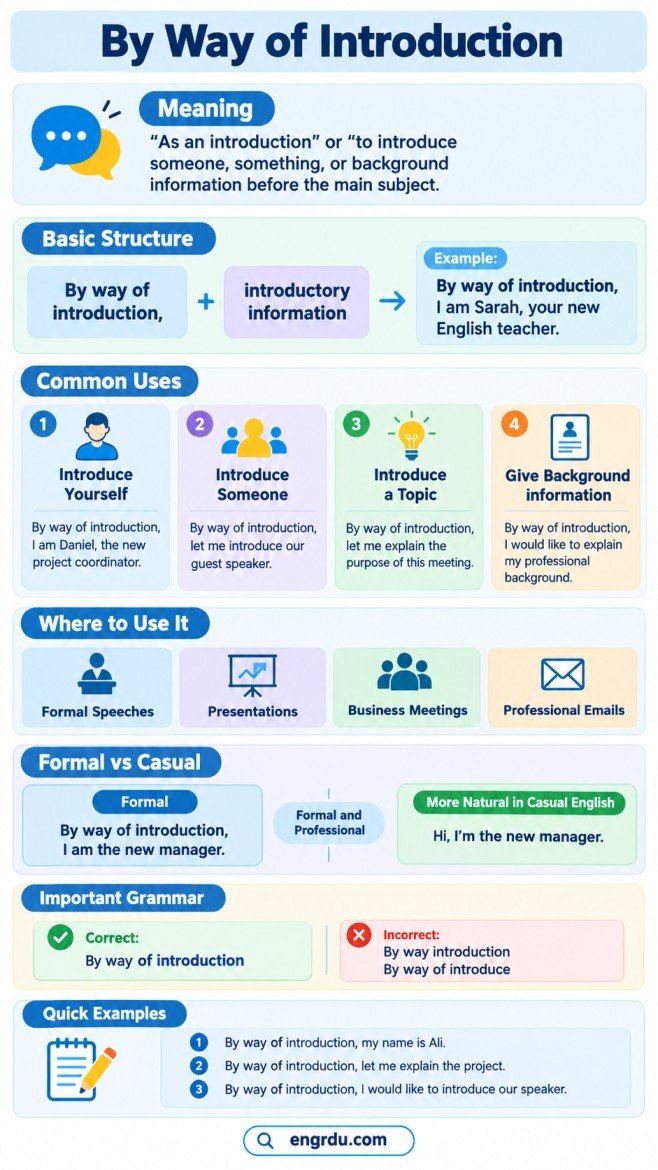
By Way of Introduction Infographic
Examples of By Way of Introduction
Here are examples showing how the expression works in different sentences.
Introducing Yourself
- By way of introduction, I am James, the new project coordinator.
- By way of introduction, let me briefly explain my background.
- By way of introduction, my name is Emma, and I teach English at a local school.
- By way of introduction, I have worked in marketing for eight years.
Introducing Someone
- By way of introduction, I would like to introduce our new director.
- By way of introduction, let me present Dr. Wilson.
- By way of introduction, our guest today is a well-known writer.
Introducing a Subject
- By way of introduction, let us consider the main purpose of this meeting.
- By way of introduction, I would like to explain the background to this decision.
- By way of introduction, here is some information about the organization.
Formal Writing
By way of introduction, I am writing to explain my interest in the position.
By way of introduction, our company provides educational services to schools and universities.
By Way of Introduction in Different Situations
The expression works best in situations where a formal or polite introduction is appropriate.
| Situation | Example |
|---|---|
| Job interview | By way of introduction, I am a graduate of ABC University. |
| Business meeting | By way of introduction, I manage the company’s training department. |
| Presentation | By way of introduction, let me explain the purpose of today’s presentation. |
| Formal email | By way of introduction, my name is David Brown. |
| Speech | By way of introduction, I would like to share my experience. |
| Academic writing | By way of introduction, the study examines changes in language use. |
In a Job Interview
The expression can introduce your background, but it may sound more formal than necessary.
By way of introduction, I have five years of experience in customer service.
For a natural interview response, you can also say:
Let me briefly introduce myself. I have five years of experience in customer service.
In a Presentation
It is particularly suitable for formal presentations.
By way of introduction, let me explain the three main objectives of this presentation.
In an Email
It can identify the writer and provide the reason for contacting the recipient.
By way of introduction, my name is Ali, and I am contacting you about the training program.
By Way of Introduction vs Similar Expressions
These expressions have similar meanings, but their tone and use can differ.
| Expression | Meaning | Typical Use |
|---|---|---|
| By way of introduction | As an introduction | Formal |
| As an introduction | To introduce something | Neutral/formal |
| Let me introduce myself | I want to tell you who I am | Natural and direct |
| I would like to introduce myself | I want to introduce myself | Polite/formal |
| First, let me introduce myself | Introduction comes first | Neutral |
| To introduce myself | For the purpose of introducing myself | Neutral |
Compare the Sentences
Formal:
By way of introduction, I am the company’s new financial manager.
More natural in everyday conversation:
Let me introduce myself. I’m the company’s new financial manager.
Both are correct. The difference is mainly tone and context.
When Should You Use By Way of Introduction?
Use the phrase when you want to make an introduction sound formal and organized.
It works especially well in:
- Formal speeches
- Business meetings
- Professional emails
- Presentations
- Official letters
- Academic communication
- Professional introductions
For casual conversations, shorter expressions usually sound more natural.
Formal:
By way of introduction, I am your new neighbor.
Casual:
Hi, I’m your new neighbor.
Common Mistakes to Avoid
- Wrong: By way introduction, I am John.
Correct: By way of introduction, I am John. - Wrong: By way of introduce, I am Sarah.
Correct: By way of introduction, I am Sarah. - Do not use the phrase repeatedly in the same speech or email.
- Avoid it in very casual conversations when “Hi, I’m…” sounds more natural.
- Do not confuse “by way of introduction” with “by introduction.”
Practice Exercise
Choose the best expression to complete each sentence.
1. ________, my name is Daniel, and I am the new sales manager.
A. By way of introduction
B. By introduction way
C. By way introduce
2. Which sentence is correct?
A. By way introduction, let me explain the project.
B. By way of introduction, let me explain the project.
C. By way of introduce, let me explain the project.
3. Which expression is more suitable for a formal presentation?
A. By way of introduction
B. Hey, I’m…
C. What’s up, everyone?
4. Complete the sentence:
By way of introduction, I would like to ________ our guest speaker.
A. introduce
B. introduction
C. introducing
5. Which sentence uses the expression correctly?
A. By way of introduction, I have worked here for five years.
B. By way introduction, I have worked here for five years.
C. By way of introduce, I have worked here for five years.
Answers
- A — By way of introduction
- B — By way of introduction, let me explain the project.
- A — By way of introduction
- A — introduce
- A — By way of introduction, I have worked here for five years.
FAQs
What does “by way of introduction” mean?
“By way of introduction” means as an introduction or before presenting the main information about a person, subject, or situation.
Is “by way of introduction” formal?
Yes. It is generally a formal or professional expression, commonly used in speeches, presentations, emails, meetings, and official communication.
Can I use “by way of introduction” in an email?
Yes. It can introduce your name, position, background, or reason for contacting someone in a formal email.
What is another way to say “by way of introduction”?
Common alternatives include “as an introduction,” “let me introduce myself,” “I would like to introduce myself,” and “first, let me introduce myself.”
Can I use “by way of introduction” in a speech?
Yes. It is suitable for formal speeches when you want to introduce yourself, another speaker, or background information before the main topic.
Is “by way introduction” correct?
No. The correct expression is “by way of introduction.” The word “of” is an important part of the phrase.
Is “by way of introduction” suitable for casual conversation?
It is grammatically correct, but it may sound formal. In casual conversation, “Hi, I’m…” or “Let me introduce myself” is usually more natural.
What comes after “by way of introduction”?
The phrase is commonly followed by a comma and introductory information, such as a name, background, role, or explanation.
Conclusion
By way of introduction means “as an introduction” and is mainly used in formal or professional English. You can use it to introduce yourself, another person, a topic, or background information.
Remember the basic pattern:
By way of introduction, + introductory information.
For formal communication, it is a useful expression. For casual conversation, shorter phrases such as “Hi, I’m…” are usually more natural.