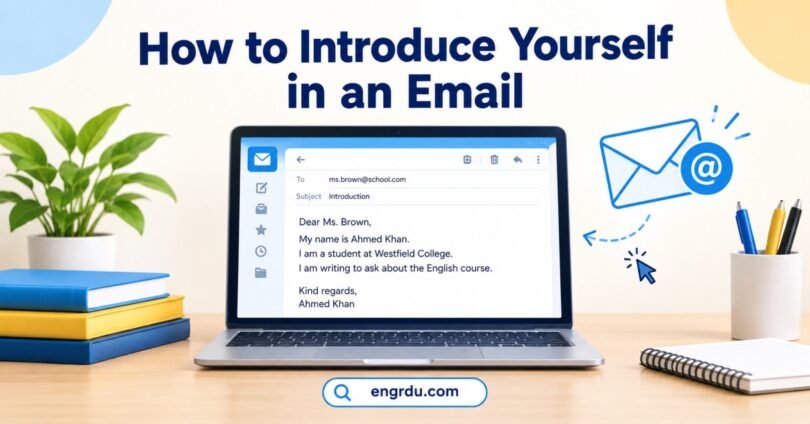

How do you introduce yourself in an email without sounding too formal, too casual, or unclear? How to Introduce Yourself in an Email becomes much easier when you know what to say first, what details to include, and how to end the message.
A good email introduction usually includes your name, role or connection, reason for writing, and a polite closing. The wording changes depending on whether you are writing to a teacher, employer, customer, colleague, or someone you have never contacted before.
What Does It Mean to Introduce Yourself in an Email?
Introducing yourself in an email means giving the reader enough information to know who you are, why you are contacting them, and how you are connected to the situation.
You do not need to tell your whole story. A short introduction is usually more effective.
For example:
Dear Ms. Ahmed,
My name is Ali Khan, and I am a second-year business student at City College. I am writing to ask about the internship opportunities available at your company.
This introduction gives three useful details:
- Name: Ali Khan
- Background: Second-year business student
- Purpose: Asking about an internship
The best introduction matches the relationship and purpose of the email.
How to Introduce Yourself in an Email
A strong email introduction normally follows this order:
Greeting → Name → Background or role → Reason for writing → Relevant connection
A useful basic pattern is:
Hello [Name],
My name is [Your Name], and I am [your role, position, or relationship]. I am writing to [reason for contacting the person]. [Optional relevant detail].
Example:
Hello Mr. Brown,
My name is Sarah Ali, and I am a new member of the marketing team. I am writing to introduce myself and ask about the current project schedule.
You can make the introduction shorter when the reader already knows why you are contacting them:
Hi James,
My name is Daniel, and I recently joined the sales team. I look forward to working with you.
The goal is not to include every detail about yourself. Give the reader the information needed to understand the email.
The Basic Email Introduction Structure
A well-organised introduction usually has five parts.
| Part | What to write | Example |
|---|---|---|
| Greeting | Address the reader politely | Dear Ms. Lee, |
| Introduction | State your name | My name is Ahmed Khan. |
| Background | Say who you are | I am a university student. |
| Purpose | Explain why you are writing | I am writing to ask about your course. |
| Closing | End politely | I look forward to hearing from you. |
Short Structure
Use this structure when the email does not need much background:
Dear Mr. Wilson,
My name is Hamza Ali, and I am a new employee in the finance department. I am writing to introduce myself and look forward to working with you.
Kind regards,
Hamza Ali
Detailed Structure
Use more information when the reader does not know you:
Dear Dr. Patel,
My name is Maria Khan, and I am a final-year biology student at Westfield University. I recently attended your research presentation on environmental science. I am writing because I am interested in learning more about your research and possible student opportunities.
Kind regards,
Maria Khan
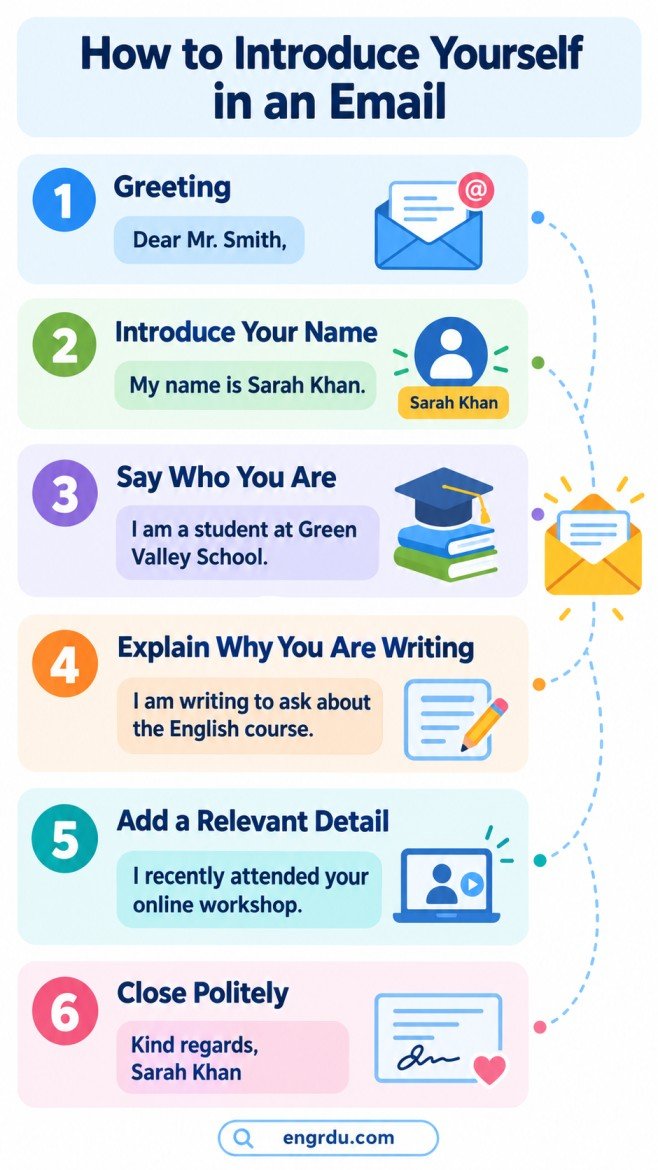
Email Introduction_ Six Simple Steps
What to Include in Your Introduction
The information you include should depend on the purpose of your message.
Include Your Name
State your name clearly, especially when the recipient has never met you.
My name is Omar Ahmed.
You can also write:
I am Omar Ahmed.
Both are correct.
Include Your Role or Position
Tell the reader what you do when it helps explain your reason for writing.
I am a marketing assistant at Bright Solutions.
I am a Grade 10 student at Green Valley School.
I recently joined the customer support team.
Include Your Organisation or School
This is useful in professional and academic emails.
I am a teacher at Lincoln High School.
I am currently studying computer science at Northbridge University.
Explain Your Reason for Writing
This is one of the most important parts of the introduction.
Useful patterns include:
I am writing to ask about…
I am writing regarding…
I am contacting you about…
I would like to introduce myself because…
I am reaching out to discuss…
I am writing to express my interest in…
Mention a Relevant Connection
When appropriate, explain how you found the person or why you are contacting them.
Your colleague, Mr. Ahmed, suggested that I contact you.
I attended your workshop last month.
We met during the education conference in Lahore.
I was given your email address by the admissions office.
Do not add a connection that has no relevance to the email.
How to Start an Email Introduction
The opening depends on how formal the relationship is.
Formal Openings
Use these when writing to someone you do not know well or when the situation is professional or academic.
Dear Mr. Ahmed,
Dear Ms. Wilson,
Dear Dr. Khan,
Dear Professor Smith,
Dear Sir or Madam,
When you know the person’s name, using their name is usually better than a generic greeting.
Professional but Friendly Openings
Hello Sarah,
Hello Mr. Brown,
Hi James,
Good morning, Mr. Ali.
Choose the greeting that matches the relationship and workplace culture.
Casual Openings
Use these with friends, classmates, familiar colleagues, or other people with whom you have an informal relationship.
Hi Tom,
Hello Emma,
Hi everyone,
Avoid very casual greetings when writing to an employer, professor, client, or unfamiliar professional contact.
How to Introduce Yourself in a Formal Email
A formal introduction should be respectful, direct, and relevant. Avoid slang, unnecessary personal information, and overly casual expressions.
A useful structure is:
Dear [Title + Last Name],
My name is [Name], and I am [role/background]. I am writing to [purpose]. [Relevant connection or detail].
Kind regards,
[Name]
Example: Formal Business Email
Dear Ms. Carter,
My name is Ahmed Khan, and I am the new operations coordinator at Horizon Logistics. I am writing to introduce myself and discuss the delivery schedule for our upcoming project.
Kind regards,
Ahmed Khan
Example: Formal Academic Email
Dear Professor Wilson,
My name is Sara Ali, and I am a third-year English literature student. I am currently researching modern poetry for my final project and would like to ask for your advice about suitable sources.
Sincerely,
Sara Ali
How to Introduce Yourself in a Professional Email
A professional email introduction should answer three questions quickly:
Who are you? What do you do? Why are you contacting the reader?
Example:
Hello Mr. Davis,
My name is John Ahmed, and I am a graphic designer at Creative Studio. I am contacting you regarding the website redesign project that your team requested last week. I will be working with you on the visual design and would like to discuss the project requirements.
Best regards,
John Ahmed
When You Are New to a Team
Hi everyone,
My name is Ayesha Khan, and I recently joined the content team as an SEO writer. I am looking forward to working with all of you and contributing to the upcoming projects.
When You Are Taking Over Someone’s Responsibilities
Dear Mr. Taylor,
My name is Bilal Ahmed, and I have recently taken over the account from Sarah Jones. I will be your main contact for future enquiries and project updates.
How to Introduce Yourself to a New Colleague in an Email
When introducing yourself to a colleague, keep the message friendly and work-related.
Example
Hi Daniel,
My name is Hassan, and I recently joined the development team. I will be working on the same project as you, so I wanted to introduce myself. I look forward to working with you.
Very Short Version
Hi Emma,
I’m Noah, the new content editor. I’m pleased to meet you and look forward to working together.
You do not need a long introduction for someone you will work with regularly.
How to Introduce Yourself to a Teacher or Professor in an Email
Students often need to introduce themselves by email before asking a question, requesting help, or discussing an assignment.
Include your name, class or course, and reason for contacting the teacher.
Example
Dear Professor Ahmed,
My name is Ali Raza, and I am a student in your Introduction to Psychology class. I am writing to ask about the research assignment due next week. I would appreciate some clarification about the required format.
Best regards,
Ali Raza
Example for a School Teacher
Dear Ms. Brown,
My name is Sara Khan, and I am a student in Grade 8. I am writing because I would like to ask about the English presentation scheduled for Friday.
Avoid writing only:
Hi Teacher,
Myself Ahmed.
A better opening is:
Dear Ms. Khan,
My name is Ahmed, and I am a student in your Grade 8 English class.
How to Introduce Yourself When Applying for a Job
A job-related introduction should connect your background with the position.
Include:
- Your name
- Your current role or qualification
- The position you are interested in
- A relevant skill or experience
- The reason for contacting the employer
Example
Dear Hiring Manager,
My name is Fatima Ali, and I am a graphic designer with three years of experience in digital design. I am writing to express my interest in the Junior Graphic Designer position at ABC Media. My experience with branding, social media graphics, and Adobe Creative Cloud closely matches the requirements of the role.
I have attached my CV for your consideration.
Kind regards,
Fatima Ali
When Sending a CV by Email
Do not repeat your entire CV in the introduction.
Instead, highlight the most relevant point:
My name is Hamza Malik, and I am a recent computer science graduate with internship experience in web development. I am applying for the Web Developer position advertised on your careers page.
The introduction should encourage the reader to continue, not replace the attached CV.
How to Introduce Yourself to a Client or Customer
A client email should quickly establish your role and explain how you will help.
Example
Dear Mr. Wilson,
My name is Ahmed Khan, and I am your new account manager at Bright Digital. I will be handling your account and supporting you with upcoming campaigns. I am looking forward to working with you and helping with your marketing goals.
Example for a New Customer
Hello Ms. Taylor,
My name is Jessica Brown, and I am a customer support specialist at GreenTech. I am contacting you regarding your recent service request and will be assisting you with the next steps.
Keep the focus on the reason for contact rather than giving too much personal information.
How to Introduce Yourself in a Casual Email
A casual email can sound more natural and personal.
Example
Hi Alex,
I’m Sam. We met at the photography workshop last Saturday. I enjoyed talking with you about travel photography, so I thought I’d get in touch.
Example to a Classmate
Hi Maria,
I’m David from your English class. I’m working on the group project with you and wanted to discuss our presentation ideas.
A casual email can use contractions such as I’m, I’ve, and I’d.
Complete Email Introduction Examples
The examples below show how the structure changes according to the situation.
1. Introducing Yourself to Someone You Have Never Met
Subject: Introduction – Daniel Khan
Dear Ms. Wilson,
My name is Daniel Khan, and I am a project coordinator at North Star Solutions. I am contacting you because I will be working with your team on the new training programme. I wanted to introduce myself before our first meeting.
I look forward to working with you.
Best regards,
Daniel Khan
2. Introducing Yourself to a New Client
Subject: Your New Account Contact
Dear Mr. Ahmed,
My name is Sarah Malik, and I am your new account manager at Bright Media. I will be your main contact for future project updates and enquiries.
Please feel free to contact me whenever you need assistance.
Kind regards,
Sarah Malik
3. Introducing Yourself for Networking
Subject: Introduction – Ali Raza from TechConnect
Hello Mr. Brown,
My name is Ali Raza, and I am a software developer at TechConnect. We met briefly at the technology conference last month, where we discussed mobile application development. I enjoyed our conversation and wanted to stay in touch.
Best regards,
Ali Raza
4. Introducing Yourself to a Potential Employer
Subject: Application for Marketing Assistant Position
Dear Hiring Manager,
My name is Ayesha Khan, and I recently completed a degree in business administration. I am writing to apply for the Marketing Assistant position at your company. I have experience creating social media content and supporting digital marketing campaigns.
My CV is attached for your review.
Sincerely,
Ayesha Khan
5. Introducing Yourself to a Professor
Subject: Introduction and Course Question
Dear Professor Smith,
My name is Omar Ali, and I am enrolled in your English Composition course this semester. I am writing to introduce myself and ask about the reading assignment for next week.
Thank you for your time.
Kind regards,
Omar Ali
6. Introducing Yourself to a New Team
Subject: Hello from the New Content Writer
Hi everyone,
My name is Maria, and I recently joined the content team as a writer. I will be helping with blog articles and website content. I’m looking forward to meeting everyone and working together.
Best,
Maria
Useful Phrases for Email Introductions
You can build your own email by combining the phrases below.
To State Your Name
My name is…
I am…
I’m…
I’d like to introduce myself. My name is…
To State Your Role
I am a…
I currently work as…
I recently joined…
I am currently studying…
I work in the…
I am part of the…
To Explain Your Purpose
I am writing to…
I am contacting you regarding…
I am reaching out about…
I would like to ask about…
I am writing in connection with…
I am interested in…
To Explain a Connection
We met at…
I was referred to you by…
Your colleague recommended that I contact you.
I recently attended…
I received your contact information from…
To End the Introduction
I look forward to working with you.
I look forward to hearing from you.
Thank you for your time.
Please feel free to contact me.
I would be happy to provide further information.
Formal and Casual Email Introduction Comparison
The same message can sound very different depending on the situation.
| Purpose | Formal | Casual |
|---|---|---|
| Name | My name is Daniel Khan. | I’m Daniel. |
| Role | I am a marketing assistant. | I’m the new marketing assistant. |
| Purpose | I am writing to introduce myself. | I wanted to introduce myself. |
| Request | I would like to ask about… | I wanted to ask about… |
| Closing | Kind regards | Best / Thanks |
Formal Example
Dear Ms. Green,
My name is Ahmed Ali, and I am the new sales coordinator. I am writing to introduce myself and discuss our upcoming meeting.
Casual Example
Hi Emma,
I’m Ahmed, the new sales coordinator. I wanted to say hello and introduce myself before our meeting.
Both examples communicate the same basic message, but the tone is different.
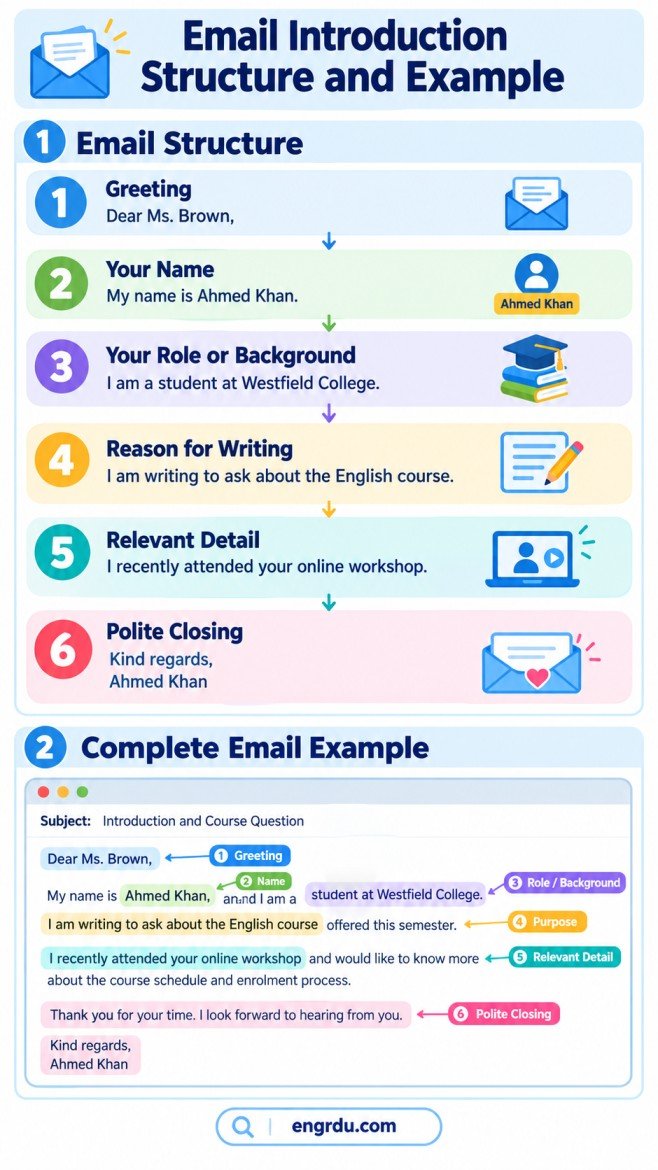
Email Introduction Structure Guide
Common Mistakes When Introducing Yourself in an Email
These errors are common among English learners.
- Myself Ali. → My name is Ali. / I’m Ali.
- I am introduce myself. → I would like to introduce myself.
- I am writing email to you. → I am writing to you about…
- Dear Teacher. → Use the teacher’s name or title when you know it.
- Too much personal information. → Include only details relevant to the email.
How to Make Your Email Introduction Better
A strong introduction is not necessarily a long introduction. It is one that gives the right information in the right order.
Start With the Information the Reader Needs
Do not spend several sentences describing yourself before explaining the purpose.
Less effective:
I have always been interested in business. Since I was young, I have enjoyed meeting new people and learning about different companies. I recently became interested in your organisation…
More direct:
My name is Ahmed Khan, and I am a business administration student. I am writing to ask about internship opportunities at your company.
Match the Level of Formality
The relationship affects your word choice.
Formal:
I am writing to introduce myself and discuss the project.
Neutral:
I wanted to introduce myself and discuss the project.
Casual:
I’m just getting in touch to say hello and introduce myself.
Keep Personal Details Relevant
You may mention your interests when they help create a genuine connection, but they should not distract from the purpose.
Useful:
I recently completed a course in digital marketing and am interested in learning more about your team’s work.
Less useful in a professional introduction:
I like watching films, playing games, eating pizza, and travelling.
Use the Right Closing
Your closing should match the tone of your message.
| Situation | Suitable Closing |
|---|---|
| Formal business email | Kind regards |
| Job application | Sincerely / Kind regards |
| Academic email | Best regards / Kind regards |
| Professional colleague | Best regards / Best |
| Casual email | Best / Thanks |
A Reusable Email Introduction Template
Use this structure when you need to write your own message:
Subject: [Clear Subject]
Dear/Hello [Name],
My name is [Your Name], and I am [your role, position, or background].
I am writing to [reason for the email].
[Add one relevant detail about your connection, experience, request, or next step.]
[Polite closing sentence.]
Kind regards,
[Your Name]
Example Using the Template
Subject: Introduction – New Marketing Assistant
Dear Mr. Lee,
My name is Hassan Ahmed, and I am the new marketing assistant at Green Solutions.
I am writing to introduce myself because I will be supporting your account from this month.
I look forward to working with you and assisting with the upcoming campaign.
Kind regards,
Hassan Ahmed
A Short Email Introduction Template
For a brief message, use:
Hello [Name],
My name is [Name], and I am [role]. I am contacting you about [reason].
Best regards,
[Name]
Example:
Hello Mr. Khan,
My name is Sara, and I am a student at Greenfield College. I am contacting you about the summer internship programme.
Best regards,
Sara
FAQs
How do you introduce yourself in an email?
State your name, role or background, and reason for writing. Add one relevant connection or detail when necessary.
What is the best first sentence for an email introduction?
“My name is [Name], and I am [role or background]” is a clear first sentence for most formal and professional introductions.
How do I introduce myself in a professional email?
Give your name, job title or role, purpose of the email, and relevant connection without adding unnecessary personal information.
How do I introduce myself to someone I have never met by email?
Use a polite greeting, state your name and role, explain why you are contacting the person, and mention how you obtained their contact information.
Is “Myself Ali” correct in an email?
No. Use “My name is Ali” or “I’m Ali.” “Myself Ali” is not standard English for introducing yourself.
Should I introduce myself in every email?
Not always. Introduce yourself when the recipient does not know you, when your role matters, or when previous context does not identify you clearly.
How long should an email introduction be?
Most email introductions can be two to four sentences. Include only information that helps the recipient understand your identity and purpose.
What should I write after introducing myself in an email?
Explain your reason for writing, make your request or provide the relevant information, then finish with an appropriate closing and your name.
Conclusion
How to Introduce Yourself in an Email depends mainly on your relationship with the reader and your reason for writing. In most cases, state your name, role or background, purpose, and relevant connection in a few direct sentences.
For a formal email, use polite and professional language. For a casual message, a shorter and more natural introduction is appropriate. Avoid phrases such as “Myself Ali” and focus on information that helps the reader understand who you are and why you are contacting them.