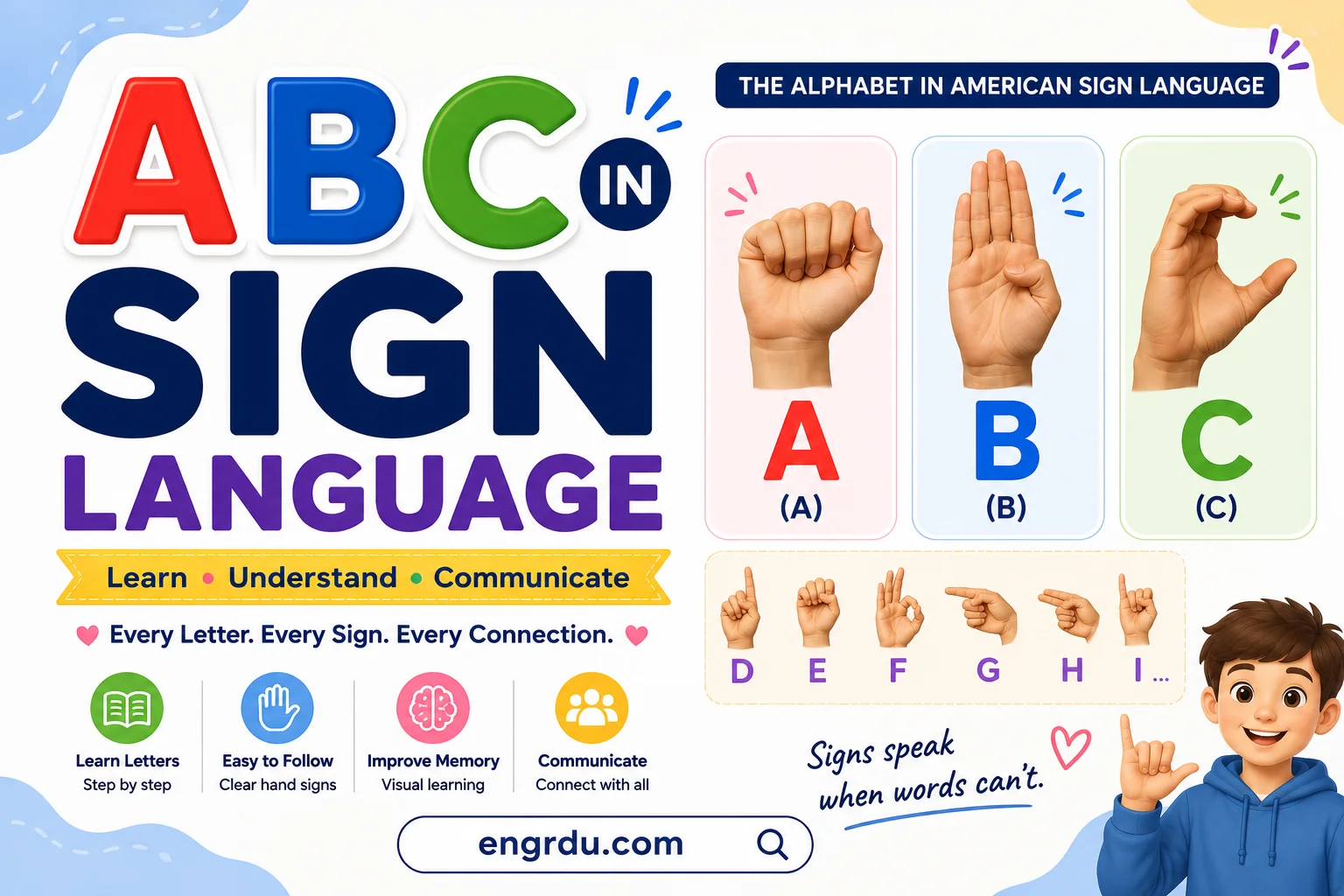

Have you ever wondered how to spell your name using ABC in Sign Language? The ASL alphabet, also called the American manual alphabet, lets you represent English letters with specific handshapes and movements.
In this article, you will learn the complete A to Z alphabets in sign language, how each ASL letter relates to English spelling and sounds, when fingerspelling is used, and how to practice the alphabet accurately.
What Is ABC in Sign Language?
ABC in Sign Language usually refers to the complete A–Z fingerspelled alphabet used with American Sign Language (ASL). Each English letter has a corresponding handshape, and some letters also use a particular movement or orientation.
The ASL alphabet is used mainly for fingerspelling, which means spelling English words letter by letter with your hands. It is especially useful for names, places, brands, titles, technical terms, and words that may not have an established sign in the situation.
One important point is easy to miss: ASL is a complete language, not just a system of hand gestures for English letters. The alphabet is one part of ASL communication.
What does “ABC in ASL” mean?
A, B, C, D, E, F, G, H, I, J, K, L, M, N, O, P, Q, R, S, T, U, V, W, X, Y, Z.
The letters are produced using the American Fingerspelled Alphabet, also known as the American Manual Alphabet.
ASL Alphabet A to Z
The ASL alphabets contain the same 26 English letters from A through Z, but the letters are represented visually through handshapes instead of printed symbols.
Here is a quick overview:
| Letter | English Letter Name | Common English Sound | Example Word |
|---|---|---|---|
| A | ay | /æ/, /eɪ/ | apple |
| B | bee | /b/ | book |
| C | see | /k/, /s/ | cat |
| D | dee | /d/ | dog |
| E | ee | /ɛ/, /iː/ | egg |
| F | ef | /f/ | fish |
| G | gee | /g/, /dʒ/ | game |
| H | aitch | /h/ | house |
| I | eye | /ɪ/, /aɪ/ | ice |
| J | jay | /dʒ/ | juice |
| K | kay | /k/ | kite |
| L | el | /l/ | lamp |
| M | em | /m/ | moon |
| N | en | /n/ | nose |
| O | oh | /ɒ/, /oʊ/ | orange |
| P | pee | /p/ | pen |
| Q | cue | /kw/ | queen |
| R | ar | /r/ | red |
| S | ess | /s/ | sun |
| T | tee | /t/ | table |
| U | you | /ʌ/, /uː/ | umbrella |
| V | vee | /v/ | van |
| W | double-you | /w/ | water |
| X | ex | /ks/, /gz/ | X-ray |
| Y | why | /j/, /aɪ/ | yellow |
| Z | zee/zed | /z/ | zebra |
Important: these are the English letter names and example sounds. The ASL fingerspelled letter itself is not pronounced like an English sound. Fingerspelling represents written English letters visually.
ABC in Sign Language
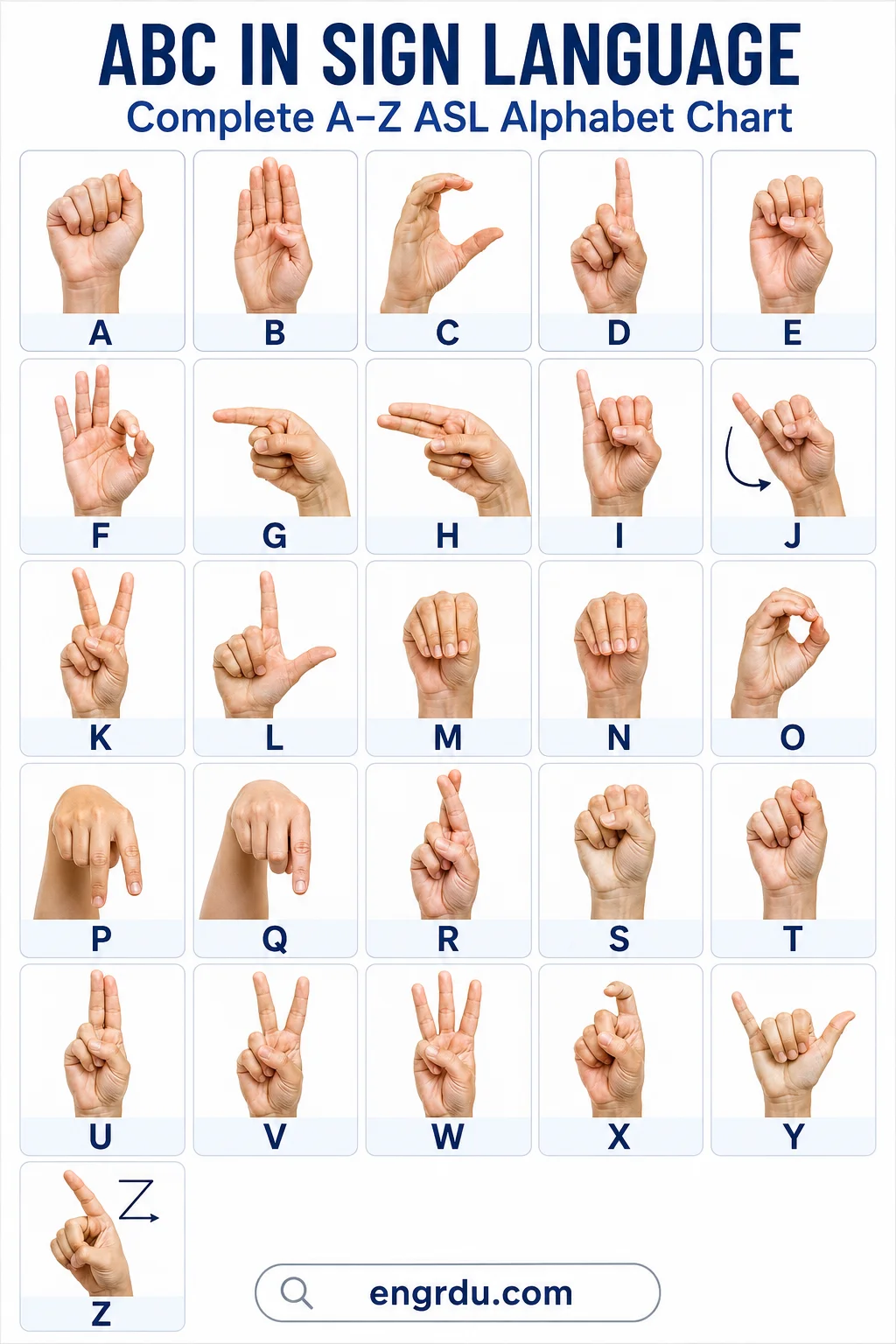
A–Z ASL Alphabet Chart
The following chart gives a practical description of the basic handshape or movement associated with each letter.
| Letter | ASL Fingerspelling Description |
|---|---|
| A | Make a closed fist with the thumb resting along the side of the fingers. |
| B | Hold the four fingers straight together and fold the thumb across the palm. |
| C | Curve the fingers and thumb into a C shape. |
| D | Hold the index finger up while the remaining fingers form a rounded shape with the thumb. |
| E | Curl the fingers downward toward the thumb, creating the characteristic E handshape. |
| F | Touch the thumb and index finger together while the other three fingers remain raised. |
| G | Extend the index finger and thumb horizontally, with the other fingers closed. |
| H | Extend the index and middle fingers together horizontally while the remaining fingers are closed. |
| I | Make a fist and extend the little finger upward. |
| J | Use the I handshape and trace the shape of a J through the air. |
| K | Extend the index and middle fingers while positioning the thumb between them. |
| L | Extend the thumb and index finger to form an L shape. |
| M | Curl the first three fingers over the thumb, creating the M handshape. |
| N | Curl the first two fingers over the thumb to form the N handshape. |
| O | Curve the fingers and thumb together to make an O shape. |
| P | Similar to K but oriented downward rather than forward. |
| Q | Similar to G but oriented downward, with the index finger and thumb directed toward the floor. |
| R | Cross the index and middle fingers while keeping the other fingers folded. |
| S | Make a closed fist with the thumb wrapped across the front of the fingers. |
| T | Make a fist with the thumb positioned between the index and middle fingers. |
| U | Extend the index and middle fingers together vertically. |
| V | Extend and separate the index and middle fingers to form a V shape. |
| W | Extend the thumb and three fingers so the hand resembles a W. |
| X | Bend the index finger into a hooked shape while the remaining fingers stay folded. |
| Y | Extend the thumb and little finger while the middle three fingers remain folded. |
| Z | Use the index finger to trace a Z-shaped movement in the air. |
The standard ASL fingerspelled alphabet is commonly described as having 26 letter representations formed from fewer basic handshapes because several letters share a handshape but differ in orientation or movement. J and Z, for example, use movement to distinguish them, while pairs such as G/Q, K/P, I/J, and H/U involve related handshapes with different orientations or movements.
A useful way to notice the differences
Some letters are easiest to learn as families:
- I → J: J adds movement to the I handshape.
- G → Q: Q uses the related handshape with a downward orientation.
- K → P: P changes the orientation of the K-type handshape.
- H → U: Both use two extended fingers, but their orientation differs.
- V → U: Both use two fingers, but V separates them while U keeps them together.
These relationships make memorizing the alphabet much easier than treating all 26 letters as unrelated shapes.
How Each ASL Letter Works
Learning the alphabet is more than memorizing pictures. Pay attention to three things: handshape, orientation, and movement.
A, B, C, D, E
These early letters help establish the basic idea of ASL fingerspelling.
A uses a closed hand with the thumb alongside the fingers.
B opens the four fingers while the thumb folds across the palm.
C is visually distinctive because the whole hand curves into a C shape.
D combines an extended index finger with a rounded lower part of the hand.
E requires the fingers to curl toward the thumb.
F, G, H, I, J
This group introduces more variation.
F is recognizable from the contact between the thumb and index finger.
G extends both the index finger and thumb horizontally.
H uses two extended fingers together in a horizontal position.
I is a closed hand with the little finger raised.
J starts from the I handshape but adds a movement that traces a J in the air.
K, L, M, N, O
These letters introduce several classic handshapes.
K is formed with the index and middle fingers extended with the thumb positioned between them.
L is one of the easiest letters to recognize because the thumb and index finger form a clear L.
M and N both involve fingers curling over the thumb, so learners often confuse them at first.
O forms a rounded circle with the fingers and thumb.
P, Q, R, S, T
This group includes several letters that need careful attention to orientation.
P and Q resemble related handshapes but point downward.
R uses crossed index and middle fingers.
S is a closed fist with the thumb across the front.
T is another fist-based handshape, but the thumb is positioned between the index and middle fingers.
U, V, W, X, Y, Z
The final six letters are especially useful for visual comparison.
U keeps two fingers together.
V separates those fingers.
W extends three fingers plus the thumb.
X bends the index finger into a hook-like shape.
Y extends the thumb and little finger.
Z is different from most letters because the index finger traces a Z movement in the air.
Does ASL Have Uppercase and Lowercase Letters?
No. The ASL fingerspelled alphabet does not have separate handshapes for uppercase and lowercase English letters.
For example, the printed English letters A and a differ visually, but the fingerspelled ASL representation is the same.
This is an important distinction for English learners:
| Written English | Fingerspelled ASL |
|---|---|
| A | Same letter handshape |
| a | Same letter handshape |
| B | Same letter handshape |
| b | Same letter handshape |
| C | Same letter handshape |
| c | Same letter handshape |
Capitalization is handled by English writing conventions rather than by a separate lowercase ASL alphabet.
ASL Alphabet vs. English Alphabet
The two systems are connected, but they are not identical in how they function.
| Feature | English Alphabet | ASL Fingerspelled Alphabet |
|---|---|---|
| Number of letters | 26 | 26 |
| Main form | Written or printed symbols | Handshapes and movements |
| Uppercase/lowercase | Yes | No separate forms |
| Used for spelling | Yes | Yes, through fingerspelling |
| Represents English spelling | Directly | Visually |
| Part of a complete language | English writing system | One component of ASL |
The most important difference is that fingerspelling is not the same thing as signing every word letter by letter.
ASL has its own vocabulary and grammar. Fingerspelling is a tool used within ASL communication rather than the entire language.
When Do People Use Fingerspelling?
Fingerspelling is particularly helpful when a signer needs to communicate a word that is best represented through its English spelling.
Common situations include:
- Names: personal names and surnames
- Places: cities, streets, countries, and locations
- Brand names: products and companies
- Titles: books, films, shows, or organizations
- Technical terms: unfamiliar or specialized vocabulary
- New vocabulary: words for which a signer may not know the established sign
- Clarification: spelling a word when the meaning needs to be made clear
Fingerspelling is also used for some words that have signs, depending on the signer, context, community, or communicative purpose.
Does every English word need to be fingerspelled?
No.
A common mistake is assuming that ASL works by translating every English word into a sequence of letters. It does not.
For everyday communication, ASL sign vocabulary is normally used when an established sign is appropriate. Fingerspelling is used selectively.
How to Learn the ASL Alphabet Faster
Memorizing 26 letters becomes easier when you train your eyes and hands together.
Start with handshape groups
Instead of learning A through Z only as a sequence, compare similar letters:
M → N → T
G → Q
K → P
H → U
I → J
U → V
These comparisons help you notice small differences in orientation and finger position.
Practice recognition before speed
First, make sure you can recognize every letter when someone signs it slowly.
Then practice producing the letters yourself.
A useful progression is:
See the letter → identify it → reproduce it → recognize it in random order → use it inside a word.
Practice your own information
Try fingerspelling:
- Your first name
- Your last name
- Your city
- A favorite food
- A school subject
- A book title
- A brand you know
Personal vocabulary is easier to remember because you already have a reason to use it.
Learn movement letters carefully
Do not treat J and Z like static handshapes.
J is made using movement, and Z is produced by tracing a Z through the air.
Common ASL Alphabet Mistakes
Learners often know the general shapes but lose accuracy when letters are similar.
- Confusing M, N, and T: watch exactly where the thumb sits.
- Mixing up U and V: U keeps the two fingers together; V separates them.
- Confusing G and Q: orientation changes the letter.
- Treating J and Z as still images: both require movement.
- Thinking fingerspelling is the whole ASL language: the alphabet is only one part of ASL.
Another common problem is trying to force the hand into an uncomfortable position. Fingerspelling should look controlled and natural rather than strained. Lifeprint notes that palm orientation does not need to be forced directly toward the person you’re communicating with.
Practice: Spell Words with ASL
Once you know all 26 letters, practice short English words before attempting long ones.
Easy practice words
| Word | Letters |
|---|---|
| CAT | C-A-T |
| DOG | D-O-G |
| SUN | S-U-N |
| BOOK | B-O-O-K |
| FISH | F-I-S-H |
| HOME | H-O-M-E |
| WATER | W-A-T-E-R |
| SCHOOL | S-C-H-O-O-L |
| FRIEND | F-R-I-E-N-D |
| FAMILY | F-A-M-I-L-Y |
These examples are for fingerspelling practice. They do not mean that each word must normally be fingerspelled in ASL conversation.
Practice medical and technical vocabulary
Fingerspelling is also useful for unfamiliar specialized terms. Examples include:
- MRI
- X-RAY
- ICU
- LAB
- VITAMIN
- ASPIRIN
- RX
Specialized vocabulary may be fingerspelled depending on context and the conventions of the signing community.
A quick self-test
Cover the answers and try to fingerspell these words:
- APPLE
- WATER
- SCHOOL
- FRIEND
- FAMILY
Then reverse the exercise: ask someone to fingerspell a word and identify each letter.
For stronger practice, do not always work from A to Z. Have the letters appear in random order. Recognition in random order is much closer to real fingerspelling than simply reciting the alphabet from A through Z.
What Is the Difference Between ASL Letters and ASL Signs?
An ASL letter represents a letter of the English alphabet through fingerspelling.
An ASL sign represents a word, idea, phrase, or grammatical function within ASL.
For example, spelling C-A-T is not the same thing as using the established ASL sign for “cat.”
This distinction matters because ASL is a natural language with its own structure and grammar, rather than a manual version of written English.
The Gallaudet Dictionary of American Sign Language describes ASL as having its own syntax and structure, while fingerspelling is incorporated where appropriate.
Can You Use the ASL Alphabet to Spell Any English Word?
Yes. The 26-letter fingerspelled alphabet can be used to represent the letters of English words.
However, knowing how to spell an English word with your hands does not automatically mean you know ASL.
To communicate naturally in ASL, learners also need to study:
- ASL vocabulary
- Grammar and sentence structure
- Facial expressions and nonmanual signals
- Signing space
- Number systems
- Conversation patterns
- Deaf community and cultural conventions
The alphabet is an excellent starting point, but it is only one component of the language.
FAQs About ABC in ASL
What is ABC in Sign Language?
ABC in Sign Language usually means the complete A–Z American Sign Language fingerspelled alphabet used to represent English letters visually.
How many letters are in the ASL alphabet?
The ASL fingerspelled alphabet represents all 26 letters of the English alphabet, from A through Z.
Is the ASL alphabet the same as English?
The letters correspond to English A–Z, but ASL represents them through handshapes and movement rather than written symbols.
Does ASL have lowercase letters?
No. The ASL fingerspelled alphabet does not use separate handshapes for English uppercase and lowercase letters.
What is fingerspelling in ASL?
Fingerspelling is the use of handshapes and movements corresponding to English letters to spell words visually.
Which ASL letters use movement?
The most notable movement-based letters are J and Z, which use the hand to trace their respective shapes.
Is ASL just the ABC alphabet?
No. The alphabet is only one part of American Sign Language, which has its own vocabulary, grammar, syntax, and linguistic structure.
What is the easiest way to learn the ASL alphabet?
Start by learning the handshapes in small groups, compare similar letters, practice recognition, and then fingerspell familiar names and short words.
Conclusion
Learning ABC in Sign Language gives you a practical introduction to the A to Z alphabets in sign language and the American fingerspelled alphabet used with ASL.
The 26 letters connect visual handshapes with English spelling, making it possible to fingerspell names, places, titles, specialized terms, and other words when appropriate. Some letters are static handshapes, while J and Z use distinctive movement.
The best next step is to move beyond simply memorizing A–Z. Practice recognizing letters in random order, compare similar handshapes, and gradually use fingerspelling alongside broader ASL vocabulary and grammar. That turns the alphabet from a memorization exercise into a practical communication skill.
Explore More Related Articles