

What does the ABC in Thai Language look like if Thai does not use the English A–Z alphabet? Thai has its own writing system, with 44 basic consonant letters, vowel symbols, tone marks, and no capital-or-lowercase system like English.
For English learners, the important point is this: Thai does not have a direct A = ก, B = ข, C = ค relationship. Instead, learners study the Thai alphabet, especially its consonants, their names, sounds, and tone classes.
This article explains the A to Z Alphabets in Thai in a practical way, including the full set of Thai consonants, pronunciation, vowels, examples, and common points of confusion.
What Is the ABC in Thai Language?
The ABC in Thai Language is not an A–Z alphabet like English. Thai uses the Thai script (อักษรไทย), which has 44 basic consonant letters. Vowels are generally written as symbols around consonants, and tone is influenced by consonant class, vowel length, syllable type, and tone marks.
So, when someone searches for ABCs in Thai, they usually want to know:
- What are the Thai letters?
- How do Thai consonants sound?
- What is the Thai equivalent of the English alphabet?
- How are Thai letters pronounced?
- How do Thai vowels work?
- How can English speakers memorize Thai Alphabets?
There is no one-to-one Thai version of the English letters A, B, C, and so on. Thai spelling is organized around consonants, vowels, syllables, and tones rather than the English alphabet sequence.
How Many Letters Are in the Thai Alphabet?
The Thai writing system contains 44 basic consonant letters. Thai also uses vowel symbols and tone marks, so learning the script involves more than memorizing 44 isolated characters.
A useful way to think about the system is:
| Part | What it does |
|---|---|
| 44 consonants | Represent initial and, for some letters, final consonant sounds |
| Vowel symbols | Represent vowel sounds and can appear before, after, above, or below a consonant |
| Tone marks | Help indicate tone in combination with other spelling rules |
| Consonant classes | Group consonants into low, middle, and high classes for tone rules |
| Thai numerals | A separate set of symbols used for numbers |
Thai is written from left to right, but its vowels can appear visually before, above, below, or after the consonant they belong to.
The 44 Thai Consonants
The 44 consonants are the most important part of the Thai alphabet for new learners. Each consonant has a traditional name, and those names often include a familiar Thai word beginning with the same consonant sound. This makes the letters easier to remember.
Complete Thai Consonant Chart
| # | Thai | Letter Name | Approx. English Sound |
|---|---|---|---|
| 1 | ก | ก ไก่ (ko kai) | k / g-like |
| 2 | ข | ข ไข่ (kho khai) | kh |
| 3 | ฃ | ฃ ขวด (kho khuat) | kh |
| 4 | ค | ค ควาย (kho khwai) | kh |
| 5 | ฅ | ฅ คน (kho khon) | kh |
| 6 | ฆ | ฆ ระฆัง (kho ra-khang) | kh |
| 7 | ง | ง งู (ngo ngu) | ng |
| 8 | จ | จ จาน (cho chan) | j / ch-like |
| 9 | ฉ | ฉ ฉิ่ง (cho ching) | ch |
| 10 | ช | ช ช้าง (cho chang) | ch |
| 11 | ซ | ซ โซ่ (so so) | s |
| 12 | ฌ | ฌ เฌอ (cho choe) | ch |
| 13 | ญ | ญ หญิง (yo ying) | y |
| 14 | ฎ | ฎ ชฎา (do cha-da) | d |
| 15 | ฏ | ฏ ปฏัก (to pa-tak) | t |
| 16 | ฐ | ฐ ฐาน (tho than) | th |
| 17 | ฑ | ฑ มณโฑ (tho montho) | th / t |
| 18 | ฒ | ฒ ผู้เฒ่า (tho phu-thao) | th |
| 19 | ณ | ณ เณร (no nen) | n |
| 20 | ด | ด เด็ก (do dek) | d |
| 21 | ต | ต เต่า (to tao) | t |
| 22 | ถ | ถ ถุง (tho thung) | th |
| 23 | ท | ท ทหาร (tho thahan) | th |
| 24 | ธ | ธ ธง (tho thong) | th |
| 25 | น | น หนู (no nu) | n |
| 26 | บ | บ ใบไม้ (bo baimai) | b |
| 27 | ป | ป ปลา (po pla) | p |
| 28 | ผ | ผ ผึ้ง (pho phueng) | ph |
| 29 | ฝ | ฝ ฝา (fo fa) | f |
| 30 | พ | พ พาน (pho phan) | ph |
| 31 | ฟ | ฟ ฟัน (fo fan) | f |
| 32 | ภ | ภ สำเภา (pho sam-phao) | ph |
| 33 | ม | ม ม้า (mo ma) | m |
| 34 | ย | ย ยักษ์ (yo yak) | y |
| 35 | ร | ร เรือ (ro ruea) | r |
| 36 | ล | ล ลิง (lo ling) | l |
| 37 | ว | ว แหวน (wo waen) | w |
| 38 | ศ | ศ ศาลา (so sala) | s |
| 39 | ษ | ษ ฤๅษี (so rue-si) | s |
| 40 | ส | ส เสือ (so suea) | s |
| 41 | ห | ห หีบ (ho hip) | h |
| 42 | ฬ | ฬ จุฬา (lo chu-la) | l |
| 43 | อ | อ อ่าง (o ang) | vowel carrier / o |
| 44 | ฮ | ฮ นกฮูก (ho nok-huk) | h |
The traditional names above are commonly used for identifying the letters. Some Thai consonants represent sounds that have become identical in modern Thai pronunciation; they remain important because their spelling and tone-class behavior differ.
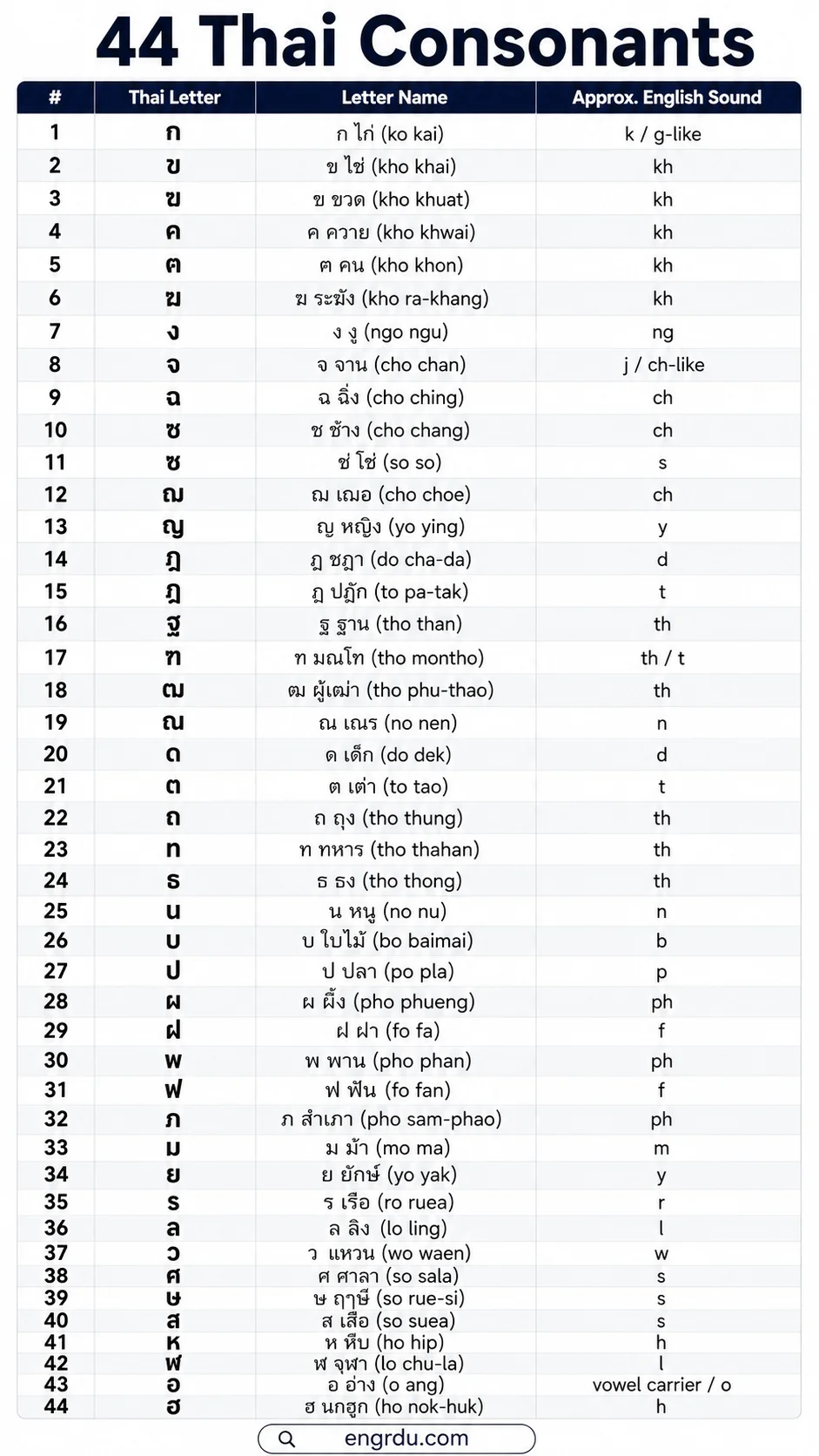
44 Thai Consonants Chart
Important Note About ฃ and ฅ
Two letters in the traditional 44-letter inventory, ฃ and ฅ, are generally considered obsolete in modern standard Thai writing. They are still included when people learn the traditional 44 Thai consonants.
You will normally encounter modern spellings using ข and ค instead.
Thai Alphabet Chart With English Sounds
English learners often want to connect the Thai script with familiar Roman letters. That can help at the beginning, but transliteration is only an approximation.
For example:
| Thai | Approximate Sound | Example |
|---|---|---|
| ก | k | ไก่ |
| ข | kh | ไข่ |
| ค | kh | ควาย |
| ง | ng | งู |
| จ | j/ch | จาน |
| ซ | s | โซ่ |
| ด | d | เด็ก |
| ต | t | เต่า |
| น | n | หนู |
| บ | b | ใบไม้ |
| ป | p | ปลา |
| ม | m | ม้า |
| ย | y | ยักษ์ |
| ร | r | เรือ |
| ล | l | ลิง |
| ว | w | แหวน |
| ส | s | เสือ |
| ห | h | หีบ |
| อ | carrier / vowel support | อ่าง |
| ฮ | h | นกฮูก |
Why “kh,” “ph,” and “th” Can Be Confusing
When you see spellings such as kh, ph, and th in Thai romanization, they do not necessarily mean the same sounds as English “th” or a consonant cluster.
For example:
- kh usually represents an aspirated k sound.
- ph usually represents an aspirated p sound, not English /f/.
- th usually represents an aspirated t sound, not English “th” as in think or this.
Thai pronunciation is therefore easier to learn by listening to the sound rather than relying only on Roman spelling.
Thai Letter Names and What They Mean
Consonants in the Thai language are often taught through acrophonic names. Instead of simply saying the sound of a letter, a learner says the letter name followed by a familiar example word.
For example:
- ก ไก่ — ko kai = k + chicken
- ข ไข่ — kho khai = kh + egg
- ค ควาย — kho khwai = kh + buffalo
- ง งู — ngo ngu = ng + snake
- ม ม้า — mo ma = m + horse
- ล ลิง — lo ling = l + monkey
- ส เสือ — so suea = s + tiger
This naming system is useful because it gives learners a memorable word for every consonant.
Why Thai Uses Several Letters for Similar Sounds
One of the biggest surprises for English learners is that Thai has several consonants that can sound the same in modern speech.
For example, several letters represent an s-like sound, including:
ซ, ศ, ษ, ส
Likewise, several letters can represent kh, th, or ph sounds.
These letters are not unnecessary. Their historical spelling differences remain relevant, and consonant class affects tone rules.
Does Thai Have Uppercase and Lowercase Letters?
No. Thai does not use uppercase and lowercase letters in the same way English does.
English has:
- A / a
- B / b
- C / c
Thai letters normally keep the same basic form whether they appear at the beginning or elsewhere in a sentence.
Instead of capitalization, Thai writing uses other conventions for sentence structure, names, and formal writing.
This means there is no separate Thai equivalent of “capital A” and “small a.”
Thai Vowels
Learning Thai Alphabets does not stop with consonants. Thai vowels are written using vowel symbols that combine with consonants, and those symbols may appear before, after, above, or below the consonant.
This is one reason Thai spelling can look unusual to an English speaker.
Common Thai Vowel Patterns
| Thai | Approximate Sound | Example Pattern |
|---|---|---|
| -ะ | a | กะ |
| -า | aa | กา |
| -ิ | i | กิ |
| -ี | ii | กี |
| -ึ | ue | กึ |
| -ื | long ue | กื |
| -ุ | u | กุ |
| -ู | uu | กู |
| เ- | e | เก |
| แ- | ae | แก |
| โ- | o | โก |
| ใ- | ai | ใก |
| ไ- | ai | ไก |
| เ-า | ao | เกา |
The exact pronunciation of a vowel depends on its form and the surrounding consonants. Thai has more vowel distinctions than can be represented conveniently by the five basic vowel letters used in English.
Why Thai Vowels Look “Out of Order”
In English, we normally expect a vowel to appear directly after a consonant.
Thai can place a written vowel before the consonant even though the vowel is pronounced as part of the same syllable.
For example:
เ + ก = เก
The vowel symbol appears visually before ก, but learners should read the whole written syllable rather than trying to pronounce each symbol separately.
Thai Tones and Consonant Classes
Thai is a tonal language with five contrastive tones: mid, low, falling, high, and rising.
This means changing the pitch pattern can change the meaning of a syllable.
Tone is not determined by a single mark alone. It depends on several factors:
- Consonant class
- Vowel length
- Syllable type
- Tone marker
- Final consonant behavior
Thai consonants are divided into three main classes:
| Class | Thai Term | Role |
|---|---|---|
| Middle | อักษรกลาง | Helps determine tone |
| High | อักษรสูง | Helps determine tone |
| Low | อักษรต่ำ | Helps determine tone |
These classes are extremely important once you move beyond memorizing individual Thai letters.
The Five Thai Tones
| Tone | Description |
|---|---|
| Mid | Relatively level pitch |
| Low | Lower pitch |
| Falling | Starts higher and falls |
| High | Higher pitch |
| Rising | Rises in pitch |
For example, Thai forms built around mai can have different meanings depending on tone and spelling. Thai sources commonly use forms such as ใหม่, ไม่, ไม้, and ไหม to illustrate tone contrasts.
How Thai Sounds Differ From English
English speakers often try to fit Thai letters into familiar A–Z pronunciation patterns. This works only as a rough starting point.
1. Aspirated and Unaspirated Sounds
Thai distinguishes sounds that may sound similar to English learners.
For example, ป and พ are not simply two ways of writing English “p.” One is unaspirated while the other is aspirated.
2. Final Consonants Can Change Sound
Some Thai consonants are pronounced differently when they occur at the end of a syllable than when they occur at the beginning.
This is especially important when reading complete Thai words.
3. One Sound Can Have Several Letters
Several Thai consonants have similar modern pronunciations because historical distinctions have been lost. Their different spellings still matter for written Thai and tone classification.
4. Vowels Do Not Always Appear After the Consonant
Thai spelling may place vowel symbols around the consonant, so visual order does not always match pronunciation order.
Common Thai Alphabet Confusions
When learning Thai Language Alphabets, these are some of the mistakes English speakers commonly make:
- พ is not normally the English f sound; its typical initial value is an aspirated p sound.
- ท / ธ / ถ can all relate to aspirated t-like sounds, but their spelling and tone classes differ.
- ซ / ศ / ษ / ส can have the same modern s sound while remaining different letters.
- ป and พ should not be treated as identical simply because both resemble “p” in English romanization.
- Thai has no capital/lowercase pair system like A/a or B/b.
How to Learn Thai Alphabets Faster
Memorizing 44 characters as one huge list can feel difficult. A better approach is to connect each letter with its name, sound, and a familiar word.
Step 1: Learn the Letter Shape
Start by recognizing the visual form of the consonant.
Step 2: Learn the Letter Name
For example:
ม = ม ม้า = mo ma
The name gives you a stable memory connection.
Step 3: Learn the Main Sound
Associate the letter with its normal initial sound.
Step 4: Learn the Consonant Class
Once you know the basic letters, begin grouping them as low, middle, and high class.
Step 5: Read Short Syllables
Move from isolated letters to combinations of consonants and vowels.
Step 6: Listen While Reading
Thai tones are difficult to master through Roman letters alone. Listening helps connect spelling with actual pronunciation.
Thai Alphabet Practice
Try reading these Thai consonants aloud from memory:
ก ข ค ง จ ช ด ต น บ ป ม ย ร ล ว ส ห อ ฮ
Then test yourself with these questions.
Practice Questions
- Which Thai letter represents the ng sound?
- Which Thai letters can represent an s sound?
- Does Thai use uppercase and lowercase letters?
- How many basic Thai consonants are traditionally counted?
- What are the three Thai consonant classes?
Answers
- ง
- ซ, ศ, ษ, ส
- No, not in the English uppercase/lowercase sense.
- 44
- Low, middle, and high
Thai Alphabet vs. English Alphabet
The biggest difference is that the English and Thai writing systems organize information differently.
| Feature | English | Thai |
|---|---|---|
| Basic alphabet order | A–Z | Traditional Thai consonant sequence |
| Basic consonants | 21 | 44 |
| Capital letters | Yes | No English-style capitalization system |
| Vowels | Independent letters | Mainly written as symbols combined with consonants |
| Tone | Not normally lexical | Five contrastive tones |
| Consonant classes | No equivalent system | Low, middle, high |
| Vowel placement | Usually linear | Can appear around the consonant |
Thai is therefore better understood as a script and sound system, rather than as an English alphabet translated into Thai.
Is There an A-to-Z Alphabet in Thai?
Not exactly.
There is no standard sequence equivalent to English:
A, B, C, D … Z
Instead, Thai learners traditionally memorize the sequence of its consonant letters. When people say A to Z Alphabets in Thai, they may be asking for an English-to-Thai transliteration chart, but Thai letters do not map one-to-one onto English letters.
For example, English B can often be represented by Thai บ in words, but that does not make บ the “Thai B.” It is one Thai consonant with its own name, spelling rules, and tone class.
Thai Alphabet Pronunciation: What Should Beginners Focus On?
For early learners, pronunciation is easier when you separate three ideas:
Letter → Sound → Word
For example:
ม → m → ม้า
This approach is more useful than trying to memorize a Roman-letter equivalent alone.
You should also listen carefully to:
- Aspirated vs. unaspirated consonants
- Short vs. long vowels
- Initial vs. final consonants
- The five tones
These features are part of what makes spoken Thai different from English.
FAQs About ABC in Thai Language
How many letters are in the Thai alphabet?
The traditional Thai alphabet has 44 basic consonant letters, along with vowel symbols and other writing marks.
What is A in Thai?
There is no direct Thai equivalent of English A. Thai uses its own consonants and vowel symbols rather than an A–Z system.
Does Thai use the English alphabet?
Thai normally uses the Thai script, not the Latin alphabet, although Latin letters are sometimes used for romanization and foreign names.
Does Thai have capital and lowercase letters?
No. Thai does not use uppercase and lowercase forms like A/a or B/b in English.
How many Thai consonants are there?
There are 44 basic Thai consonant letters in the traditional inventory. Two of them, ฃ and ฅ, are obsolete in ordinary modern Thai usage.
Why does Thai have several letters for the same sound?
Some historical sound distinctions merged in modern Thai. Different letters were retained because spelling and consonant classes still matter.
How many tones does Thai have?
Modern standard Thai has five contrastive tones: mid, low, falling, high, and rising.
Are Thai vowels written like English vowels?
No. Thai vowel symbols can appear before, after, above, or below a consonant, and their spelling patterns differ from English.
Conclusion
The ABC in Thai Language is different from the English A–Z alphabet. Instead of 26 Latin letters, Thai learners begin with 44 basic consonants, vowel symbols, tone marks, and three consonant classes that help determine pronunciation and tone.
The best way to learn Thai Alphabets is to study each consonant with its Thai name, sound, example word, and consonant class. Once those foundations are familiar, reading Thai vowels, tones, and complete words becomes much easier.
Explore More Related Articles: