
What Does ABC Mean in Spanish?
The ABC in Spanish refers to the letters used to write Spanish words. Spanish speakers commonly call the alphabet el alfabeto or el abecedario.
Here are three useful Spanish terms:
El alfabeto: The alphabet.
El abecedario: The alphabet arranged in its traditional letter sequence.
Las letras: The letters.
For example, Estoy aprendiendo el abecedario español means “I am learning the Spanish alphabet.”
The alphabet helps learners recognize letters, spell words, read signs, write sentences, and pronounce unfamiliar vocabulary.
How Many Letters Are in the Spanish Alphabet?
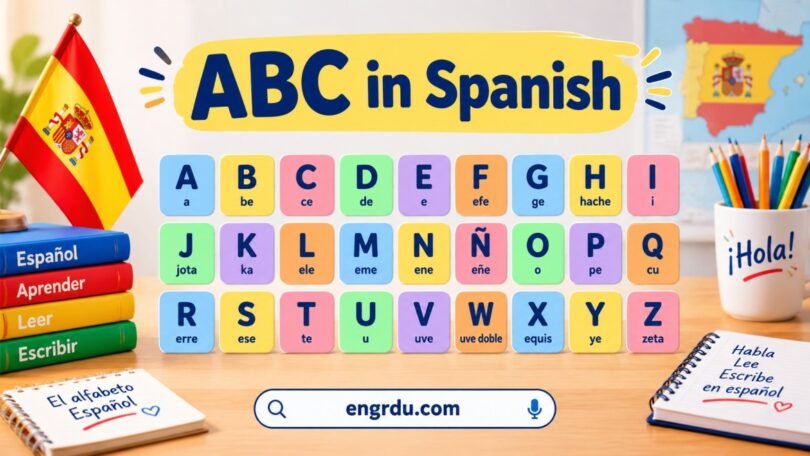
The modern Spanish alphabet has 27 letters, from A to Z, with the letter Ñ included after N.
Spanish uses the same basic Latin alphabet as English, but the names and sounds of several letters differ.
| Feature | Spanish Alphabet | English Alphabet |
|---|---|---|
| Number of letters | 27 | 26 |
| First letter | A | A |
| Last letter | Z | Z |
| Distinctive letter | Ñ | No Ñ |
| Written accents | Used on vowels and ü in specific contexts | Used mainly in loanwords and some names |
| Alphabet terms | Alfabeto, abecedario | Alphabet |
Important: CH and LL were traditionally treated as separate letters in Spanish alphabet lists. Since the 2010 orthographic reform, they are classified as letter combinations rather than independent alphabet letters.
All 27 Spanish Alphabet Letters With Pronunciation
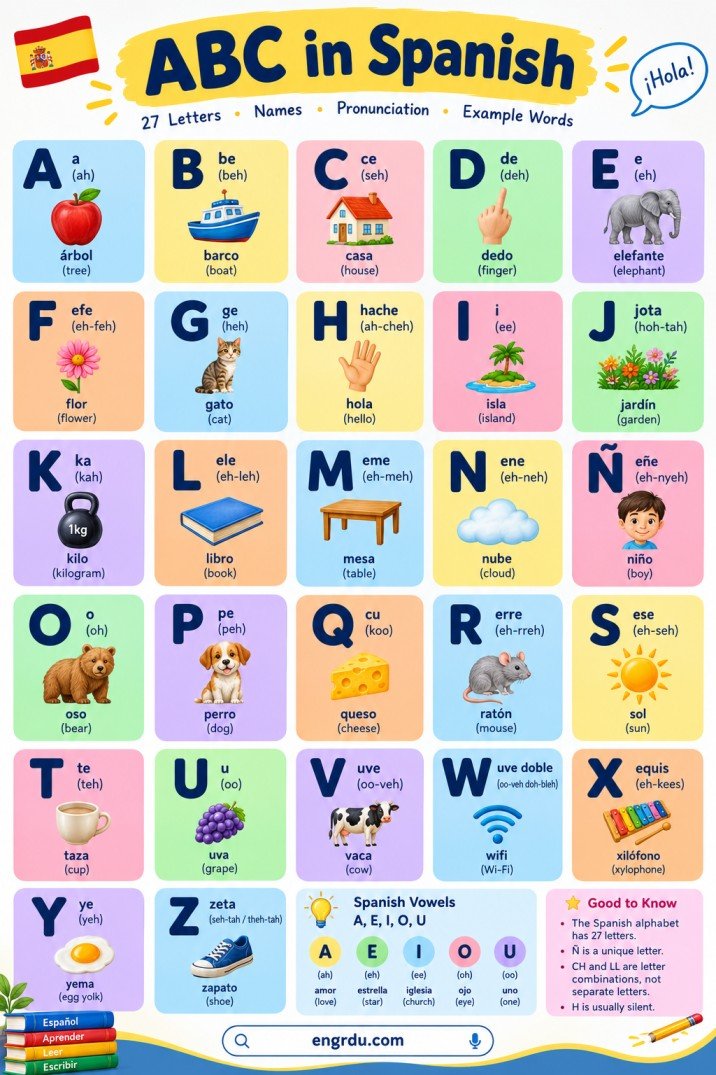
The following table lists every letter in the Spanish alphabet, its Spanish name, an approximate English pronunciation, and an example word.
Pronunciation guides are approximate because English sounds do not always match Spanish sounds exactly.
| Letter | Spanish Name | Approximate Pronunciation | Spanish Example | English Meaning |
|---|---|---|---|---|
| A | a | ah | árbol | Tree |
| B | be | beh | barco | Boat |
| C | ce | seh | casa | House |
| D | de | deh | dedo | Finger |
| E | e | eh | elefante | Elephant |
| F | efe | eh-feh | flor | Flower |
| G | ge | heh | gato | Cat |
| H | hache | ah-cheh | hola | Hello |
| I | i | ee | isla | Island |
| J | jota | hoh-tah | jardín | Garden |
| K | ka | kah | kilo | Kilogram |
| L | ele | eh-leh | libro | Book |
| M | eme | eh-meh | mesa | Table |
| N | ene | eh-neh | nube | Cloud |
| Ñ | eñe | eh-nyeh | niño | Boy or child |
| O | o | oh | oso | Bear |
| P | pe | peh | perro | Dog |
| Q | cu | koo | queso | Cheese |
| R | erre | eh-rreh | ratón | Mouse |
| S | ese | eh-seh | sol | Sun |
| T | te | teh | taza | Cup |
| U | u | oo | uva | Grape |
| V | uve | oo-veh | vaca | Cow |
| W | uve doble | oo-veh doh-bleh | wifi | Wi-Fi |
| X | equis | eh-kees | xilófono | Xylophone |
| Y | ye | yeh | yema | Egg yolk |
| Z | zeta | seh-tah or theh-tah | zapato | Shoe |
Regional note: The names of some letters vary across Spanish-speaking countries. For example, V is also called ve or ve corta, while W may be called doble ve. The pronunciation of Z also varies by region.
Spanish Alphabet ABC Learning
Spanish Vowels: A, E, I, O, U
Spanish has five vowel letters: A, E, I, O, and U. Their sounds are generally more consistent than English vowel sounds.
| Vowel | Approximate Sound | Example | Meaning |
|---|---|---|---|
| A | ah | amor | Love |
| E | eh | estrella | Star |
| I | ee | iglesia | Church |
| O | oh | ojo | Eye |
| U | oo | uno | One |
Unlike English, where a vowel can have several different sounds, Spanish vowels usually keep a relatively stable pronunciation.
Practice saying the five vowels slowly, then use each one in a Spanish word.
Spanish Alphabet Examples With Words
Learning a letter is easier when you connect it to familiar vocabulary. These examples show how Spanish alphabet letters appear at the beginning of common words.
Common Spanish Words From A to Z
| Letter | Spanish Word | English Meaning |
|---|---|---|
| A | amigo | Friend |
| B | biblioteca | Library |
| C | comida | Food |
| D | día | Day |
| E | escuela | School |
| F | familia | Family |
| G | gracias | Thank you |
| H | hermano | Brother |
| I | invierno | Winter |
| J | joven | Young person |
| K | karate | Karate |
| L | leche | Milk |
| M | madre | Mother |
| N | naranja | Orange |
| Ñ | ñandú | Rhea, a large flightless bird |
| O | ocho | Eight |
| P | papel | Paper |
| Q | quince | Fifteen |
| R | rosa | Rose |
| S | semana | Week |
| T | trabajo | Work |
| U | universidad | University |
| V | ventana | Window |
| W | web | Web |
| X | taxi | Taxi |
| Y | yo | I |
| Z | zanahoria | Carrot |
Notice that the example for X contains X within the word rather than at the beginning. Spanish has relatively few common native words beginning with X, so loanwords and words with X in other positions are useful examples.
Spanish Words That Contain Ñ
The letter Ñ is one of the most recognizable features of Spanish spelling. It represents a sound different from N.
Examples include:
Niño: Boy or child.
Niña: Girl or female child.
Año: Year.
Baño: Bathroom or bath.
Mañana: Tomorrow or morning.
España: Spain.
The tilde above Ñ is not an optional decoration. It changes the letter and can change a word’s meaning.
For example, año means “year,” while ano refers to the anus. Correct spelling matters.
How Spanish Alphabet Pronunciation Differs From English
Spanish and English share many written letters, but their names and sounds are not always the same. Understanding these differences helps you spell Spanish words and read them more accurately.
1. The Letter H Is Silent
In standard Spanish pronunciation, H is not pronounced when it appears in an ordinary word.
Examples:
Hola: Hello.
Hotel: Hotel.
Hombre: Man.
Huevo: Egg.
For instance, hola begins with a vowel sound rather than the English H sound.
2. B and V Usually Sound Similar
In Spanish, B and V generally represent the same phoneme, although their exact pronunciation changes with their position in a word and the surrounding sounds.
Examples:
Barco: Boat.
Vaca: Cow.
Beber: To drink.
Vivir: To live.
Do not rely on the English distinction between B and V when pronouncing Spanish words.
3. C and Z Have Regional Differences
In much of Latin America, C before E or I and the letter Z are pronounced like S.
Examples:
Cena: Dinner.
Cielo: Sky or heaven.
Zapato: Shoe.
In much of Spain, these sounds are pronounced with the tongue near the teeth, similar to the English TH in think. This difference is called distinción.
Before A, O, or U, C generally has a K sound, as in casa (house).
4. G and J Can Have a Stronger Sound
G has different sounds depending on the following vowel.
Gato: Cat — G has a sound similar to English G in go.
Gente: People — G has a sound similar to Spanish J.
Guitarra: Guitar — the U is silent in the written combination GUI.
Jardín: Garden — J has a strong, breathy sound.
The Spanish J sound does not normally match the English J in jam.
5. R and RR Are Different in Pronunciation
Spanish R has a tap sound in many positions, while RR represents a strong trill.
Pero: But.
Perro: Dog.
Caro: Expensive.
Carro: Car in many Latin American varieties.
The difference between pero and perro can change the meaning, so practice the R sounds carefully.
How to Use the Spanish ABC in Everyday Situations
The Spanish alphabet is useful beyond language classes. You can use it whenever you need to communicate a name, understand spelling, or enter information correctly.
Spelling Names in Spanish
When someone asks you to spell a name, you can use these expressions:
| Spanish Expression | English Meaning |
|---|---|
| ¿Cómo se escribe? | How is it spelled? |
| ¿Puedes deletrearlo? | Can you spell it? |
| Se escribe con A. | It is spelled with A. |
| Mi nombre se escribe… | My name is spelled… |
| ¿Con B o con V? | With B or V? |
Example conversation
Ana: ¿Cómo se escribe tu nombre?
Luis: Se escribe L-U-I-S.
Ana: Gracias.
Luis: De nada.
English translation:
Ana: How do you spell your name?
Luis: It is spelled L-U-I-S.
Ana: Thank you.
Luis: You’re welcome.
Reading Spanish Signs and Labels
Knowing the alphabet helps you recognize words on signs, menus, product labels, and public information boards.
For example:
Salida: Exit.
Entrada: Entrance.
Abierto: Open.
Cerrado: Closed.
Prohibido: Prohibited.
Recognizing individual letters makes unfamiliar words easier to read and remember.
Understanding Accents and Other Written Marks
Spanish uses accent marks and the letter ü in certain words. These marks are not additional letters in the 27-letter alphabet, but they affect spelling and pronunciation.
| Written Form | Example | Use |
|---|---|---|
| Acute accent (´) | café | Marks stress according to Spanish spelling rules |
| Diaeresis (¨) | pingüino | Shows that U is pronounced in güe or güi |
| Tilde on Ñ | niño | Forms a distinct letter with its own sound |
For example, pingüino means “penguin.” The two dots over U indicate that the U should be pronounced.
An accent mark can also distinguish words with different meanings, such as sí (yes) and si (if).
Common Spanish Alphabet Mistakes
Learners who already know English sometimes apply English spelling and pronunciation rules to Spanish. Watch out for these frequent errors.
Treating Ñ as N: Ñ is a separate letter, not simply N with decoration.
Pronouncing H: The H in hola is silent.
Using English B and V sounds: Spanish B and V generally share a phoneme.
Treating CH and LL as separate alphabet letters: They are letter combinations in modern Spanish alphabet ordering.
Ignoring accent marks: Written accents can affect stress or distinguish meanings.
Practice Exercises With Answers
Test your understanding of Spanish alphabet letters, spelling, and vocabulary. Try answering each question before checking the answer key.
Exercise 1: Complete the Missing Letters
Fill in each blank with the correct Spanish alphabet letter.
A, B, __, D, E
L, M, __, Ñ, O
P, Q, __, S, T
U, V, __, X, Y, Z
X, Y, __
Exercise 2: Match the Spanish Words With Their Meanings
Match each Spanish word to the correct English meaning.
| Spanish Word | English Meaning |
|---|---|
| 1. Gato | A. Sun |
| 2. Libro | B. Cat |
| 3. Sol | C. Book |
| 4. Agua | D. Water |
| 5. Flor | E. Flower |
Exercise 3: Choose the Correct Answer
1. How many letters are in the modern Spanish alphabet?
A. 25
B. 26
C. 27
2. Which letter is unique to the Spanish alphabet compared with the standard English alphabet?
A. Ñ
B. W
C. K
3. Which letter is usually silent in Spanish words?
A. H
B. M
C. L
4. Which Spanish word means “dog”?
A. Pero
B. Perro
C. Pelo
5. What does abecedario mean?
A. Dictionary
B. Alphabet
C. Sentence
Answer Key
Exercise 1
C
N
R
W
Z
Exercise 2
B
C
A
D
E
Exercise 3
C — 27
A — Ñ
A — H
B — Perro
B — Alphabet
FAQs About ABC in Spanish
1. What is ABC in Spanish?
ABC in Spanish refers to the Spanish alphabet, called el alfabeto or el abecedario, which contains 27 letters used to write Spanish words.
2. How do you say the alphabet in Spanish?
You can say el alfabeto or el abecedario. Both expressions refer to the Spanish alphabet and are widely understood across Spanish-speaking countries.
3. How many letters are in the Spanish alphabet?
The modern Spanish alphabet has 27 letters, including Ñ. CH and LL are letter combinations, not separate letters in the current alphabet.
4. Is Ñ a separate letter in Spanish?
Yes, Ñ is a separate Spanish alphabet letter that comes after N. It represents a distinct sound, as heard in niño and España.
5. Does Spanish use the same alphabet as English?
Spanish uses the Latin alphabet like English, but it includes Ñ as an additional letter and uses accent marks for spelling and pronunciation.
6. How do you pronounce ABC in Spanish?
The Spanish names of A, B, and C are a, be, and ce. Their approximate pronunciations are ah, beh, and seh in Latin America.
7. Are CH and LL letters in the Spanish alphabet?
No. CH and LL were traditionally listed as separate letters, but modern Spanish alphabet ordering treats them as letter combinations made from existing letters.
8. What is the easiest way to learn the Spanish alphabet?
Practice the 27 letters in order, say their Spanish names aloud, connect each letter to a familiar word, and review spelling exercises regularly.
Conclusion
Learning the ABC in Spanish gives you a foundation for reading, spelling, and pronouncing Spanish words. The modern Spanish alphabet contains 27 letters, including Ñ, and each letter has a Spanish name. Focus on the five vowels, the silent H, the pronunciation of B and V, and the difference between R and RR. Practice the alphabet with everyday vocabulary and spelling exercises to build confidence as you continue learning Spanish.