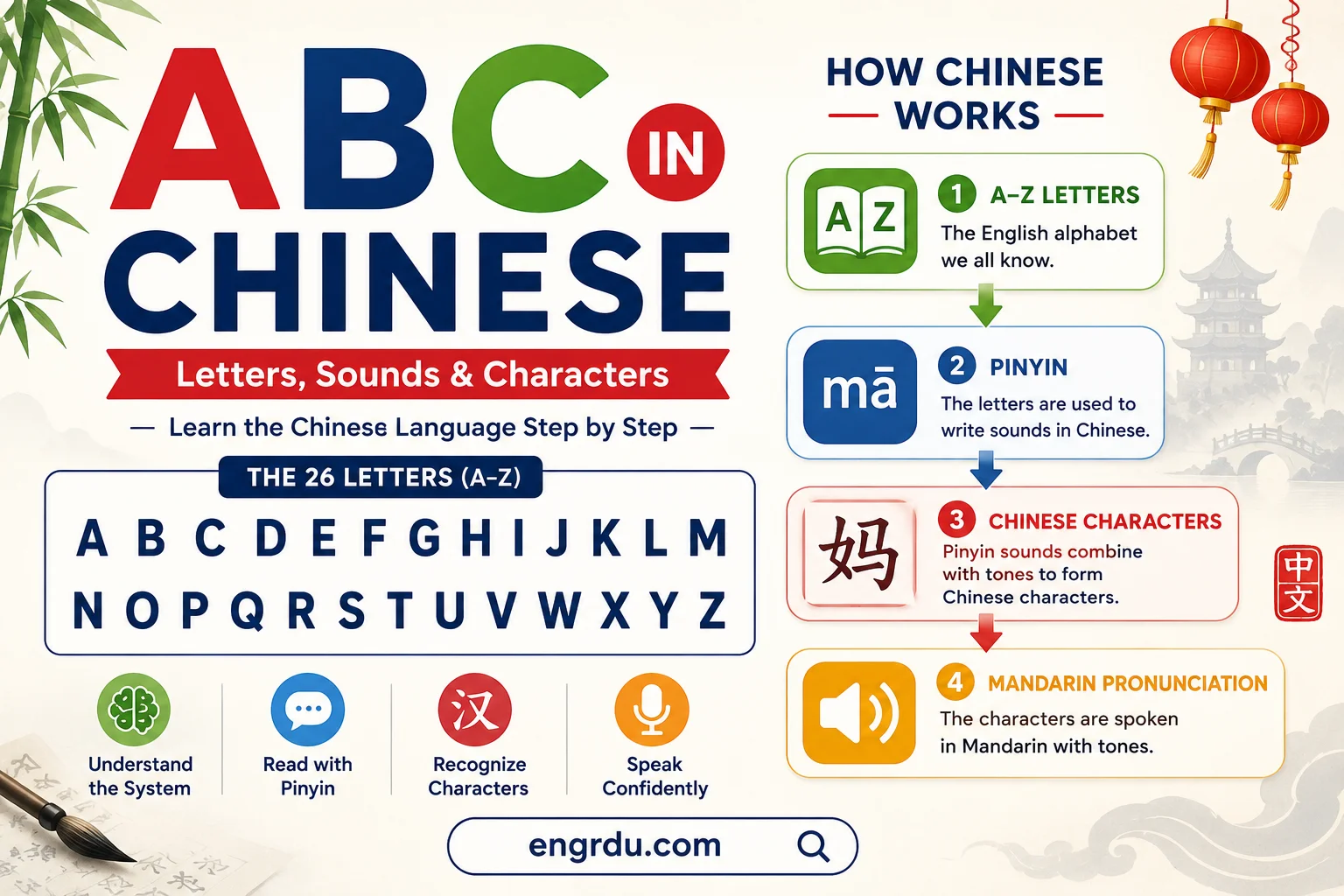

Learning ABC in Chinese can feel a little different from learning the English alphabet. Chinese writing does not use A–Z as its main writing system, but these letters are still very important when learning Mandarin. You will see them often in Pinyin, which uses Latin letters to show Chinese pronunciation. This guide covers the A–Z alphabet in Chinese, how Pinyin letters sound, and simple examples to help you read and pronounce them with more confidence.
Does Chinese Have an Alphabet?
Chinese does not have an alphabet in the same way English does. Standard Chinese is normally written with Chinese characters, such as 我, 你, 学, and 中.
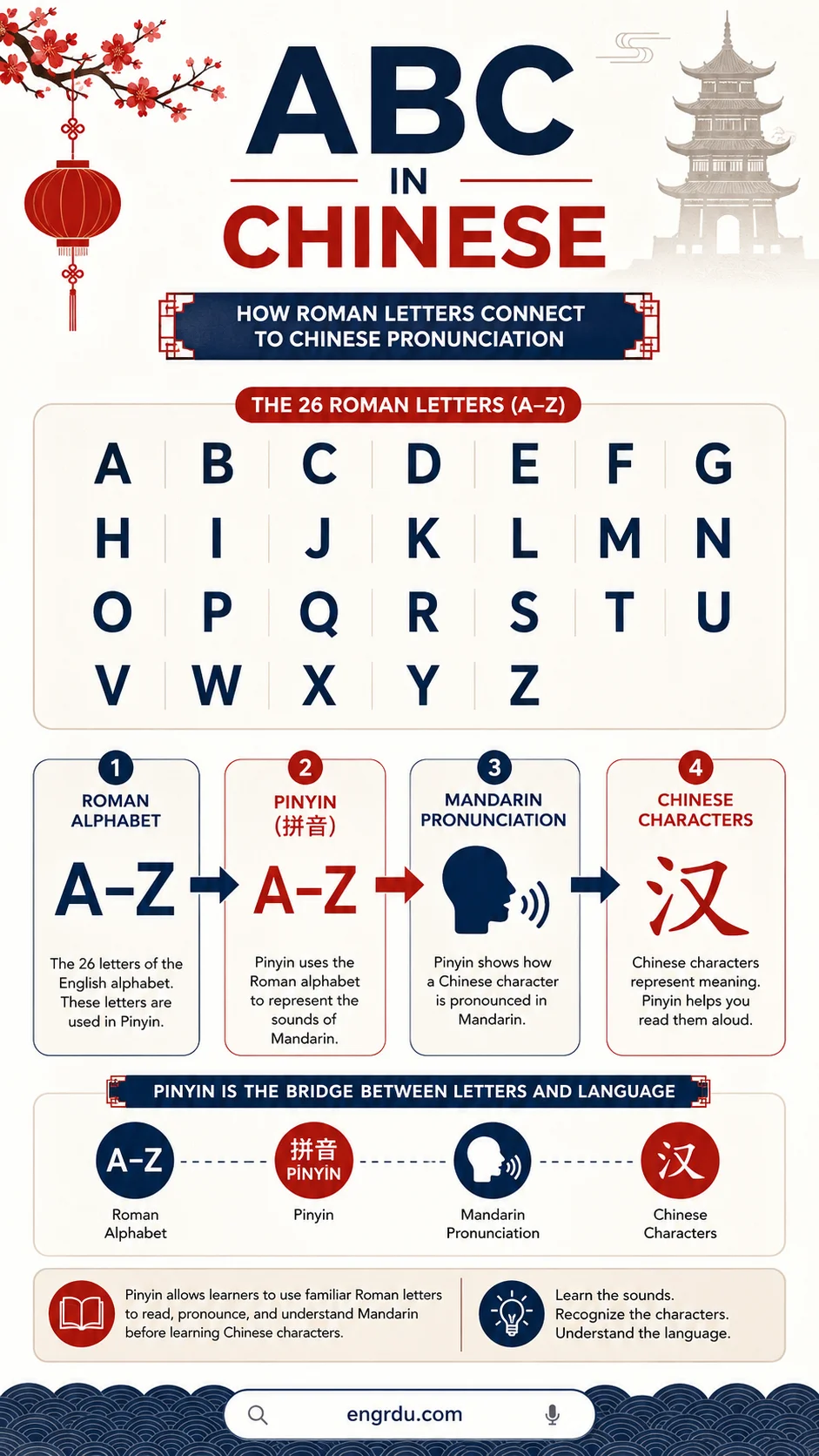
For pronunciation, Mandarin commonly uses Hanyu Pinyin, a romanization system based on the Latin alphabet. Pinyin helps learners read and pronounce Chinese words and is also used in dictionaries and computer input.
Chinese characters vs. Pinyin
| System | What it uses | Main purpose |
|---|---|---|
| Chinese writing | Chinese characters | Writing the language |
| Pinyin | Roman letters + tone marks | Showing pronunciation |
| English alphabet | A–Z | Writing English |
For example:
你 = Chinese character
nǐ = Pinyin
you = English meaning
This is why A to Z alphabets in Chinese usually means the Roman letters used to write Mandarin pronunciation rather than a separate Chinese A–Z writing system.
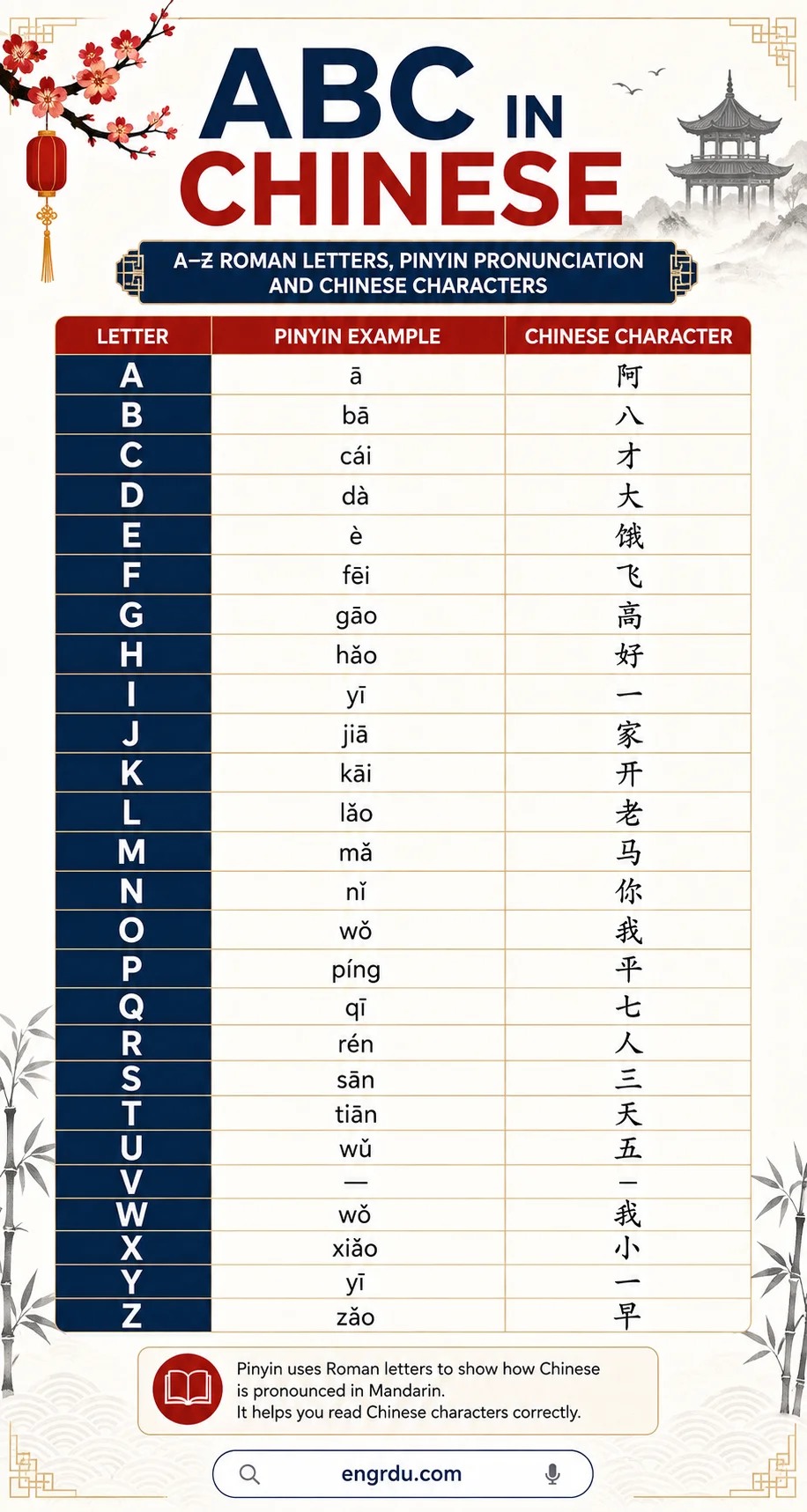
ABC in Chinese: A to Z
The Pinyin system uses the 26 basic Roman letters, A through Z, but they do not all behave like English letters. Some represent consonant sounds, some represent vowel sounds, and some occur in particular spelling patterns.
| Letter | Uppercase | Lowercase | Example Pinyin | Chinese | Meaning |
|---|---|---|---|---|---|
| A | A | a | ā | 阿 | used in names and syllables |
| B | B | b | bā | 八 | eight |
| C | C | c | cái | 才 | only / just |
| D | D | d | dà | 大 | big |
| E | E | e | hē | 喝 | drink |
| F | F | f | fān | 番 | measure / instance |
| G | G | g | gāo | 高 | tall / high |
| H | H | h | hǎo | 好 | good |
| I | I | i | nǐ | 你 | you |
| J | J | j | jiā | 家 | home |
| K | K | k | kāi | 开 | open |
| L | L | l | lǎo | 老 | old |
| M | M | m | mā | 妈 | mother |
| N | N | n | nǐ | 你 | you |
| O | O | o | wǒ | 我 | I / me |
| P | P | p | pà | 怕 | be afraid |
| Q | Q | q | qī | 七 | seven |
| R | R | r | rén | 人 | person |
| S | S | s | sān | 三 | three |
| T | T | t | tā | 他 | he |
| U | U | u | wǔ | 五 | five |
| V | V | v | — | — | not a regular Pinyin letter |
| W | W | w | wǒ | 我 | I / me |
| X | X | x | xiǎo | 小 | small |
| Y | Y | y | yī | 一 | one |
| Z | Z | z | zǎo | 早 | early |
The examples above show how individual letters appear inside Pinyin spellings. A Pinyin letter should not always be pronounced exactly like its English counterpart.
ABC in Chinese with Characters
The 26 Letters in Chinese Pinyin
The Chinese language alphabets often shown online are actually the Roman letters used by Pinyin. Pinyin represents Mandarin sounds through combinations of letters rather than by treating each letter as an independent sound.
For example:
- b + ā = bā → 八 → eight
- m + ā = mā → 妈 → mother
- sh + u + ǐ = shuǐ → 水 → water
- zh + ī = zhī → 知 → know
This means learning the alphabet is only the first step. Learners also need to understand Pinyin initials, finals, and tones. Pinyin syllables are built from these sound components, and tone is an important part of Mandarin pronunciation.
Chinese Alphabet Pronunciation
One common mistake is trying to pronounce every Pinyin letter exactly like English.
Some letters look familiar but represent different sounds. The letters q, x, c, z, j, zh, ch, and sh, for example, need practice because their Mandarin sounds do not map neatly to ordinary English spelling.
Here are some useful pronunciation comparisons:
| Pinyin | Example | Meaning | Pronunciation tip |
|---|---|---|---|
| b | bā 八 | eight | light, unaspirated sound |
| p | pā | climb | stronger puff of air |
| d | dà 大 | big | light, unaspirated sound |
| t | tā 他 | he | stronger puff of air |
| g | gāo 高 | high | light, unaspirated sound |
| k | kāi 开 | open | stronger puff of air |
| j | jī 鸡 | chicken | tongue position differs from English j |
| q | qī 七 | seven | like an aspirated j-type sound |
| x | xī 西 | west | soft sound made near the front of the mouth |
| zh | zhī 知 | know | curled-tongue sound |
| ch | chī 吃 | eat | aspirated curled-tongue sound |
| sh | shī 师 | teacher | curled-tongue sh sound |
The most useful approach is to learn these sounds through complete Pinyin syllables, not isolated letters.
ABC in Chinese and Pinyin Learning Guide
How Pinyin Uses Chinese Alphabets
Pinyin is not a direct letter-for-letter replacement for Chinese characters. It is a romanization system, meaning it uses Roman letters to represent Mandarin pronunciation.
Consider this example:
你好
nǐ hǎo
hello
The Chinese characters are 你 and 好. The Roman letters n, i, h, a, o show how those characters are pronounced.
Pinyin also uses tone marks:
- ā = first tone
- á = second tone
- ǎ = third tone
- à = fourth tone
Mandarin tones can change the meaning of a syllable, so learning the letters without learning tones can lead to incorrect pronunciation.
A useful example: ma
The spelling ma can represent different words depending on its tone and character.
| Pinyin | Character | Meaning |
|---|---|---|
| mā | 妈 | mother |
| má | 麻 | hemp / numb |
| mǎ | 马 | horse |
| mà | 骂 | scold |
The letters stay almost the same, but the tone changes the word.
Chinese Initials and Finals
Pinyin pronunciation becomes much easier to understand when you separate a syllable into initials and finals.
An initial is usually the beginning consonant sound. A final contains the remaining vowel or vowel-related sound. Pinyin syllables can be formed from these parts, although not every syllable contains both.
Common Pinyin initials
The main consonant initials include:
b, p, m, f
d, t, n, l
g, k, h
j, q, x
zh, ch, sh, r
z, c, s
Examples:
- b in bā
- m in mā
- n in nǐ
- x in xiǎo
- zh in zhī
- sh in shī
Notice that zh, ch, and sh use two Roman letters to represent one initial sound.
Common Pinyin finals
Pinyin also has vowel and vowel-combination patterns such as:
a, o, e, i, u, ü
and combinations such as:
ai, ei, ao, ou, ia, ie, ua, uo, üe
For example:
- hǎo contains h + ao
- mā contains m + a
- shuǐ contains sh + ui
- xué contains x + üe
The complete Pinyin system contains many possible combinations of initials and finals rather than simply assigning one sound to each A–Z letter.
A–Z Examples in Chinese
Here is a practical way to study the A to Z Alphabets in Chinese. The examples show letters inside actual Pinyin words instead of treating English letter names as Chinese vocabulary.
| Letter | Pinyin example | Chinese character | English meaning |
|---|---|---|---|
| A | ā | 阿 | used in some names |
| B | bā | 八 | eight |
| C | cái | 才 | only / just |
| D | dà | 大 | big |
| E | è | 饿 | hungry |
| F | fēi | 飞 | fly |
| G | gāo | 高 | high |
| H | hǎo | 好 | good |
| I | yī | 一 | one |
| J | jiā | 家 | home |
| K | kāi | 开 | open |
| L | lǎo | 老 | old |
| M | mǎ | 马 | horse |
| N | nǐ | 你 | you |
| O | wǒ | 我 | I / me |
| P | píng | 平 | flat / peaceful |
| Q | qī | 七 | seven |
| R | rén | 人 | person |
| S | sān | 三 | three |
| T | tiān | 天 | sky / day |
| U | wǔ | 五 | five |
| V | — | — | not normally used in standard Pinyin |
| W | wǒ | 我 | I / me |
| X | xiǎo | 小 | small |
| Y | yī | 一 | one |
| Z | zǎo | 早 | early |
This table is useful for alphabet practice, but it should not give the impression that each Roman letter has one fixed Mandarin sound.
What About the Letter V and Ü?
The letter V deserves special attention.
Standard Hanyu Pinyin does not normally use v as one of its regular spelling letters. However, many Chinese computer input systems use v as a convenient way to type ü.
For example:
lü may sometimes be entered as lv when typing Chinese on a keyboard.
The vowel ü is a genuine part of Mandarin Pinyin, even though it is not one of the 26 basic English alphabet letters.
You can see ü in words such as:
- nǚ — 女 — woman
- lǜ — 绿 — green
- xué — 学 — study
This is one reason the phrase Chinese alphabets can be confusing: Pinyin uses the Roman alphabet, but its pronunciation system is specifically designed for Mandarin.
Common Confusions About Chinese Alphabets
A few misunderstandings appear again and again when people search for ABC in Chinese Language.
- Chinese does not use A–Z as its main writing system. Chinese characters are the normal written form.
- Pinyin is not the Chinese alphabet. It is a romanization system used to represent pronunciation.
- Pinyin letters do not always sound like English letters. Their pronunciation follows Mandarin sound rules.
- V is not a normal Pinyin letter. It is sometimes used when typing ü with a keyboard.
- Learning A–Z alone is not enough. Mandarin learners also need syllables and tones.
Easy Practice for Chinese Alphabets
Try reading these Pinyin examples aloud:
- bā
- mā
- nǐ
- hǎo
- qī
- xiǎo
- zhōng
- shuǐ
Now match each one with its Chinese character.
| Pinyin | Choose the meaning |
|---|---|
| bā | a. water |
| mǎ | b. eight |
| nǐ | c. horse |
| shuǐ | d. you |
Another practice activity
Complete each word with the missing Pinyin letter:
- _ǎo → 好
- _ā → 妈
- _ī → 七
- _ǎn → 三
- _ěi → 谁
The goal is not simply to memorize letters. Practice the whole syllable and pay attention to its tone.
Answers
Matching activity:
- bā → eight
- mǎ → horse
- nǐ → you
- shuǐ → water
Missing-letter activity:
- hǎo
- mā
- qī
- sān
- shéi
FAQs About ABC in Chinese
Does Chinese have an A–Z alphabet?
No. Chinese is mainly written with characters. A–Z letters are used in Pinyin, a system for representing Mandarin pronunciation.
What are the Chinese alphabets from A to Z?
The Pinyin system uses the 26 Roman letters from A to Z, although they do not function exactly like English alphabet letters.
Is Pinyin the Chinese alphabet?
No. Pinyin is a romanization system. It uses Roman letters to show how Mandarin Chinese is pronounced.
How many letters are in the Chinese alphabet?
There is no traditional Chinese A–Z alphabet. Pinyin uses the 26 basic Roman letters, plus ü as a distinct vowel symbol.
How do you write ABC in Chinese?
The Roman letters A, B, C can remain A, B, C. When referring to the alphabet, Chinese commonly uses the term 字母 (zìmǔ) for “letters.”
What is the difference between Chinese characters and Pinyin?
Chinese characters represent written Chinese, while Pinyin uses Roman letters to represent the pronunciation of Mandarin words.
Does Chinese use the English alphabet?
Roman letters are widely used in Pinyin and in areas such as names, abbreviations, technology, and international terms, but Chinese writing itself mainly uses characters.
Should I learn Chinese letters or Pinyin first?
For most Mandarin learners, learning basic Pinyin pronunciation and tones first makes it easier to read and pronounce new Chinese words.
Conclusion
ABC in Chinese is best understood through the relationship between Chinese characters and Pinyin. Chinese does not have a native A–Z alphabet like English, but Mandarin uses the Roman alphabet in Hanyu Pinyin to show pronunciation.
Learning the 26 letters gives you a useful starting point, but accurate Chinese pronunciation also depends on initials, finals, syllables, and tones. Once you understand how these pieces work together, Chinese Pinyin becomes much easier to read and practice.
Explore More Related Articles: