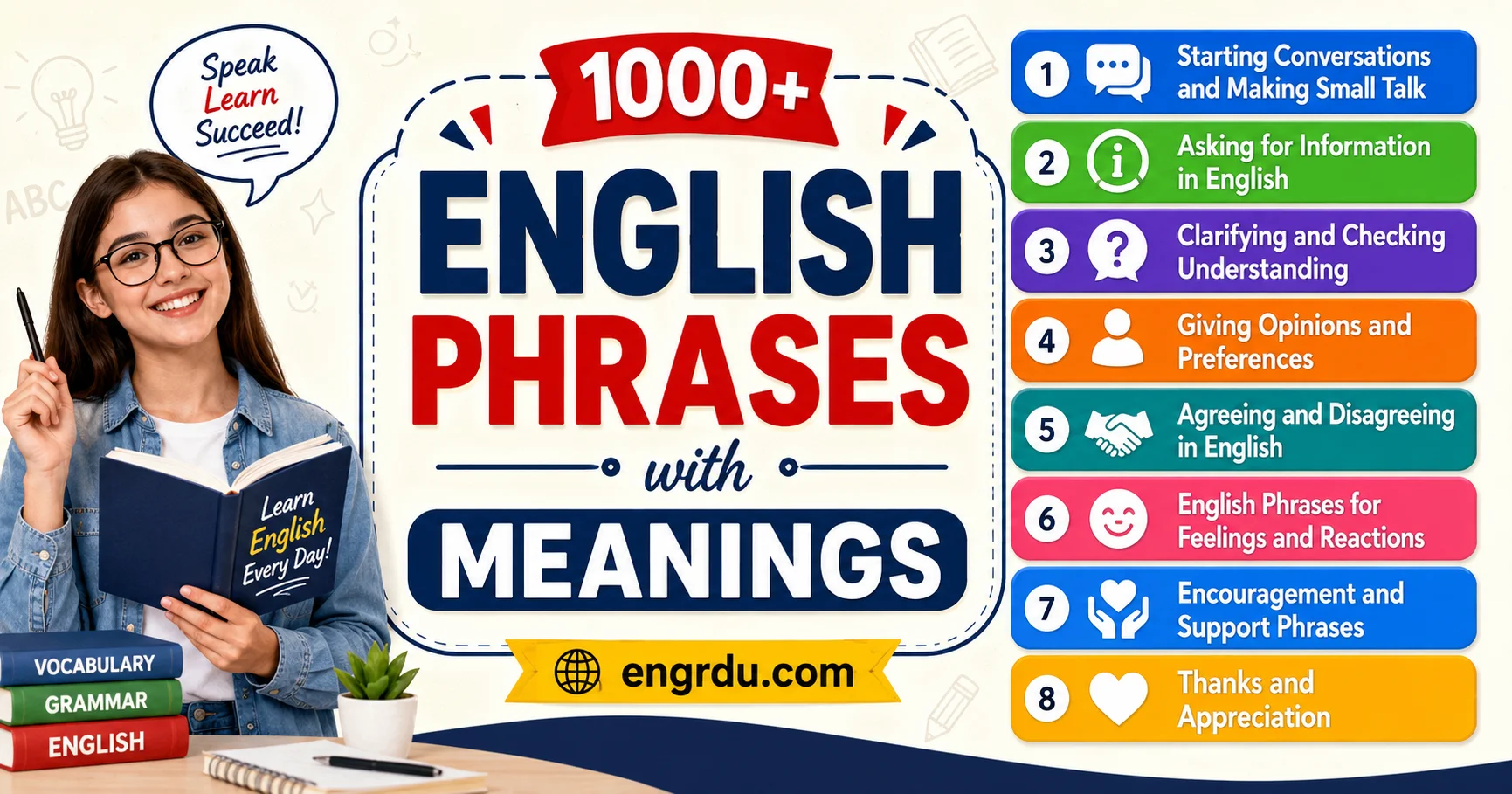

Learning English phrases can make everyday speaking much easier because you learn complete expressions instead of building every sentence word by word.
This collection contains 1,080 common phrases in English for greetings, questions, work, school, shopping, travel, food, phone calls, feelings, social situations, problems, and daily conversations. Each phrase includes a short meaning or tells you when to use it.
English Phrases for Greetings and Introductions
Greetings are often the first phrases learners use in spoken English. These expressions help you meet people, introduce yourself, and respond naturally in formal and informal situations.
| English Phrase | Meaning / When to Use |
|---|---|
| Hello! | Standard greeting |
| Hi! | Friendly informal greeting |
| Hey! | Very casual greeting |
| Good morning. | Greeting used in the morning |
| Good afternoon. | Greeting used after midday |
| Good evening. | Greeting used in the evening |
| How are you? | Ask about someone’s condition |
| How are you doing? | Friendly way to ask how someone is |
| How’s it going? | Casual greeting |
| How have you been? | Ask someone after not meeting for some time |
| What’s up? | Very casual greeting |
| What’s new? | Ask about recent news |
| How’s everything? | Ask generally about life |
| How are things? | Informal general greeting |
| Nice to meet you. | First-time introduction |
| Pleased to meet you. | Polite first meeting |
| It’s nice meeting you. | Friendly introduction |
| I’ve heard a lot about you. | Meeting someone you already know about |
| My name is Alex. | Introduce your name |
| I’m Alex. | Short self-introduction |
| Let me introduce myself. | Begin a formal introduction |
| Allow me to introduce myself. | More formal introduction |
| This is my friend, Sam. | Introduce another person |
| Have you two met? | Check whether two people know each other |
| I don’t think we’ve met. | Begin introducing yourself |
| You must be Sarah. | Recognize someone you expected to meet |
| It’s good to see you. | Greeting someone you know |
| Great to see you again. | Greeting after meeting previously |
| Long time no see. | Informal greeting after a long time |
| It’s been a while. | You have not met recently |
| Welcome! | Greet someone arriving |
| Welcome back. | Greet someone returning |
| Glad you could make it. | Welcome someone who attended |
| Thanks for coming. | Appreciate someone’s visit |
| What should I call you? | Ask someone’s preferred name |
| Where are you from? | Ask about someone’s origin |
| Do you live around here? | Ask whether someone lives nearby |
| What do you do? | Ask about someone’s job |
| How do you know everyone here? | Start conversation at a gathering |
| It’s a pleasure to meet you. | Polite formal introduction |
Polite English Phrases for Everyday Conversation
Polite expressions make conversations sound respectful and natural. They are especially useful when speaking with strangers, teachers, customers, colleagues, or older people.
| English Phrase | Meaning / When to Use |
|---|---|
| Please. | Make a request polite |
| Thank you. | Show gratitude |
| You’re welcome. | Respond to thanks |
| Excuse me. | Get attention politely |
| Pardon me. | Polite interruption or apology |
| May I? | Ask permission |
| Could I…? | Polite request for permission |
| Would you mind…? | Very polite request |
| If you don’t mind. | Ask politely |
| After you. | Let someone go first |
| Please go ahead. | Allow someone to continue |
| Be my guest. | Give permission |
| Take your time. | Tell someone not to hurry |
| No rush. | There is no need to hurry |
| That’s very kind of you. | Respond to kindness |
| I appreciate that. | Express gratitude politely |
| Would you please…? | Respectful request |
| Could you please…? | Common polite request |
| May I ask something? | Politely begin a question |
| Would it be possible to…? | Formal polite request |
| If possible, please… | Politely state a preference |
| Whenever you’re ready. | Give someone time |
| Sorry to bother you. | Politely interrupt someone |
| I hope I’m not disturbing you. | Check before interrupting |
| Do you have a moment? | Ask for someone’s time |
| Could I have a word with you? | Ask for a short private conversation |
| Please have a seat. | Politely ask someone to sit |
| Make yourself comfortable. | Welcome someone |
| Help yourself. | Invite someone to take food or something |
| Please feel free to ask. | Invite questions |
| Don’t mention it. | Polite response to thanks |
| Not at all. | Polite response to thanks or apology |
| It was my pleasure. | Say you were happy to help |
| I beg your pardon. | Formal apology or request to repeat |
| Sorry, may I pass? | Ask someone to let you through |
| Would you excuse me? | Politely leave temporarily |
| Please accept my thanks. | Formal gratitude |
| That’s thoughtful of you. | Appreciate consideration |
| I hope that’s okay with you. | Politely check agreement |
| With your permission… | Formal way to ask approval |
Starting Conversations and Making Small Talk
Small talk helps you begin friendly conversations without discussing anything too personal. These phrases work at school, work, events, waiting areas, and social gatherings.
| English Phrase | Meaning / When to Use |
|---|---|
| How’s your day going? | Ask about someone’s day |
| Busy day? | Casual conversation starter |
| Having a good day? | Friendly small talk |
| How was your weekend? | Ask about the weekend |
| Did you have a good weekend? | Friendly Monday conversation |
| Any plans for the weekend? | Ask about upcoming plans |
| Beautiful day, isn’t it? | Talk about pleasant weather |
| It’s cold today, isn’t it? | Weather small talk |
| Looks like rain. | Comment on the weather |
| It’s really busy here today. | Comment on surroundings |
| Have you been here before? | Start conversation somewhere new |
| Is this your first time here? | Ask about someone’s experience |
| What brings you here? | Ask why someone is at a place |
| Are you enjoying yourself? | Ask at an event |
| How do you like it here? | Ask someone’s opinion about a place |
| Do you come here often? | Casual question about a place |
| What have you been up to lately? | Ask about recent activities |
| How’s work going? | Ask about someone’s job |
| How’s school going? | Ask about studies |
| How’s the family? | Ask about family |
| How are things at home? | Friendly personal small talk |
| Have you seen any good movies lately? | Start entertainment conversation |
| Are you watching anything interesting? | Discuss TV or streaming |
| What kind of music do you like? | Start music conversation |
| What do you do for fun? | Ask about hobbies |
| Are you into sports? | Ask about sports interests |
| Have you tried this before? | Discuss an activity or food |
| What do you think of this place? | Ask for an opinion |
| That’s a nice jacket. | Friendly compliment |
| I like your shoes. | Casual compliment |
| Where did you get that? | Continue a compliment |
| This place is lovely. | Comment on surroundings |
| It’s quieter than usual today. | Observation for small talk |
| There are a lot of people here. | Casual observation |
| I wasn’t expecting it to be this busy. | Comment on a crowd |
| It’s been a long day. | Casual shared observation |
| The time went quickly today. | Small-talk comment |
| You look familiar. | Begin conversation with someone recognizable |
| Haven’t we met before? | Ask whether you have met |
| So, how do you know the host? | Start conversation at an event |
Asking for Information in English
Good conversation depends on asking clear questions. These phrases help you request names, places, explanations, prices, times, details, and other information.
| English Phrase | Meaning / When to Use |
|---|---|
| What’s this? | Ask about an object |
| What’s that? | Ask about something farther away |
| Who is that? | Ask someone’s identity |
| What’s your name? | Ask a person’s name |
| Where is it? | Ask about location |
| Where are you going? | Ask someone’s destination |
| Where can I find this? | Ask where something is located |
| When does it start? | Ask starting time |
| When does it finish? | Ask ending time |
| What time is it? | Ask the current time |
| What time should I come? | Ask arrival time |
| How much is it? | Ask a price |
| How much does this cost? | Ask an item’s price |
| How many do you need? | Ask about quantity |
| How long does it take? | Ask duration |
| How far is it? | Ask distance |
| How old is it? | Ask age of something |
| How does it work? | Ask for an explanation |
| What does this mean? | Ask meaning |
| What happened? | Ask about an event |
| Why did that happen? | Ask for a reason |
| Which one do you mean? | Ask someone to identify an option |
| What kind do you want? | Ask about type |
| What size do you need? | Ask about size |
| What are you looking for? | Ask what someone needs |
| Can you tell me more? | Request additional details |
| Could you explain that? | Ask for explanation |
| Do you know where it is? | Ask about location |
| Do you know what time it starts? | Ask about time |
| Do you happen to know…? | Polite information request |
| Can I ask why? | Politely ask for a reason |
| What do you mean by that? | Ask about meaning |
| Where did you hear that? | Ask for the source |
| How did you find out? | Ask how someone learned something |
| Who told you? | Ask for the source person |
| What’s the answer? | Ask for a solution |
| What’s the problem? | Ask what is wrong |
| Is there anything else I should know? | Ask for additional details |
| What exactly happened? | Request specific details |
| Could you give me some information? | General polite information request |
Clarifying and Checking Understanding
Use these expressions when something is unclear, you did not hear correctly, or you want to confirm that you understood the speaker.
| English Phrase | Meaning / When to Use |
|---|---|
| Sorry? | Ask someone to repeat |
| What did you say? | Ask for repetition |
| Could you repeat that? | Polite repetition request |
| Can you say that again? | Ask someone to repeat |
| Could you speak more slowly? | Ask for slower speech |
| Please speak a little louder. | Ask for more volume |
| I didn’t catch that. | You did not hear or understand |
| I missed the last part. | You missed part of a sentence |
| I didn’t quite understand. | Politely show confusion |
| I’m not sure I understand. | Ask indirectly for clarification |
| What do you mean? | Ask for explanation |
| What does that mean? | Ask meaning |
| Could you explain it differently? | Request another explanation |
| Could you give me an example? | Ask for an example |
| Can you show me what you mean? | Ask for demonstration |
| How do you spell that? | Ask spelling |
| How do you pronounce that? | Ask pronunciation |
| Did you say fifteen or fifty? | Check similar-sounding information |
| Let me make sure I understand. | Introduce a confirmation |
| So you’re saying that…? | Restate someone’s point |
| Do you mean…? | Check intended meaning |
| Is that what you mean? | Confirm interpretation |
| Am I understanding you correctly? | Check comprehension |
| Have I got that right? | Confirm understanding |
| Did I hear you correctly? | Confirm what you heard |
| Let me check that. | Verify information |
| Just to confirm… | Introduce confirmation |
| Let me repeat that back. | Check details by repeating |
| Are you saying we should wait? | Confirm an instruction |
| Which part are you referring to? | Clarify a specific point |
| Could you be more specific? | Request precise information |
| What exactly do you mean? | Ask for precise meaning |
| Can you put that another way? | Ask for rephrasing |
| I’m a little confused. | State confusion politely |
| I’m not following you. | Say you do not understand |
| You’ve lost me. | Informal way to say you are confused |
| Does that mean…? | Check a conclusion |
| Is that clear? | Check someone else’s understanding |
| Does that make sense? | Check whether an explanation is understandable |
| Are we on the same page? | Check shared understanding |
Giving Opinions and Preferences
These conversational English phrases help you say what you think, what you like, and what you would choose.
| English Phrase | Meaning / When to Use |
|---|---|
| I think so. | Express a positive opinion |
| I don’t think so. | Express doubt or disagreement |
| I think it’s a good idea. | Give a positive opinion |
| In my opinion… | Introduce your view |
| From my point of view… | Give your perspective |
| As far as I’m concerned… | State your position |
| The way I see it… | Introduce your view |
| Personally, I think… | Give a personal opinion |
| If you ask me… | Informal opinion phrase |
| I believe that… | State a belief |
| I’d say… | Give an opinion or estimate |
| It seems to me that… | Give a cautious opinion |
| I have a feeling that… | Express an impression |
| My guess is… | State an uncertain opinion |
| I prefer this one. | State preference |
| I’d rather stay home. | Prefer one action |
| I like this better. | Compare preferences |
| This is my favorite. | State your top choice |
| I’m not a fan of it. | Politely say you dislike something |
| It’s not really my thing. | Informal dislike |
| I quite like it. | Moderate positive opinion |
| I really like it. | Strong positive opinion |
| I love it. | Very strong liking |
| I don’t mind it. | Neutral or mild acceptance |
| I could take it or leave it. | No strong preference |
| I’m interested in it. | Express interest |
| I’m not interested. | Express lack of interest |
| That sounds good to me. | Approve a suggestion |
| That doesn’t appeal to me. | Say something is unattractive |
| I’d choose the first one. | State a choice |
| I’d go with this option. | Choose an option |
| This one suits me better. | Say one option fits your needs |
| That’s more my style. | Express personal preference |
| I’m leaning toward this one. | Show developing preference |
| I haven’t decided yet. | No final choice |
| I’m open to either option. | Both choices are acceptable |
| It depends. | Opinion changes with circumstances |
| I’m in favor of it. | Support an idea |
| I’m against it. | Oppose an idea |
| That’s how I see it. | Finish stating your opinion |
Agreeing and Disagreeing in English
Agreement does not always need “yes,” and disagreement does not have to sound rude. These phrases help you respond naturally during discussions.
| English Phrase | Meaning / When to Use |
|---|---|
| I agree. | Direct agreement |
| I completely agree. | Strong agreement |
| I totally agree. | Informal strong agreement |
| Absolutely. | Strong confirmation |
| Exactly. | Say someone is correct |
| That’s right. | Confirm a statement |
| You’re right. | Agree with someone |
| I think you’re right. | Softer agreement |
| That’s true. | Agree that something is correct |
| Good point. | Recognize a strong argument |
| You have a point. | Admit some truth |
| I couldn’t agree more. | Very strong agreement |
| We’re on the same page. | Share the same view |
| That’s exactly what I think. | Complete agreement |
| I feel the same way. | Share the same feeling |
| So do I. | Agree with a positive statement |
| Neither do I. | Agree with a negative statement |
| Me too. | Informal agreement |
| Same here. | Share the same experience |
| Fair enough. | Accept someone’s point |
| I see your point. | Understand someone’s argument |
| I partly agree. | Agree only in part |
| I agree up to a point. | Limited agreement |
| Maybe you’re right. | Uncertain agreement |
| That’s one way to look at it. | Recognize another view |
| I’m not sure I agree. | Polite disagreement |
| I don’t agree. | Direct disagreement |
| I disagree. | Formal direct disagreement |
| I see it differently. | Polite disagreement |
| I don’t see it that way. | State a different view |
| I’m afraid I disagree. | Polite formal disagreement |
| I’m not convinced. | Say an argument is not persuasive |
| I have a different opinion. | State another view |
| That’s not how I see it. | Disagree politely |
| I wouldn’t say that. | Mild disagreement |
| I’m not so sure about that. | Express doubt |
| Not necessarily. | Say something is not always true |
| That’s debatable. | Say the point can be argued |
| Let’s agree to disagree. | End a disagreement peacefully |
| We may have to disagree on this. | Accept different opinions |
English Phrases for Feelings and Reactions
These expressions help you respond naturally to good news, bad news, surprises, worries, excitement, disappointment, and unexpected situations.
| English Phrase | Meaning / When to Use |
|---|---|
| I’m happy. | Express happiness |
| I’m so glad. | Express strong happiness |
| I’m excited. | Show enthusiasm |
| I can’t wait. | Strong anticipation |
| I’m looking forward to it. | Feel excited about something upcoming |
| I’m feeling great. | Say you feel very good |
| I’m in a good mood. | Express positive mood |
| I’m relieved. | Worry has ended |
| What a relief! | React when a problem ends |
| That’s wonderful! | React to very good news |
| That’s great news! | Positive reaction |
| I’m impressed. | Show admiration |
| That’s amazing! | Strong positive surprise |
| That’s incredible! | Strong surprise |
| Really? | Show surprise or interest |
| No way! | Informal surprise |
| You’re kidding! | React to surprising information |
| I can’t believe it. | Strong surprise |
| What a surprise! | React to something unexpected |
| That’s interesting. | Show interest |
| I’m curious about that. | Express curiosity |
| I’m worried. | Express concern |
| I’m a little nervous. | Express mild anxiety |
| I’m scared. | Express fear |
| I’m not comfortable with this. | Express uneasiness |
| That worries me. | Show concern |
| I’m disappointed. | Express disappointment |
| That’s disappointing. | React to disappointing news |
| What a shame. | Express regret |
| That’s too bad. | Sympathetic response |
| I’m sorry to hear that. | Respond to bad news |
| That’s upsetting. | Say something causes distress |
| I’m frustrated. | Express annoyance with difficulty |
| That’s annoying. | React to irritation |
| I’m tired of this. | Express frustration |
| I’m confused. | Say you do not understand |
| I’m surprised. | Express surprise |
| I’m shocked. | Express strong surprise |
| I’m speechless. | You do not know what to say |
| I don’t know how to feel. | Express mixed emotions |
Encouragement and Support Phrases
Use these expressions when someone needs confidence, reassurance, motivation, or emotional support.
| English Phrase | Meaning / When to Use |
|---|---|
| You can do it. | Encourage someone |
| Keep going. | Tell someone not to stop |
| Don’t give up. | Encourage persistence |
| Give it a try. | Encourage an attempt |
| Do your best. | Encourage effort |
| Keep trying. | Encourage repeated effort |
| You’re doing great. | Praise progress |
| You’re doing well. | Positive feedback |
| You’re almost there. | Encourage near the finish |
| Keep up the good work. | Praise continued effort |
| Believe in yourself. | Encourage confidence |
| Trust yourself. | Encourage self-confidence |
| Take it one step at a time. | Encourage gradual progress |
| Don’t worry about it. | Reassure someone |
| It’ll be okay. | Offer reassurance |
| Everything will be fine. | Comfort someone |
| You’ve got this. | Informal encouragement |
| I’m here for you. | Offer emotional support |
| I’m on your side. | Show support |
| You can count on me. | Promise support |
| Let me know if you need anything. | Offer help |
| I’m happy to help. | Offer assistance |
| Take your time. | Remove pressure |
| There’s no need to rush. | Encourage calm progress |
| Don’t be too hard on yourself. | Encourage self-kindness |
| Everyone makes mistakes. | Comfort after an error |
| It happens to everyone. | Normalize a mistake |
| Tomorrow is another day. | Encourage hope |
| Things will get better. | Offer hope |
| Stay positive. | Encourage optimism |
| Hang in there. | Encourage someone during difficulty |
| Keep your head up. | Stay hopeful |
| You’re stronger than you think. | Encourage confidence |
| I believe in you. | Express confidence in someone |
| I’m proud of you. | Praise achievement |
| That was a good effort. | Praise an attempt |
| You’re making progress. | Recognize improvement |
| Don’t let it stop you. | Encourage perseverance |
| Learn from it and move on. | Encourage recovery from mistakes |
| Take another shot at it. | Encourage another attempt |
Thanks and Appreciation
English has many ways to express gratitude. Choosing different phrases helps your speech sound warmer and less repetitive.
| English Phrase | Meaning / When to Use |
|---|---|
| Thanks. | Informal gratitude |
| Thanks a lot. | Stronger informal gratitude |
| Thank you very much. | Polite strong gratitude |
| Thanks so much. | Warm gratitude |
| Many thanks. | Short polite gratitude |
| I really appreciate it. | Sincere thanks |
| I appreciate your help. | Thank someone for assistance |
| Thanks for your help. | Common gratitude |
| Thanks for letting me know. | Appreciate information |
| Thanks for telling me. | Thank someone for information |
| Thanks for coming. | Appreciate attendance |
| Thanks for inviting me. | Appreciate invitation |
| Thanks for your time. | Appreciate someone’s time |
| Thanks for waiting. | Appreciate patience |
| Thanks for understanding. | Appreciate understanding |
| Thanks for being patient. | Appreciate patience |
| Thank you for your support. | Appreciate support |
| I appreciate your patience. | Formal gratitude |
| I’m grateful for your help. | Strong sincere gratitude |
| I can’t thank you enough. | Very strong gratitude |
| That means a lot to me. | Say something is emotionally meaningful |
| You’ve been very helpful. | Praise someone’s assistance |
| I owe you one. | Informally promise to return a favor |
| You’re a lifesaver. | Informal strong thanks |
| That was very helpful. | Appreciate useful assistance |
| Thanks for everything. | General gratitude |
| I appreciate everything you’ve done. | Strong broad thanks |
| It was kind of you to help. | Recognize kindness |
| You shouldn’t have. | Respond to an unexpected gift |
| That’s very generous of you. | Appreciate generosity |
| I really value your support. | Strong appreciation |
| Your help made a difference. | Explain the value of someone’s help |
| I’m thankful for that. | Express gratitude |
| Please accept my gratitude. | Formal thanks |
| Thanks for thinking of me. | Appreciate consideration |
| I appreciate the gesture. | Thank someone for a kind action |
| That was thoughtful. | Appreciate consideration |
| I couldn’t have done it without you. | Credit someone’s help |
| I’m glad you were there. | Appreciate someone’s presence |
| You’ve made my day. | Say someone made you happy |
Apologies and Forgiveness
These phrases help you apologize sincerely, explain small mistakes, and respond when someone says sorry.
| English Phrase | Meaning / When to Use |
|---|---|
| I’m sorry. | Standard apology |
| Sorry about that. | Apologize for a small mistake |
| I’m really sorry. | Stronger apology |
| I’m so sorry. | Very sincere apology |
| I apologize. | Formal apology |
| Please forgive me. | Ask for forgiveness |
| It was my fault. | Accept responsibility |
| That was my mistake. | Admit an error |
| I shouldn’t have done that. | Admit your action was wrong |
| I shouldn’t have said that. | Apologize for words |
| I didn’t mean to upset you. | Explain lack of bad intention |
| I didn’t mean it that way. | Clarify intention |
| I didn’t mean to interrupt. | Apologize for interrupting |
| Sorry I’m late. | Apologize for lateness |
| Sorry to keep you waiting. | Apologize for delay |
| Sorry for the inconvenience. | Formal apology for trouble |
| Sorry for the confusion. | Apologize for misunderstanding |
| Sorry for the misunderstanding. | Apologize after communication problem |
| I owe you an apology. | Admit an apology is needed |
| I take full responsibility. | Accept responsibility formally |
| It won’t happen again. | Promise not to repeat mistake |
| I’ll be more careful next time. | Promise improvement |
| Please accept my apology. | Formal apology |
| I hope you can forgive me. | Ask for forgiveness |
| Can we start over? | Ask for a fresh start |
| No worries. | Accept a small apology |
| It’s okay. | Forgive or reassure |
| That’s all right. | Accept apology |
| Don’t worry about it. | Tell someone the issue is minor |
| Forget about it. | Tell someone to stop worrying |
| These things happen. | Accept an accidental mistake |
| No harm done. | Nothing serious happened |
| We’re good. | Informal sign that conflict is over |
| I understand. | Accept someone’s explanation |
| I know you didn’t mean it. | Reassure someone after apology |
| Apology accepted. | Clearly accept apology |
| Let’s put it behind us. | Move past the problem |
| Let’s move on. | Stop discussing the mistake |
| There’s nothing to forgive. | Say an apology is unnecessary |
| Thank you for apologizing. | Appreciate someone’s apology |
Requests and Asking for Help
These phrases range from casual requests to respectful expressions you can use with strangers, colleagues, teachers, or service staff.
| English Phrase | Meaning / When to Use |
|---|---|
| Can you help me? | Basic request for help |
| Could you help me? | More polite request |
| Can you give me a hand? | Informal request for help |
| Could you give me a hand? | Polite informal request |
| I need some help. | State that assistance is needed |
| Could you do me a favor? | Ask someone to help |
| Can I ask you a favor? | Introduce a request |
| Would you help me with this? | Polite request |
| Can you show me how? | Ask for a demonstration |
| Could you show me where it is? | Ask for location help |
| Can you explain this to me? | Ask for explanation |
| Could you check this for me? | Ask someone to inspect something |
| Can you hold this? | Ask someone to hold an item |
| Could you open the door? | Polite practical request |
| Can you wait a moment? | Ask someone to wait |
| Could you come here for a second? | Ask someone to come closer |
| Can you call me later? | Request a phone call |
| Could you send it to me? | Request something be sent |
| Can you write it down? | Ask someone to write information |
| Could you say that again? | Request repetition |
| Can you speak more slowly? | Request slower speech |
| Could you turn it down? | Ask for lower volume |
| Can you turn it up? | Ask for higher volume |
| Could you move a little? | Ask someone to change position |
| Can you make some room? | Ask for space |
| Would you mind waiting outside? | Polite request |
| Would you mind closing the window? | Polite action request |
| Is there any chance you could help? | Very polite request |
| Could I borrow this? | Ask to use something temporarily |
| Can I use your phone? | Ask permission to use a phone |
| Could you lend me a pen? | Ask to borrow an item |
| Can you pick me up? | Request transportation |
| Could you drop me off here? | Ask for a ride to a place |
| Would you take a look at this? | Ask someone to inspect something |
| Could you keep an eye on this? | Ask someone to watch something |
| Can you remind me later? | Ask for a reminder |
| Could you wait for me? | Ask someone not to leave |
| Would you mind helping me carry this? | Polite physical-help request |
| Can I get some assistance here? | Request service or help |
| Who can help me with this? | Ask for the right person |
Offers and Invitations
Use these phrases when offering food, help, transportation, company, or inviting someone to an event or activity.
| English Phrase | Meaning / When to Use |
|---|---|
| Can I help you? | Offer assistance |
| May I help you? | More formal offer |
| Do you need any help? | Check whether help is needed |
| Would you like some help? | Polite offer |
| Let me help you. | Volunteer assistance |
| Let me do that for you. | Offer to perform a task |
| Shall I carry that? | Offer to carry something |
| Shall I open the window? | Offer an action |
| Can I get you anything? | Offer food, drink, or another item |
| Would you like some coffee? | Offer a drink |
| Would you like something to eat? | Offer food |
| Have some more. | Offer additional food |
| Can I give you a ride? | Offer transportation |
| I’ll take you home. | Offer transportation home |
| Let me know if I can help. | General offer |
| You’re welcome to join us. | Invite someone |
| Would you like to come? | Basic invitation |
| Do you want to come along? | Informal invitation |
| Would you like to join us? | Polite invitation |
| Why don’t you come with us? | Friendly invitation |
| How about having lunch together? | Suggest eating together |
| Let’s grab a coffee. | Casual invitation |
| Let’s meet for lunch. | Suggest a meeting |
| Come over sometime. | Invite someone to your home |
| Would you like to come over? | Specific home invitation |
| We’re having a small get-together. | Introduce an invitation |
| Are you free tonight? | Check availability |
| Are you doing anything tomorrow? | Check availability for invitation |
| We’d love to have you. | Warm invitation |
| It would be great if you could come. | Encourage attendance |
| Feel free to bring a friend. | Allow an additional guest |
| You’re invited. | Direct invitation |
| Count me in. | Accept an invitation |
| I’d love to come. | Warm acceptance |
| That sounds like fun. | Positive response |
| Thanks, I’d be happy to. | Polite acceptance |
| I’d love to, but I can’t. | Polite refusal |
| Maybe another time. | Decline while suggesting later |
| Thanks for asking. | Appreciate invitation |
| I’ll let you know. | Delay your decision |
Plans and Arrangements
These phrases are useful for organizing meetings, social activities, appointments, and future plans.
| English Phrase | Meaning / When to Use |
|---|---|
| What are your plans? | Ask about plans |
| What are you doing later? | Ask about near-future plans |
| What are you doing tomorrow? | Ask about tomorrow |
| Are you free this evening? | Check availability |
| Are you available on Friday? | Ask about a specific day |
| Do you have any plans tonight? | Ask about evening plans |
| Let’s make a plan. | Suggest organizing something |
| Let’s meet tomorrow. | Arrange a meeting |
| Let’s meet at six. | Set a meeting time |
| Shall we meet outside? | Suggest a meeting place |
| Where should we meet? | Ask for meeting location |
| What time works for you? | Ask preferred time |
| Does six o’clock work for you? | Suggest a time |
| Is Friday okay for you? | Check a date |
| How about Saturday? | Suggest an alternative day |
| How about meeting at noon? | Suggest a time |
| That works for me. | Accept an arrangement |
| That sounds good. | Accept a plan |
| Friday is fine with me. | Accept a date |
| I can make it. | Say you are available |
| I should be able to make it. | Likely availability |
| I’ll be there. | Confirm attendance |
| See you at six. | Confirm meeting time |
| Let’s confirm tomorrow. | Delay final confirmation |
| I’ll check my schedule. | Need to verify availability |
| Let me get back to you. | Respond later |
| I’ll let you know by tomorrow. | Promise a decision time |
| Can we change the time? | Request rescheduling |
| Can we move it to Friday? | Suggest a new date |
| Could we meet earlier? | Request an earlier meeting |
| Could we meet later? | Request a later meeting |
| Something came up. | Explain an unexpected conflict |
| I need to cancel. | Cancel a plan |
| I’m afraid I can’t make it. | Polite cancellation |
| Can we reschedule? | Ask for another time |
| Let’s postpone it. | Delay a plan |
| Let’s leave it for another day. | Postpone informally |
| The plan is still on. | Confirm no change |
| Are we still meeting today? | Check whether plan remains |
| I’ll see you there. | Confirm meeting at the location |
Time, Dates, and Frequency Phrases
These expressions help you discuss schedules, deadlines, duration, dates, frequency, and timing more naturally.
| English Phrase | Meaning / When to Use |
|---|---|
| What time is it? | Ask current time |
| It’s almost noon. | Say noon is approaching |
| It’s half past six. | 6:30 |
| It’s a quarter past four. | 4:15 |
| It’s a quarter to nine. | 8:45 |
| It’s just after five. | Shortly after 5:00 |
| It’s nearly ten. | Almost 10:00 |
| It’s around three o’clock. | Approximate time |
| What day is it today? | Ask the weekday |
| What’s today’s date? | Ask the calendar date |
| What date is it? | Ask the date |
| See you tomorrow. | Refer to the next day |
| I saw him yesterday. | Refer to the previous day |
| I’ll do it today. | Action happening today |
| I’ll do it tonight. | Action later tonight |
| I’ll do it this afternoon. | Action during afternoon |
| I’ll do it this evening. | Action during evening |
| I’ll do it next week. | Future week |
| I did it last week. | Previous week |
| Earlier this morning… | Something happened earlier today |
| Later this evening… | Something will happen tonight |
| In a few minutes. | Short future period |
| In half an hour. | Thirty minutes later |
| In about an hour. | Approximately one hour later |
| A few days ago. | Recent past |
| A couple of weeks ago. | About two weeks earlier |
| Once a day. | Daily frequency |
| Twice a week. | Two times each week |
| Three times a month. | Monthly frequency |
| Every morning. | Daily morning routine |
| Every other day. | Once every two days |
| From time to time. | Occasionally |
| Once in a while. | Occasionally |
| Most of the time. | Usually |
| Every now and then. | Occasionally |
| All day long. | Throughout the day |
| For the time being. | Temporarily |
| Sooner or later. | Eventually |
| Right on time. | Exactly at the planned time |
| Better late than never. | Doing something late is better than not doing it |
English Phrases for Work
Workplace English includes asking for updates, discussing tasks, arranging meetings, solving problems, and communicating with colleagues.
| English Phrase | Meaning / When to Use |
|---|---|
| I’m at work. | Say you are working |
| I’m working from home today. | Describe remote work |
| I’m in a meeting. | Say you are unavailable |
| I have a busy day. | Many tasks today |
| What are you working on? | Ask about someone’s task |
| I’m working on it. | Task is in progress |
| I’m almost finished. | Task is nearly complete |
| I’m done with it. | Task is complete |
| I’ll finish it today. | Promise completion today |
| I’ll send it shortly. | Send something soon |
| I’ll get back to you. | Respond later |
| Let me check. | Verify something |
| I’ll look into it. | Investigate an issue |
| I’ll take care of it. | Accept responsibility |
| Leave it with me. | Promise to handle something |
| Can you handle this? | Ask someone to manage a task |
| Could you send me the file? | Request a document |
| Did you get my email? | Check email receipt |
| I’ve sent you the details. | Confirm information was sent |
| Please keep me updated. | Ask for progress reports |
| Any updates? | Ask about progress |
| What’s the status? | Ask current progress |
| We’re on schedule. | Progress matches the plan |
| We’re running behind. | Progress is late |
| We’re ahead of schedule. | Progress is faster than planned |
| We need more time. | Request extra time |
| What’s the deadline? | Ask completion date |
| Can we extend the deadline? | Request more time |
| Let’s discuss this later. | Postpone discussion |
| Let’s set up a meeting. | Arrange a meeting |
| Let’s talk this through. | Discuss carefully |
| What do you suggest? | Ask for recommendation |
| That’s a good solution. | Approve an idea |
| We need another approach. | Suggest changing strategy |
| I’ll take notes. | Offer to record key points |
| Can you cover for me? | Ask someone to handle your duties |
| I’m taking the day off. | Say you will not work that day |
| I’m on my lunch break. | Temporarily away for lunch |
| Let’s call it a day. | Stop working for today |
| Good job today. | Praise someone’s work |
English Phrases for School and Study
Students can use these expressions in classrooms, homework discussions, group projects, exams, and conversations with teachers.
| English Phrase | Meaning / When to Use |
|---|---|
| What class do you have next? | Ask about someone’s lesson |
| What subject do you like? | Ask about favorite subject |
| What’s your favorite subject? | Ask school preference |
| I have English class. | State your class |
| What page are we on? | Ask textbook page |
| Which chapter are we studying? | Ask current chapter |
| What’s the homework? | Ask assigned work |
| When is it due? | Ask submission deadline |
| Have you finished your homework? | Ask about completion |
| I’m still working on it. | Homework is incomplete |
| I forgot my homework. | Explain missing work |
| I didn’t understand the question. | Ask for clarification |
| Can you explain this part? | Request explanation |
| Could you give another example? | Ask for another example |
| How do you spell this word? | Ask spelling |
| What does this word mean? | Ask vocabulary meaning |
| How do you pronounce this word? | Ask pronunciation |
| Can you check my answer? | Request answer review |
| Is this answer correct? | Check correctness |
| I got the same answer. | Compare answers |
| I got a different answer. | Note different result |
| Can I borrow your notes? | Request study notes |
| Did you take notes? | Ask whether notes were written |
| Let’s study together. | Suggest group study |
| Let’s work in pairs. | Suggest two-person work |
| Who’s in your group? | Ask about group members |
| I’ll do the first part. | Divide group work |
| Can you do the second part? | Assign part of task |
| When is the test? | Ask exam date |
| What’s on the test? | Ask exam content |
| I need to study. | State need for preparation |
| I’m preparing for my exam. | Describe current studying |
| How did the test go? | Ask about exam experience |
| I think I did well. | Positive exam impression |
| That question was difficult. | Comment on an exam |
| I need more practice. | Recognize need to improve |
| I’ve learned a lot today. | Describe learning |
| Can I ask a question? | Ask permission to question |
| May I come in? | Enter class politely |
| May I leave early today? | Ask permission to leave |
Shopping and Money Phrases
Use these expressions in shops, markets, malls, supermarkets, and conversations about payment, price, sizes, discounts, and returns.
| English Phrase | Meaning / When to Use |
|---|---|
| I’m just looking. | Tell staff you do not need help yet |
| I’m looking for a shirt. | Explain what you want |
| Do you have this in stock? | Ask about availability |
| Do you have another one? | Ask for another item |
| Do you have this in black? | Ask for another color |
| Do you have a larger size? | Ask for bigger size |
| Do you have a smaller size? | Ask for smaller size |
| What size is this? | Ask clothing size |
| Can I try this on? | Ask to try clothing |
| Where are the fitting rooms? | Ask where to try clothes |
| It fits perfectly. | Clothing fits well |
| It’s too big. | Size is larger than needed |
| It’s too small. | Size is smaller than needed |
| It’s too tight. | Clothing feels restrictive |
| It’s too loose. | Clothing is not tight enough |
| How much does it cost? | Ask price |
| What’s the price of this? | Ask item price |
| That’s too expensive. | Price is too high |
| Do you have anything cheaper? | Ask for lower-priced option |
| Is this on sale? | Ask about discount |
| Is there a discount? | Ask whether price can be reduced |
| What’s the final price? | Ask total amount |
| I’ll take it. | Decide to buy |
| I’ll take two. | Buy two items |
| I think I’ll leave it. | Decide not to buy |
| Can I pay by card? | Ask about card payment |
| Do you take cash? | Ask whether cash is accepted |
| Can I pay contactless? | Ask about contactless payment |
| Where do I pay? | Ask checkout location |
| Could I have a receipt? | Request proof of purchase |
| Do you need a bag? | Common cashier question |
| I don’t need a bag. | Decline a shopping bag |
| Can I return this? | Ask about returning an item |
| I’d like to return this. | Request a return |
| I’d like to exchange this. | Request another item instead |
| There’s something wrong with it. | Explain defective item |
| I bought this yesterday. | Give purchase information |
| Can I get a refund? | Request money back |
| What’s your return policy? | Ask return rules |
| Keep the change. | Tell someone not to return small change |
Food and Restaurant Phrases
These phrases help you order meals, ask about ingredients, make requests, and communicate naturally in cafés and restaurants.
| English Phrase | Meaning / When to Use |
|---|---|
| A table for two, please. | Request restaurant seating |
| Do you have a table available? | Ask about seating |
| We’d like to sit outside. | Request outdoor seating |
| Could we sit by the window? | Request a specific table |
| Can I see the menu? | Request menu |
| Could we have the menu, please? | Polite menu request |
| What’s today’s special? | Ask about special dish |
| What do you recommend? | Ask for food recommendation |
| What’s popular here? | Ask about common choices |
| What is this dish? | Ask for dish explanation |
| What does this come with? | Ask about side dishes |
| Does this contain nuts? | Ask about an ingredient |
| Is this vegetarian? | Ask whether food contains meat |
| Is this spicy? | Ask about spice level |
| I’ll have this. | Order a dish |
| I’d like the chicken, please. | Polite order |
| I’ll have the same. | Order what another person ordered |
| Could I have some water? | Request water |
| Can we get another bottle? | Order another drink |
| No ice, please. | Request drink without ice |
| Could I have it without onions? | Request ingredient removal |
| Can I get the sauce on the side? | Request separate sauce |
| Could you make it less spicy? | Request milder food |
| I’d like it well done. | Request meat cooked thoroughly |
| Everything tastes great. | Compliment food |
| This is delicious. | Strong food compliment |
| The food is excellent. | Praise meal |
| I’m full. | Say you have eaten enough |
| I couldn’t eat another bite. | Say you are completely full |
| Would you like dessert? | Offer dessert |
| Could we see the dessert menu? | Request desserts |
| Can I have some coffee? | Order coffee |
| Could we have the bill, please? | Request the bill |
| Can we get the check? | US English bill request |
| Is service included? | Ask about service charge |
| Can we split the bill? | Ask to pay separately |
| We’ll pay together. | One combined payment |
| I’ll get this. | Offer to pay |
| It’s my treat. | Say you will pay |
| The meal was lovely. | Compliment the experience |
Travel and Direction Phrases
These phrases are useful when visiting unfamiliar places, asking for directions, checking into accommodation, or exploring a city.
| English Phrase | Meaning / When to Use |
|---|---|
| Where are we? | Ask current location |
| Where is the city center? | Ask location of central area |
| How do I get there? | Ask for directions |
| Can you show me on the map? | Request map guidance |
| Which way is it? | Ask direction |
| Is it far from here? | Ask distance |
| Is it within walking distance? | Ask whether you can walk |
| How long does it take to walk? | Ask walking time |
| Go straight ahead. | Direction instruction |
| Keep going straight. | Continue forward |
| Turn left. | Direction instruction |
| Turn right. | Direction instruction |
| Take the first left. | Turn at first left road |
| Take the second right. | Turn at second right road |
| It’s on your left. | Destination is on left side |
| It’s on your right. | Destination is on right side |
| It’s across the street. | Destination is opposite |
| It’s next to the bank. | Describe nearby location |
| It’s between the two buildings. | Describe position |
| It’s just around the corner. | Very nearby location |
| You can’t miss it. | Place is easy to find |
| I’m lost. | Say you do not know your location |
| I think we’re going the wrong way. | Suspect incorrect direction |
| Can you point me in the right direction? | Ask general directional help |
| Where’s the nearest hotel? | Ask for nearby accommodation |
| I have a reservation. | Tell hotel staff you booked |
| I’d like to check in. | Begin hotel arrival process |
| What time is check-in? | Ask room access time |
| What time is check-out? | Ask departure time |
| Is breakfast included? | Ask about hotel meal |
| Does the room have Wi-Fi? | Ask about internet |
| Could I have the room key? | Request key |
| What floor is my room on? | Ask room location |
| Is there an elevator? | Ask about lift |
| Could you store my luggage? | Request luggage storage |
| I’d like to stay another night. | Extend accommodation |
| I’d like to check out. | Begin departure process |
| Can you call a taxi for me? | Request transportation |
| What places should I visit? | Ask sightseeing advice |
| Where can I get a tourist map? | Ask for visitor information |
Transport and Commuting Phrases
Use these expressions on buses, trains, taxis, subways, airports, or while discussing your daily commute.
| English Phrase | Meaning / When to Use |
|---|---|
| Where’s the bus stop? | Ask bus stop location |
| Which bus should I take? | Ask correct bus |
| Does this bus go downtown? | Check destination |
| Does this stop at the station? | Check a stop |
| When is the next bus? | Ask departure time |
| How often do the buses run? | Ask service frequency |
| Where can I buy a ticket? | Ask ticket location |
| One ticket, please. | Buy one ticket |
| A return ticket, please. | Buy round-trip ticket |
| A one-way ticket, please. | Buy single-direction ticket |
| What platform does it leave from? | Ask train platform |
| Which platform do I need? | Ask correct platform |
| Is this the right train? | Check train |
| Where does this train go? | Ask destination |
| Is this seat taken? | Ask whether seat is available |
| Can I sit here? | Ask permission to sit |
| What station is this? | Ask current station |
| What’s the next stop? | Ask upcoming stop |
| Please tell me when we get there. | Ask for arrival reminder |
| I need to get off here. | State your stop |
| Excuse me, this is my stop. | Ask people to let you pass |
| The bus is late. | Describe delay |
| The train has been delayed. | Describe train delay |
| The flight is on time. | No flight delay |
| My flight has been canceled. | Explain cancellation |
| Where is the departure gate? | Ask airport gate location |
| What gate is the flight from? | Ask gate number |
| Where is baggage claim? | Ask luggage collection area |
| My luggage is missing. | Report missing baggage |
| Where can I get a taxi? | Ask taxi location |
| Could you take me to this address? | Give destination to driver |
| How long will it take? | Ask journey duration |
| How much will the fare be? | Ask approximate taxi cost |
| Please stop here. | Ask driver to stop |
| Could you drop me off here? | Request drop-off |
| I’m stuck in traffic. | Explain transport delay |
| Traffic is terrible today. | Comment on congestion |
| I missed the bus. | Bus left before you arrived |
| I missed my train. | Train left before you arrived |
| I usually commute by train. | Describe regular travel |
Phone and Internet Phrases
These expressions cover phone calls, messages, video meetings, internet problems, emails, and common digital communication.
| English Phrase | Meaning / When to Use |
|---|---|
| Hello, who’s speaking? | Ask caller identity |
| May I speak to Daniel? | Ask for a person on phone |
| This is Daniel speaking. | Identify yourself on phone |
| Who’s calling, please? | Politely ask caller’s name |
| Hold on, please. | Ask caller to wait |
| Just a moment, please. | Short polite wait request |
| I’ll put you through. | Connect caller to someone |
| He’s not available right now. | Person cannot answer |
| She’s away from her desk. | Person temporarily unavailable |
| Can I take a message? | Offer to record information |
| Would you like to leave a message? | Offer message-taking |
| Please ask him to call me back. | Request return call |
| I’ll call you back later. | Promise return call |
| Sorry, I missed your call. | Explain unanswered call |
| My phone was on silent. | Explain missed call |
| I couldn’t hear you. | Sound problem |
| You’re breaking up. | Connection makes voice unclear |
| The signal is weak. | Poor mobile connection |
| We got disconnected. | Call ended unexpectedly |
| Can you hear me now? | Check audio |
| Your microphone is muted. | Tell someone their mic is off |
| I can’t see your video. | Video is not visible |
| The screen is frozen. | Video stopped moving |
| My internet is slow. | Describe connection problem |
| The Wi-Fi isn’t working. | Internet connection failure |
| What’s the Wi-Fi password? | Ask network password |
| Can you send me the link? | Request web link |
| I’ll send you a message. | Promise text message |
| Did you get my message? | Check message receipt |
| Check your inbox. | Tell someone to look at email |
| Check your spam folder. | Suggest looking for missing email |
| I’ve attached the file. | Mention an email attachment |
| The attachment won’t open. | Report file problem |
| Could you resend it? | Request another copy |
| I’ll forward it to you. | Send received message onward |
| I’ll share my screen. | Show your screen online |
| Can you see my screen? | Check screen sharing |
| Let’s join the call. | Enter online meeting |
| I’ll send you the meeting link. | Share online meeting access |
| Let’s talk offline. | Discuss privately outside the current channel |
Home and Daily Routine Phrases
These phrases describe ordinary activities such as waking up, cleaning, cooking, resting, and managing household tasks.
| English Phrase | Meaning / When to Use |
|---|---|
| I’m awake. | Say you are no longer sleeping |
| I just woke up. | You woke very recently |
| It’s time to get up. | Tell someone to leave bed |
| I need five more minutes. | Ask for extra rest |
| I’m getting ready. | Preparing to leave or start day |
| I’m taking a shower. | Describe current activity |
| I’m brushing my teeth. | Describe morning or night routine |
| I’m getting dressed. | Putting on clothes |
| I’m making breakfast. | Preparing morning meal |
| Breakfast is ready. | Announce meal |
| I’m leaving now. | Say you are departing |
| I’m on my way. | Traveling toward destination |
| I’m back home. | Say you returned |
| I’m home. | Announce arrival |
| I’m cooking dinner. | Preparing evening meal |
| Dinner is almost ready. | Meal nearly finished |
| Can you set the table? | Request table preparation |
| Could you wash the dishes? | Request dishwashing |
| I’ll do the dishes. | Volunteer to wash dishes |
| I’m doing the laundry. | Washing clothes |
| The washing machine is running. | Machine is currently washing |
| I need to clean the house. | State household task |
| Could you tidy your room? | Ask someone to organize room |
| Take out the trash, please. | Request rubbish removal |
| The floor needs cleaning. | Say floor is dirty |
| Can you turn off the light? | Request light be switched off |
| Please lock the door. | Request security |
| Did you lock the door? | Check whether door is secure |
| Someone’s at the door. | Announce visitor |
| Can you answer the door? | Ask someone to open it |
| I’m going upstairs. | Move to upper floor |
| I’ll be downstairs. | Say where you will be |
| I’m going to bed. | Prepare to sleep |
| I’m tired. | Express need for rest |
| I’m going to get some sleep. | Say you will sleep |
| Sleep well. | Wish someone good sleep |
| Did you sleep well? | Ask about someone’s sleep |
| I’m staying home today. | No plans to go out |
| Let’s relax for a while. | Suggest resting |
| Make yourself at home. | Tell guest to feel comfortable |
Health and Appointment Phrases
These everyday phrases help you describe basic discomfort, arrange appointments, and communicate during routine healthcare visits.
| English Phrase | Meaning / When to Use |
|---|---|
| I don’t feel well. | Say you feel unwell |
| I’m not feeling very well. | Polite description of illness |
| I feel sick. | General illness |
| I have a headache. | Describe head pain |
| I have a sore throat. | Describe throat discomfort |
| I have a cough. | Describe coughing |
| I have a cold. | Describe common cold symptoms |
| I have a fever. | Say your temperature is high |
| My stomach hurts. | Describe stomach pain |
| My back hurts. | Describe back pain |
| My leg hurts. | Describe leg pain |
| I feel dizzy. | Describe dizziness |
| I feel tired. | Describe fatigue |
| I’m feeling better. | Health is improving |
| I’m feeling much better today. | Stronger improvement |
| I’m getting better. | Recovery is happening |
| I need to rest. | Say rest is needed |
| I think I need a doctor. | Seek medical attention |
| I’d like to make an appointment. | Arrange healthcare visit |
| Do you have any appointments today? | Ask about availability |
| Is there anything available tomorrow? | Ask next-day availability |
| What time is my appointment? | Confirm time |
| I have an appointment at three. | State appointment time |
| I’m here for my appointment. | Check in |
| How long will I have to wait? | Ask waiting time |
| Where does it hurt? | Ask pain location |
| It hurts here. | Show pain location |
| How long have you felt like this? | Ask symptom duration |
| Since yesterday. | Give duration starting point |
| For about three days. | Give approximate duration |
| Is it getting worse? | Ask whether symptoms are increasing |
| It’s getting better. | Symptoms are improving |
| It comes and goes. | Symptom is intermittent |
| It hurts when I move. | Describe movement-related pain |
| I’m allergic to this medicine. | State medication allergy |
| I’m taking medication. | State current medicine use |
| Where’s the nearest pharmacy? | Ask pharmacy location |
| I need to pick up my prescription. | Collect prescribed medicine |
| Take care of yourself. | Wish someone good health |
| Get well soon. | Wish someone recovery |
Friends, Family, and Social Life
These phrases help you talk about relationships, visits, friendships, family activities, celebrations, and spending time with other people.
| English Phrase | Meaning / When to Use |
|---|---|
| How’s your family doing? | Ask about family |
| Everyone’s doing well. | Give family update |
| Say hello to your family for me. | Send greetings |
| Give my regards to your parents. | Send polite greetings |
| How are the kids? | Ask about someone’s children |
| We’re very close. | Describe strong relationship |
| We get along well. | Have a good relationship |
| We have a lot in common. | Share interests or traits |
| We’ve known each other for years. | Describe long friendship |
| We grew up together. | Known each other since childhood |
| He’s an old friend of mine. | Describe long-term friend |
| She’s one of my closest friends. | Describe close friendship |
| We’re just friends. | Clarify non-romantic relationship |
| Let’s hang out sometime. | Suggest spending time together |
| Do you want to hang out? | Casual social invitation |
| Let’s catch up soon. | Suggest talking after time apart |
| It was nice catching up. | End reunion conversation |
| Come and visit us sometime. | Invite a visit |
| You’re always welcome here. | Warm invitation |
| How was the party? | Ask about social event |
| Did you have fun? | Ask whether someone enjoyed themselves |
| We had a great time. | Describe enjoyable experience |
| It was nice seeing everyone. | Positive event comment |
| Who else is coming? | Ask about guests |
| I’ll bring a friend. | Say another person will come |
| Can I bring someone with me? | Ask permission for extra guest |
| Happy birthday! | Birthday greeting |
| Congratulations! | Celebrate achievement |
| I’m happy for you. | Express joy for someone’s success |
| That’s fantastic news. | React to positive personal news |
| Best wishes to both of you. | Congratulate a couple |
| Have a great time. | Wish someone enjoyment |
| Enjoy your trip. | Wish someone pleasant travel |
| Have a safe journey. | Wish someone safe travel |
| Let me know when you arrive. | Ask for arrival update |
| Text me when you get home. | Ask for safe-arrival message |
| It was lovely having you here. | Thank a guest |
| Thanks for having me. | Thank a host |
| We should do this again. | Suggest repeating social activity |
| Don’t be a stranger. | Encourage someone to stay in touch |
Problems and Emergency Phrases
These phrases help you communicate clearly when something goes wrong. In urgent situations, short and direct language is often easiest to understand.
| English Phrase | Meaning / When to Use |
|---|---|
| Help! | Immediate request for assistance |
| I need help. | State urgent need |
| Please help me. | Direct help request |
| What’s wrong? | Ask about a problem |
| Something’s wrong. | Report a problem |
| We have a problem. | State difficulty |
| There’s been an accident. | Report an accident |
| Call an ambulance. | Request emergency medical help |
| Call the police. | Request police assistance |
| Call the fire department. | Request fire service |
| Is everyone okay? | Check people’s safety |
| Are you hurt? | Ask about injury |
| I’m okay. | Say you are safe |
| I’m not hurt. | Say you are uninjured |
| Stay where you are. | Tell someone not to move |
| Don’t touch that. | Warn someone |
| Be careful! | Give warning |
| Watch out! | Warn of immediate danger |
| Look out! | Immediate warning |
| Get back! | Tell someone to move away |
| Stay back! | Keep distance |
| Get out of here! | Tell someone to leave danger |
| We need to leave now. | Urgent departure |
| Follow me. | Ask someone to come with you |
| This way! | Direct someone |
| Is there a safe way out? | Ask about exit |
| Where’s the emergency exit? | Ask emergency exit location |
| I can’t find my phone. | Report missing phone |
| I’ve lost my wallet. | Report missing wallet |
| My bag is missing. | Report missing bag |
| Someone stole my phone. | Report theft |
| I locked myself out. | Cannot enter your home or room |
| The door won’t open. | Report door problem |
| The car won’t start. | Report vehicle problem |
| I’ve run out of fuel. | Vehicle has no fuel |
| I have a flat tire. | Tire has lost air |
| The power is out. | Electricity has stopped |
| There’s no running water. | Water supply is unavailable |
| Who should I contact? | Ask who can solve problem |
| What should we do now? | Ask for next action |
Goodbyes and Ending Conversations
Different situations call for different ways to leave. These expressions range from casual farewells to professional conversation endings.
| English Phrase | Meaning / When to Use |
|---|---|
| Goodbye. | Standard farewell |
| Bye. | Common informal farewell |
| Bye-bye. | Friendly casual farewell |
| See you. | Informal farewell |
| See you later. | Expect to meet later |
| See you soon. | Expect to meet fairly soon |
| See you tomorrow. | Farewell until tomorrow |
| See you next week. | Farewell until next week |
| See you around. | Casual farewell |
| Catch you later. | Very informal farewell |
| Talk to you later. | End conversation temporarily |
| Speak to you soon. | Expect another conversation |
| I’ll talk to you tomorrow. | Plan another conversation |
| I’ll call you later. | Promise later call |
| Keep in touch. | Encourage continued contact |
| Stay in touch. | Encourage future communication |
| Take care. | Warm farewell |
| Take care of yourself. | Caring farewell |
| Have a good day. | Daytime farewell |
| Have a nice day. | Polite daytime farewell |
| Have a good evening. | Evening farewell |
| Have a good night. | Nighttime farewell |
| Good night. | Farewell before sleeping or late at night |
| Have a great weekend. | Friday/weekend farewell |
| Enjoy your weekend. | Wish pleasant weekend |
| Have a good trip. | Wish pleasant travel |
| Safe travels. | Wish safe journey |
| It was nice talking to you. | Politely finish conversation |
| It was great seeing you. | Farewell after meeting |
| Nice seeing you again. | End a reunion |
| I’m glad we talked. | Positive conversation ending |
| Thanks for stopping by. | Thank visitor |
| Thanks for your time. | Professional conversation ending |
| I won’t keep you any longer. | Politely end a long conversation |
| I should get going. | Say you need to leave |
| I’d better get going. | Informal departure |
| I have to run. | Leave because you are busy |
| I’ll let you get back to it. | Let someone return to work |
| Until next time. | Farewell until future meeting |
| Have a good one. | Casual general farewell |
Common English Phrase Confusions
A few everyday expressions can sound similar but are used differently.
- Good evening vs. good night: Use good evening when greeting someone and good night when leaving late or going to sleep.
- How are you? vs. How have you been?: Use How have you been? when you have not seen someone for some time.
- Excuse me vs. I’m sorry: Use excuse me before interrupting or passing someone; use I’m sorry after causing a problem.
- Would you mind…? usually takes an -ing form: “Would you mind closing the door?”
- I agree is correct. Avoid saying “I am agree”; agree is a verb, not an adjective.
How to Learn This English Phrases List
You do not need to memorize all 1,080 expressions at once. Learn phrases by situation so your brain connects each expression with a practical use.
A useful routine is:
- Learn 10 phrases from one topic.
- Read each phrase aloud several times.
- Make one short sentence or mini-dialogue with it.
- Review the same phrases the following day.
- Use contractions such as I’m, you’re, I’ll, I’d, can’t, and don’t when practicing spoken English.
- Return to phrases you actually need at school, work, home, or while traveling.
This structure also makes the collection useful as an English phrases PDF book or printable study resource. Instead of memorizing isolated vocabulary, learners can review complete expressions according to everyday situations.
FAQs About English Phrases
What are English phrases?
English phrases are groups of words commonly used together to express an idea, ask a question, respond, request something, or manage everyday conversation.
Which English phrases should beginners learn first?
Beginners should first learn greetings, polite requests, basic questions, introductions, shopping expressions, directions, apologies, thanks, and phrases for asking someone to repeat.
How can I learn English phrases quickly?
Learn phrases in small topic-based groups, say them aloud, use them in short conversations, and review them repeatedly instead of memorizing isolated words.
Why should I learn phrases instead of individual words?
Phrases show how words naturally work together, helping learners speak more quickly, choose correct grammar, and sound more natural during conversation.
How many English phrases should I learn each day?
Around five to fifteen useful phrases per day is manageable for most learners when each expression is practiced aloud and reviewed regularly.
What are the most useful phrases in English conversation?
Greetings, requests, questions, clarifying expressions, agreement phrases, apologies, thanks, directions, shopping expressions, and conversation endings are among the most frequently useful.
Can I use these English phrases for spoken English practice?
Yes. The phrases cover common speaking situations including home, school, work, shopping, restaurants, travel, phone calls, friendships, appointments, and everyday small talk.
Can this English phrases list be used as a PDF book?
Yes. The topic-based structure is suitable for an English Phrases PDF Book, classroom handout, speaking workbook, revision sheet, or offline vocabulary resource.
Conclusion
Learning English phrases gives you ready-to-use language for situations you face every day. Instead of translating every sentence from your first language, practice complete expressions until they become automatic.
This list of 1,080 English phrases with meanings covers conversations at home, school, work, shops, restaurants, transport, travel, social events, appointments, phone calls, and many other situations. Learn a small group at a time, say each phrase aloud, and use it whenever the right situation appears.
Download 1000+ English Phrases PDF Book
Explore More English Learning Resources