

Doctors and surgeons use many special tools during medical procedures. These tools are called operation instruments. Each instrument has a specific name and purpose. Learning this vocabulary helps English learners recognize important words used in hospitals, health articles, and educational videos. When you learn the names of instruments such as scalpel, forceps, and retractors, you begin to connect language with real medical situations. In this blog post, you will explore different operation instruments and how doctors use them during surgery.
What Are Operation Instruments?
Operation instruments are medical tools used by surgeons during surgical procedures. They help doctors cut tissue, control bleeding, hold organs, and close wounds.
Each tool has a special design to perform a particular task. Some instruments cut, some hold tissue, and others help doctors see the surgical area clearly.
These instruments are carefully cleaned and sterilized before every surgery to keep patients safe.
Why Learning Operation Instrument Names
Understanding operation instrument names provides several learning benefits:
- Improves medical vocabulary
- Helps learners understand hospital discussions
- Supports reading medical articles and textbooks
- Builds confidence in speaking about healthcare topics
- Improves listening comprehension in medical videos
Students, English learners, and healthcare trainees often study these words to communicate clearly in medical environments.
Common Operation Instrument Names and Uses
Here are some important operation instruments and their uses.
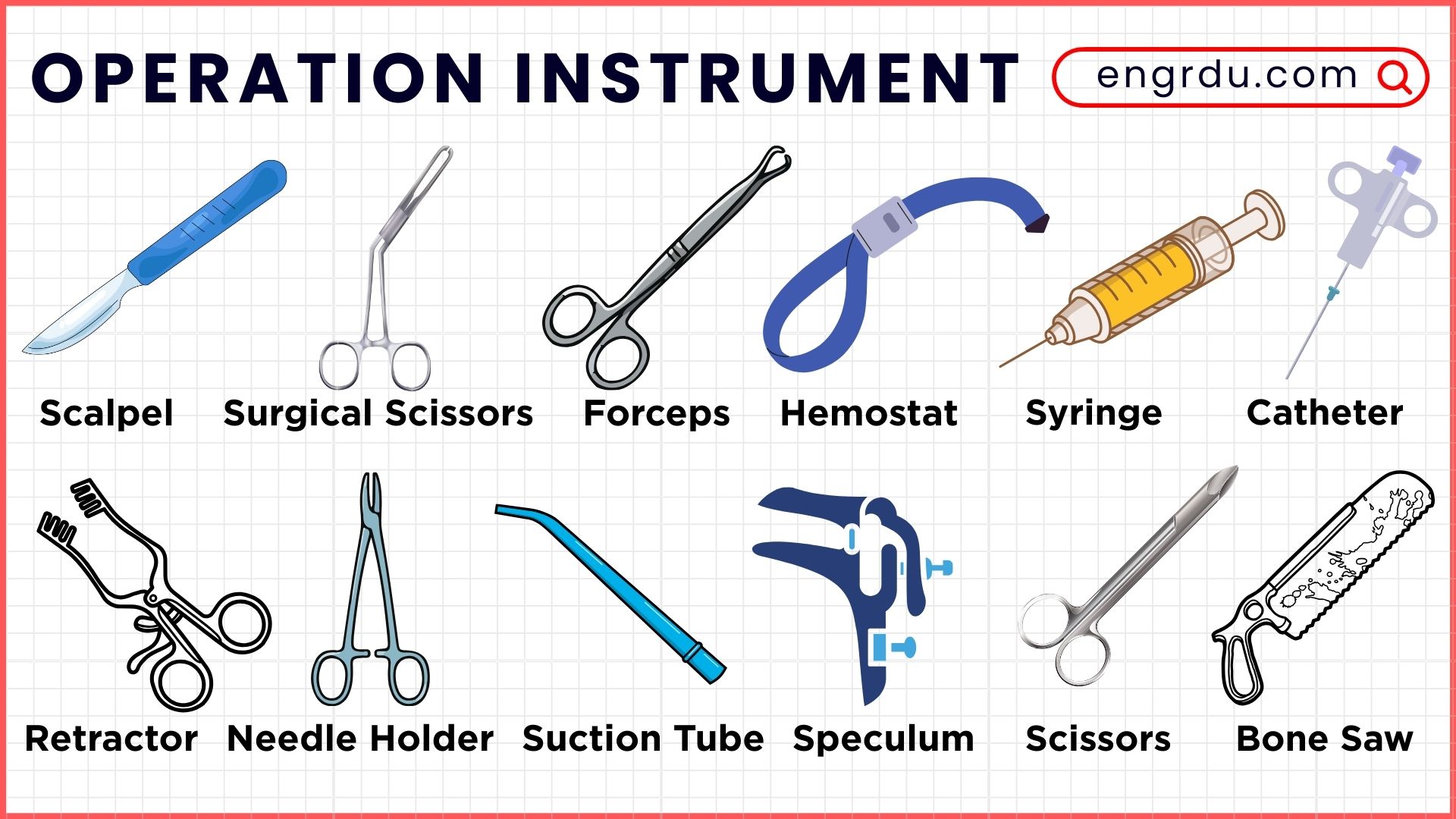
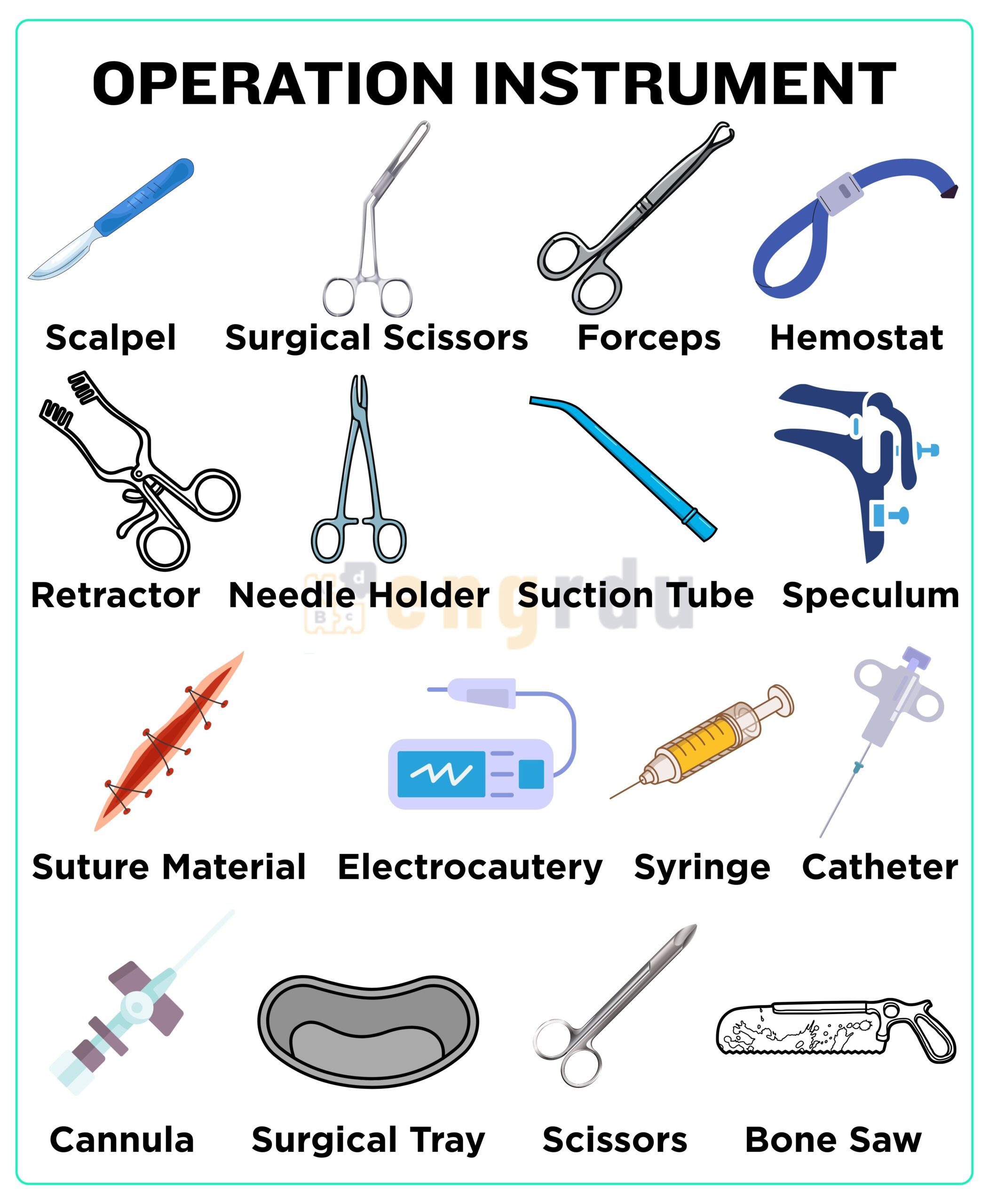
- Scalpel – A small, sharp surgical knife used to make precise cuts in skin or tissue.
- Surgical Scissors – Used to cut tissue, bandages, or sutures during surgery.
- Forceps – A tool used to hold or grasp tissue or small objects.
- Hemostat – A clamp used to stop bleeding by holding blood vessels.
- Retractor – Used to hold tissues or organs open so surgeons can see the surgical area.
- Needle Holder – Holds a surgical needle when stitching wounds.
- Suction Device – Removes blood and fluids from the surgical area.
- Speculum – Opens body cavities for examination or surgery.
- Towel Clamp – Holds surgical drapes in place during operations.
- Surgical Tray – A tray that organizes instruments during procedures.
- Bone Saw – Used to cut bones in orthopedic surgery.
- Curette – A spoon-shaped tool used to scrape tissue.
- Probe – Used to explore wounds or body cavities.
- Cannula – A thin tube inserted into the body to deliver or remove fluids.
- Catheter – A flexible tube used to drain fluids from the body.
- Electrocautery Device – Uses electricity to cut tissue or stop bleeding.
- Skin Hook – Used to lift small sections of skin during surgery.
- Dilator – Used to widen body openings during medical procedures.
- Spatula – Used to lift or move tissue gently.
- Surgical Stapler – Used to close wounds or surgical incisions quickly.
Operation Instrument Names and Pictures
Types of Operation Instruments Used in Surgery
Operating instruments are usually grouped according to their function.
Cutting Instruments
These tools cut tissue or bone.
Examples:
- Scalpel
- Surgical scissors
- Bone saw
- Osteotome
Grasping and Holding Instruments
These instruments hold tissues or objects during surgery.
Examples:
- Forceps
- Tissue forceps
- Babcock clamp
- Allis clamp
Clamping Instruments
These tools stop bleeding or control blood vessels.
Examples:
- Hemostat
- Vascular clamp
- Artery forceps
Retracting Instruments
These instruments hold tissues apart so the surgeon can see the surgical area.
Examples:
- Retractor
- Skin hook
- Self-retaining retractors
Suturing Instruments
Used to close wounds after surgery.
Examples:
- Needle holder
- Sutures
- Surgical stapler
Frequently Used Operation Instruments in Hospitals
Some operation instruments appear in almost every surgical procedure.
Common examples include:
- Scalpel
- Surgical scissors
- Forceps
- Hemostat
- Needle holder
- Retractor
- Suction tube
- Surgical stapler
These tools form the basic instrument set used in operating rooms worldwide.
Tips to Remember Operation Instrument Names
Learning medical vocabulary becomes easier with the right methods.
Use pictures
Images help learners remember instrument shapes and names.
Group instruments by function
Study cutting tools, holding tools, and suturing tools separately.
Practice using sentences
Example: The surgeon used a scalpel to make a precise cut.
Review regularly
Repeated practice helps learners remember vocabulary longer.
Conclusion
Operation instruments play an important role in medical procedures. Each tool has a specific design that helps surgeons work safely and accurately.
Learning operation instrument names and uses improves medical vocabulary and helps English learners understand healthcare topics more easily. When learners recognize these words, they can read medical texts, watch health videos, and discuss medical tools with confidence.
FAQs
What are operation instruments?
Operation instruments are medical tools that surgeons use during surgery to cut tissue, hold organs, control bleeding, and close wounds safely and accurately.
What is the most common operation instrument used in surgery?
The scalpel is one of the most common operation instruments. Surgeons use it to make precise cuts in the skin or tissue at the beginning of many surgical procedures.
What are forceps used for in an operation?
Forceps are operation instruments used to hold, grasp, or move tissue and small objects during surgery. They help surgeons work carefully without touching delicate tissue directly.
Why are retractors important operation instruments?
Retractors help hold skin, muscles, or organs away from the surgical area. This allows surgeons to see the operation site clearly and perform procedures more safely.
What is a needle holder used for in surgery?
A needle holder is an operation instrument used to hold a surgical needle while stitching tissue. It allows surgeons to place sutures accurately during wound closure.
What are surgical scissors used for during operations?
Surgical scissors cut tissue, sutures, and bandages during medical procedures. Their curved or straight designs help surgeons cut different types of tissue precisely.
What is the role of a hemostat in surgical operations?
A hemostat is a clamp used to stop bleeding by holding blood vessels tightly. It is a common operation instrument in many types of surgical procedures.
Related Articles:

Leave a Comment