
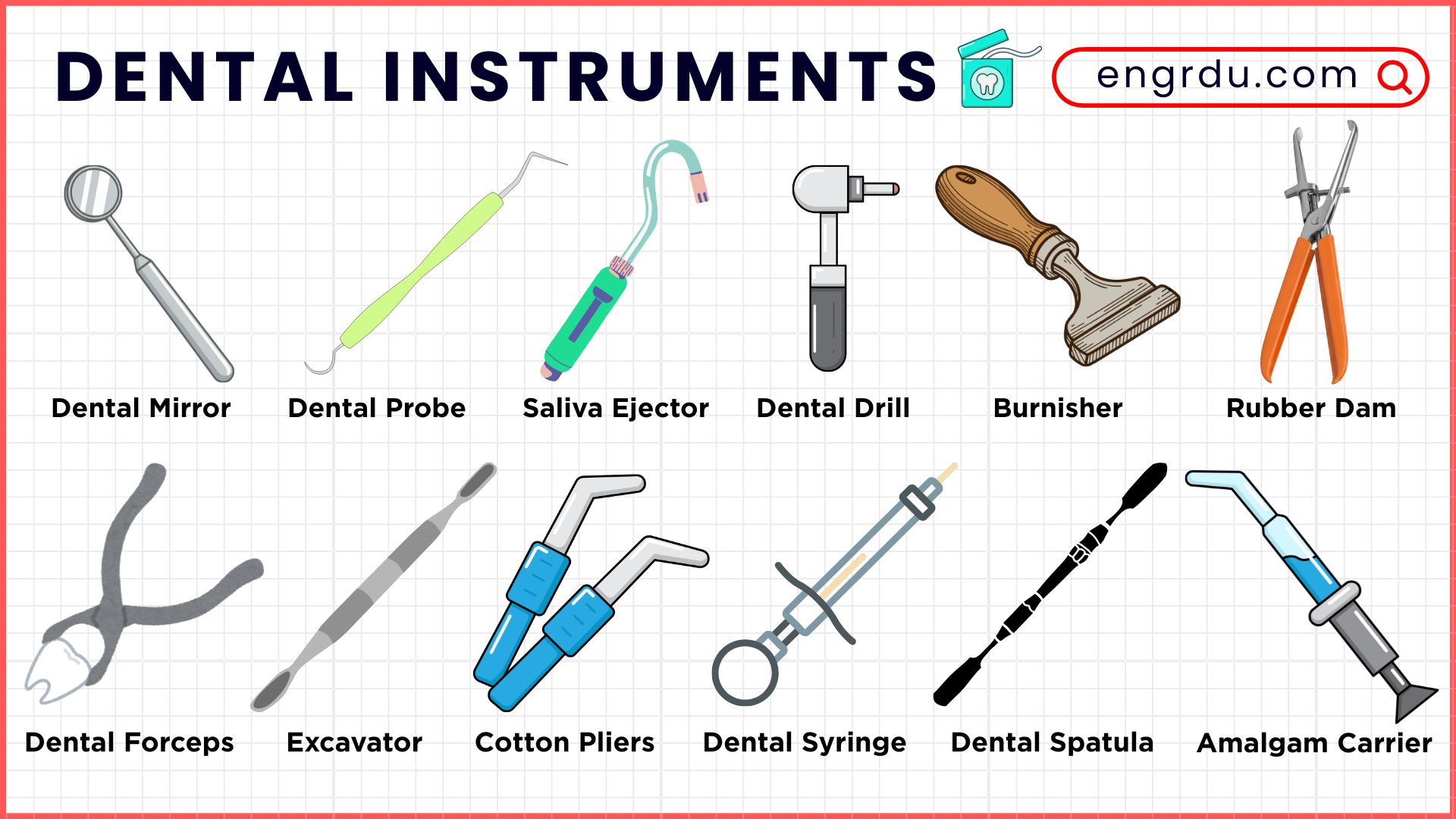

Dental instruments are specialized tools used by dentists and dental hygienists to examine teeth, clean gums, remove plaque, treat cavities, and perform different dental procedures. Common dental tools include mouth mirrors, dental probes, scalers, forceps, excavators, and suction devices. Each instrument has a specific purpose, helping dental professionals examine oral health, treat dental problems, and maintain healthy teeth and gums.
In this article, we explore over 100 dental instruments names in English with pictures and their uses. The list covers examination tools, cleaning instruments, extraction tools, restorative instruments, and other equipment used in dental clinics. We explain the basic function of each tool to help us recognize dental instruments, understand their purpose, and expand our English vocabulary related to dentistry and oral healthcare.
What Are Dental Instruments?
Dental instruments are tools dentists use to examine teeth, diagnose dental problems, clean teeth, and perform treatments. These instruments help dentists work accurately and safely inside the mouth.
Each instrument has a unique shape designed for a specific task. Some tools help dentists check teeth, while others remove plaque, repair cavities, or extract damaged teeth.
Dental instruments are sterilized carefully before each use to maintain hygiene and patient safety.
Why Learning Dental Instruments Names Is Important
Understanding dental instrument names provides several learning advantages:
- Improves medical and dental vocabulary
- Helps learners understand dental procedures
- Supports reading dental health information
- Improves speaking about oral care topics
- Helps students follow dentist instructions easily
Many English learners, dental students, and healthcare learners study these terms to communicate effectively in dental settings.
Common Dental Instruments Names and Uses
Below are important dental instruments and their functions.
- Dental Mirror – Used to view areas inside the mouth that are difficult to see directly.
- Dental Probe (Explorer) – Used to check tooth surfaces for cavities or decay.
- Scaler – Removes plaque and tartar from teeth.
- Dental Forceps – Used to hold and remove teeth during extraction.
- Dental Drill – Used to remove decayed parts of a tooth before filling.
- Dental Excavator – Removes soft decayed tooth material.
- Mouth Mirror Handle – Holds the dental mirror for examination.
- Cotton Pliers – Used to place or remove cotton during treatment.
- Dental Syringe – Injects anesthesia to numb the treatment area.
- Dental Spatula – Mixes dental materials such as filling compounds.
- Amalgam Carrier – Carries filling material to the tooth cavity.
- Burnisher – Smooths dental filling surfaces.
- Dental Tweezers – Picks up small objects inside the mouth.
- Periodontal Probe – Measures gum pocket depth around teeth.
- Saliva Ejector – Removes saliva from the mouth during treatment.
- Dental Curette – Cleans plaque under the gums.
- Cheek Retractor – Holds the cheek away from the teeth during procedures.
- Dental Elevator – Loosens teeth before extraction.
- Dental Scissors – Cuts dental materials or sutures.
- Rubber Dam Clamp – Holds rubber dam sheets used during dental treatment.

Dental Instruments Names and Uses
Dental Examination Instruments Names and Their Uses
Dental Mirror – Provides an indirect view of teeth and other areas inside the mouth.
Dental Explorer – Detects cavities, irregularities, and other surface defects on teeth.
Periodontal Probe – Measures the depth of gum pockets around teeth.
College Tweezers – Picks up and places small items such as cotton pellets inside the mouth.
Mouth Prop – Keeps the patient’s mouth open during dental procedures.
Mouth Gag – Holds the mouth open during certain dental and oral surgical procedures.
Dental Caliper – Measures distances and dimensions of teeth and oral structures.
Occlusal Paper Holder – Holds articulating paper to check tooth contacts and bite alignment.
Articulating Paper – Marks contact points between upper and lower teeth.
Dental Shade Guide – Helps select a suitable tooth color for restorations and dental prostheses.
Dental Cleaning and Preventive Instruments Names and Their Uses
Dental Scaler – Removes plaque and hardened tartar from tooth surfaces.
Sickle Scaler – Removes calculus deposits, particularly from accessible tooth surfaces.
Universal Curette – Removes calculus from above and below the gumline.
Gracey Curette – Removes subgingival calculus from specific tooth surfaces.
Ultrasonic Scaler – Removes plaque and calculus using high-frequency vibrations.
Dental Prophy Cup – Polishes teeth using a rotating rubber cup and polishing paste.
Dental Prophy Brush – Removes stains and polishes tooth surfaces.
Air Polisher – Removes stains and biofilm using a controlled stream of air, water, and polishing powder.
Dental Floss Holder – Holds dental floss to help clean between teeth.
Interdental Brush – Cleans spaces between teeth and around dental appliances.
Dental Restorative Instruments Names and Their Uses
Dental Excavator – Removes softened and decayed tooth material.
Spoon Excavator – Removes soft carious dentin from cavities.
Dental Chisel – Shapes and removes small amounts of tooth structure.
Enamel Hatchet – Cuts and shapes enamel during cavity preparation.
Dental Hoe – Smooths cavity walls and floors during restorative procedures.
Dental Condenser – Packs and compresses restorative materials into a cavity.
Amalgam Carrier – Transfers dental amalgam into a prepared cavity.
Amalgam Plugger – Condenses amalgam inside a prepared tooth cavity.
Composite Placement Instrument – Places and shapes composite resin during tooth restoration.
Composite Spatula – Mixes or handles restorative materials.
Ball Burnisher – Smooths and shapes restorative materials.
Acorn Burnisher – Shapes and smooths restorative materials during dental fillings.
Carver – Shapes and removes excess restorative material.
Hollenback Carver – Shapes and removes excess restorative material, particularly around restoration margins.
Interproximal Carver – Shapes restorative material between adjacent teeth.
Matrix Band – Forms a temporary wall around a tooth during restorative procedures.
Tofflemire Matrix Retainer – Holds a matrix band around a tooth.
Wedge – Separates adjacent teeth slightly and helps adapt a matrix band.
Composite Finishing Bur – Smooths and refines the surface of composite restorations.
Dental Finishing Strip – Finishes and polishes restoration surfaces between adjacent teeth.
Dental Extraction and Oral Surgery Instruments Names and Their Uses
Extraction Forceps – Grips and removes teeth during extraction.
Upper Universal Forceps – Extracts many types of upper teeth.
Lower Universal Forceps – Extracts many types of lower teeth.
Root Forceps – Grips and removes retained tooth roots.
Dental Elevator – Loosens teeth and roots before extraction.
Straight Elevator – Loosens teeth or roots using a straight working end.
Cryer Elevator – Helps remove retained roots and tooth fragments, especially in molar extraction.
Periosteal Elevator – Separates the gum tissue and periosteum from underlying bone.
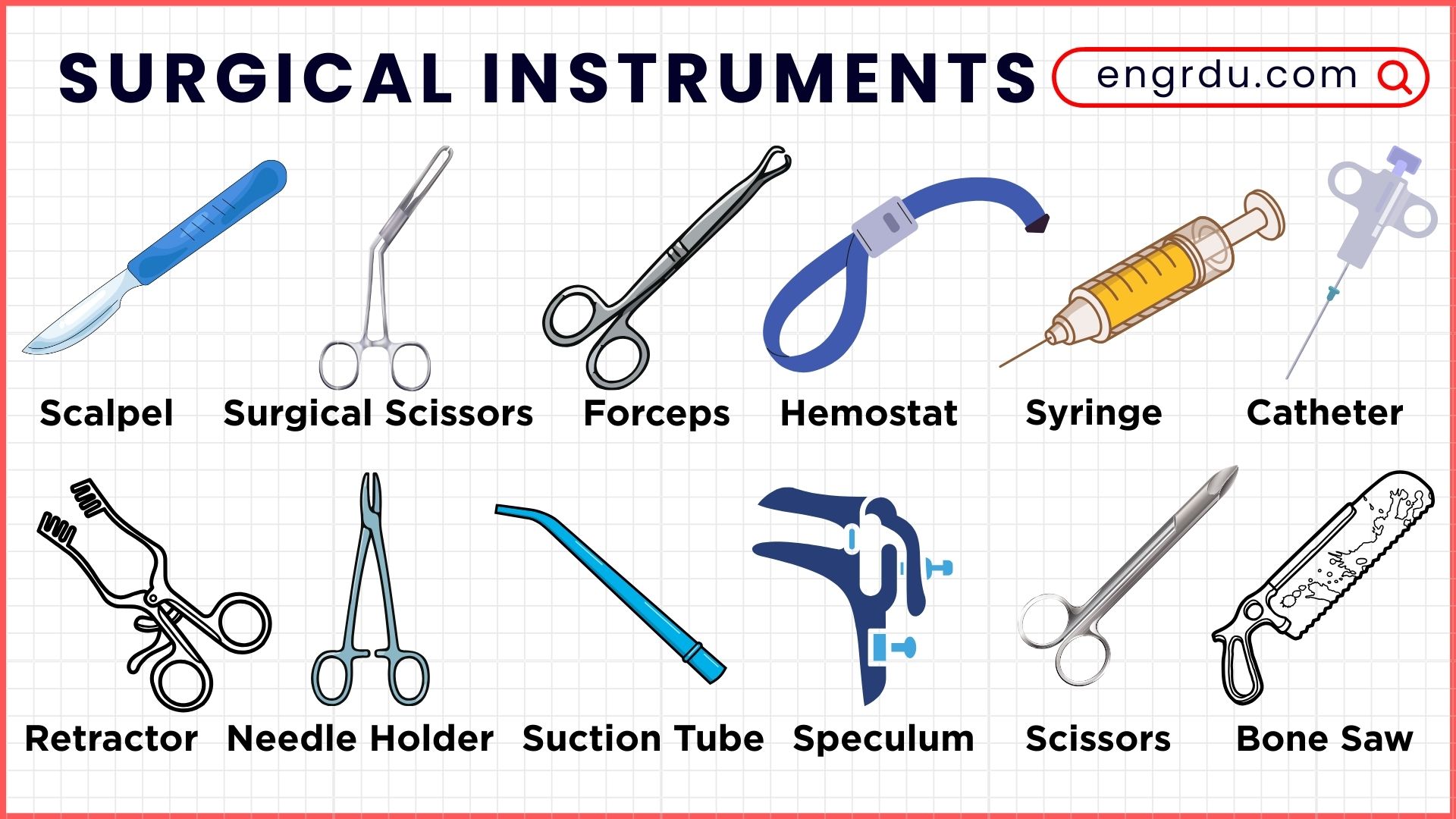
Surgical Scalpel – Makes precise incisions in oral soft tissues.
Surgical Blade Holder – Holds a surgical blade during oral surgery.
Hemostat – Grasps blood vessels or small tissues during surgical procedures.
Tissue Forceps – Holds and handles soft tissues during surgery.
Surgical Scissors – Cuts soft tissues, sutures, and other materials.
Bone Rongeurs – Removes or trims small amounts of bone.
Bone File – Smooths rough bone edges after surgery.
Surgical Curette – Removes unwanted tissue or debris from a surgical site.
Bone Chisel – Cuts or reshapes bone during oral surgery.
Surgical Retractor – Holds back soft tissues to improve visibility during surgery.
Needle Holder – Holds a surgical needle during suturing.
Suture Scissors – Cuts sutures during or after oral surgery.
Endodontic Instruments Names and Their Uses
Endodontic Explorer – Locates root canal openings and examines tooth surfaces during root canal treatment.
Endodontic File – Cleans and shapes root canals.
K-File – Cleans and shapes root canals using a flexible, twisted metal instrument.
H-File (Hedström File) – Removes dentin and shapes root canals using its cutting flutes.
Reamer – Enlarges and shapes root canals by cutting dentin.
Barbed Broach – Removes pulp tissue from root canals.
Gates-Glidden Drill – Enlarges the coronal portion of root canals.
Peeso Reamer – Enlarges root canals and prepares spaces for certain post restorations.
Endodontic Spreader – Creates space and laterally compacts gutta-percha during root canal filling.
Endodontic Plugger – Vertically compacts gutta-percha inside root canals.
Gutta-Percha Point – Fills and seals prepared root canals.
Paper Point – Dries root canals after irrigation.
Irrigation Syringe – Delivers irrigating solutions into root canals.
Apex Locator – Determines the working length of a root canal by locating the root apex electronically.
Endodontic Ruler – Measures and adjusts the working length of endodontic instruments.
Orthodontic Instruments Names and Their Uses
Orthodontic Pliers – Grips, bends, and adjusts orthodontic wires and appliances.
Bird Beak Pliers – Bends and shapes orthodontic wires.
Weingart Pliers – Places and removes archwires from orthodontic brackets.
Distal End Cutter – Cuts the distal ends of orthodontic archwires.
Ligature Cutter – Cuts orthodontic ligature wires.
Bracket Removing Pliers – Removes orthodontic brackets from teeth.
Band Removing Pliers – Removes orthodontic bands from teeth.
Band Seater – Helps position orthodontic bands around teeth.
Bracket Positioning Gauge – Helps position orthodontic brackets at the correct height.
Mathieu Needle Holder – Holds and handles small orthodontic ligatures during placement.
Prosthodontic and Dental Laboratory Instruments Names and Their Uses
Dental Impression Tray – Holds impression material while recording the shape of teeth and oral tissues.
Alginate Mixing Bowl – Holds alginate impression material during mixing.
Alginate Spatula – Mixes alginate impression material.
Dental Wax Knife – Cuts and shapes dental wax.
Dental Wax Spatula – Applies and shapes wax during dental laboratory procedures.
Dental Articulator – Simulates the movements and relationship of the upper and lower jaws.
Dental Surveyor – Evaluates the parallelism of surfaces on dental casts during removable partial denture design.
Dental Flask – Holds a denture and its mold during processing.
Dental Vibrator – Helps remove air bubbles when pouring dental stone or plaster into impressions.
Dental Laboratory Handpiece – Rotates burs and polishing tools for shaping dental laboratory materials.
Dental Instruments for Anesthesia, Imaging, and Sterilization
Dental Syringe (Aspirating Syringe) – Administers local anesthetic during dental procedures.
Dental Anesthetic Needle – Delivers local anesthetic into the required oral tissue.
Dental X-ray Sensor – Captures digital images of teeth and surrounding structures.
Dental Autoclave – Sterilizes reusable dental instruments using pressurized steam.
Dental Ultrasonic Cleaner – Removes debris from dental instruments using high-frequency sound waves before sterilization.
Tips to Remember Dental Instrument Names
Learning dental vocabulary becomes easier with these techniques.
Study with images
Looking at pictures helps learners connect names with instrument shapes.
Group instruments by function
Study diagnostic tools, cleaning tools, and extraction tools separately.
Practice using sentences
Example: The dentist used a dental mirror to examine the back teeth.
Review regularly
Frequent review helps learners remember vocabulary longer.
FAQs about Dental Instruments
What are dental instruments?
Dental instruments are special tools that dentists use to examine, clean, and treat teeth and gums. These tools help dentists perform dental procedures safely and accurately.
What is the most common dental instrument used by dentists?
The dental mirror is one of the most common dental instruments. Dentists use it to see inside the mouth and check areas that are difficult to view directly.
What is a dental scaler used for?
A dental scaler is used to remove plaque and tartar from the surface of teeth. Dentists use it during professional teeth cleaning to maintain oral health.
What are dental forceps used for?
Dental forceps are instruments used to hold and remove teeth during tooth extraction. Dentists carefully grip the tooth to remove it safely from the socket.
Why is a dental probe important in dentistry?
A dental probe helps dentists check teeth for cavities and gum problems. It allows them to detect early signs of tooth decay and gum disease.
What is the function of a saliva ejector in dental treatment?
A saliva ejector removes saliva and fluids from the mouth during dental procedures. This helps keep the treatment area dry and easier for the dentist to work.
What instruments are commonly used during a dental check-up?
During a dental check-up, dentists usually use instruments such as a dental mirror, dental probe, scaler, and saliva ejector to examine and clean teeth.
Related Articles:
Conclusion
Dental instruments play an important role in oral healthcare. Dentists rely on these tools to examine teeth, clean plaque, repair cavities, and treat dental problems.
Learning dental instruments names and uses helps English learners improve dental vocabulary and understand dental procedures better. When learners recognize these words, they can read dental health materials, follow dentist instructions, and discuss oral care topics confidently.

Leave a Comment