


Understanding the Present Perfect and Past Simple tenses helps you talk about past actions clearly and accurately. In this Grammar lesson, learning the differences between these tenses improves your speaking, writing, and reading skills. Using them correctly makes your sentences precise and easy to understand. In this blog post, you will explore present perfect vs past simple with examples to practice and use confidently in English.
Present Perfect vs Past Simple
Past Simple
The past simple is used to talk about finished actions in the past. The time is known, mentioned, or understood.
Example:
- I visited Paris in 2019.
Read more about: Past Simple Tense with Chart
Present Perfect
The present perfect is used to talk about past actions that are connected to the present. The exact time is not important or not mentioned.
Example:
- I have visited Paris.
A helpful way to remember this:
- Past simple = finished time
- Present perfect = experience or result now
Read More about: Present Perfect Tense Structure and Examples
Forms of Present Perfect vs Past Simple
Both tenses have affirmative, negative, and question forms.
Past Simple Forms
Affirmative
- Subject + past verb
- She finished her homework.
Negative
- Subject + did not + base verb
- She did not finish her homework.
Question
- Did + subject + base verb?
- Did she finish her homework?
Present Perfect Forms
Affirmative
- Subject + have / has + past participle
- She has finished her homework.
Negative
- Subject + have / has not + past participle
- She has not finished her homework.
Question
- Have / Has + subject + past participle?
- Has she finished her homework?
Rules/Usage of Present Perfect vs Past Simple
This is the most important section. Read it slowly and carefully.
When to Use the Past Simple
Use the past simple when:
1. The time is finished and known
- yesterday, last week, in 2020, two days ago
- I met my teacher yesterday.
2. The action is completely finished
- They watched the film and went home.
3. You tell a story or sequence of past events
- He woke up, had breakfast, and left the house.
Tip:
If you can answer “When?” easily, use the past simple.
When to Use the Present Perfect
Use the present perfect when:
1. The time is not mentioned or not important
- I have read that book.
2. The action has a result now
- She has lost her keys. (She cannot find them now.)
3. You talk about life experience
- We have travelled to Spain.
4. The action started in the past and continues now
- I have lived here for five years.
5. With unfinished time expressions
- today, this week, this year
- I have studied a lot this week.
Tip:
If the past action is connected to now, use the present perfect.
Examples of Present Perfect vs Past Simple
Past Simple
- I bought this phone last month.
- They didn’t understand the question.
- Did you see the news yesterday?
Present Perfect
- I have bought a new phone.
- They haven’t understood the question yet.
- Have you seen the news?
Words Often Used in both Tenses
Past Simple
- yesterday
- last night
- in 2018
- ago
Present Perfect
- ever
- never
- already
- yet
- just
- for/since
Common Mistakes
Many learners make the same mistakes. Let’s fix them.
Mistake 1: Using present perfect with finished time
❌ I have visited London last year.
✔ I visited London last year.
Why?
“Last year” is finished time.
Mistake 2: Using past simple without time
❌ I went to Italy. (when is unclear)
✔ I have been to Italy.
Why?
If time is not important, use present perfect.
Mistake 3: Confusing “been” and “gone”
- She has been to Paris. (She returned.)
- She has gone to Paris. (She is there now.)
Common Past Participles Used to Contrast
Present Perfect vs Past Simple
| Base Verb | Past Simple | Past Participle |
|---|---|---|
| go | went | gone |
| be | was / were | been |
| see | saw | seen |
| do | did | done |
| eat | ate | eaten |
| take | took | taken |
| make | made | made |
| give | gave | given |
| write | wrote | written |
| buy | bought | bought |
| lose | lost | lost |
| find | found | found |
| finish | finished | finished |
| break | broke | broken |
| choose | chose | chosen |
Example Sentences:
| Examples of Past Simple | Examples of Present Perfect |
|---|---|
| I went home at 6 pm. | I have gone home. |
| She was tired yesterday. | She has been tired all day. |
| I saw him last night. | I have seen him before. |
| They did the test yesterday. | They have done the test. |
| We ate lunch at noon. | We have eaten already. |
| He took the bus this morning. | He has taken the bus many times. |
| She made a cake yesterday. | She has made a cake. |
| He gave me the book last week. | He has given me the book. |
| I wrote the email yesterday. | I have written the email. |
| I bought a phone last year. | I have bought a new phone. |
| She lost her keys yesterday. | She has lost her keys. |
| They found the place easily. | They have found the answer. |
| He finished work at 5 pm. | He has finished work. |
| He broke his arm last year. | He has broken his arm. |
| She chose the red dress. | She has chosen the red dress. |
Comparison: Present Perfect vs Past Simple
| Feature | Past Simple | Present Perfect |
|---|---|---|
| Time mentioned | Yes | No |
| Finished time | Yes | No |
| Connection to now | No | Yes |
| Common words | yesterday, ago | ever, already |
| Example | I saw him yesterday. | I have seen him. |
Tips for Learners
- Ask yourself: Is the time finished?
- Look for time words in the sentence.
- Practise with daily life examples.
- Listen to real English conversations.
- Keep a list of common past participles.
Small steps help you improve faster.

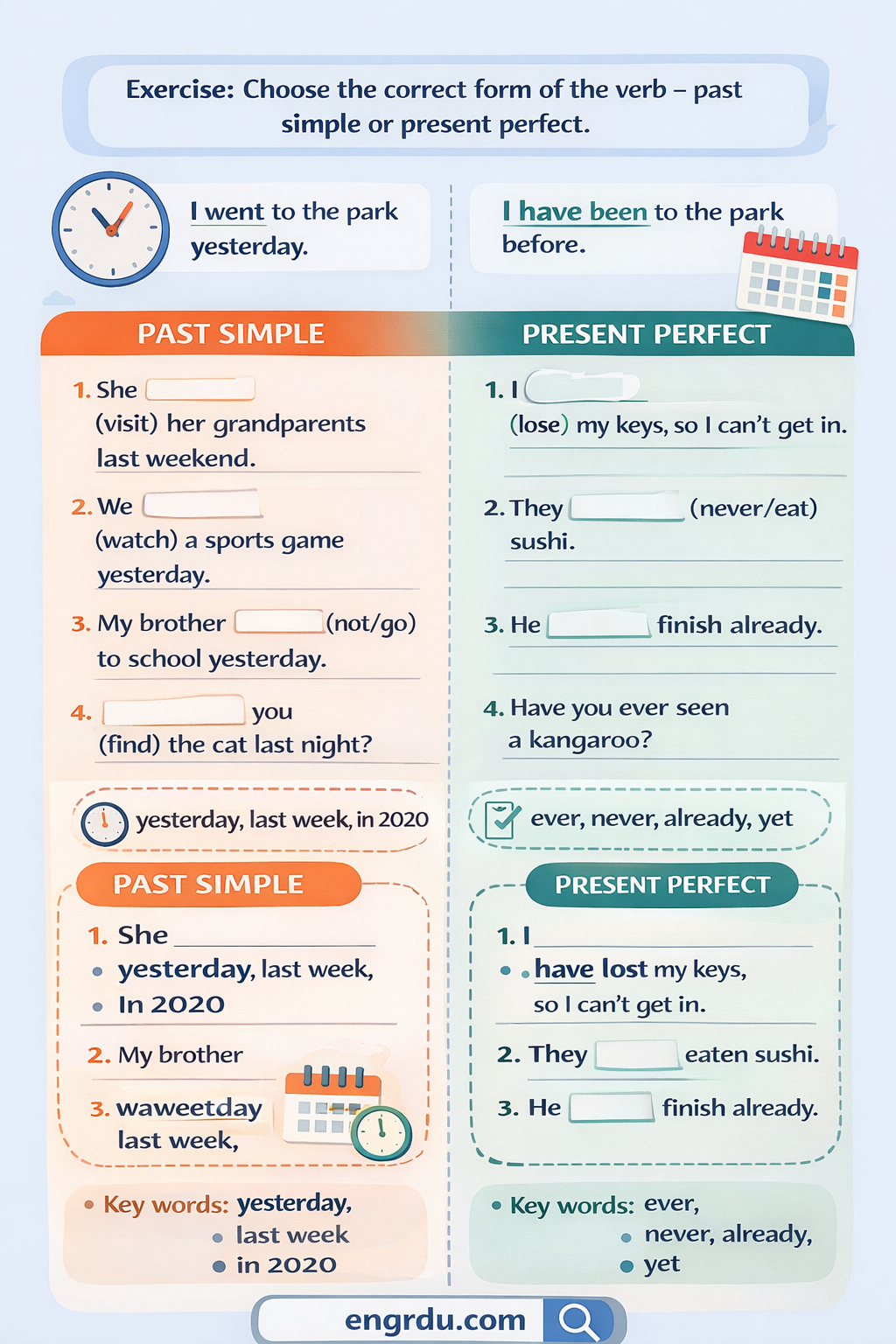
Present Perfect vs Past Simple
Present Perfect vs Past Simple Exercises
Exercise 1: Choose the Correct Tense
Instructions:
Choose the correct form of the verb. Use past simple or present perfect.
- I __________ (finish) my homework already.
- She __________ (visit) her grandparents last weekend.
- We __________ (never / try) Indian food before.
- They __________ (watch) a movie yesterday evening.
- He __________ (lose) his wallet, so he can’t pay now.
- __________ you ever __________ (see) snow?
- I __________ (buy) this jacket two years ago.
- The teacher __________ (not / check) our tests yet.
Answers – Exercise 1
- have finished
- visited
- have never tried
- watched
- has lost
- Have you ever seen
- bought
- has not checked
Exercise 2: Complete the Sentences
Instructions:
Complete each sentence using the correct tense of the verb in brackets.
- My brother __________ (go) to school at 8 a.m. today.
- I __________ (be) to London three times.
- She __________ (not / eat) breakfast this morning yet.
- We __________ (meet) our new neighbour last night.
- They __________ (live) in this city since 2015.
- __________ you __________ (finish) the report yesterday?
- The bus __________ (arrive) ten minutes ago.
- He __________ (just / clean) his room.
Answers – Exercise 2
- went
- have been
- has not eaten
- met
- have lived
- Did you finish
- arrived
- has just cleaned
Present Perfect vs Past Simple Exercises
Conclusion
The past simple and present perfect both talk about the past, but they have different jobs.
✔ Use the past simple for finished actions with known time.
✔ Use the present perfect for experiences, results, and actions connected to now.
The best way to learn is practice. Try to use both tenses when you speak, write, and read English every day.
Frequently Asked Questions
What is the main difference between the present perfect and the past simple?
The past simple is used for finished actions at a specific time in the past, while the present perfect is used for past actions that are connected to the present or when the time is not mentioned.
When should I use the past simple instead of the present perfect?
Use the past simple when the time is finished and known, such as yesterday, last year, or in 2021. If you can say exactly when something happened, the past simple is usually correct.
When do we use the present perfect in English?
The present perfect is used to talk about life experiences, recent actions with results now, actions that started in the past and continue to the present, or when the exact time is not important.
Can I use the present perfect with words like yesterday or last week?
No. Words like yesterday, last week, last night, and ago are finished time expressions, so they must be used with the past simple, not the present perfect.
What is the structure of the present perfect tense?
The structure is subject + have/has + past participle. For example: She has finished her homework.
What is the structure of the past simple tense?
The structure is subject + past verb. For regular verbs, add -ed. For irregular verbs, use the second form. For example: They went home early.
Why do learners often confuse present perfect and past simple?
Learners often confuse them because both tenses talk about the past. The key difference is whether the time is finished or whether the action has a connection to the present.
Read More




Leave a Comment