Understanding the Future Perfect Continuous Tense helps you describe actions that will be ongoing up to a specific time in the future. In this Grammar lesson, learning this tense improves your speaking, writing, and reading skills. Using it correctly makes your sentences precise and detailed when talking about future events. In this blog post, you will explore the uses and examples of the future perfect continuous tense to practice and use confidently in English.
To read more about the 12 tenses in one place, visit our 12 Tenses Chart.
What is the Future Perfect Continuous Tense?
The Future Perfect Continuous Tense expresses an action that will continue up to a certain time in the future. It focuses on the duration of the activity.
- Structure: Subject + will + have + been + verb(-ing)
- Example: By next year, I will have been learning English for five years.
Here, the tense shows that the learning started in the past, continues in the present, and will still be ongoing until a specific future time.
Forms of Future Perfect Continuous Tense
The Future Perfect Continuous Tense can be used in three main forms: affirmative, negative, and question.
1. Affirmative
Shows that the action will continue up to a point in the future.
- Structure: Subject + will + have + been + verb(-ing)
- Example: She will have been working here for ten years by 2026.
2. Negative
Shows that the action will not continue up to a future point.
- Structure: Subject + will + not + have + been + verb(-ing)
- Example: He will not have been studying for long by the time you arrive.
3. Question
Used to ask about the duration of an ongoing future action.
- Structure: Will + subject + have + been + verb(-ing)?
- Example: Will you have been waiting long when the train arrives?
Usage
Understanding the rules of this tense helps you use it correctly.
1. Focus on Duration
Use this tense when you want to emphasise how long an activity will continue.
Example: By noon, we will have been walking for three hours.
2. Mention a Future Time
Always connect it with a specific future time or event.
Example: By 2025, I will have been living in London for five years.
3. Combine with “for” or “since”
For: Shows duration in time.
I will have been teaching here for seven years by June.
Since: Shows the starting point of the action.
She will have been studying English since 2018.
4. Use with Continuous Actions
Only use with actions that are continuous, not one-time events.
- Correct: By next month, they will have been building the bridge for two years.
- Incorrect: By next month, they will have been opening the shop.
5. Time Expressions
Common expressions used: by the time, for, since, before, until, by next year.
Example: By the time you come back, I will have been working all day
Examples of Future Perfect Continuous Tense
Affirmative Sentences
- By tomorrow, I will have been studying for five hours.
- She will have been practising the piano for ten years by 2026.
- They will have been travelling around Europe for two months by June.
Negative Sentences
- I will not have been waiting long when you arrive.
- He will not have been exercising enough by the time of the competition.
- We will not have been using this software for more than a year by December.
Question Sentences
- Will you have been working here long when the manager returns?
- Will she have been learning French for three years by 2025?
- Will they have been staying at the hotel for a week by Friday?
Common Mistakes
Learners often make these mistakes with this tense:
Using simple future instead of continuous future perfect
- Incorrect: By next year, I will study English for five years.
- Correct: By next year, I will have been studying English for five years.
Omitting “been”
- Incorrect: I will have studying for three hours by noon.
- Correct: I will have been studying for three hours by noon.
Using it for short, completed actions
- Incorrect: By evening, I will have been writing a letter.
- Correct: By evening, I will have been writing letters for two hours.
Wrong placement of time expressions
- Incorrect: I will have been studying five hours by tomorrow.
- Correct: By tomorrow, I will have been studying for five hours.
Comparison with Future Perfect Tense
This tense is often confused with Future Perfect Tense. Here’s a simple comparison:
| Feature | Future Perfect | Future Perfect Continuous |
|---|---|---|
| Focus | Completion of action | Duration of action |
| Structure | will + have + past participle | will + have + been + verb(-ing) |
| Example | By 5 pm, I will have finished my homework. | By 5 pm, I will have been doing my homework for two hours. |
Notice how the continuous version emphasises the process, not just the completion.
Exercise of Future Perfect Continuous Tense
Fill in the blanks
Complete the sentences using the Future Perfect Continuous Tense.
- By next week, she __________ (study) at this university for three years.
- We __________ (work) on this project for ten hours by the time the manager arrives.
- He __________ (learn) French for two years by the end of this course.
- By tomorrow, I __________ (wait) for you at the station for over an hour.
- They __________ (travel) around Europe for a month by the time they return home.
Answers:
- will have been studying
- will have been working
- will have been learning
- will have been waiting
- will have been travelling
Rewrite the sentences
Rewrite the following sentences in the Future Perfect Continuous Tense.
- She starts teaching at this school in 2018. By 2025, she teaches here.
- I start reading this book at 2 pm. At 6 pm, I read.
- They start building the bridge in January. By July, they build.
- He starts practising the guitar in 2020. By 2025, he practises.
- We start working on the assignment at 9 am. By 3 pm, we work.
Answers:
- By 2025, she will have been teaching at this school for seven years.
- By 6 pm, I will have been reading this book for four hours.
- By July, they will have been building the bridge for six months.
- By 2025, he will have been practising the guitar for five years.
- By 3 pm, we will have been working on the assignment for six hours.
Tips for Learners
- Think about duration: Use it only when the action lasts over a period of time.
- Use time markers: Words like by, for, since make your sentence clear.
- Practice with real-life situations: Imagine your daily tasks and express them in this tense.
- Compare with similar tenses: This helps avoid confusion with future perfect or future continuous.
- Listen and read: Pay attention to how native speakers describe ongoing future actions.
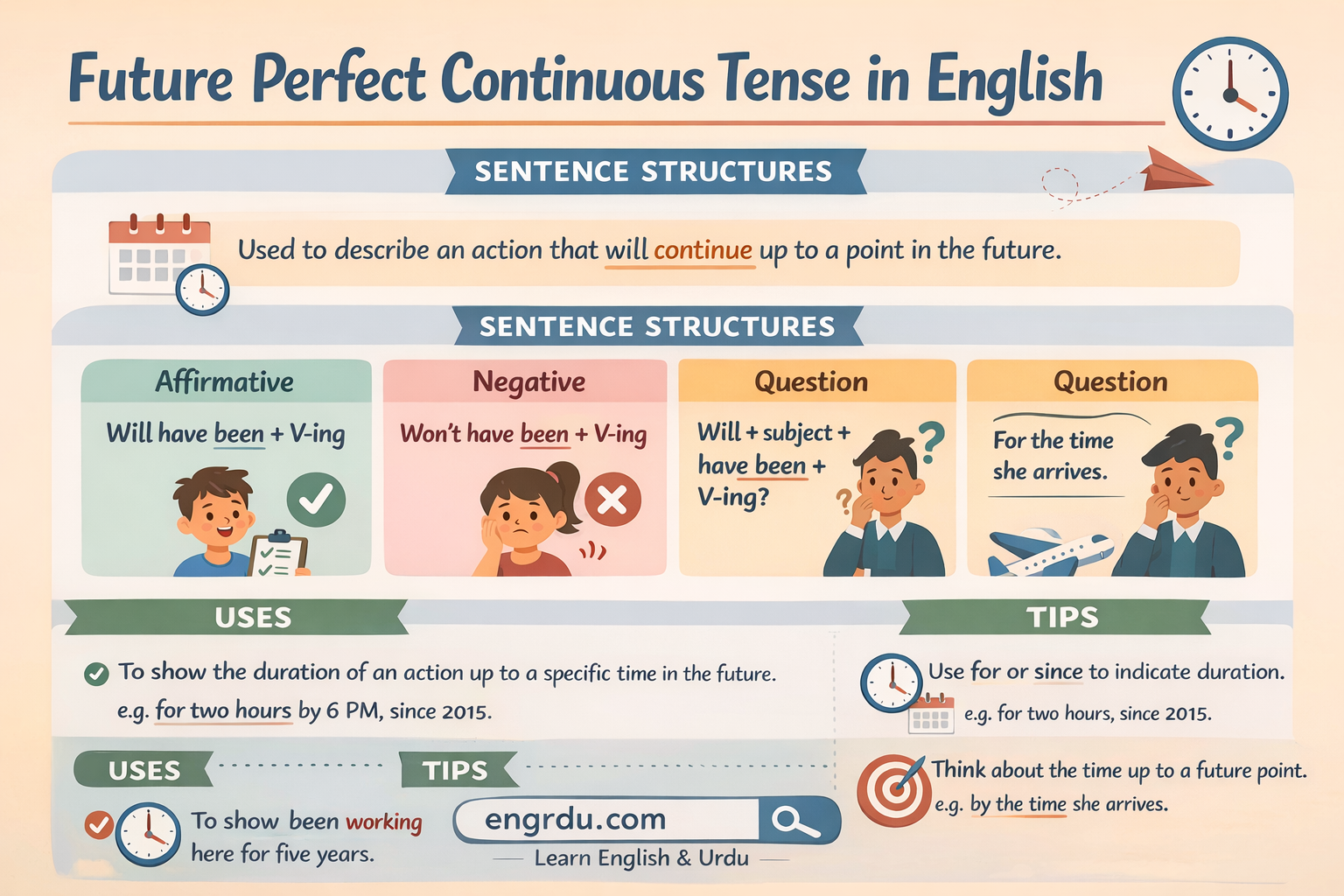
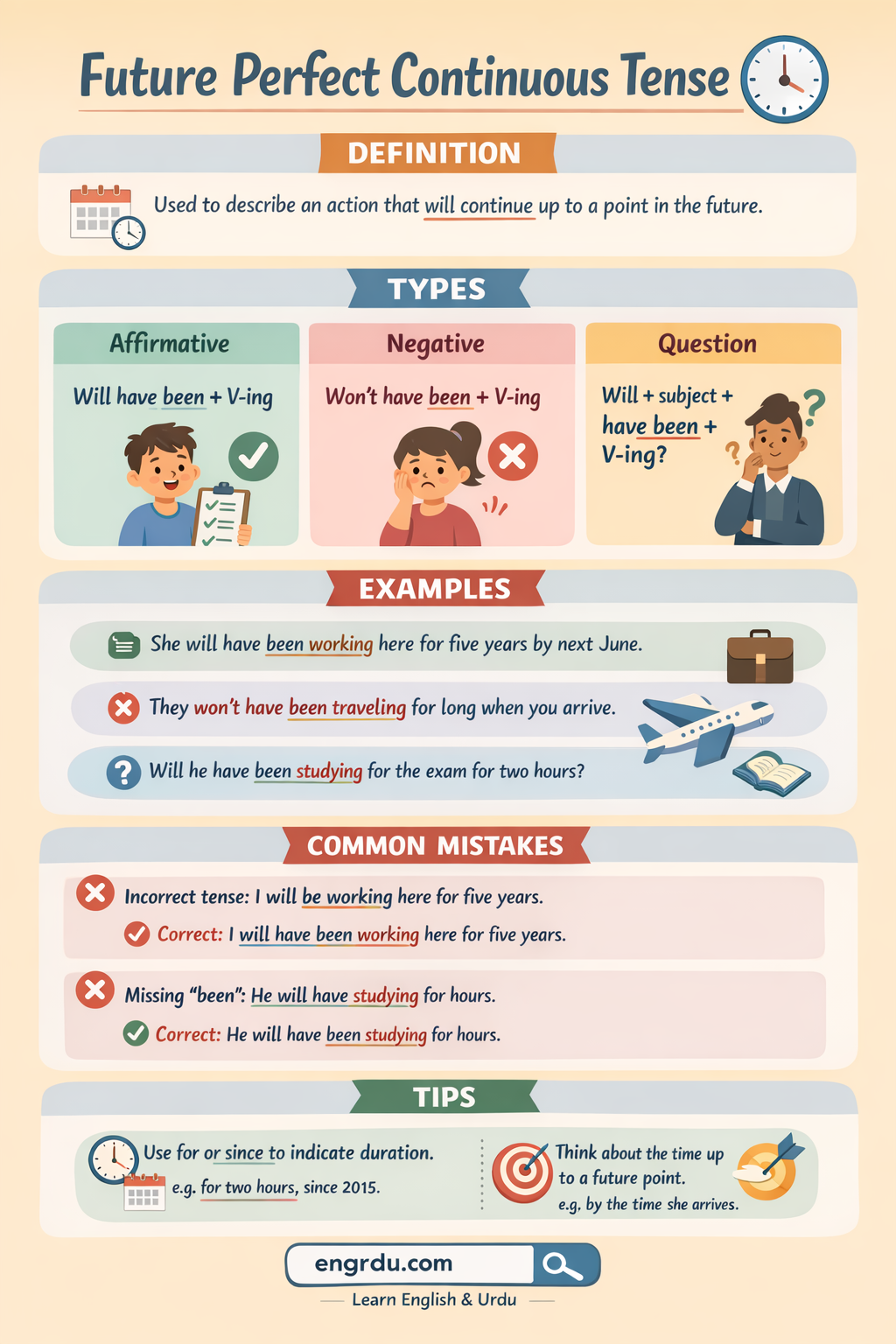
Future Perfect Continuous Tense Infographic
Conclusion
The Future Perfect Continuous Tense helps you express how long an action will have been happening at a certain point in the future. It is formed using will + have + been + verb(-ing). Remember to use it with continuous actions, include time expressions, and focus on duration. Avoid common mistakes like omitting “been” or confusing it with future perfect.
Frequently Asked Questions
What is the Future Perfect Continuous Tense?
The Future Perfect Continuous Tense describes actions that will continue up to a specific time in the future, focusing on the duration of the activity.
How is the Future Perfect Continuous Tense formed?
It is formed using will + have + been + verb(-ing). Example: By next month, I will have been studying English for five years.
When should I use the Future Perfect Continuous Tense?
Use it to show how long an action will have been happening by a certain future time or event.
Can the Future Perfect Continuous Tense be used for negative sentences?
Yes. Use will not have been + verb(-ing). Example: He will not have been working long by the time you arrive.
How do I form questions in the Future Perfect Continuous Tense?
Place will before the subject: Will + subject + have + been + verb(-ing)? Example: Will you have been waiting long when the train comes?
What are common time expressions used with the Future Perfect Continuous Tense?
Common expressions include by the time, for, since, before, until, by next year.
What is the difference between Future Perfect and Future Perfect Continuous Tense?
Future Perfect focuses on completion of an action. Future Perfect Continuous focuses on the duration of the action. Example: Future Perfect: I will have finished the work. Future Perfect Continuous: I will have been working for three hours.
Read More