
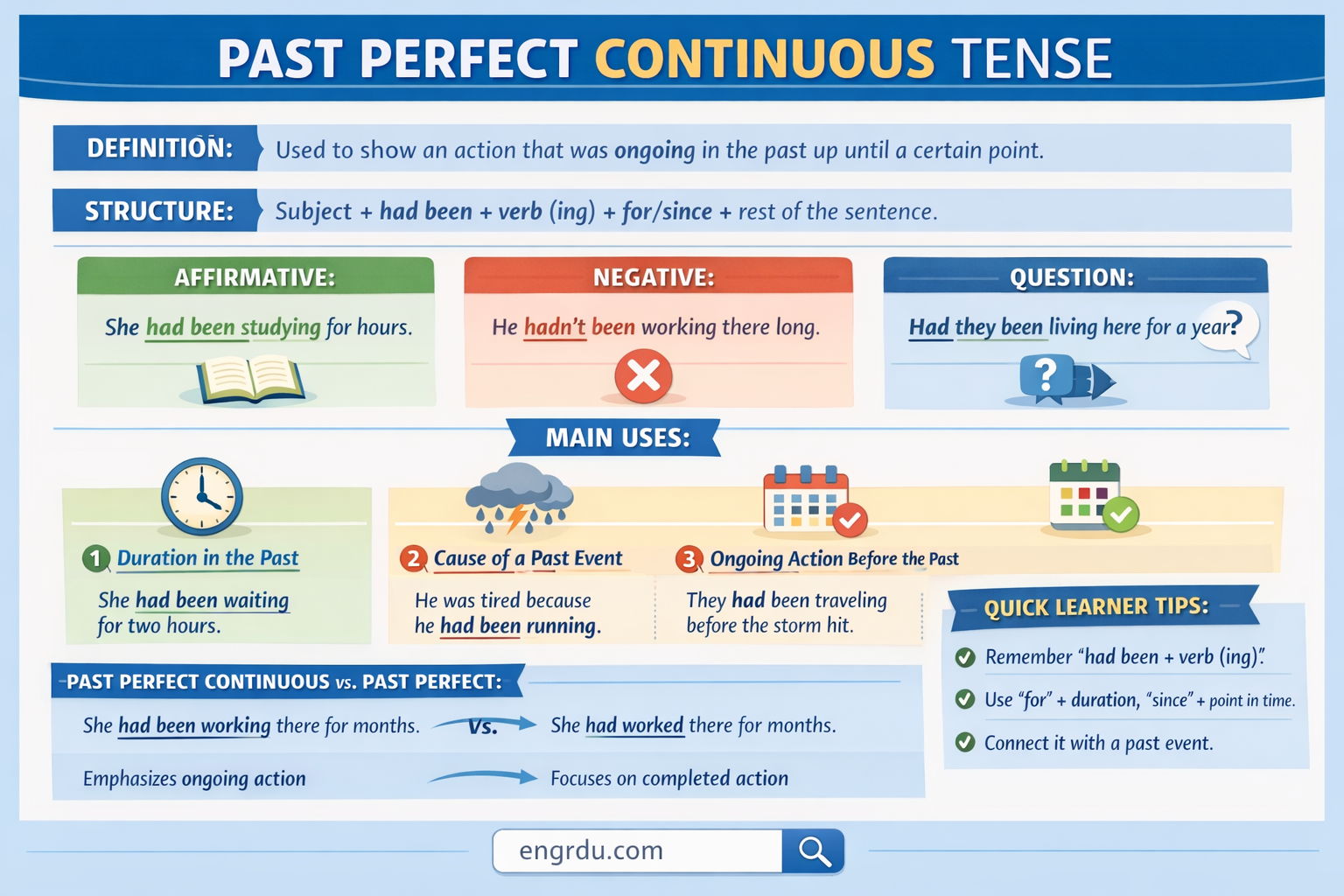

The Past Perfect Continuous Tense is used to show actions that were ongoing over a period of time before another action in the past. In this Grammar lesson, learning this tense helps you write, speak, and understand English more accurately. Using it correctly makes your sentences detailed and precise when describing past events. In this blog post, you will learn the past perfect continuous tense with a chart and examples to practice and use confidently in English.
To read more about the 12 tenses in one place, visit our 12 Tenses Chart.
What is the Past Perfect Continuous Tense?
The Past Perfect Continuous Tense is used to describe an action that started in the past, continued for a period of time, and ended before another past action or time.
It focuses on how long an activity was happening before something else occurred.
Simple definition:
We use the Past Perfect Continuous Tense to show that an action had been continuing before another action happened in the past.
Example:
- She had been studying for two hours before the exam started.
Forms of the Past Perfect Continuous Tense
The Past Perfect Continuous Tense has three main sentence forms.
1. Affirmative (Positive) Sentences
These sentences state that something was happening before another past action.
Structure:
Subject + had been + verb-ing + object
Examples:
- I had been waiting for the bus for thirty minutes.
- They had been living in London before they moved to Paris.
2. Negative Sentences
These sentences say that an action was not happening continuously before another past event.
Structure:
Subject + had not been (hadn’t been) + verb-ing + object
Examples:
- She had not been sleeping well before the interview.
- We hadn’t been using the computer for long.
3. Interrogative (Question) Sentences
These sentences ask whether an action had been continuing in the past.
Structure:
Had + subject + been + verb-ing + object?
Examples:
- Had you been working there for many years?
- Had they been travelling all night?
Usage of the Past Perfect Continuous Tense
Understanding when to use this tense is more important than memorising rules.
To Show Duration Before Another Past Action
Use this tense to show how long something was happening before another action.
Examples:
- He had been playing football for an hour before it started raining.
- She had been teaching at that school before she changed her job.
To Explain the Cause of a Past Result
Sometimes we use it to explain why something happened in the past.
Examples:
- He was tired because he had been running all morning.
- The road was wet because it had been raining.
With Time Expressions
Common time expressions used with this tense include:
for, since, all day, all night, for hours, before, until
Examples:
- They had been talking for hours before the teacher arrived.
- I had been waiting since morning.
Use “Had Been” for All Subjects
Unlike some other tenses, “had been” is the same for all subjects.
✔ I had been
✔ He had been
✔ They had been
This makes the tense easier to remember.
Helpful Learning Tips
- Focus on two past actions: one longer, one shorter.
- Ask yourself: Was the action continuing before something else happened?
- Do not forget verb-ing after “been”.
Examples in Real-Life Situations
Daily Life
- She had been cooking dinner before the guests arrived.
- We had been cleaning the house all day.
School and Study
- The students had been revising their lessons before the test.
- I had been reading the book before the bell rang.
Work and Office
- He had been working late before showing signs of stress.
- They had been discussing the project before the meeting ended.
Affirmative, Negative, and Question Examples Together
- Affirmative: She had been practising piano for months.
- Negative: She had not been practising piano for months.
- Question: Had she been practising piano for months?
Common Mistakes and How to Avoid Them
1. Using Past Continuous Instead of Past Perfect Continuous
❌ She was studying for two hours before dinner.
✔ She had been studying for two hours before dinner.
Tip:
Use Past Perfect Continuous when two past actions are involved.
2. Forgetting “Been”
❌ He had working all day.
✔ He had been working all day.
Tip:
Always remember: had + been + verb-ing
3. Using It Without a Clear Past Reference
❌ I had been living here.
✔ I had been living here before I moved to Spain.
Tip:
This tense usually needs a past reference or result.
4. Using Stative Verbs Incorrectly
Some verbs like know, believe, love are rarely used in continuous forms.
❌ I had been knowing her for years.
✔ I had known her for years.
Comparisons with Similar Tenses
Learners often confuse the Past Perfect Continuous with other past tenses.
Past Perfect Continuous vs Past Perfect
| Feature | Past Perfect Continuous | Past Perfect |
|---|---|---|
| Focus | Duration of action | Completion of action |
| Form | had been + verb-ing | had + past participle |
| Example | She had been studying for hours | She had finished studying |
Past Perfect Continuous vs Past Continuous
| Feature | Past Perfect Continuous | Past Continuous |
|---|---|---|
| Time reference | Before another past action | At a specific past time |
| Example | He had been working before dinner | He was working at 7 pm |
Past Perfect Continuous vs Present Perfect Continuous
| Feature | Past Perfect Continuous | Present Perfect Continuous |
|---|---|---|
| Time | Action ended in the past | Action continues to now |
| Example | I had been waiting before she came | I have been waiting since morning |
Tips for Learners
- Practise with real-life situations.
- Always look for two past events in a sentence.
- Use timelines to visualise actions.
- Learn common time expressions with this tense.
- Read short stories and notice how writers show duration.
- Write your own examples from daily life.
Past Perfect Continuous Tense Infographic
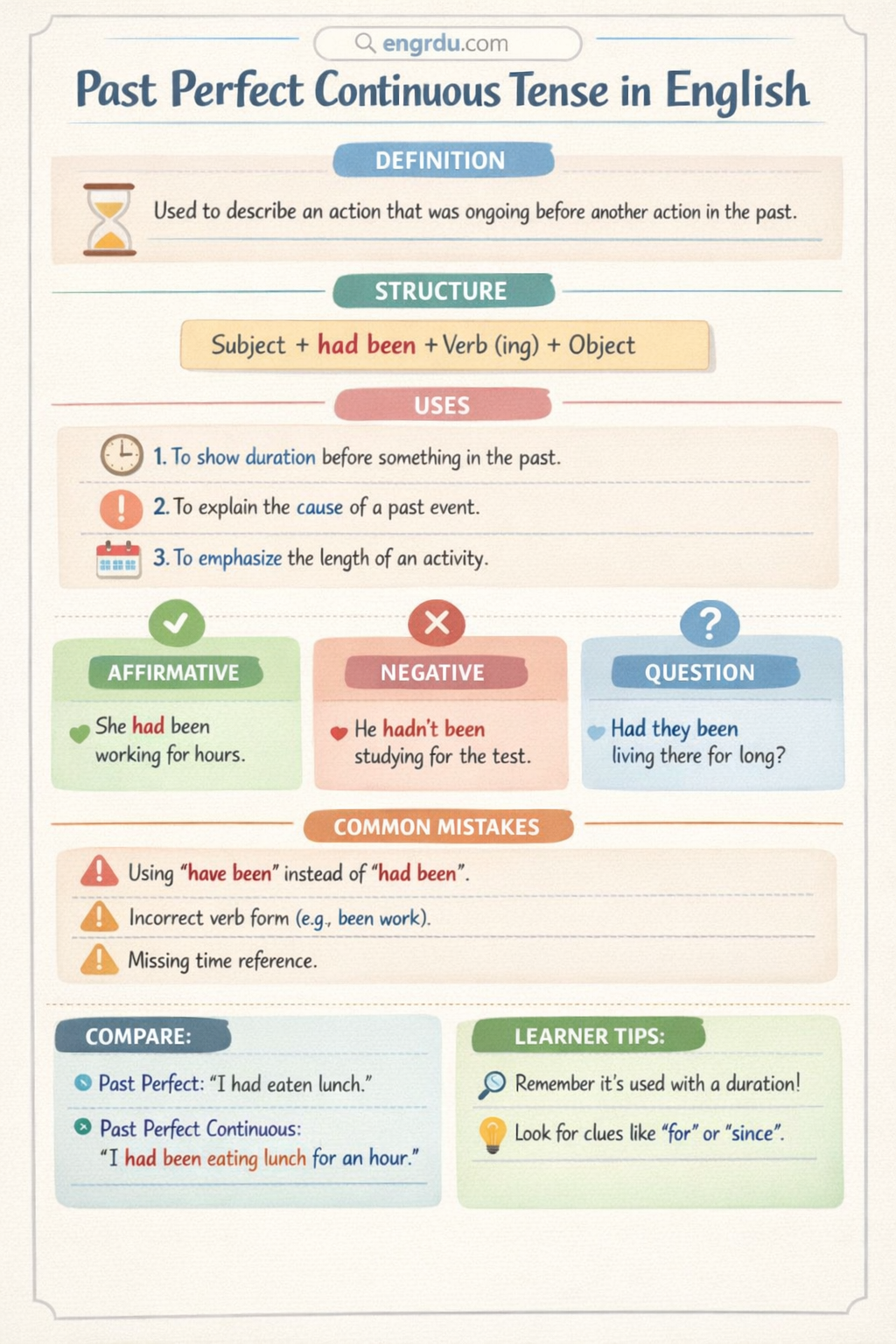
Past Perfect Continuous Tense in English
Conclusion
The Past Perfect Continuous Tense helps us talk about actions that were happening for some time before another past event. It shows duration, cause, and background information. By understanding its structure, uses, and common mistakes, learners can use this tense confidently. With regular practice and real-life examples, this tense becomes simple and natural in everyday English communication.
Frequently Asked Questions
What is the Past Perfect Continuous Tense used for?
The Past Perfect Continuous Tense is used to show that an action was happening for a period of time before another action or time in the past.
What is the structure of the Past Perfect Continuous Tense?
The structure is subject + had been + verb-ing, and it is the same for all subjects like I, he, she, we, and they.
When should we use “for” and “since” in the Past Perfect Continuous Tense?
We use for to show the duration of time and since to show the starting point of the action before another past event.
How is the Past Perfect Continuous Tense different from the Past Perfect Tense?
The Past Perfect Continuous focuses on the duration of an action, while the Past Perfect Tense focuses on the completion of an action.
Can we use the Past Perfect Continuous Tense in negative sentences?
Yes, negative sentences are formed by using had not been + verb-ing, for example, She had not been studying before the test.
Is the Past Perfect Continuous Tense used with all verbs?
No, it is usually not used with stative verbs like know, believe, like, because these verbs do not show continuous action.
Why is the Past Perfect Continuous Tense important for learners?
It helps learners explain past actions clearly, especially when talking about causes, duration, and background events before another past action.
Read More


Leave a Comment