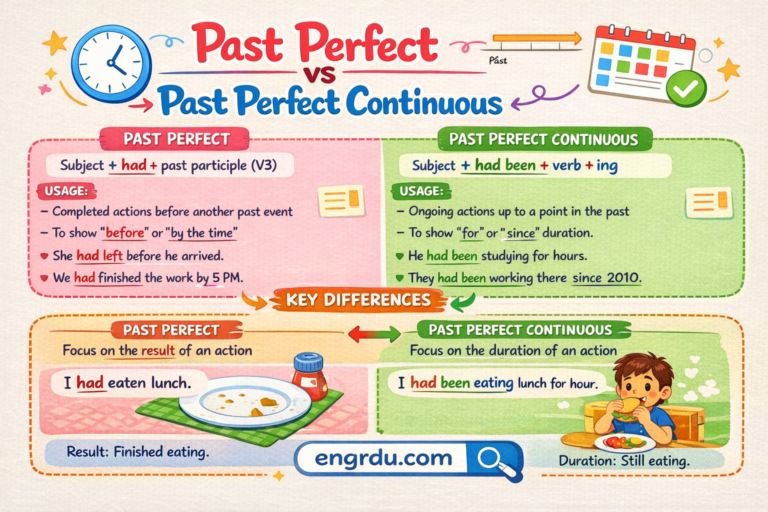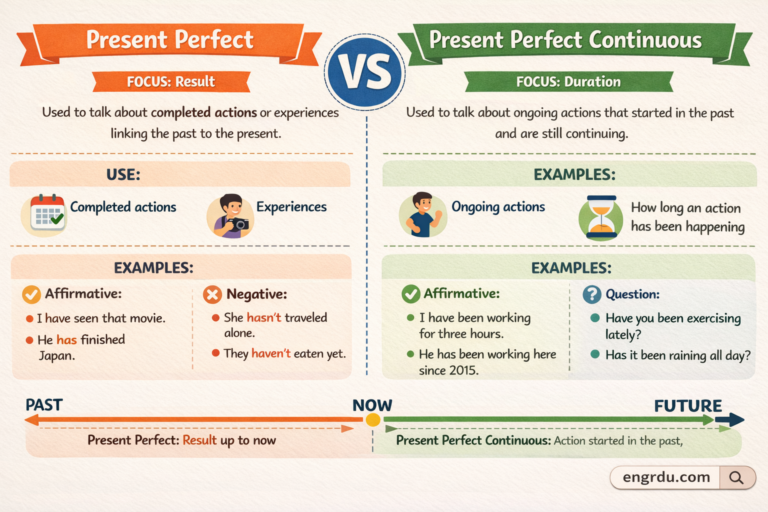
The Past Continuous Tense is used to describe actions that were happening at a specific time in the past. In this Grammar lesson, learning the past continuous tense helps you speak, write, and understand English more clearly. Using it correctly makes your sentences descriptive and precise when talking about past events. In this blog post, you will explore the past continuous tense with a chart and examples to practice and use confidently in English.
To read more about the 12 tenses in one place, visit our 12 Tenses Chart.
What is the Past Continuous Tense?
The Past Continuous Tense is used to describe an action that was happening at a particular time in the past.
It shows that the action was in progress, not finished at that moment.
In simple words, it tells us:
- What someone was doing
- At a specific time in the past
Basic Idea
Something started before a past time and continued for some time.
Example:
I was reading a book at 8 pm yesterday.
(The reading was in progress at 8 pm.)
Forms of Past Continuous Tense
The Past Continuous Tense has three main forms:
1. Affirmative (Positive) Sentences
Used to say that an action was happening in the past.
Structure:
Subject + was/were + verb + ing
Examples:
- She was cooking dinner.
- They were playing football.
- I was studying for my exam.
2. Negative Sentences
Used to say that an action was not happening.
Structure:
Subject + was/were + not + verb + ing
Examples:
- He was not watching TV.
- We were not sleeping at that time.
- She was not listening carefully.
3. Interrogative (Question) Sentences
Used to ask if an action was happening.
Structure:
Was/Were + subject + verb + ing?
Examples:
- Was she working late?
- Were you waiting for me?
- Were they travelling last night?
Rules and Usage of Past Continuous Tense
Understanding when and how to use this tense is very important.
Action in Progress at a Specific Time
Use the Past Continuous to show an action happening at a particular past time.
Examples:
- I was doing my homework at 6 pm.
- They were sleeping at midnight.
Tip:
Always think about “what was happening then?”
Two Actions Happening at the Same Time
When two actions were happening together in the past, use Past Continuous for both.
Examples:
- She was reading while her brother was playing games.
- I was cooking and my mother was cleaning.
Interrupted Actions
Use Past Continuous for the long action and Past Simple for the short action that interrupts it.
Examples:
- I was watching TV when the phone rang.
- They were walking when it started to rain.
Hint:
- Long action → Past Continuous
- Short action → Past Simple
Temporary Situations in the Past
Use Past Continuous for situations that were temporary.
Examples:
- He was living in Paris last year.
- We were working on a new project then.
Polite or Soft Descriptions
Sometimes the Past Continuous is used to sound polite.
Example:
- I was wondering if you could help me.
Examples of Past Continuous Tense
Affirmative Examples
- She was learning English last summer.
- We were waiting for the bus.
- The children were laughing loudly.
Negative Examples
- I was not feeling well yesterday.
- They were not paying attention.
- He was not driving fast.
Question Examples
- Were you studying last night?
- Was she crying?
- Were they discussing the problem?
Real-Life Context Examples
- I was travelling to work when I met my old friend.
- She was preparing lunch while her kids were doing homework.
- We were enjoying the match at that moment.
Common Mistakes and How to Avoid Them
Mistake 1: Using Past Simple Instead of Past Continuous
❌ I watched TV at 8 pm.
✅ I was watching TV at 8 pm.
Why?
Because the action was in progress.
Mistake 2: Forgetting “was” or “were”
❌ She playing outside.
✅ She was playing outside.
Tip:
Always use was/were before the verb.
Mistake 3: Using Wrong Helping Verb
❌ I were studying.
✅ I was studying.
Quick Tip:
- I / He / She / It → was
- You / We / They → were
Mistake 4: Using “ing” Form Incorrectly
❌ He was play football.
✅ He was playing football.
Remember:
Verb must end with -ing.
Comparison with Similar Tenses
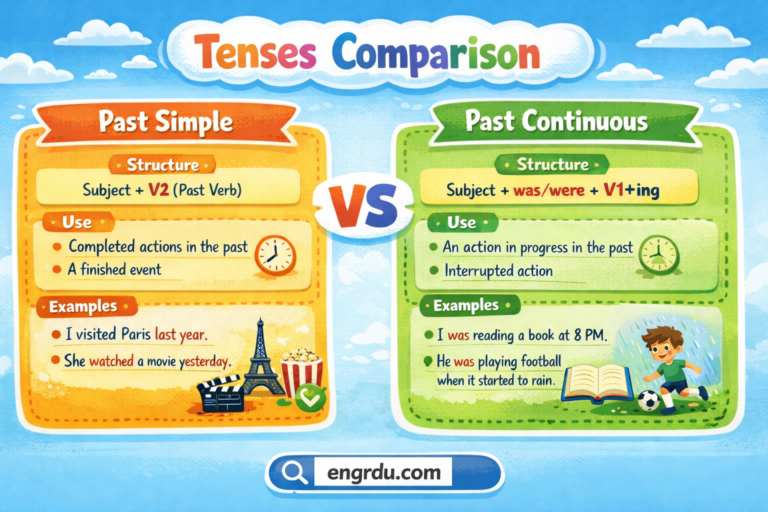
Past Continuous vs Past Simple
| Feature | Past Continuous | Past Simple |
|---|---|---|
| Action type | Ongoing action | Completed action |
| Focus | Action in progress | Action finished |
| Example | I was reading. | I read a book. |
Sentence Comparison:
- I was reading when she called.
- I read the book yesterday.
Past Continuous vs Present Continuous
| Feature | Past Continuous | Present Continuous |
|---|---|---|
| Time | Past | Present |
| Helping verb | was / were | am / is / are |
| Example | She was working. | She is working. |
Tips for Learners
- Think about time first. Ask: What was happening then?
- Practise with daily routines and past events.
- Use time expressions like at that time, when, while.
- Read short stories and notice how Past Continuous is used.
- Speak in simple sentences before making long ones.
- Write 5 sentences every day using this tense.
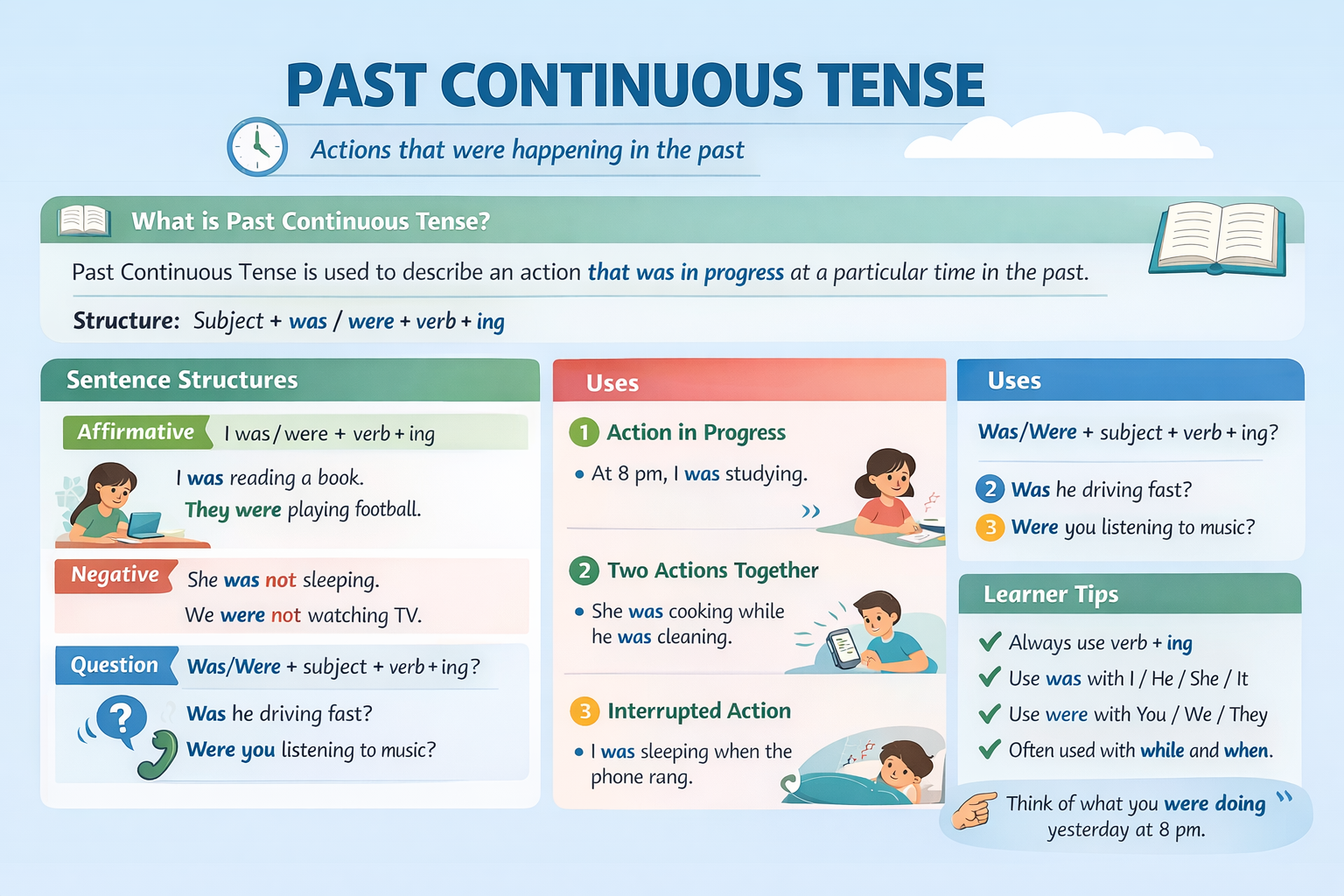
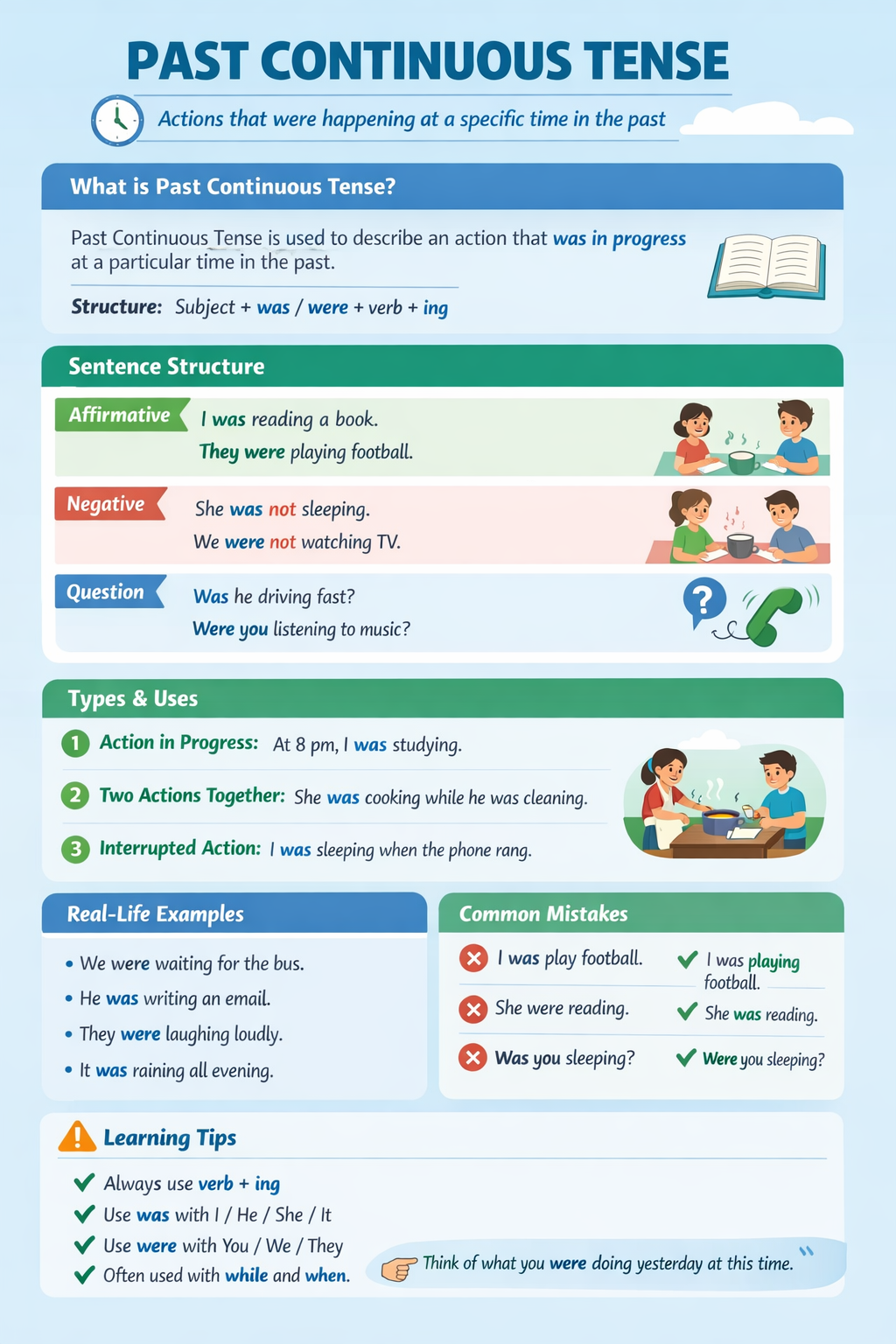
Past Continuous Tense Infographic
Conclusion
The Past Continuous Tense helps learners describe actions that were happening in the past. It is easy to form and very useful in real-life English. By understanding its structure, rules, and common mistakes, learners can use it with confidence. Practise using it in speaking and writing to make your English more natural and clear.
Frequently Asked Questions
What is the Past Continuous Tense used for?
The Past Continuous Tense is used to describe an action that was happening at a specific time in the past. It shows that the action was in progress and not finished at that moment.
What are the main parts of the Past Continuous Tense structure?
The Past Continuous Tense has three important parts: the subject, the helping verb (was or were), and the main verb with “-ing”. All three parts work together to show an ongoing past action.
When do we use “was” and “were” in the Past Continuous Tense?
“Was” is used with singular subjects like I, he, she, and it, while “were” is used with plural subjects like you, we, and they. Choosing the correct helping verb is necessary to form correct sentences.
How is the Past Continuous Tense used with “when” and “while”?
The Past Continuous is often used with “when” and “while” to show two past actions. “While” usually connects two ongoing actions, and “when” introduces a shorter action that interrupts a longer one.
What is the difference between Past Simple and Past Continuous Tense?
The Past Simple Tense describes a completed action in the past, while the Past Continuous Tense describes an action that was still happening at a certain past time. The focus of Past Continuous is on the duration of the action.
Can the Past Continuous Tense be used in negative and question forms?
Yes, the Past Continuous Tense can be used in negative sentences by adding “not” after was or were, and in questions by placing was or were before the subject. This helps express denial or ask about past actions.
What are common time expressions used with the Past Continuous Tense?
Common time expressions include “at that time”, “at 7 pm”, “when”, “while”, and “all day”. These words help clearly show the time period during which the past action was happening.
Read More