
Understanding modal verbs for advice helps you give suggestions, recommendations, and guidance clearly in English. In this Grammar lesson, learning these modals improves your speaking, writing, and reading skills. Using them correctly makes your sentences polite and effective when advising someone. In this blog post, you will explore the meanings and uses of modal verbs for advice to practice and use confidently in everyday English.
Modal Verbs for Advice: Definition and Examples
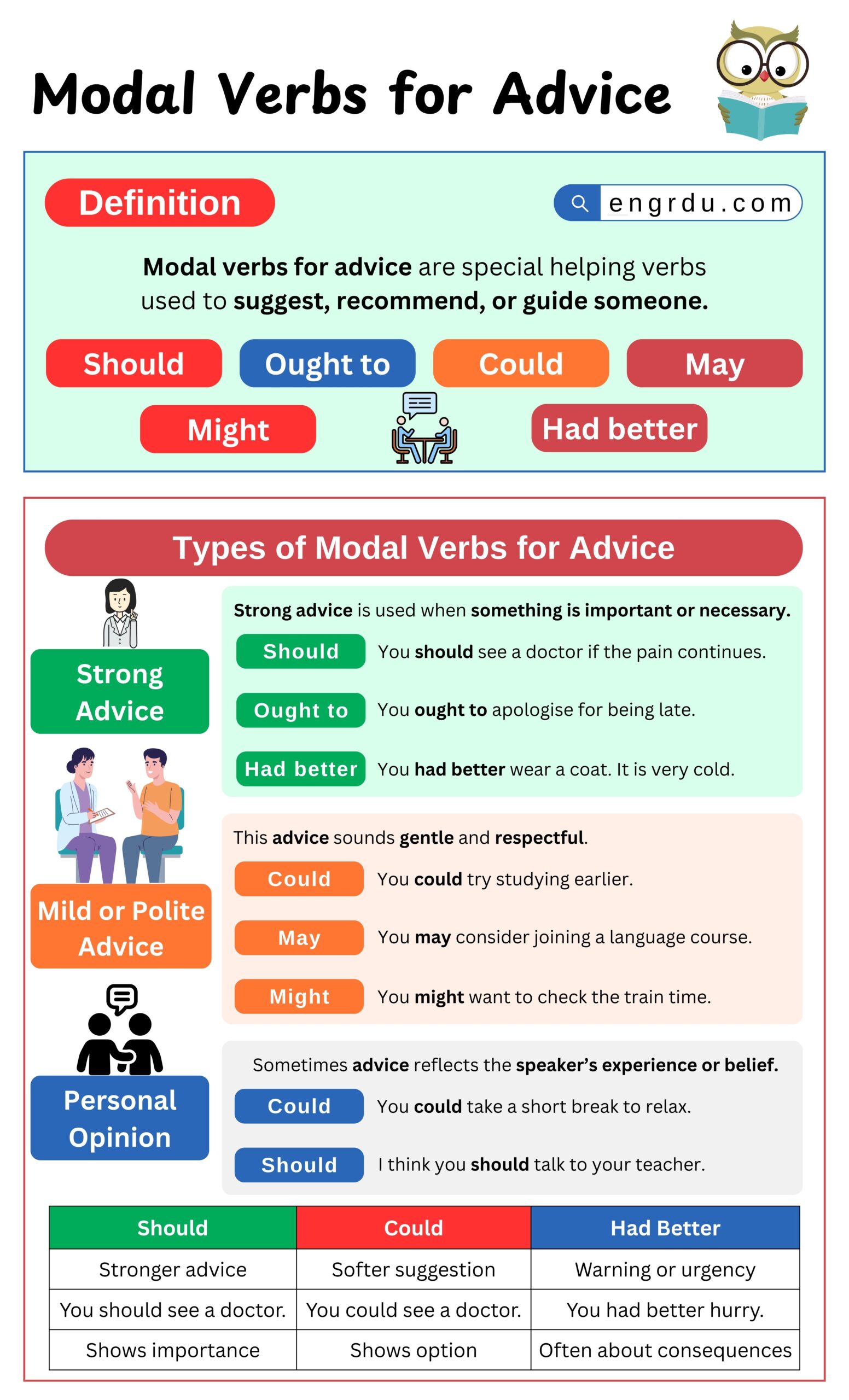
Modal verbs for advice are special helping verbs used to suggest, recommend, or guide someone. They do not show strong orders. Instead, they sound polite, friendly, or thoughtful.
The most common modal verbs for advice are:
- Should
- Ought to
- Could
- May
- Might
- Had better
These verbs help speakers share opinions, suggestions, and warnings without sounding rude.
Types of Modal Verbs for Advice
Modal verbs for advice can be grouped by strength. Some give strong advice, while others sound softer and more polite.
1. Strong Advice
Strong advice is used when something is important or necessary.
Modal verbs used:
- Should
- Ought to
- Had better
Examples:
- You should see a doctor if the pain continues.
- You ought to apologise for being late.
- You had better wear a coat. It is very cold.
2. Mild or Polite Advice
This advice sounds gentle and respectful. It is common in conversations and suggestions.
Modal verbs used:
- Could
- Might
- May
Examples:
- You could try studying earlier.
- You might want to check the train time.
- You may consider joining a language course.
3. Advice Based on Personal Opinion
Sometimes advice reflects the speaker’s experience or belief.
Modal verbs used:
- Should
- Could
Examples:
- I think you should talk to your teacher.
- You could take a short break to relax.
Rules and Usage of Modal Verbs for Advice
Learning the rules helps you use modal verbs correctly and confidently.
Rule 1: Modal verbs do not change form
Modal verbs stay the same for all subjects.
Correct:
- She should rest.
- They should rest.
Incorrect:
- She shoulds rest.
Rule 2: Use the base form of the verb
After a modal verb, always use the base form of the main verb.
Correct:
- You should drink more water.
Incorrect:
- You should drinking more water.
Rule 3: Do not use “to” (except with “ought to”)
Most modal verbs do not use “to”.
Correct:
- You should study more.
Exception:
- You ought to study more.
Rule 4: Negative form uses “not”
Add “not” after the modal verb to give negative advice.
Examples:
- You should not skip breakfast.
- You should not drive when tired.
Short forms are common in spoken English:
- should not → shouldn’t
- could not → couldn’t
Rule 5: Questions use inversion
Place the modal verb before the subject.
Examples:
- Should I call her now?
- Could we leave earlier?
Examples of Modal Verbs for Advice
Here are practical examples used in daily situations.
- You should revise before the test.
- You could ask your teacher for help.
- You shouldn’t copy homework from others.
- You ought to clean your room.
- You might help your parents in the kitchen.
- You had better lock the door at night.
- You should arrive on time for meetings.
- You could improve your skills with online courses.
- You shouldn’t ignore emails from clients.
- You should exercise regularly.
- You might try eating more vegetables.
- You had better stop smoking for your health.
Common Mistakes while Using Modal Verbs
Many learners make small but common errors with modal verbs.
Mistake 1: Using “to” after all modals
Incorrect:
- You should to study more.
Correct:
- You should study more.
Mistake 2: Adding “s” or “ed”
Incorrect:
- She shoulds go home.
- He shoulded rest.
Correct:
- She should go home.
- He should rest.
Mistake 3: Confusing advice with obligation
Learners often confuse should with must.
- Should = advice
- Must = strong obligation
Example:
- You should eat healthy. (advice)
- You must wear a helmet. (rule or law)
Comparisons with Similar Grammar Points
Understanding comparisons helps avoid confusion.
Modal Verbs vs Imperatives
| Feature | Modal Verbs for Advice | Imperatives |
|---|---|---|
| Tone | Polite, friendly | Direct, strong |
| Example | You should study more. | Study more. |
| Use | Advice or suggestion | Orders or commands |
Should vs Could
| Should | Could |
|---|---|
| Stronger advice | Softer suggestion |
| You should see a doctor. | You could see a doctor. |
| Shows importance | Shows option |
Had Better vs Should
| Had Better | Should |
|---|---|
| Warning or urgency | General advice |
| You had better hurry. | You should hurry. |
| Often about consequences | More neutral |
Tips for Learners
- Listen to native speakers in films and podcasts.
- Practise giving advice in short sentences.
- Use should first. It is the easiest and most common.
- Read dialogues and notice how advice sounds polite.
- Write your own examples about daily life.
- Avoid translating advice directly from your language.
Conclusion
Modal verbs for advice help you speak English politely and naturally. They allow you to guide others without sounding rude or strict. Words like should, could, and might are common in daily conversations, school, work, and travel. With regular practice, you will feel more confident using them. Try using one modal verb each day in real situations and notice how your English improves.
Frequently Asked Questions
What are modal verbs for advice in English?
Modal verbs for advice are helping verbs used to suggest, recommend, or guide someone politely. Common modal verbs for advice include should, ought to, could, might, may, and had better. They are used to share opinions or helpful suggestions without giving direct orders.
What are 10 examples of advice sentences?
Here are 10 simple advice sentences using modal verbs:
You should drink more water.
You should study regularly.
You could ask your teacher for help.
You might try going to bed earlier.
You ought to apologise for the mistake.
You had better save some money.
You should not skip meals.
You could practise English every day.
You might want to check the weather.
You should listen carefully in class.
Which modal verb is used for giving advice?
The most common modal verb used for giving advice is should. It is easy to use and sounds polite and natural. Other modal verbs like could, might, ought to, and had better are also used depending on how strong or soft the advice needs to be.
What are the 10 examples of modal verbs?
Ten common modal verbs in English are:
can, could, may, might, must, shall, should, will, would, and ought to.
Some of these, such as should, could, and might, are often used for giving advice.
What type of verb is “advice”?
The word advice is a noun, not a verb. It refers to an opinion or suggestion given to help someone. The verb form is advise, which means to give advice.
What is the difference between should and could for advice?
Should is used for strong or important advice, while could is used for softer and more polite suggestions. For example, you should see a doctor shows stronger advice than you could see a doctor.
Can modal verbs for advice be used in questions and negative sentences?
Yes, modal verbs for advice can be used in questions and negative sentences. For example, should I talk to her now is a question, and you should not ignore the problem is a negative advice sentence.
Read More
