An imperative sentence gives a command, request, or instruction. In this Grammar lesson, learning imperative sentences helps you speak, write, and understand English more effectively. Using them correctly makes your sentences clear and direct. In this blog post, you will explore the definition, uses, and examples of imperative sentences to practice and apply them confidently in daily English.
What is an Imperative Sentence?
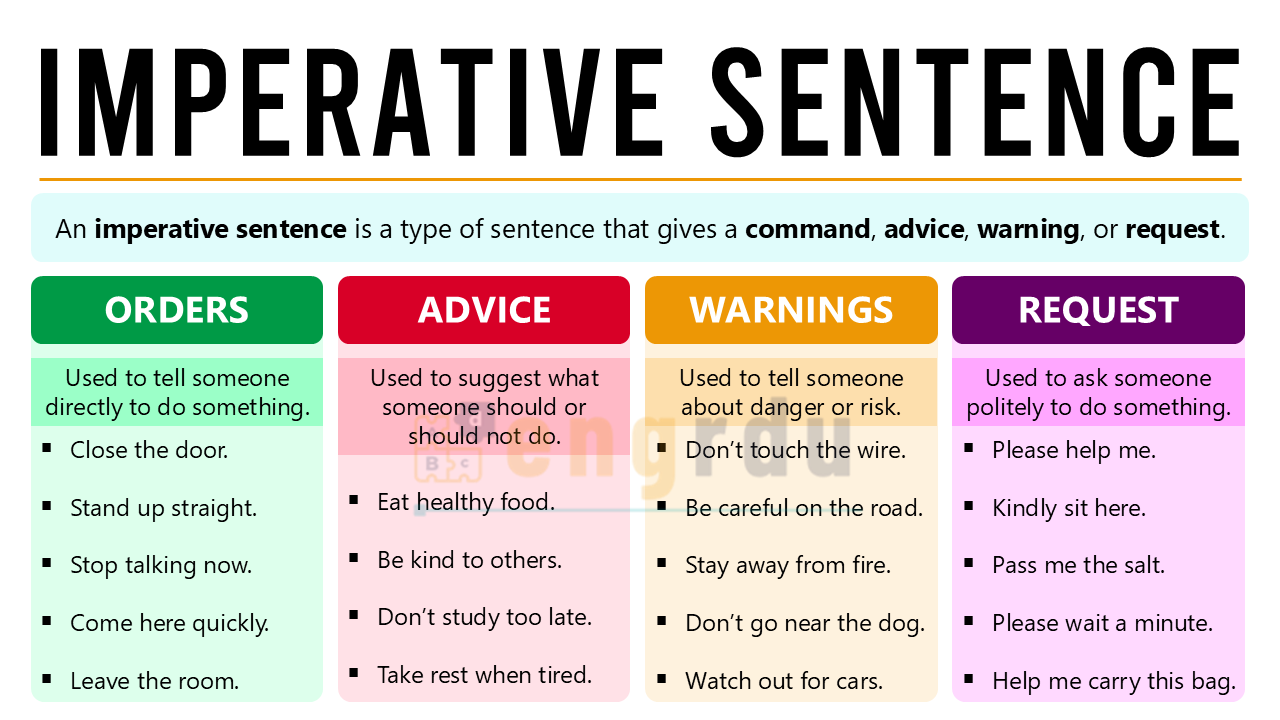
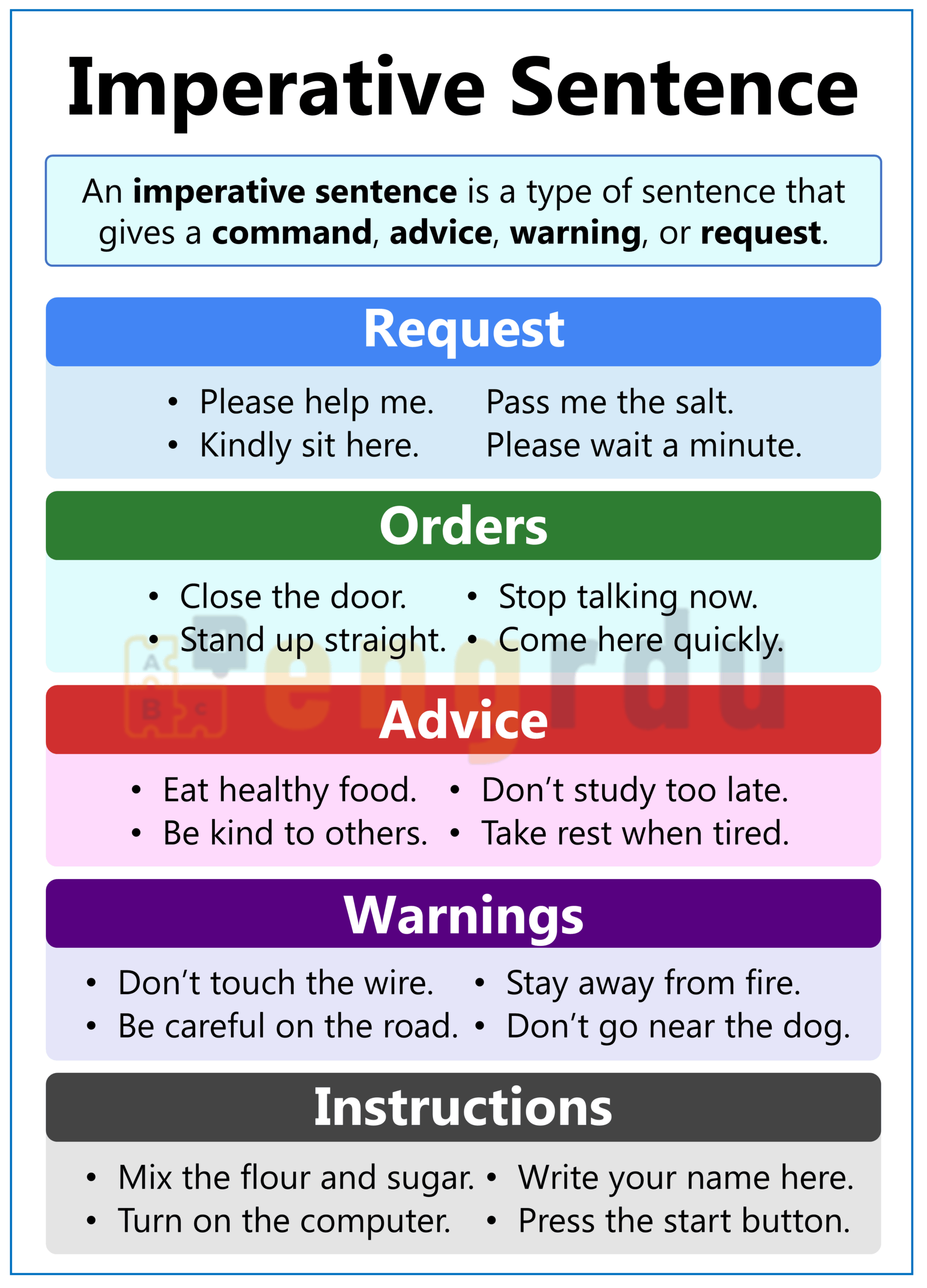
An imperative sentence is a type of sentence that gives a command, advice, warning, or request. It usually starts with a verb and often has an understood subject — the word “you” is implied but not written.
Examples:
- (You) Close the door.
- (You) Please sit down.
So, even if “you” is not written, it is understood that the speaker is talking to someone directly.
Imperative Sentence Structure
| Part | Description | Example |
|---|---|---|
| Verb | The action word comes first | Open the window. |
| Object (optional) | What or who receives the action | Turn off the light. |
| Please (optional) | Used to make the sentence polite | Please help me. |
Uses of Imperative Sentences
Imperative sentences are used in different situations in everyday English. Let’s understand them one by one:
1. To Give Commands
Used when telling someone to do something directly.
- Stop talking.
- Turn off the TV.
2. To Give Instructions
Used in guides, recipes, or directions.
- Mix the flour and sugar.
- Take the first left turn.
3. To Make Requests
Used to ask politely for help or something.
- Please open the window.
- Kindly wait here.
4. To Offer or Invite
Used to invite or suggest something nicely.
- Have some tea.
- Come and join us.
5. To Give Advice or Warnings
Used to warn or suggest an action for safety.
- Be careful!
- Don’t touch the wire!
Positive and Negative Imperative Sentences
| Type | Meaning | Example |
|---|---|---|
| Positive | Tells someone to do something | Speak slowly. |
| Negative | Tells someone not to do something | Don’t speak loudly. |
- Positive: Help your friend.
- Negative: Don’t forget your bag.
30 Examples of Imperative Sentence
- Close the door.
- Please sit down.
- Turn off the lights.
- Be quiet during the meeting.
- Don’t touch that button.
- Help your brother with his homework.
- Kindly wait for your turn.
- Keep your room clean.
- Don’t make any noise.
- Follow the instructions carefully.
- Bring me a glass of water.
- Don’t run in the hallway.
- Take care of your health.
- Open your books to page ten.
- Listen to your teacher.
- Don’t forget your umbrella.
- Please call me later.
- Stop talking and pay attention.
- Be honest with everyone.
- Let’s go for a walk.
- Don’t be late for school.
- Turn right at the corner.
- Wash your hands before eating.
- Sit here and relax.
- Try to do your best.
- Stay away from danger.
- Don’t waste your time.
- Take a deep breath.
- Enjoy your meal.
- Keep smiling every day.

Imperative Sentence vs Declarative Sentence
Understanding the difference between imperative sentences and declarative sentences is very important for learning English grammar. Both are common in everyday speech and writing, but they serve different purposes and have different structures.
| Feature | Imperative Sentence | Declarative Sentence |
|---|---|---|
| Purpose | Gives a command, request, or instruction | Gives information or statements |
| Subject | (You) – understood or hidden | Clearly stated |
| Verb Position | Starts with a base verb | Comes after the subject |
| Punctuation | Ends with . or ! | Ends with . |
| Example | Please stand up. | He is standing now. |
Imperative sentences are an essential part of everyday English communication. They help you express commands, make polite requests, and give advice clearly and effectively. By practising them, you can speak and write more confidently and naturally in English.
Imperative Sentence Worksheet
This imperative sentence worksheet helps you practise commands, requests, instructions, and advice. Read each section carefully and complete the exercises to test your understanding of imperative sentences.
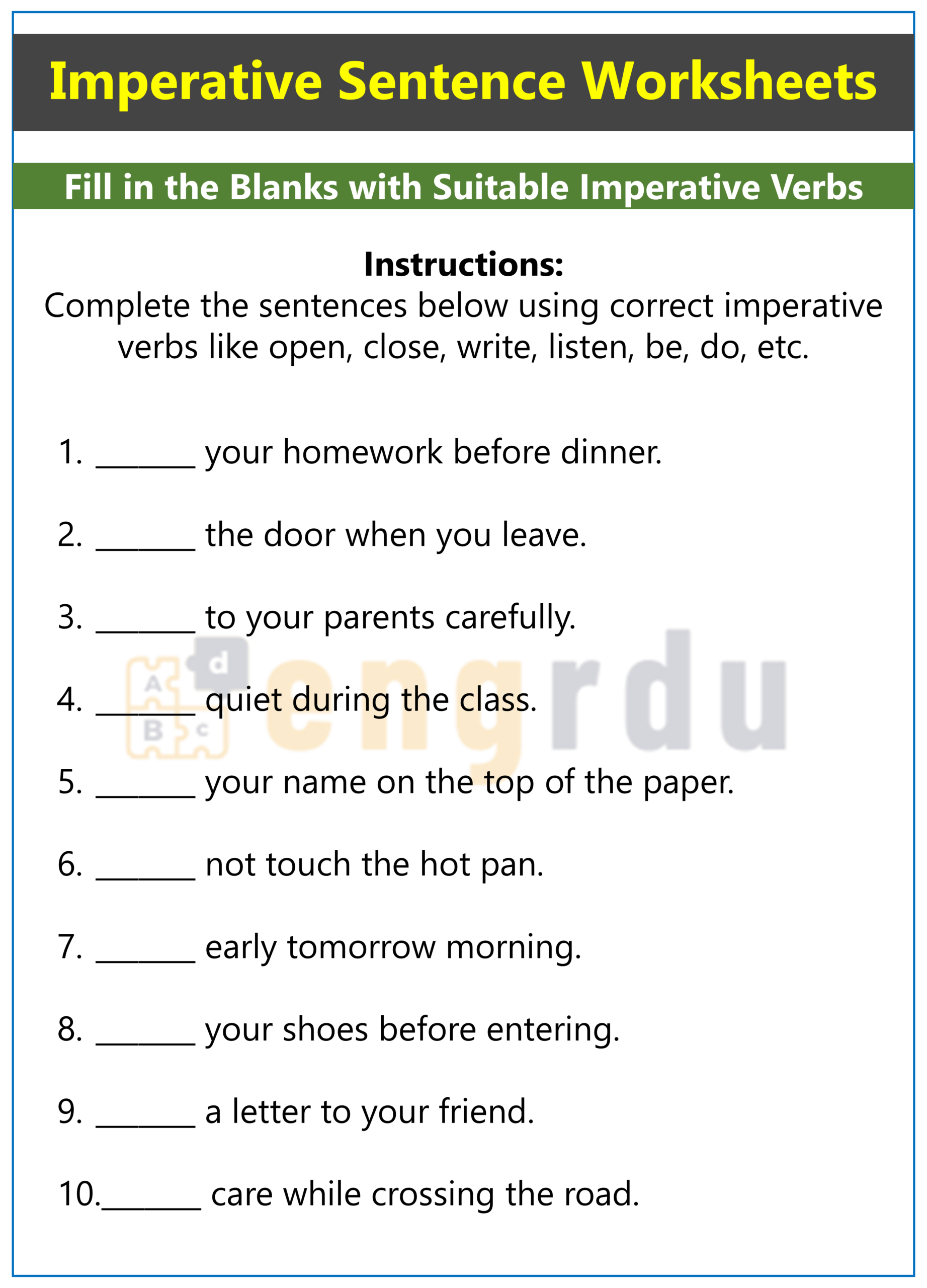
A. Fill in the Blanks with Suitable Imperative Verbs
Complete the sentences below using correct imperative verbs like open, close, write, listen, be, do, etc.
- _______ your homework before dinner.
- _______ the door when you leave.
- _______ to your parents carefully.
- _______ quiet during the class.
- _______ your name on the top of the paper.
- _______ not touch the hot pan.
- _______ early tomorrow morning.
- _______ your shoes before entering.
- _______ a letter to your friend.
- _______ care while crossing the road.
B. Change the Following Declarative Sentences into Imperative Sentences
- You should close the window.
➡️ _________________________________________ - You need to take your medicine.
➡️ _________________________________________ - You must be careful while driving.
➡️ _________________________________________ - You should not talk in the library.
➡️ _________________________________________ - You have to wash your hands.
➡️ _________________________________________
C. Choose the Correct Type of Sentence
Write Imperative (I) or Declarative (D) beside each sentence.
- Please help me with this bag. _______
- She is helping her mother. _______
- Don’t run in the hall. _______
- The cat is sleeping on the chair. _______
- Be honest in your work. _______
- I love learning English. _______
- Don’t forget to call me. _______
- They play football every evening. _______
D. Write Your Own Imperative Sentences
Write five sentences using the correct imperative form.
Answer Key
(Use this to check your answers after you complete the worksheet.)
A (Sample Answers): 1. Do, 2. Close, 3. Listen, 4. Be, 5. Write, 6. Do, 7. Wake, 8. Remove, 9. Write, 10. Take
B (Sample Answers): Close the window. / Take your medicine. / Be careful while driving. / Don’t talk in the library. / Wash your hands.
C: 1. I, 2. D, 3. I, 4. D, 5. I, 6. D, 7. I, 8. D
D: (Answers will vary)

FAQs about Imperative Sentence
What is an imperative sentence?
An imperative sentence is a type of sentence used to give a command, request, advice, or instruction. It usually starts with a verb and has an understood subject (you).
Example: (You) Close the window.
What is an imperative sentence with example?
An imperative sentence tells someone to do something. It may sound firm or polite depending on the tone.
Example: Please sit down.
Example: Don’t be late.
What is the meaning of imperative sentence?
The meaning of an imperative sentence is to express an order, request, warning, or instruction. It directs the listener to take or avoid an action.
Example: Be quiet during the class.
What punctuation is used in imperative sentences?
Imperative sentences usually end with a full stop (.) or an exclamation mark (!) depending on the tone.
Example: Sit down.
Example: Be quiet!
What is the difference between positive and negative imperative sentences?
A positive imperative tells someone to do something, while a negative imperative tells someone not to do something.
Positive: Help your friend.
Negative: Don’t touch that.
Read More