
Adjectives ending in -ing describe the quality of a person, thing, or situation that causes a feeling. For example, “interesting,” “boring,” and “exciting” tell us what something is like. They often come from verbs and explain why someone feels happy, tired, or surprised. In this blog post, you will learn how to use, identify, and form -ing adjectives in sentences. Understanding these adjectives will help you speak more naturally, improve your writing, and describe experiences more accurately in English.
What are -ing Adjectives?
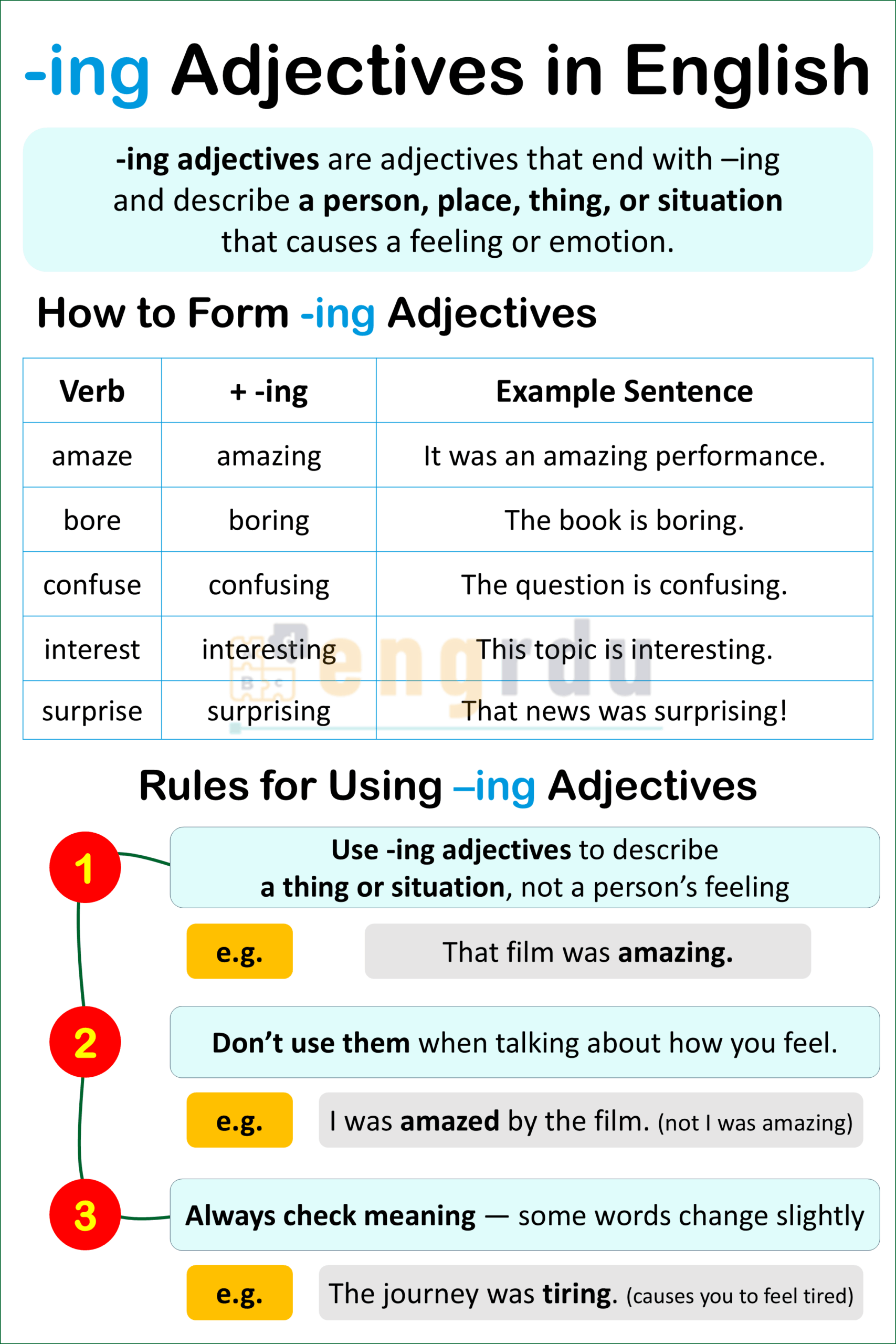
-ing adjectives are adjectives that end with -ing and describe a person, place, thing, or situation that causes a feeling or emotion.
- The movie was exciting.
- It was a boring lecture.
- She told an interesting story.
In these examples, exciting, boring, and interesting describe the thing that gives us a feeling.
How to Form -ing Adjectives
You can form -ing adjectives by adding “-ing” to a verb.
| Verb | + -ing | Example Sentence |
|---|---|---|
| amaze | amazing | It was an amazing performance. |
| bore | boring | The book is boring. |
| confuse | confusing | The question is confusing. |
| interest | interesting | This topic is interesting. |
| surprise | surprising | That news was surprising! |
Rule: Add -ing to the base form of the verb.
Example → tire → tiring, shock → shocking
Rules for Using -ing Adjectives
Here are some simple rules to remember:
1. Use -ing adjectives to describe a thing or situation, not a person’s feeling.
That film was amazing.
2. Don’t use them when talking about how you feel. Use -ed adjectives for that instead.
I was amazed by the film. (not I was amazing)
3. Always check meaning — some words change slightly:
The journey was tiring. (causes you to feel tired)
Difference Between -ed and -ing Adjectives
| -ed Adjectives | -ing Adjectives |
|---|---|
| Describe feelings of a person | Describe things or situations that cause feelings |
| Example → I am bored. | Example → The movie is boring. |
| Shows how someone feels | Shows what makes someone feel that way |
Examples:
- I am interested in art.
- Art is interesting.
Examples of Common -ing Adjectives
| Verb | Adjective (-ing) | Example Sentence |
|---|---|---|
| amaze | amazing | The view was amazing. |
| bore | boring | The speech was boring. |
| confuse | confusing | The map is confusing. |
| disappoint | disappointing | The result was disappointing. |
| excite | exciting | It was an exciting trip. |
| surprise | surprising | That answer was surprising. |
| tire | tiring | Cleaning is tiring. |
| worry | worrying | It’s a worrying situation. |
| please | pleasing | The outcome was pleasing. |
| annoy | annoying | The noise is really annoying. |
| charm | charming | What a charming little village! |
| chill | chilling | It was a chilling story. |
| depress | depressing | Rainy weather can be depressing. |
| embarrass | embarrassing | That was an embarrassing mistake. |
| encourage | encouraging | Her words were encouraging. |
| entertain | entertaining | The show was entertaining. |
| exhaust | exhausting | Running all day is exhausting. |
| fascinate | fascinating | Space is a fascinating subject. |
| frighten | frightening | It was a frightening experience. |
| inspire | inspiring | Her story is truly inspiring. |
| move | moving | It was a moving speech. |
| offend | offending | Be careful not to say offending words. |
| puzzle | puzzling | His answer was puzzling. |
| relax | relaxing | A beach holiday is relaxing. |
| shock | shocking | That was a shocking accident. |
| thrill | thrilling | The race was thrilling! |
| trouble | troubling | The news is troubling. |
| interest | interesting | That’s an interesting idea. |
| confuse | confusing | The directions were confusing. |
| disturb | disturbing | The film had disturbing scenes. |
| frustrate | frustrating | Waiting in long queues is frustrating. |
| satisfy | satisfying | Completing the task was satisfying. |

When to Use -ing Adjectives
You use -ing adjectives when describing what something is like, not how you feel.
- The match was thrilling.
- That lesson was confusing.
- The show was entertaining.
Tip:
If you can say “It makes me feel…”, then you should use -ing adjectives.
Example:
The story makes me feel excited → The story is exciting.
Summary
- -ing adjectives describe things or situations.
- Form them by adding -ing to verbs.
- Use them to show what causes feelings, not what you feel.
- Remember: -ed adjectives = feelings, -ing adjectives = causes of feelings.
FAQs
What are -ing adjectives used for?
-ing adjectives describe things or events that make people feel a certain way.
How are -ing adjectives formed?
They are formed by adding -ing to the base form of a verb (e.g., bore → boring).
What is the difference between -ed and -ing adjectives?
-ed adjectives describe feelings, while -ing adjectives describe causes of feelings.
Can I use -ing adjectives for people?
Only if the person causes a feeling.
He is an interesting man.
What are some common -ing adjectives?
Common ones include boring, exciting, amazing, tiring, surprising, and confusing.
Read More