
In this blog post, you will learn 100 verbal nouns in English with example sentences and pictures. Knowing verbal nouns helps you understand how verbs can be used as nouns to describe actions, events, or activities. It also improves your speaking and writing skills because you can use verbal nouns correctly in sentences and conversations. Seeing examples with pictures makes it easier to remember and use these nouns in daily life. Learning verbal nouns will make your English vocabulary stronger, more expressive, and practical.
- Running
- Swimming
- Reading
- Writing
- Speaking
- Listening
- Dancing
- Singing
- Cooking
- Driving
- Walking
- Sleeping
- Studying
- Painting
- Drawing
- Shopping
- Hiking
- Fishing
- Traveling
- Learning
Verbal Nouns Examples with Sentences
| Verbal Noun | Example Sentence |
| Running | Running is good for your health. |
| Reading | Reading improves your vocabulary. |
| Writing | Writing helps you express your thoughts. |
| Speaking | Speaking in public makes me nervous. |
| Listening | Listening is an important skill. |
| Drawing | Drawing relaxes the mind. |
| Painting | Painting can be very therapeutic. |
| Singing | Singing brings me joy. |
| Dancing | Dancing is a great form of exercise. |
| Swimming | Swimming is my favorite activity. |
| Teaching | Teaching requires patience. |
| Learning | Learning never stops. |
| Cooking | Cooking is my weekend hobby. |
| Baking | Baking fills the house with a sweet aroma. |
| Jogging | Jogging every morning keeps me fit. |
| Driving | Driving during rain is difficult. |
| Traveling | Traveling opens up your mind. |
| Shopping | Shopping online is convenient. |
| Sewing | Sewing is a useful skill. |
| Cleaning | Cleaning the house takes time. |
| Typing | Typing fast saves time. |
| Fishing | Fishing is a peaceful activity. |
| Hunting | Hunting requires skill and patience. |
| Acting | Acting on stage is thrilling. |
| Gardening | Gardening brings me closer to nature. |
| Skating | Skating can be challenging at first. |

Verbal Nouns in English Grammar
| Verbal Noun | Grammar Function |
| Reading | Used as the subject of the sentence |
| Writing | Often appears as the object of a verb |
| Dancing | Can follow prepositions like “by” or “after” |
| Speaking | Forms compound nouns (e.g., “speaking skills”) |
| Swimming | Noun from the verb ‘to swim’ |
| Singing | Indicates an action being done |
| Cooking | Can act as a subject or an object |
| Typing | Becomes part of idioms (e.g., “good at typing”) |
| Traveling | Used with “enjoy”, “prefer”, etc. |
| Painting | Derived by adding -ing to the verb |
| Jogging | Verbal noun ending in -ing |
| Teaching | Represents the act of educating |
| Cleaning | Describes the process of making clean |
| Driving | Can show continuous action as a noun |
| Hunting | General activity or profession |
| Shopping | Expresses action turned into a noun |
| Sewing | An action noun used as a subject |
| Fishing | Used in compound structures |
| Drawing | Emphasizes the product or act |
| Skating | Common in leisure-related contexts |
| Learning | Refers to the process of gaining knowledge |
| Acting | Describes a theatrical performance |
| Baking | Refers to the act of baking food |
| Gardening | Implies cultivation of a garden |

Simple Verbal Noun Sentences for Students
| Verbal Noun | Simple Sentence |
| Reading | Reading is fun. |
| Writing | Writing is easy. |
| Running | Running is fast. |
| Speaking | Speaking is loud. |
| Listening | Listening is quiet. |
| Painting | Painting is colorful. |
| Dancing | Dancing is fun. |
| Singing | Singing is loud. |
| Swimming | Swimming is cool. |
| Drawing | Drawing is nice. |
| Driving | Driving is fast. |
| Learning | Learning is smart. |
| Teaching | Teaching is kind. |
| Typing | Typing is quick. |
| Jogging | Jogging is healthy. |
| Cooking | Cooking is tasty. |
| Baking | Baking is sweet. |
| Shopping | Shopping is fun. |
| Cleaning | Cleaning is neat. |
| Gardening | Gardening is peaceful. |
| Acting | Acting is creative. |
| Traveling | Traveling is exciting. |
| Sewing | Sewing is careful work. |
| Hunting | Hunting is quiet. |
| Fishing | Fishing is calm. |
| Skating | Skating is cool. |
| Climbing | Climbing is hard. |
| Sleeping | Sleeping is good. |

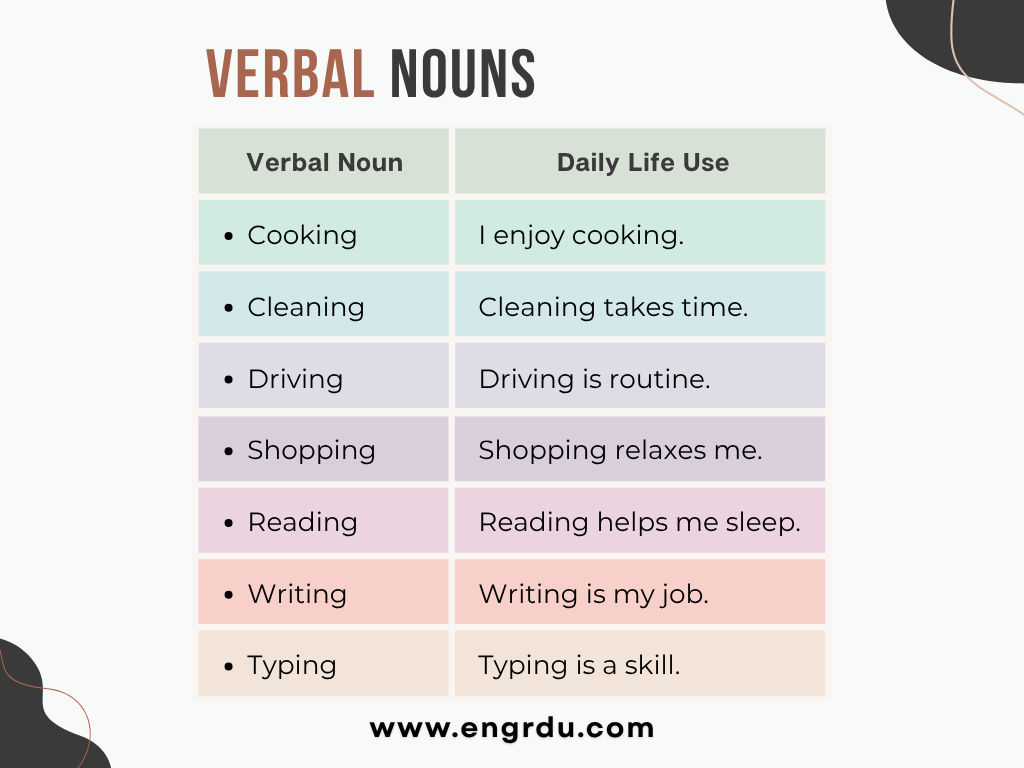
Common Verbal Nouns Used in Daily Life
| Verbal Noun | Daily Life Use |
| Cooking | I enjoy cooking dinner. |
| Cleaning | Cleaning takes up my weekend. |
| Driving | Driving to work is routine. |
| Shopping | Shopping helps me relax. |
| Reading | Reading before bed helps me sleep. |
| Writing | Writing emails is part of my job. |
| Typing | Typing quickly is a helpful skill. |
| Watching | Watching TV after dinner is relaxing. |
| Listening | Listening to music cheers me up. |
| Speaking | Speaking to clients is essential. |
| Jogging | Jogging in the morning wakes me up. |
| Eating | Eating healthy is important. |
| Drinking | Drinking enough water is key to staying fit. |
| Working | Working from home is common now. |
| Exercising | Exercising regularly is vital. |
| Planning | Planning your day saves time. |
| Drawing | Drawing helps express creativity. |
| Washing | Washing clothes is a weekly task. |
| Folding | Folding laundry is tiring. |
| Babysitting | Babysitting is a responsibility. |
| Driving | Driving my kids to school is part of my day. |
| Learning | Learning new skills keeps your mind sharp. |
FAQs About Verbal Nouns
What is a verbal noun in English?
A verbal noun is a noun formed from a verb that functions like a regular noun, often ending in -ing, like “swimming” or “reading”.
How is a verbal noun different from a gerund?
While both end in -ing, a verbal noun is purely a noun, often used with articles or adjectives (e.g., the building), while a gerund functions like both a noun and a verb (e.g., Running is fun).
Can verbal nouns take modifiers?
Yes, verbal nouns can be modified by adjectives, not adverbs. Example: His quick thinking saved the day.
Are all words verbal nouns?
No. Some -ing words act as adjectives or present participles. Only those used as nouns are verbal nouns, like “Her singing impressed everyone.”
Related Articles:

Abdul Manan is an author at engrdu.com. He is passionate about making English language learning accessible and fun. From mastering grammar to expanding vocabulary and understanding the nuances of different accents, our goal is to provide learners with practical tools for real-world communication. If you’re looking to improve comprehension or sharpen your daily conversation skills, our easy-to-follow guides, worksheets, and picture-based learning make it simple for everyone to succeed.