
A verb is a word that expresses an action, occurrence, or state of being, such as run, eat, or exist. In this Grammar lesson, learning verbs helps you speak, write, and understand English more effectively. Using them correctly makes your sentences complete and meaningful. In this blog post, you will explore the definition, types, uses, and examples of verbs to practice and use confidently in everyday English.
Verb Definition and Examples
A verb is a word that shows an action, a state, or an event. In very easy words, a verb tells us:
- What someone does
- What happens
- What something is
Without a verb, a sentence is not complete.
Examples:
- She runs every morning.
- They are happy today.
- The baby slept quietly.
In all these sentences, the highlighted words are verbs. They tell us what is happening.

Types of Verbs
English verbs can be grouped into different types. Learning these types helps you understand sentences faster and use verbs correctly.
1. Action Verbs
Action verbs show what someone or something does.
Examples:
- I eat breakfast at home.
- He writes emails every day.
- The children play in the park.
Action verbs can be physical (run, jump) or mental (think, remember).
2. Linking Verbs
Linking verbs do not show action. They connect the subject to information about the subject.
Common linking verbs: am, is, are, was, were, seem, feel, become
Examples:
- She is tired.
- The food smells good.
- He became a teacher.
The verb links the subject to a description or identity.
3. Helping (Auxiliary) Verbs
Helping verbs work with main verbs. They help show tense, mood, or voice.
Common helping verbs: be, have, do, will, can, should
Examples:
- She is reading a book.
- They have finished their work.
- We will travel tomorrow.
Here, the helping verb adds extra meaning to the main verb.
4. Main Verbs
A main verb carries the main meaning of the sentence.
Examples:
- I like coffee.
- He drives to work.
Helping verbs may support them, but main verbs can often stand alone.
5. Transitive Verbs
Transitive verbs need an object to complete their meaning.
Examples:
- She opened the door.
- He bought a new phone.
Without the object, the sentence feels incomplete.
6. Intransitive Verbs
Intransitive verbs do not need an object.
Examples:
- The baby cried.
- We arrived early.
The sentence is complete without adding anything.
7. Regular and Irregular Verbs
Regular verbs form the past tense by adding -ed.
- play → played
- clean → cleaned
Irregular verbs change form in different ways.
- go → went
- eat → ate
- see → saw
Irregular verbs must be memorised.

Rules and Usage of Verbs
1. Verb Agreement
The verb must agree with the subject.
Examples:
- She likes tea.
- They like tea.
Tip: Singular subjects often take -s in the present simple tense.
2. Verb Tense
Verbs change form to show time.
- Present: I work here.
- Past: I worked here.
- Future: I will work here.
Always think about when the action happens.
3. Negative Sentences
To make negative sentences, use not with helping verbs.
Examples:
- She does not like coffee.
- They are not coming today.
Avoid adding not directly to the main verb.
4. Question Sentences
Questions often start with a helping verb.
Examples:
- Do you like tea?
- Is he at home?
- Have they finished?
Tip: Word order is very important in questions.
Common Mistakes with Verbs
1. Missing the Verb
Incorrect: She very happy.
Correct: She is very happy.
Every sentence needs a verb.
2. Wrong Verb Form
Incorrect: He go to school every day.
Correct: He goes to school every day.
Remember subject-verb agreement.
3. Confusing Past Forms
Incorrect: I have ate lunch.
Correct: I have eaten lunch.
Use the correct past participle with helping verbs.
4. Using Two Main Verbs Together
Incorrect: She did went home.
Correct: She did go home.
After did, use the base form of the verb.
List of Verbs
| run | eat | write | read |
| play | jump | walk | talk |
| speak | listen | watch | see |
| drink | cook | clean | wash |
| open | close | buy | sell |
| help | learn | teach | study |
| work | travel | drive | ride |
| swim | climb | build | make |
| give | take | find | lose |
| come | go | think | know |
| bring | leave | start | finish |
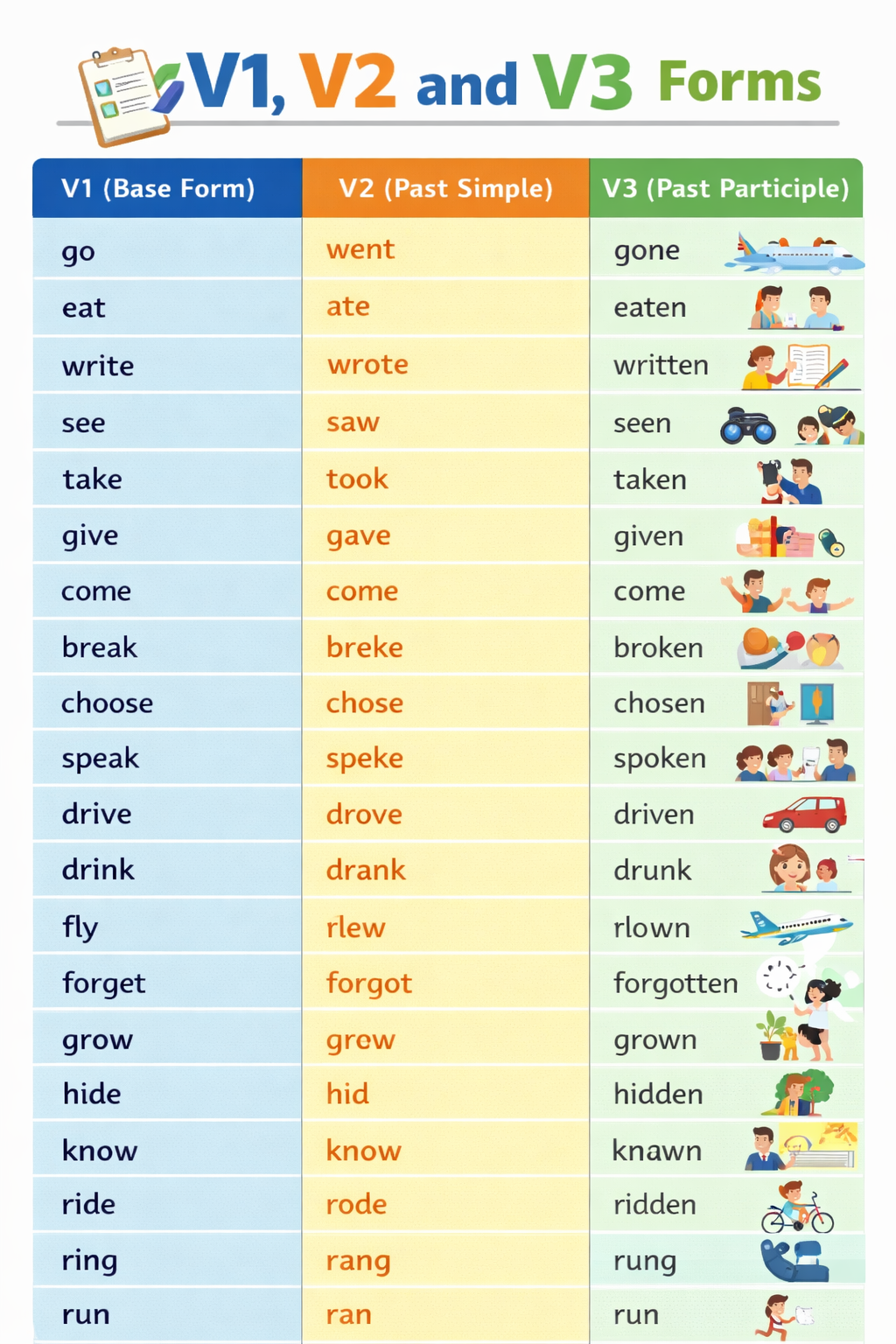
V1, V2, and V3 Forms
| V1 (Base Form) | V2 (Past Simple) | V3 (Past Participle) |
|---|---|---|
| go | went | gone |
| eat | ate | eaten |
| write | wrote | written |
| see | saw | seen |
| take | took | taken |
| give | gave | given |
| come | came | come |
| break | broke | broken |
| choose | chose | chosen |
| speak | spoke | spoken |
| drive | drove | driven |
| drink | drank | drunk |
| fly | flew | flown |
| forget | forgot | forgotten |
| grow | grew | grown |
| hide | hid | hidden |
| know | knew | known |
| ride | rode | ridden |
| ring | rang | rung |
| rise | rose | risen |
| sing | sang | sung |
| steal | stole | stolen |
| swim | swam | swum |
| throw | threw | thrown |
| wake | woke | woken |
| wear | wore | worn |
| win | won | won |
| begin | began | begun |
| fall | fell | fallen |
| freeze | froze | frozen |
Verb Examples in Sentences
| Verb | Example Sentence |
|---|---|
| run | I run every morning before school. |
| write | She writes clear notes in class. |
| eat | We eat lunch at noon. |
| play | The children play outside daily. |
| read | He reads the newspaper quietly. |
| drive | My father drives carefully at night. |
| cook | She cooks healthy meals at home. |
| jump | The cat jumps onto the table. |
| speak | They speak English at work. |
| watch | I watch the news every evening. |
| build | Workers build houses near the road. |
| clean | She cleans her room weekly. |
| swim | We swim in the local pool. |
| teach | He teaches maths at school. |
| paint | The artist paints beautiful scenes. |
| draw | The child draws animals neatly. |
| climb | They climb the hill slowly. |
| open | Please open the window. |
| close | She closes the shop early. |
| travel | We travel by train often. |
| repair | He repairs old computers. |
| listen | Students listen to the teacher. |
| dance | They dance happily together. |
| buy | I buy fresh fruit daily. |
| sell | The shop sells handmade items. |
| send | She sends emails quickly. |
| receive | We receive letters every week. |
| help | Friends help each other always. |
| learn | I learn new words daily. |
| visit | They visit their grandparents monthly. |

Verb Comparisons
Action Verb vs Linking Verb
| Action Verb | Linking Verb |
|---|---|
| Shows action | Shows state or condition |
| She runs fast | She is fast |
| He smells the food | The food smells good |
The same verb can sometimes be action or linking, depending on meaning.
Main Verb vs Helping Verb
| Main Verb | Helping Verb |
|---|---|
| Shows main action | Supports the main verb |
| She writes | She is writing |
| They finished | They have finished |
Understanding this helps with sentence structure.
Tips for Learners
- Read short English texts daily and underline verbs.
- Practise one verb tense at a time.
- Learn irregular verbs in small groups.
- Make your own sentences using new verbs.
- Speak aloud to feel confident with verb forms.
- Check subject and verb agreement carefully.
Small daily practice leads to big improvement.
Conclusion
Verbs are the heart of English sentences. They show actions, states, and events. In this article, you learned the definition of a verb, its main types, correct usage rules, common mistakes, and helpful examples. With regular practice, verbs will become easier and more natural for you. Try to notice verbs in everyday conversations and use them actively in your own speaking and writing. This is the best way to master English verbs.
Frequently Asked Questions
What is a verb in English grammar?
A verb is a word that shows an action, a state, or something that happens. It tells what a person or thing does, what happens, or what something is in a sentence.
Why are verbs important in a sentence?
Verbs are important because a sentence is not complete without a verb. They help express actions, feelings, conditions, and events clearly.
What are the main types of verbs in English?
The main types of verbs include action verbs, linking verbs, helping (auxiliary) verbs, main verbs, regular verbs, and irregular verbs. Each type has a different role in a sentence.
How do verbs change with tense?
Verbs change their form to show time, such as present, past, or future. For example, “work” becomes “worked” in the past and “will work” in the future.
What is the difference between action verbs and linking verbs?
Action verbs show what someone does, like “run” or “write.” Linking verbs connect the subject to a description or state, such as “is,” “seem,” or “feel.”
What are common verb mistakes made by learners?
Common mistakes include missing verbs, using the wrong verb form, incorrect subject-verb agreement, and confusing regular and irregular verb forms.
How can learners improve their use of verbs?
Learners can improve by practising daily, reading simple texts, making their own sentences, learning verb forms step by step, and checking subject-verb agreement carefully.
Read More