
Sentences can be simple, compound, or complex, depending on how ideas are connected. In this Grammar lesson, understanding these sentence types helps you write, speak, and read English more effectively. Using the right sentence structure makes your communication clear and engaging. In this blog post, you will learn about simple, compound, and complex sentences with examples to practice and use them confidently in English.
What are Sentences?
A sentence is a group of words that gives a complete idea or thought. Every sentence must have a subject (who or what) and a verb (action or state).
Example → She reads every night.

Simple Sentences
A simple sentence has one independent clause. It gives a complete meaning with one subject and one verb.
Structure:
Subject + Verb + Object
Examples:
- He plays football.
- They are studying English.
- The sun rises early.
Compound Sentences
A compound sentence joins two or more simple sentences using coordinating conjunctions such as and, but, or, so, for, yet, nor.
Structure:
Simple Sentence + Conjunction + Simple Sentence
Examples:
- I wanted to go out, but it was raining.
- She cooked dinner, and he washed the dishes.
- You can stay here, or you can leave.
Key Points:
- Shows equal ideas
- Joined by conjunctions
- Adds variety to writing
Common Coordinating Conjunctions Table:
| Conjunction | Meaning/Use | Example |
|---|---|---|
| and | adds information | She sang and danced. |
| but | shows contrast | He is rich but unhappy. |
| or | gives choice | Tea or coffee? |
| so | shows result | It rained, so we stayed home. |
Complex Sentences
A complex sentence has one main clause and one or more dependent clauses. The dependent clause adds extra information but cannot stand alone.
Structure:
Main Clause + Subordinating Conjunction + Dependent Clause
Examples:
- I stayed home because I was tired.
- She smiled when she saw her friend.
- If it rains, we will cancel the trip.
Common Subordinating Conjunctions Table:
| Conjunction | Use | Example |
|---|---|---|
| because | gives reason | She stayed home because she was ill. |
| when | shows time | Call me when you arrive. |
| if | shows condition | If you study, you will pass. |
| although | shows contrast | Although it was cold, we went out. |
Key Points:
- Has one main idea and extra information
- Adds depth and clarity
- Used in formal and written English
Simple Compound and Complex Sentences Examples
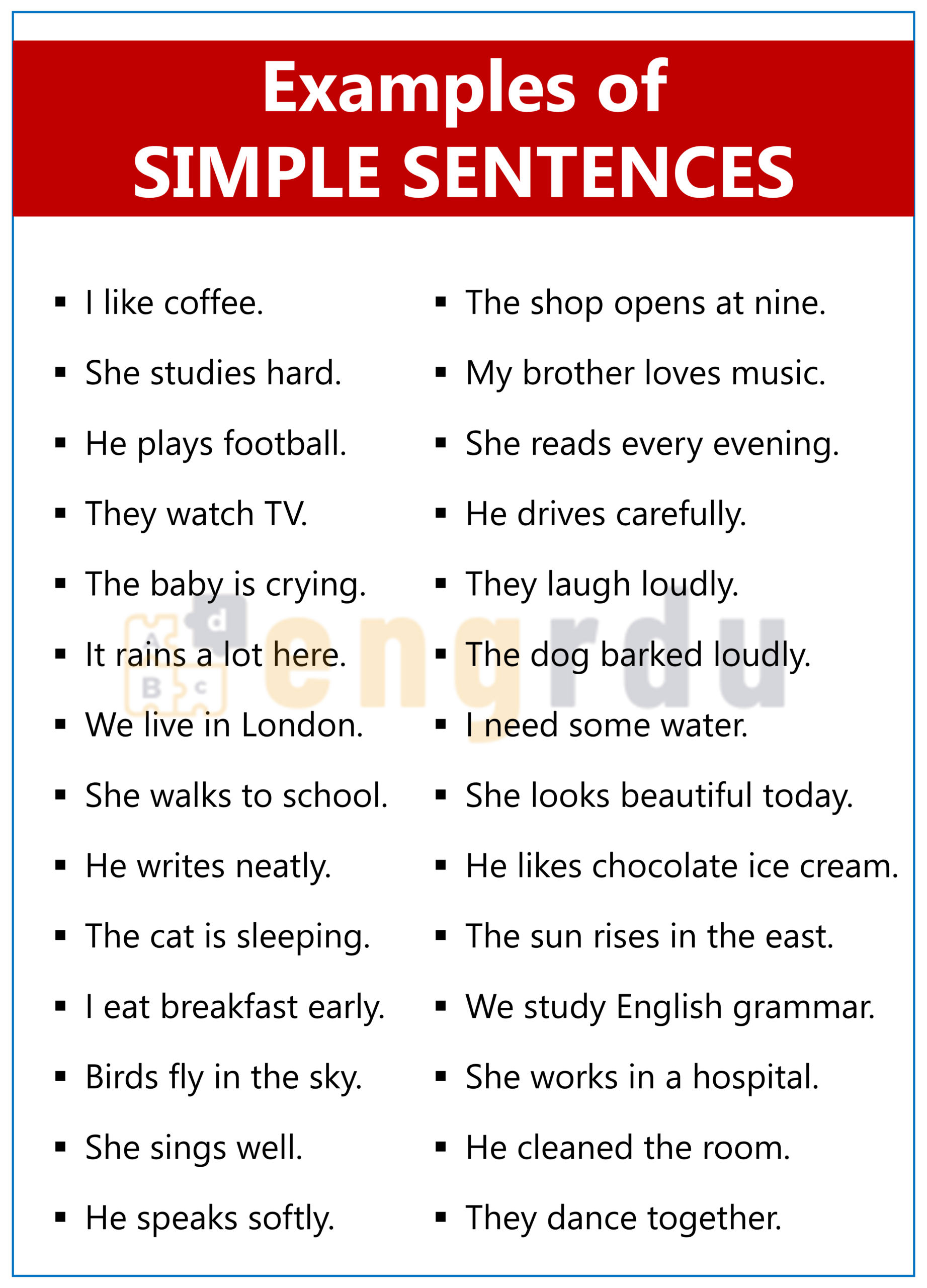
30 Examples of Simple Sentences
A simple sentence has one subject and one verb. It expresses a single complete idea.
- I like coffee.
- She studies hard.
- He plays football.
- They watch TV.
- The baby is crying.
- It rains a lot here.
- We live in London.
- She walks to school.
- He writes neatly.
- The cat is sleeping.
- I eat breakfast early.
- Birds fly in the sky.
- She sings well.
- He speaks softly.
- We enjoy summer holidays.
- The shop opens at nine.
- My brother loves music.
- She reads every evening.
- He drives carefully.
- They laugh loudly.
- The dog barked loudly.
- I need some water.
- She looks beautiful today.
- He likes chocolate ice cream.
- The sun rises in the east.
- We study English grammar.
- She works in a hospital.
- He cleaned the room.
- They dance together.
- The car stopped suddenly.
30 Examples of Compound Sentences
A compound sentence joins two independent clauses using coordinating conjunctions like and, but, or, so, yet, nor, for.
- I wanted to go out, but it was raining.
- She cooked dinner, and he washed the dishes.
- We can go now, or we can wait.
- He was tired, so he went to bed early.
- I like tea, but I don’t like coffee.
- She is smart, and she works hard.
- He didn’t study, so he failed the test.
- We tried our best, yet we lost the game.
- She called me, but I didn’t answer.
- He reads books, and she watches films.
- I wanted pizza, but there was none left.
- They worked all day, and they were very tired.
- He was late, so he took a taxi.
- You can stay here, or you can leave.
- She smiled, and everyone smiled back.
- He opened the window, and fresh air came in.
- We went shopping, but we bought nothing.
- It started to rain, so we went inside.
- He wanted to help, but he was too busy.
- The phone rang, and she answered quickly.
- I wanted to study, but I was too sleepy.
- She missed the bus, so she walked home.
- They played cricket, and we watched them.
- He loves dogs, but his sister prefers cats.
- She finished her work, and then she rested.
- I wanted to call you, but my phone died.
- He shouted loudly, yet nobody listened.
- We waited for hours, but they never came.
- He looked for his keys, and he finally found them.
- I cleaned the kitchen, and she washed the dishes.

30 Examples of Complex Sentences
A complex sentence has one main clause and one or more dependent clauses joined by subordinating conjunctions like because, when, if, although, since, while, after, before.
- I stayed home because it was raining.
- When I arrived, the class had already started.
- She smiled because she was happy.
- If it rains, we will stay inside.
- Although he is young, he is very clever.
- He left early because he was tired.
- We will go out when the sun comes out.
- I called you after I reached home.
- She was angry because he forgot her birthday.
- If you study hard, you will pass the exam.
- When the bell rang, the students left.
- Although it was cold, we went swimming.
- He didn’t come because he was ill.
- While she was cooking, the baby was crying.
- We stayed inside as it was snowing.
- She didn’t speak until I asked her name.
- If I see him, I will tell him the news.
- They will call you when they arrive.
- Although it’s late, I’m still working.
- Because I was hungry, I made a sandwich.
- She left early so that she could catch the bus.
- When I saw the dog, I ran away.
- He works hard because he wants success.
- If you don’t hurry, we’ll miss the train.
- Before you leave, please turn off the lights.
- While he was reading, she was listening to music.
- Although it looked easy, it was difficult.
- Since I moved here, I’ve made many friends.
- If I had money, I would buy a new phone.
- After I finished dinner, I watched TV.

Difference Between Simple, Compound and Complex Sentences
| Type | Number of Clauses | Connector Used | Example |
|---|---|---|---|
| Simple | One | None | I like apples. |
| Compound | Two or more | Coordinating Conjunction | I like apples, and I like bananas. |
| Complex | One main + One dependent | Subordinating Conjunction | I eat apples because they are healthy. |
How to Use Them in Daily Writing
- Use simple sentences for short and clear messages.
- Use compound sentences to connect equal ideas.
- Use complex sentences to explain reasons, time, or conditions.
Examples in Use:
- I was hungry, so I made a sandwich. (compound)
- She left because it was late. (complex)
- He runs every morning. (simple)
Learning the difference between simple, compound, and complex sentences helps you become a better English writer and speaker. Try using all three types to make your writing clear, natural, and interesting.
Simple Compound and Complex Sentences Exercises
These exercises will help you understand how to identify and write simple, compound, and complex sentences correctly.
Try to do each question first, then check your answers below.
Exercise 1: Identify the Sentence Type
Instructions:
Read each sentence and choose whether it is Simple, Compound, or Complex.
| No. | Sentence | Type |
|---|---|---|
| 1 | She likes tea. | …………… |
| 2 | I wanted to go out, but it was raining. | …………… |
| 3 | When he called, I was sleeping. | …………… |
| 4 | They play football every evening. | …………… |
| 5 | He opened the door and saw the cat. | …………… |
| 6 | Although it was cold, we went swimming. | …………… |
| 7 | She smiled and waved at me. | …………… |
| 8 | If you study hard, you will pass. | …………… |
Answers – Exercise 1
| No. | Sentence | Type |
|---|---|---|
| 1 | She likes tea. | Simple Sentence |
| 2 | I wanted to go out, but it was raining. | Compound Sentence |
| 3 | When he called, I was sleeping. | Complex Sentence |
| 4 | They play football every evening. | Simple Sentence |
| 5 | He opened the door and saw the cat. | Compound Sentence |
| 6 | Although it was cold, we went swimming. | Complex Sentence |
| 7 | She smiled and waved at me. | Compound Sentence |
| 8 | If you study hard, you will pass. | Complex Sentence |

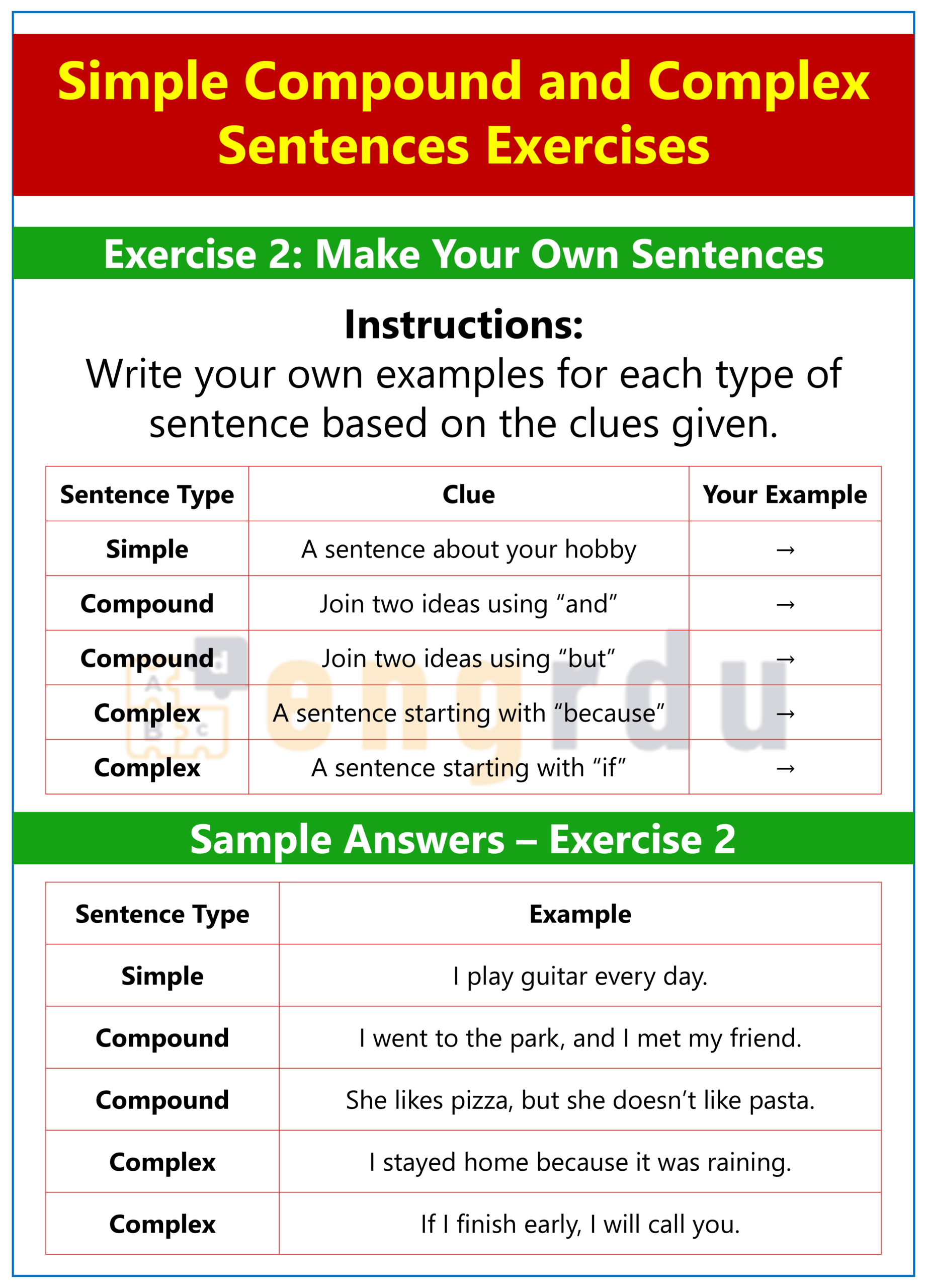
Exercise 2: Make Your Own Sentences
Instructions:
Write your own examples for each type of sentence based on the clues given.
| Sentence Type | Clue | Your Example |
|---|---|---|
| Simple | A sentence about your hobby | → |
| Compound | Join two ideas using “and” | → |
| Compound | Join two ideas using “but” | → |
| Complex | A sentence starting with “because” | → |
| Complex | A sentence starting with “if” | → |
Sample Answers – Exercise 2
| Sentence Type | Example |
|---|---|
| Simple | I play guitar every day. |
| Compound | I went to the park, and I met my friend. |
| Compound | She likes pizza, but she doesn’t like pasta. |
| Complex | I stayed home because it was raining. |
| Complex | If I finish early, I will call you. |
Exercise 3: Fill in the Missing Conjunction
Instructions:
Choose the correct conjunction (and, but, or, so, because, when, if) to complete each sentence.
| No. | Sentence | Answer |
|---|---|---|
| 1 | I was tired, ______ I went to bed early. | …………… |
| 2 | She was happy ______ she passed the exam. | …………… |
| 3 | He wanted to go out, ______ it was raining. | …………… |
| 4 | We can go for a walk ______ stay home. | …………… |
| 5 | ______ you see him, tell him to call me. | …………… |
Answers – Exercise 3
| No. | Sentence | Correct Conjunction |
|---|---|---|
| 1 | I was tired, so I went to bed early. | so |
| 2 | She was happy because she passed the exam. | because |
| 3 | He wanted to go out, but it was raining. | but |
| 4 | We can go for a walk or stay home. | or |
| 5 | If you see him, tell him to call me. | If |

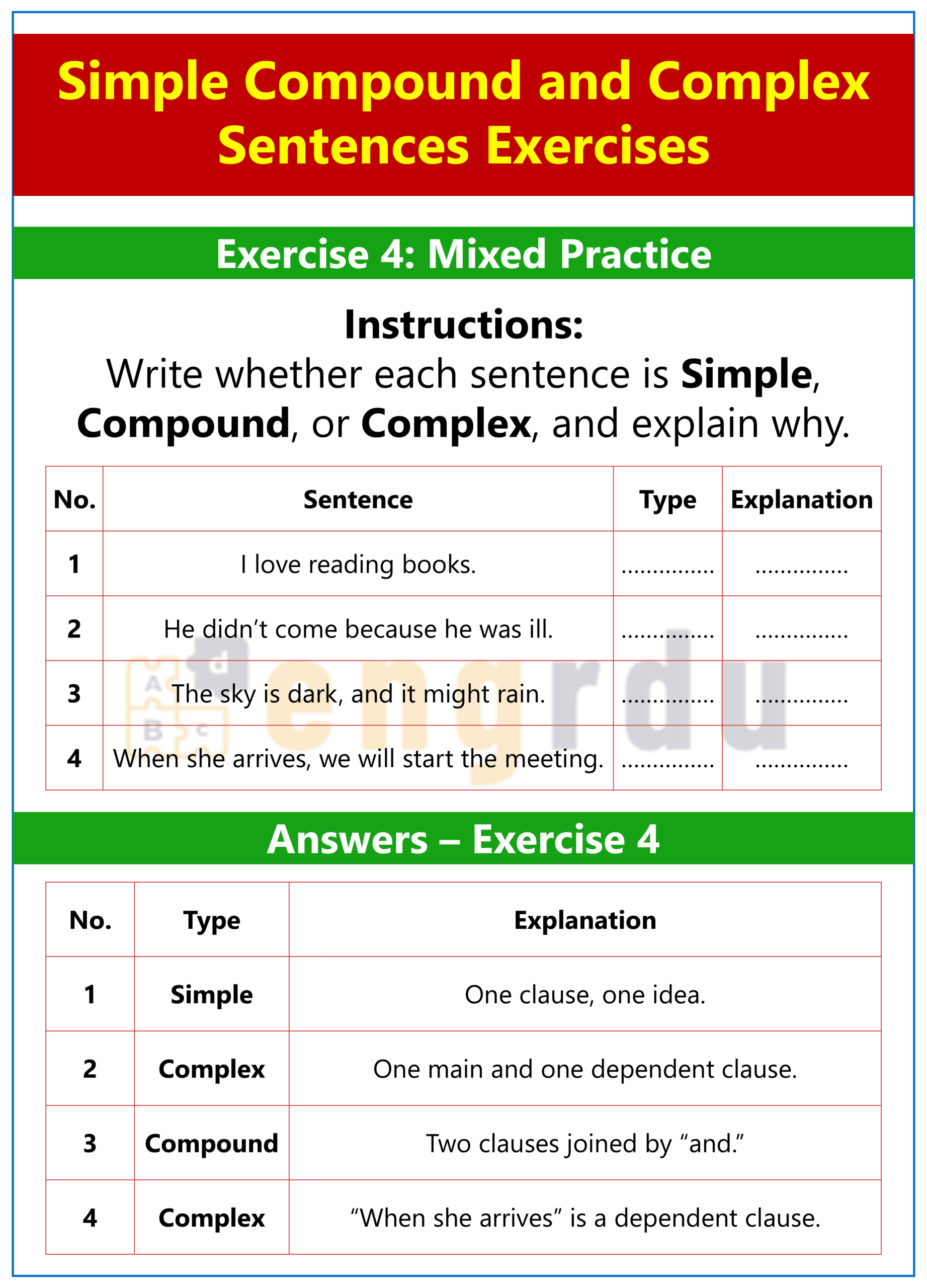
Exercise 4: Mixed Practice
Instructions:
Write whether each sentence is Simple, Compound, or Complex, and explain why.
| No. | Sentence | Type | Explanation |
|---|---|---|---|
| 1 | I love reading books. | …………… | …………… |
| 2 | He didn’t come because he was ill. | …………… | …………… |
| 3 | The sky is dark, and it might rain. | …………… | …………… |
| 4 | When she arrives, we will start the meeting. | …………… | …………… |
Answers – Exercise 4
| No. | Sentence | Type | Explanation |
|---|---|---|---|
| 1 | I love reading books. | Simple | One clause, one idea. |
| 2 | He didn’t come because he was ill. | Complex | One main and one dependent clause. |
| 3 | The sky is dark, and it might rain. | Compound | Two clauses joined by “and.” |
| 4 | When she arrives, we will start the meeting. | Complex | “When she arrives” is a dependent clause. |
By practising these exercises on simple, compound, and complex sentences, learners can build strong grammar skills and clear writing habits.
Get a free PDF book of Simple, Compound, and Complex Sentences:
FAQs about Simple Compound and Complex Sentences
What are simple, compound, and complex sentences?
Simple, compound, and complex sentences are three main sentence types in English.
A simple sentence has one idea, a compound sentence joins two equal ideas, and a complex sentence joins a main idea with an extra or dependent idea.
What are compound and complex sentences?
A compound sentence connects two or more simple sentences using words like and, but, or so.
A complex sentence joins one main clause and one or more dependent clauses using words like because, when, or if.
How to identify simple, compound, and complex sentences?
To identify the sentence type:
→ If there is one clause, it is simple.
→ If there are two or more clauses joined by and, but, or, so, it is compound.
→ If there is a main clause and a dependent clause joined by because, when, if, it is complex.
What is the difference between compound and complex sentences?
A compound sentence links equal ideas using coordinating conjunctions like and, but, or.
A complex sentence links unequal ideas — a main clause with a dependent clause using subordinating conjunctions like because, when, although.
Why are simple, compound, and complex sentences important in English?
Using all three sentence types makes your English writing and speaking more clear, natural, and interesting.
They help you express simple facts, connected ideas, and detailed explanations correctly.
Read More