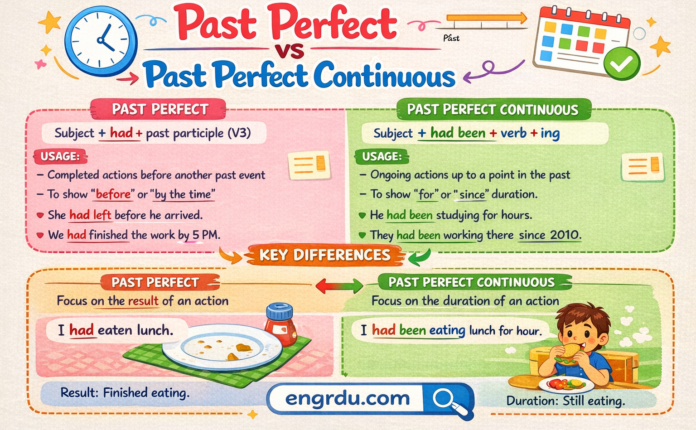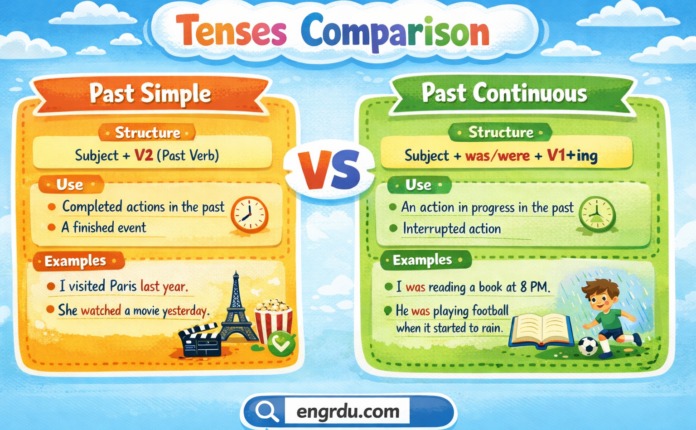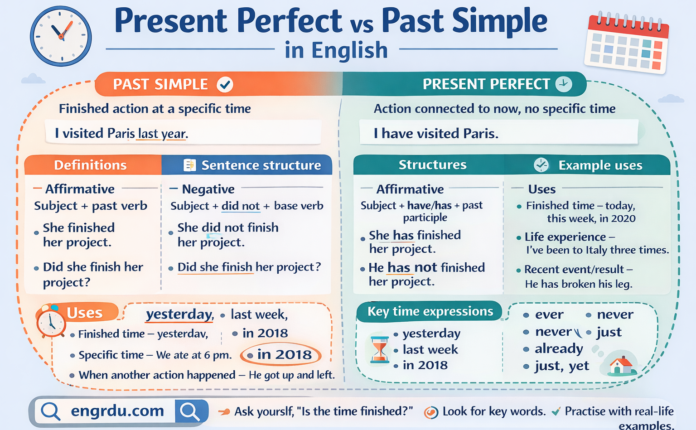

Understanding the Present Perfect and Present Perfect Continuous tenses helps you describe actions that started in the past and continue into the present more accurately. In this Grammar lesson, learning the differences between these tenses improves your speaking, writing, and reading skills. Using them correctly makes your sentences clear and precise. In this blog post, you will explore present perfect vs present perfect continuous with examples to practice and use confidently in English.
Present Perfect vs Present Perfect Continuous
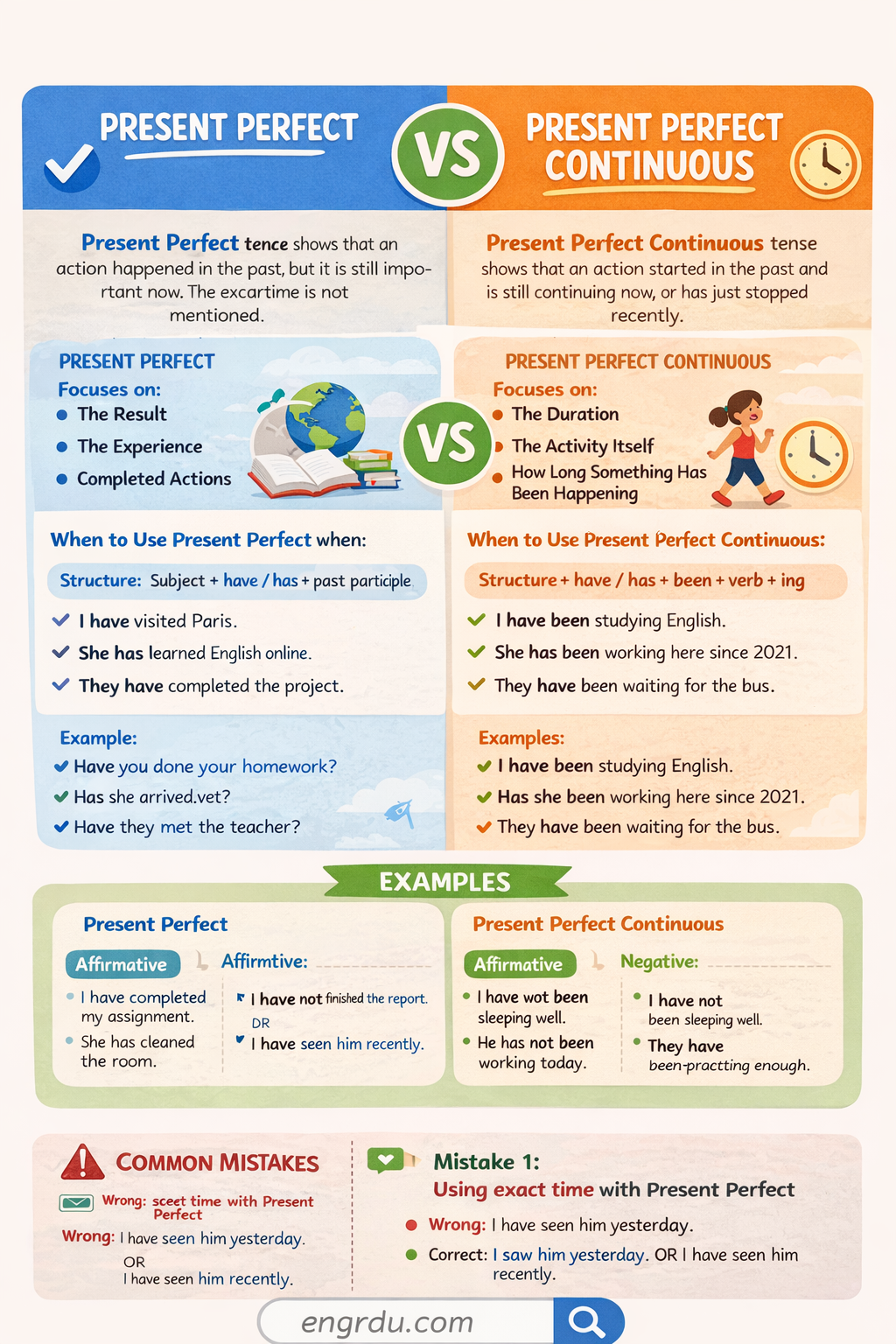
Present Perfect Tense
The Present Perfect tense shows that an action happened in the past, but it is still important now. The exact time is not mentioned.
It focuses on:
- the result
- the experience
- the completed action
Example:
I have finished my homework.
(The homework is done now.)
Present Perfect Continuous Tense
The Present Perfect Continuous tense shows that an action started in the past and is still continuing now, or has just stopped recently.
It focuses on:
- the duration
- the activity itself
- how long something has been happening
Example:
I have been doing my homework for two hours.
(The focus is on the time spent.)
Forms of Present Perfect
Structure:
Subject + have / has + past participle
Examples:
- I have visited Paris.
- She has learned English online.
- They have completed the project.
Forms of Present Perfect Continuous
Structure:
Subject + have / has + been + verb + ing
Examples:
- I have been studying English.
- She has been working here since 2021.
- They have been waiting for the bus.
When to Use Present Perfect
Use Present Perfect when:
The result is important now
- He has lost his keys.
(He cannot find them now.)
Talking about life experience
- I have travelled to Spain.
- She has never eaten sushi.
Recently completed actions
- We have just finished lunch.
With time words
- already, just, yet, ever, never
Example:
Have you ever watched this film?
When to Use Present Perfect Continuous
Use Present Perfect Continuous when:
The action started in the past and continues now
- I have been living in London for five years.
The focus is on duration
- She has been studying all night.
The action has just stopped and shows a result
- You are tired because you have been running.
With time expressions
- for, since, all day, recently, lately
Example:
They have been working since morning.
Present Perfect Examples
Affirmative
- I have completed my assignment.
- She has cleaned the room.
- We have seen this movie.
Negative
- I have not finished the report.
- He has not called me.
- They have not visited Italy.
Questions
- Have you done your homework?
- Has she arrived yet?
- Have they met the teacher?
Present Perfect Continuous Examples
Affirmative
- I have been reading this book.
- She has been learning French.
- We have been waiting for an hour.
Negative
- I have not been sleeping well.
- He has not been working today.
- They have not been practising enough.
Questions
- Have you been studying English?
- Has she been working here long?
- Have they been arguing again?
Common Mistakes
Mistake 1: Using exact time with Present Perfect
Wrong:
I have seen him yesterday.
Correct:
I saw him yesterday.
OR
I have seen him recently.
Mistake 2: Using Present Perfect Continuous with finished actions
Wrong:
I have been finishing my homework.
Correct:
I have finished my homework.
Mistake 3: Confusing result and duration
Wrong:
I have been written three emails.
Correct:
I have written three emails.
Mistake 4: Forgetting “been” in continuous form
Wrong:
She has working all day.
Correct:
She has been working all day.
Present Perfect vs Present Perfect Continuous
| Feature | Present Perfect | Present Perfect Continuous |
|---|---|---|
| Focus | Result or completion | Duration or activity |
| Action | Often finished | Still continuing or just stopped |
| Common verbs | finish, complete, see | study, work, wait |
| Time words | already, ever, just | for, since, lately |
Present Perfect vs Present Perfect Continuous Exercises
Exercise 1: Choose the Correct Tense
Choose the correct form: Present Perfect or Present Perfect Continuous.
- I ________ (finish) my homework, so I can relax now.
- She ________ (study) English for three years.
- They ________ (clean) the house, and it looks great now.
- We ________ (wait) for the bus for twenty minutes.
- He ________ (write) five emails this morning.
Answers
- have finished
- has been studying
- have cleaned
- have been waiting
- has written
Exercise 2: Complete the Sentences
Fill in the blanks using the correct tense and form of the verb in brackets.
- I ________ ________ (work) on this project since Monday.
- She ________ ________ (complete) her online course.
- They ________ ________ (play) football all afternoon.
- We ________ ________ (see) this movie before.
- He ________ ________ (learn) French for two years.
Answers
- have been working
- has completed
- have been playing
- have seen
- has been learning
Tips for Learners
- Think about what you want to show: result or activity.
- Learn common verbs used with each tense.
- Practise using real-life situations.
- Read short texts and notice how these tenses are used.
- Speak aloud to build confidence.
- Do not translate directly from your first language.
Conclusion
The difference between Present Perfect and Present Perfect Continuous is simple when you focus on meaning. Use Present Perfect to talk about results and experiences. Use Present Perfect Continuous to talk about actions and time. With practice, these tenses will feel natural. Try using them in daily conversation, writing, and reading. Small steps will bring big improvement in your English.
Frequently Asked Questions
What is the main difference between Present Perfect and Present Perfect Continuous?
The main difference is focus. Present Perfect focuses on the result or completion of an action, while Present Perfect Continuous focuses on the action itself and how long it has been happening.
When should I use Present Perfect instead of Present Perfect Continuous?
Use Present Perfect when the action is finished and the result is important now, such as achievements, experiences, or completed tasks.
When is Present Perfect Continuous the better choice?
Use Present Perfect Continuous when you want to show duration or an ongoing activity that started in the past and is still continuing or has just stopped.
Can both tenses be correct in the same situation?
Yes, both can be correct, but the meaning changes. Present Perfect shows the result, while Present Perfect Continuous shows the process or effort.
What sentence structure is used for Present Perfect?
Present Perfect uses the structure: subject + have or has + past participle of the verb.
What sentence structure is used for Present Perfect Continuous?
Present Perfect Continuous uses the structure: subject + have or has + been + verb ending in ing.
Which time words are commonly used with each tense?
Present Perfect often uses words like already, just, ever, and yet. Present Perfect Continuous commonly uses for, since, lately, and recently.
Read More