A preposition is a word that shows the relationship between a noun or pronoun and other words in a sentence, such as in, on, at, or between. In this Grammar lesson, learning prepositions helps you speak, write, and understand English more accurately. Using them correctly makes your sentences clear and precise. In this blog post, you will explore the definition, types, uses, and examples of prepositions to practice and use confidently in everyday English.
Preposition Definition and Examples
A preposition is a word that links a noun, pronoun, or phrase to another word in a sentence. It often tells us where, when, or how something happens. Prepositions are always followed by a noun or pronoun, called the object of the preposition.
Example:
- The book is on the table.
Here, “on” is the preposition showing the relationship between “book” and “table”.
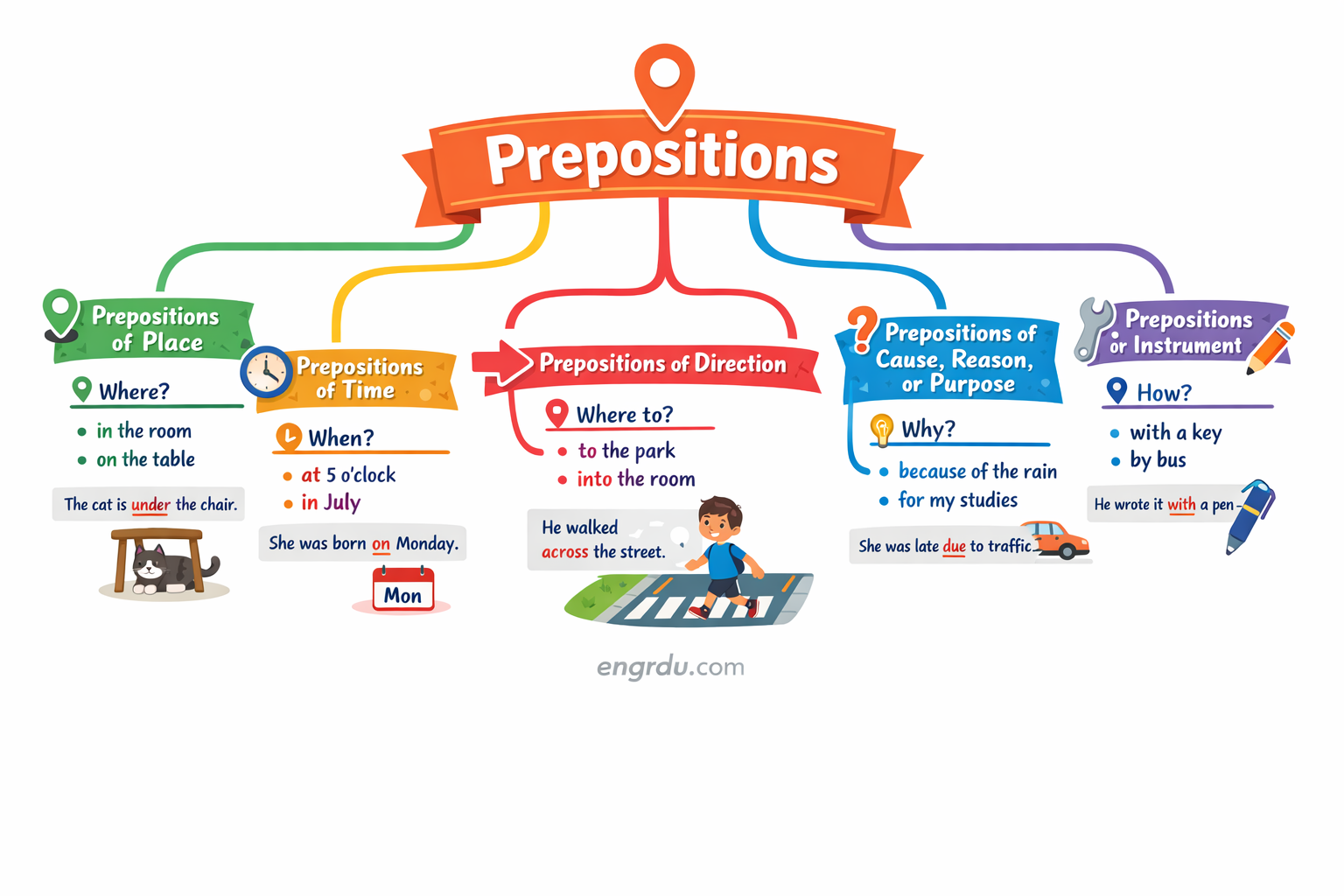
In simple terms, prepositions are words that help us connect things in a sentence so the meaning is clear.
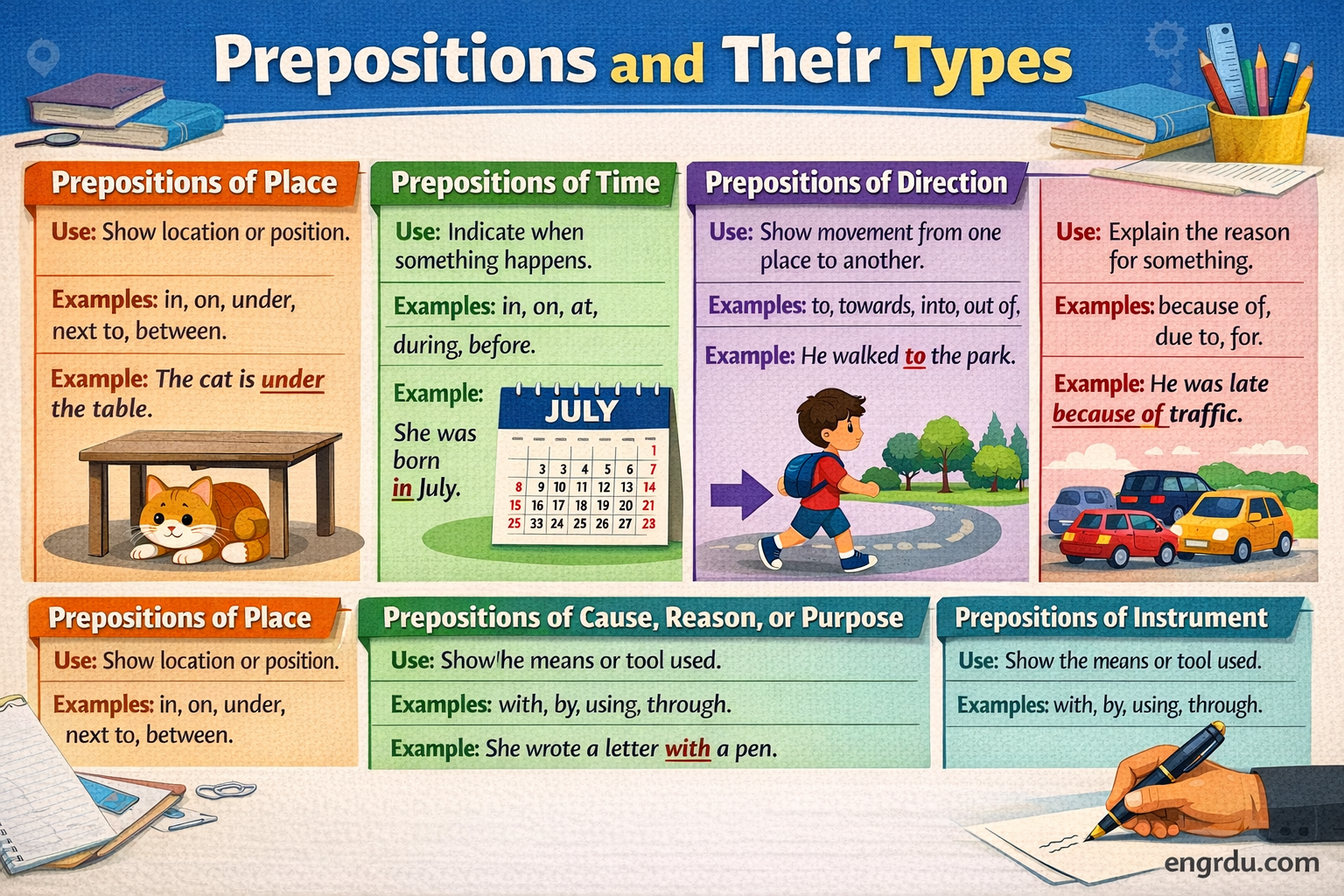
Types of Prepositions
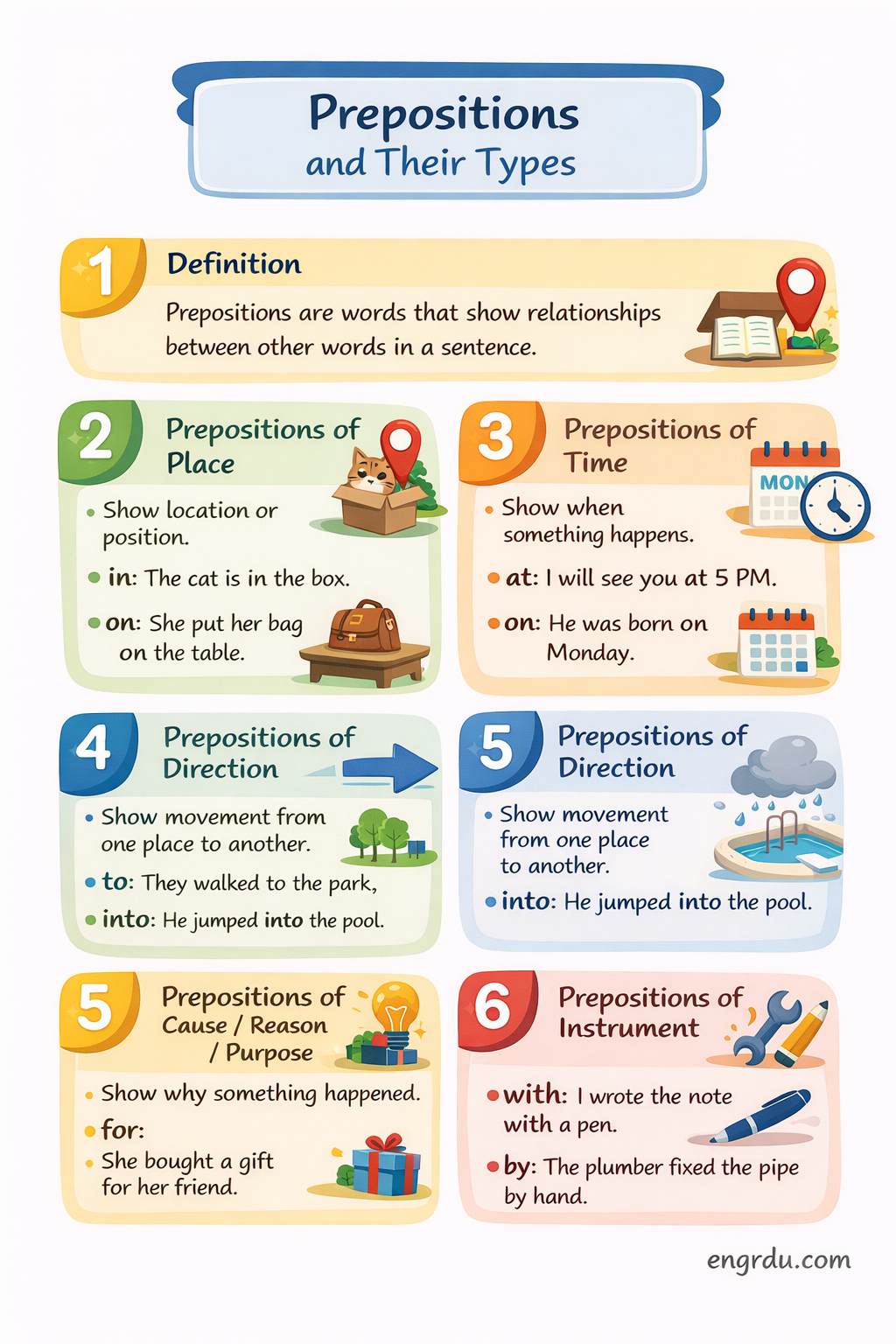
Prepositions can be divided into different categories based on their usage. Here are the main types:
1. Prepositions of Place / Position
These prepositions tell where something is located.
Common Words: in, on, at, under, above, behind, between, near, next to.
Examples:
- The cat is under the chair.
- She lives in London.
- The picture is on the wall.
2. Prepositions of Time
These prepositions indicate when something happens.
Common Words: at, on, in, during, since, for, by, until.
Examples:
- The meeting is at 10 a.m.
- I was born in January.
- She has been studying English for three years.
3. Prepositions of Direction / Movement
These prepositions show movement from one place to another.
Common Words: to, into, onto, towards, through, across, along.
Examples:
- He is going to the market.
- The dog jumped into the garden.
- Walk along the river.
4. Prepositions of Cause, Reason, or Purpose
These prepositions explain why something happens.
Common Words: because of, due to, owing to, for, with.
Examples:
- The match was cancelled because of rain.
- She got a prize for her hard work.
5. Prepositions of Instrument / Means
These prepositions indicate how something is done or what is used.
Common Words: by, with, using.
Examples:
- She wrote the letter with a pen.
- The song was sung by the choir.
Rules or Usage of Prepositions
Using prepositions correctly can be tricky. Here are some simple rules:
Always follow a noun or pronoun:
- Correct: He is sitting on the chair.
- Incorrect: He is sitting on.
Do not add extra prepositions at the end unnecessarily:
- Correct: Where are you going?
- Incorrect: Where are you going to? (In informal English, this is sometimes used, but formally it’s better without “to”.)
Some verbs, adjectives, and nouns need specific prepositions:
- Interested in reading
- Good at football
- Depend on friends
Use the right preposition for time and place:
- At: exact time or place (at 5 p.m., at the bus stop)
- In: months, years, long periods, countries, cities (in July, in 2020, in France)
- On: days, dates, surfaces (on Monday, on 1st January, on the table)
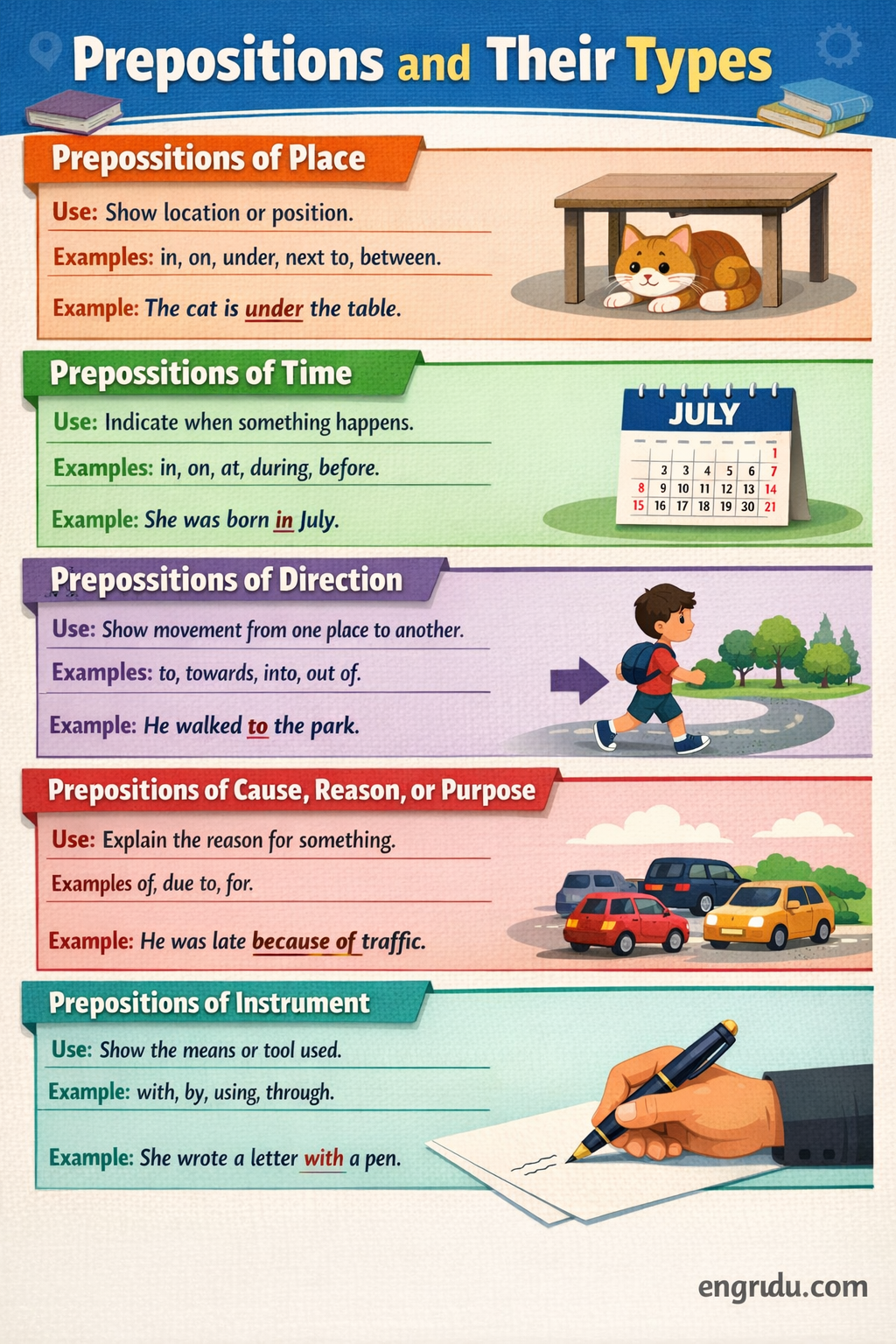
List of Prepositions in English
| in | on | at | under |
| above | below | near | next to |
| between | behind | over | across |
| through | towards | into | onto |
| from | to | with | by |
| about | for | of | off |
| during | since | until | along |
| without | within | against | among |
| around | like | after | before |
| opposite | despite | according to | because of |
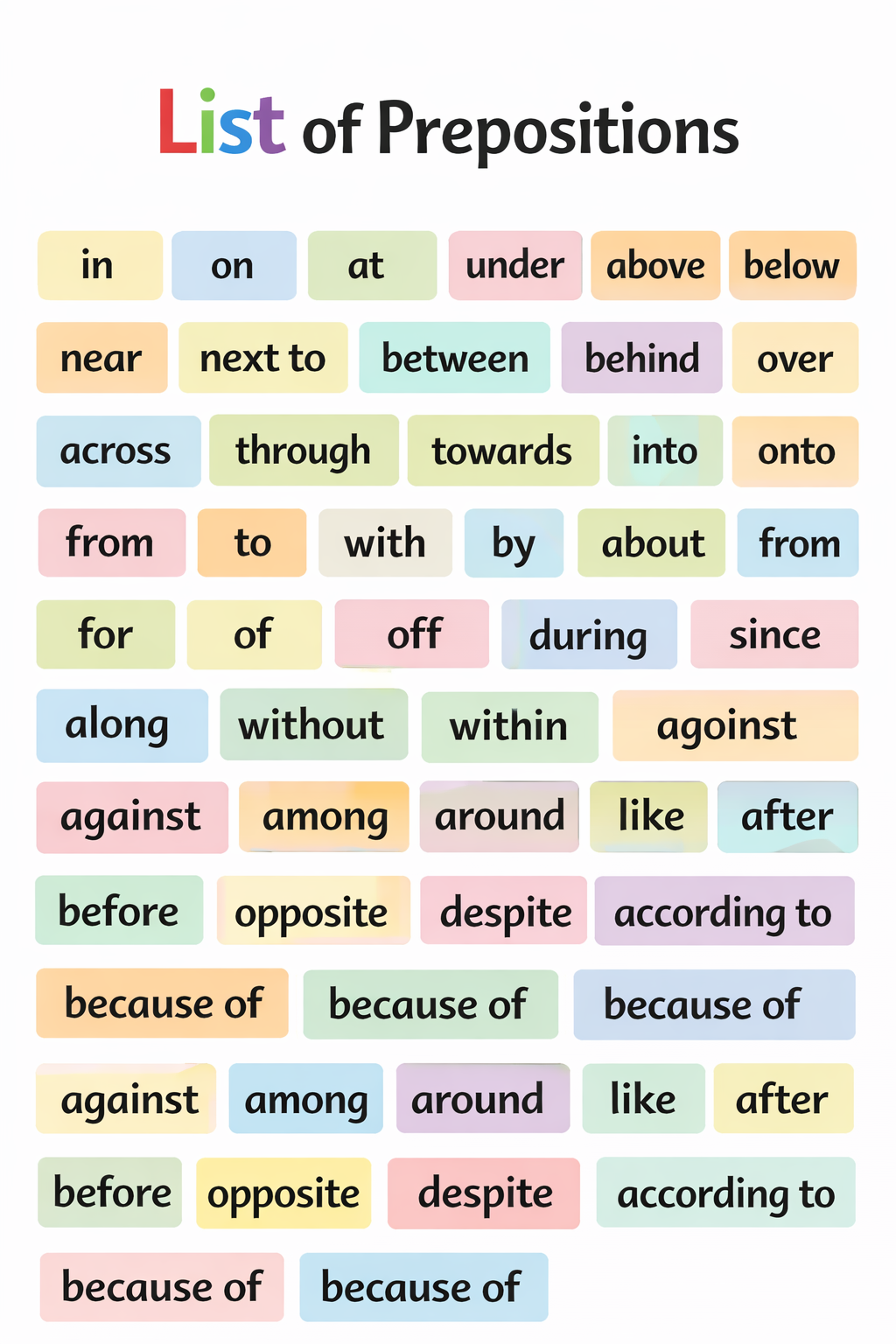
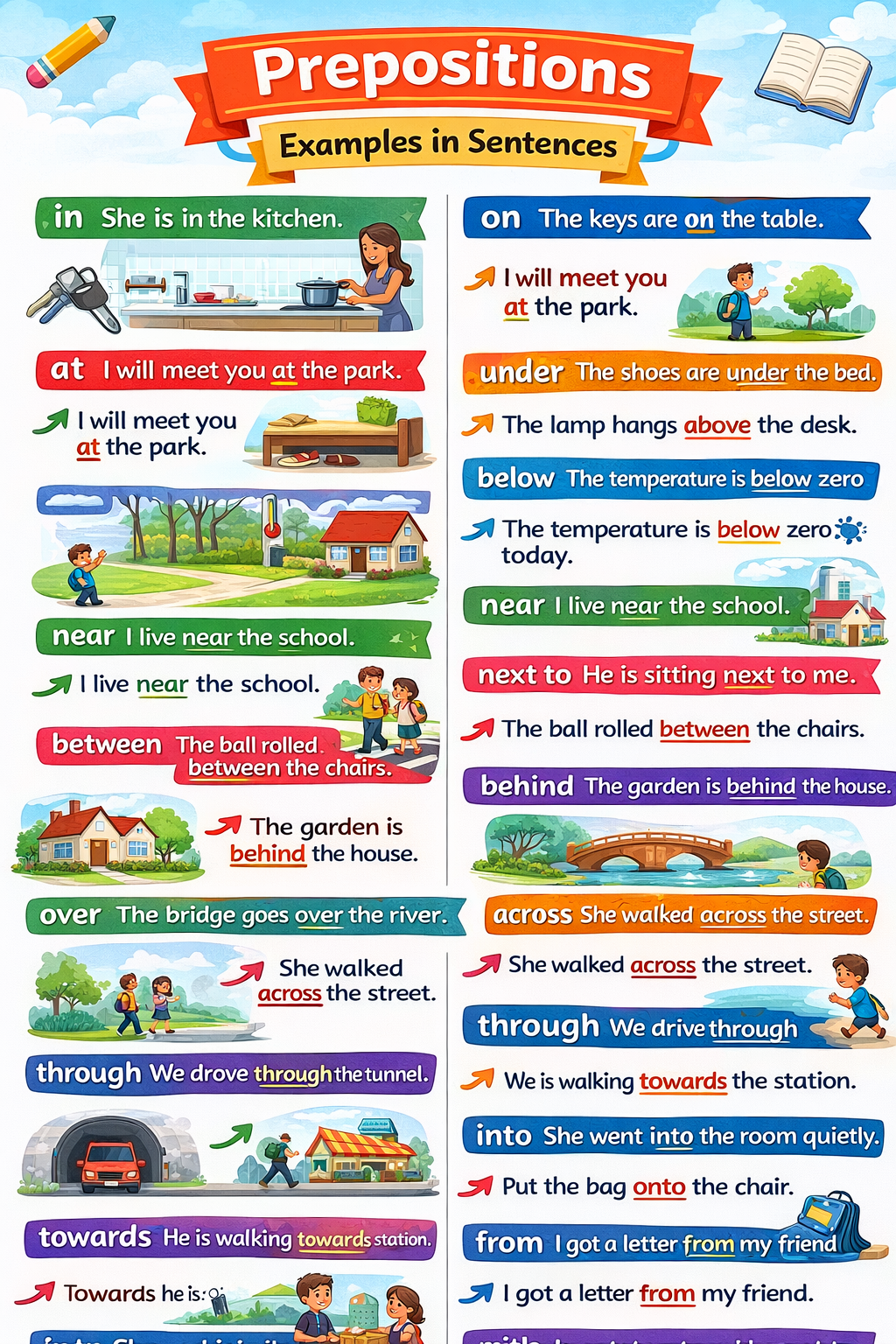
Examples of Prepositions in Sentences
| Preposition | Example Sentence |
|---|---|
| in | She is in the kitchen. |
| on | The keys are on the table. |
| at | I will meet you at the park. |
| under | The shoes are under the bed. |
| above | The lamp hangs above the desk. |
| below | The temperature is below zero today. |
| near | I live near the school. |
| next to | He is sitting next to me. |
| between | The ball rolled between the chairs. |
| behind | The garden is behind the house. |
| over | The bridge goes over the river. |
| across | She walked across the street. |
| through | We drove through the tunnel. |
| towards | He is walking towards the station. |
| into | She went into the room quietly. |
| onto | Put the bag onto the chair. |
| from | I got a letter from my friend. |
| to | We are going to the market. |
| with | I went shopping with my sister. |
| by | The book was written by a famous author. |
| about | We talked about our holiday plans. |
| for | This gift is for you. |
| of | She is a friend of mine. |
| off | Take your shoes off before entering. |
| during | I slept during the movie. |
| since | I have known him since 2015. |
| until | Wait here until I come back. |
| along | We walked along the river. |
| without | He left the house without his bag. |
| within | You must finish the work within two days. |
| against | The chair is leaning against the wall. |
| among | She shared her sweets among the children. |
| around | We walked around the park. |
| like | He looks like his father. |
Common Mistakes with Prepositions
Learners often make mistakes with prepositions. Here are some to watch out for:
Using the wrong preposition:
- Wrong: I am good in maths.
- Correct: I am good at maths.
Omitting necessary prepositions:
- Wrong: He is waiting bus.
- Correct: He is waiting for the bus.
Adding unnecessary prepositions:
- Wrong: Where are you going to? (informal use)
- Correct: Where are you going?
Confusing prepositions of time:
- Wrong: I was born at January.
- Correct: I was born in January.
Comparisons With Similar Grammar Points
Prepositions can be confused with adverbs or conjunctions. Here is a simple comparison:
| Word Type | Example | Use |
|---|---|---|
| Preposition | The cat is under the table | Shows place or relationship |
| Adverb | The cat is hiding under | Modifies the verb “hiding” |
| Conjunction | I stayed home because it rained | Connects two clauses |
Notice: Prepositions always have a noun or pronoun after them, while adverbs do not.
Tips for Learners
- Learn prepositions in groups (time, place, direction).
- Use flashcards to memorise common prepositions with examples.
- Read English daily and pay attention to prepositions in sentences.
- Practice with sentences instead of just lists.
- Check dictionaries or grammar guides if unsure which preposition to use.
Conclusion
Prepositions are small words, but they make English sentences clear and correct. They show time, place, direction, cause, and manner. By learning the types, rules, and common mistakes, you can use prepositions confidently. Remember to practice with real-life examples and always check which prepositions go with certain verbs, nouns, and adjectives.
Frequently Asked Questions
What is a preposition in English?
A preposition is a word that shows the relationship between a noun or pronoun and other words in a sentence, often indicating time, place, or direction.
What are the main types of prepositions?
The main types of prepositions are prepositions of place, time, direction, cause, and instrument, each showing a different kind of relationship in a sentence.
How do prepositions show place or position?
Prepositions like in, on, under, above, and near show where something is located in relation to another object.
How do prepositions show time?
Prepositions such as at, on, in, since, and during indicate when something happens or the duration of an event.
Can prepositions show direction or movement?
Yes, prepositions like to, into, onto, through, and towards show movement from one place to another.
What is the correct way to use prepositions in a sentence?
A preposition is always followed by a noun or pronoun called its object, and it connects that object to another word, making the sentence clear.
What are common mistakes learners make with prepositions?
Common mistakes include using the wrong preposition, omitting necessary prepositions, or adding extra ones. Learning correct usage and examples helps avoid errors.
Read More