Many French phrases are commonly used in English conversations, writing, and formal expressions. In this Vocabulary lesson, learning French phrases used in English helps you understand, read, and speak English more fluently and naturally. Using these phrases correctly makes your communication more elegant and precise. In this blog post, you will explore French phrases used in English with meanings and examples to practice and use confidently in daily conversations.
What are French Phrases Used in English?
French phrases used in English are borrowed expressions that keep their original French form but are used in everyday English speech. They often make English sound more elegant, polite, or artistic.
Let’s look at some popular French phrases that are widely used in English — with their meanings and simple examples.
Common French Phrases Used in English
| French Phrase | Meaning (in English) | Example Sentence |
|---|---|---|
| C’est la vie | That’s life / It happens | I missed the bus again! C’est la vie! |
| Bon appétit | Enjoy your meal | Here’s your dinner. Bon appétit! |
| Faux pas | A social mistake | He made a real faux pas by talking during the movie. |
| Déjà vu | The feeling of experiencing something again | I walked into the café and felt déjà vu. |
| À la carte | Choose individual dishes from a menu | We ordered à la carte instead of the set meal. |
| Rendezvous | A meeting or appointment | Let’s have a rendezvous at the café tomorrow. |
| Coup d’état | Sudden overthrow of a government | The military staged a coup d’état last night. |
| Ballet | A type of dance | She started learning ballet at the age of six. |
| Fiancé / Fiancée | Engaged man / Engaged woman | Her fiancé works abroad. |
| Résumé | Summary of qualifications (CV) | He sent his résumé to several companies. |
Popular French Phrases in Daily English
Here are some phrases you might hear in movies, offices, or daily talk:
- Je ne sais quoi – means a special or charming quality that is hard to describe.
- Au revoir – means goodbye or see you again.
- En route – means on the way.
- Vis-à-vis – means in relation to or facing each other.
- Coup de grâce – means final blow or act that ends something.
French Phrases Used in Different Contexts
Sometimes, the same French phrase is used in different ways in English:
| Phrase | Context | Meaning | Example |
|---|---|---|---|
| Encore | Music / Shows | Ask for one more performance | The audience shouted “Encore!” after the song. |
| Elite | Society / Sports | The best or most powerful group | He trained with the elite team. |
| Cuisine | Food / Cooking | Style of cooking | French cuisine is known worldwide. |
| Genre | Art / Film / Books | Type or style | My favourite genre is comedy. |
Daily Used French Phrases in English with Meanings
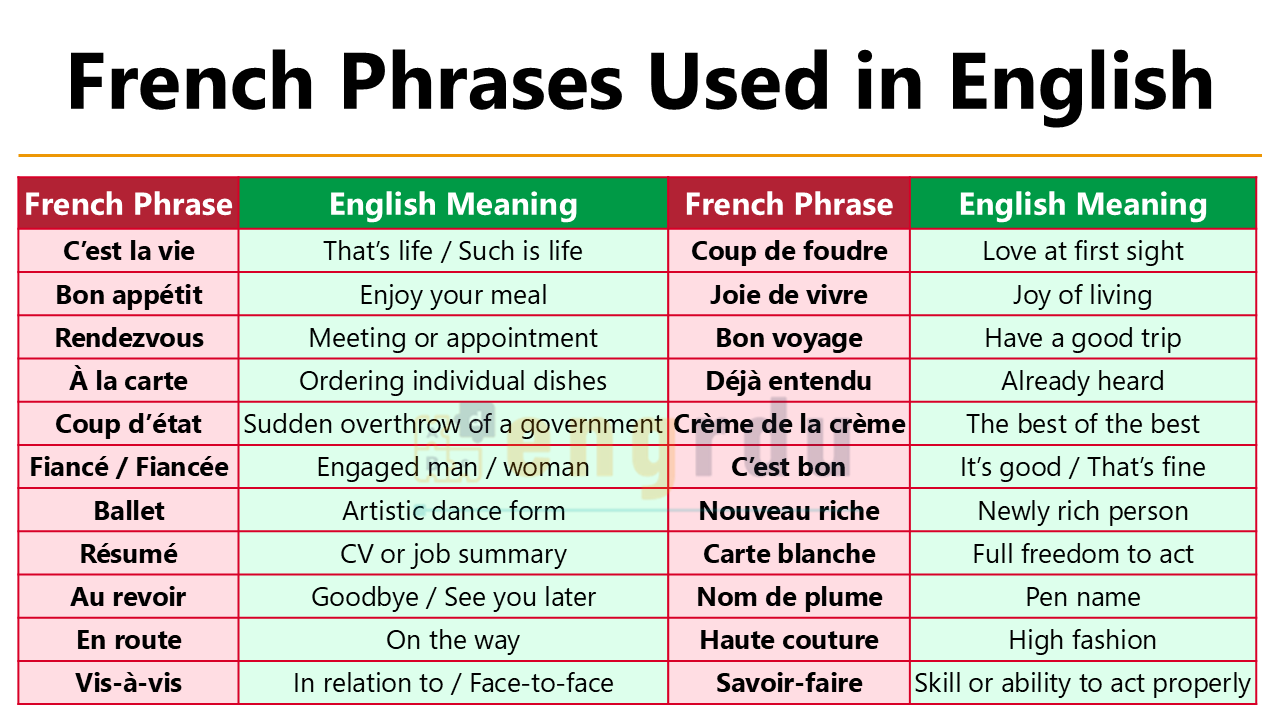
| French Phrase | Meaning (in English) | Example Sentence |
|---|---|---|
| C’est la vie | That’s life / Such is life | I lost my phone again, c’est la vie! |
| Bon appétit | Enjoy your meal | Here’s your food, bon appétit! |
| Faux pas | A social mistake | He made a faux pas by calling her the wrong name. |
| Déjà vu | Feeling of experiencing something again | This place gives me déjà vu. |
| Rendezvous | Meeting or appointment | Let’s have a rendezvous at the park. |
| À la carte | Ordering individual dishes | We chose dishes à la carte at the restaurant. |
| Coup d’état | Sudden overthrow of a government | The leader was removed after a coup d’état. |
| Fiancé / Fiancée | Engaged man / woman | Her fiancé is an engineer. |
| Ballet | Artistic dance form | She loves watching ballet performances. |
| Résumé | CV or job summary | He sent his résumé for the new position. |
| Encore | Repeat performance | The crowd shouted “Encore!” after the concert. |
| Je ne sais quoi | A special charm that can’t be explained | She has a certain je ne sais quoi about her. |
| Au revoir | Goodbye / See you later | They waved and said, “Au revoir!” |
| En route | On the way | I’m en route to your house. |
| Vis-à-vis | In relation to / Face-to-face | We sat vis-à-vis during the meeting. |
| Coup de grâce | Final act that ends something | The last goal was the coup de grâce for the team. |
| Savoir-faire | Skill or ability to act properly | He handled the issue with real savoir-faire. |
| Haute couture | High fashion | She’s wearing haute couture from Paris. |
| À la mode | In fashion / With ice cream (in food) | Apple pie à la mode is my favourite dessert. |
| Carte blanche | Full freedom to act | The manager gave her carte blanche for the project. |
| Nom de plume | Pen name | He writes under a nom de plume. |
| Tête-à-tête | Private conversation between two people | They had a short tête-à-tête after the meeting. |
| Coup de foudre | Love at first sight | It was coup de foudre when they met. |
| Joie de vivre | Joy of living | Her joie de vivre is inspiring. |
| Bon voyage | Have a good trip | Bon voyage! Have fun in Italy! |
| Déjà entendu | Already heard | That joke sounds déjà entendu. |
| Crème de la crème | The best of the best | He belongs to the crème de la crème of athletes. |
| C’est bon | It’s good / That’s fine | Your answer is correct — c’est bon! |
| Nouveau riche | Newly rich person | The nouveau riche often love showing off wealth. |
| Fait accompli | Something already done / Decided | By the time we arrived, it was a fait accompli. |

Why English Uses French Phrases
English has borrowed French words for centuries because of history and culture.
Many came after the Norman Conquest, while others entered through art, food, fashion, and politics.
Today, these words are part of modern English and make language more expressive and refined.
Summary on French Phrases
- Many French phrases are part of everyday English.
- They make speech sound smart and international.
- You don’t need to pronounce them perfectly — just use them naturally.
Learning a few French phrases used in English helps you communicate with more confidence and adds a touch of sophistication to your words.
Try using them in your daily talk — it’s a fun way to sound fluent and culturally aware!
FAQs about French Phrases Used in English
What are French phrases used in English?
French phrases used in English are words or expressions taken directly from the French language but used in everyday English. Examples include déjà vu, bon appétit, and c’est la vie. They make English sound more polite and stylish.
Why does English use so many French phrases?
English uses many French phrases because of historical contact between the two languages, especially after the Norman Conquest. Over time, French words entered English in areas like food, fashion, art, and culture.
What are the most common French phrases in English?
Some of the most common French phrases in English are faux pas (social mistake), rendezvous (meeting), à la carte (from the menu), en route (on the way), and je ne sais quoi (a special charm).
Can I use French phrases in daily English conversations?
Yes, you can! Many French expressions are part of everyday English. Using phrases like bon voyage or c’est bon makes your speech sound natural and adds a touch of elegance.
How can I learn and remember French phrases used in English?
Start by learning a few common French phrases with their meanings and examples. Try using them in short sentences daily. Reading articles, watching movies, or practising dialogues helps you remember them easily.
Read More