
Dialogues help you learn how people speak, listen, and understand English in real situations. In this Conversation lesson, you will see a dialogue between two students discussing online education, which teaches you how to ask questions, share opinions, and explain ideas. Practicing such dialogues improves your speaking and listening skills and makes your English more natural. In this blog post, you will explore a dialogue about online education to practice and use confidently in daily conversations.
What is Online Education?
Online education is learning through the internet instead of a traditional classroom. It can include:
| Key Points | Description |
|---|---|
| Meaning | Learning using digital platforms and devices. |
| Tools | Laptops, tablets, mobile phones, online courses. |
| Benefits | Flexible timing, easy access, self-paced learning. |
| Limitations | Less physical interaction, requires good internet. |
How to Write a Dialogue About Online Education
When writing a dialogue between students:
- Start with greetings → “Hi, how are you?”
- Choose a topic → Online classes, homework, apps, or experiences.
- Keep sentences short → Use simple, natural words.
- End politely → “See you in class” or “Good luck with your studies.”
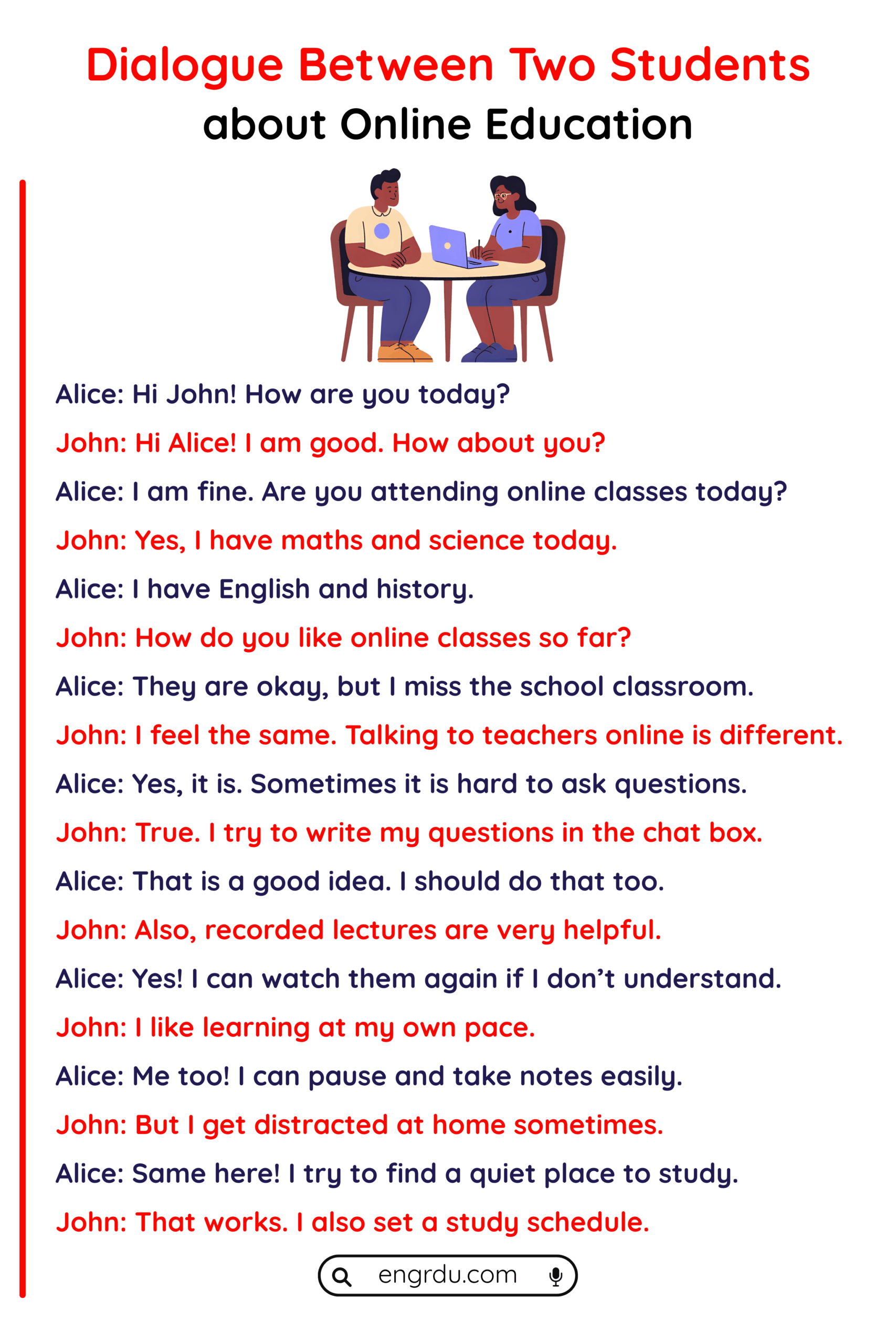
Dialogue Between Two Students about Online Education
Alice: Hi John! How are you today?
John: Hi Alice! I am good. How about you?
Alice: I am fine. Are you attending online classes today?
John: Yes, I have maths and science today.
Alice: I have English and history.
John: How do you like online classes so far?
Alice: They are okay, but I miss the school classroom.
John: I feel the same. Talking to teachers online is different.
Alice: Yes, it is. Sometimes it is hard to ask questions.
John: True. I try to write my questions in the chat box.
Alice: That is a good idea. I should do that too.
John: Also, recorded lectures are very helpful.
Alice: Yes! I can watch them again if I don’t understand.
John: I like learning at my own pace.
Alice: Me too! I can pause and take notes easily.
John: But I get distracted at home sometimes.
Alice: Same here! I try to find a quiet place to study.
John: That works. I also set a study schedule.
Alice: Oh! I should do that. I get lazy sometimes.
John: It really helps. You finish your work on time.
Alice: Do you do group study online?
John: Yes, we use video calls to discuss assignments.
Alice: That sounds fun! I like group discussions.
John: It helps to understand difficult topics.
Alice: I can try that this weekend.
John: Sure! We can study together online.
Alice: Do you like quizzes in online classes?
John: Yes! They are short and interesting.
Alice: I like them too. They make learning fun.
John: What about homework? Is it easy online?
Alice: It is easier to submit online.
John: True! No need to carry books everywhere.
Alice: But I sometimes forget the deadline.
John: I use reminders on my phone. It helps a lot.
Alice: That’s smart! I will try it.
John: Online learning also saves travel time.
Alice: Yes! I can sleep a little longer in the morning.
John: Haha! Same here. But sitting long hours is tiring.
Alice: Yes, we should take short breaks.
John: Good idea. It helps to stay fresh and focused.
Advantages of Online Education
- Flexible timing – Study anytime, anywhere.
- Access to resources – Videos, quizzes, eBooks, and lectures.
- Self-paced learning – Learn at your own speed.
- Cost-effective – Less travel and lower tuition fees.
Challenges of Online Education
- Limited interaction – Fewer chances to speak directly with teachers.
- Distractions at home – Hard to stay focused.
- Technical problems – Requires stable internet and devices.
- Less physical activity – Sitting long hours can be tiring.
Tips for Students in Online Education
- Make a study schedule and follow it.
- Use a quiet space to reduce distractions.
- Join online group discussions to stay interactive.
- Take short breaks to avoid fatigue.
- Ask questions whenever you don’t understand something.
A dialogue between two students about online education is a great way to practice English conversation while learning about modern education. Online classes have many benefits, but also some challenges. Practising such dialogues helps learners improve speaking, listening, and writing skills, making them confident in real-life conversations.
FAQs about Dialogue Between Two Students about Online Education
What is a dialogue between two students about online education?
A dialogue between two students about online education is a short conversation where they discuss online classes, apps, homework, or learning experiences.
Example:
Alice: How is your online class today?
John: It was good! I liked the interactive quiz.
How can I write a dialogue about online education?
-Start with greetings: “Hi, how are you?”
-Talk about online classes, subjects, or homework.
-Keep sentences short and simple.
-End politely: “See you in class!”
Example:
Emma: Did you watch the recorded lecture?
Liam: Yes! It helped me understand the topic better.
What are the benefits of online education for students?
Online education allows flexible timing, self-paced learning, access to online resources, and learning from home.
Example Dialogue:
Sophie: I can attend my maths class anytime online!
Mia: That’s great! I love studying at my own speed too.
What challenges do students face in online education?
Students may face distractions at home, less teacher interaction, technical problems, and long sitting hours.
Example Dialogue:
Oliver: I get distracted easily at home.
Ella: Me too! I make a quiet study corner to focus better.
How can students make online learning effective?
Create a study schedule
Participate in group discussions online
Take short breaks
Ask questions to clarify doubts
Example Dialogue:
Noah: Let’s plan a group study call this weekend.
Grace: Great idea! It will make learning fun and easier.
Read More