
A conjunction is a word that connects words, phrases, or clauses, such as and, but, and because. In this Grammar lesson, learning conjunctions helps you write, speak, and understand English more clearly. Using them correctly makes your sentences smoother and more connected. In this blog post, you will explore the definition, types, uses, and examples of conjunctions to practice and use confidently in everyday English.
Conjunction Definition and Examples
A conjunction is a word that joins words, phrases, or clauses together. It helps show the relationship between ideas, such as addition, contrast, choice, reason, or time.
In simple words, a conjunction connects ideas so that sentences flow better.
Examples:
- I like tea and coffee.
- She wanted to go out, but it was raining.
- We stayed at home because it was cold.
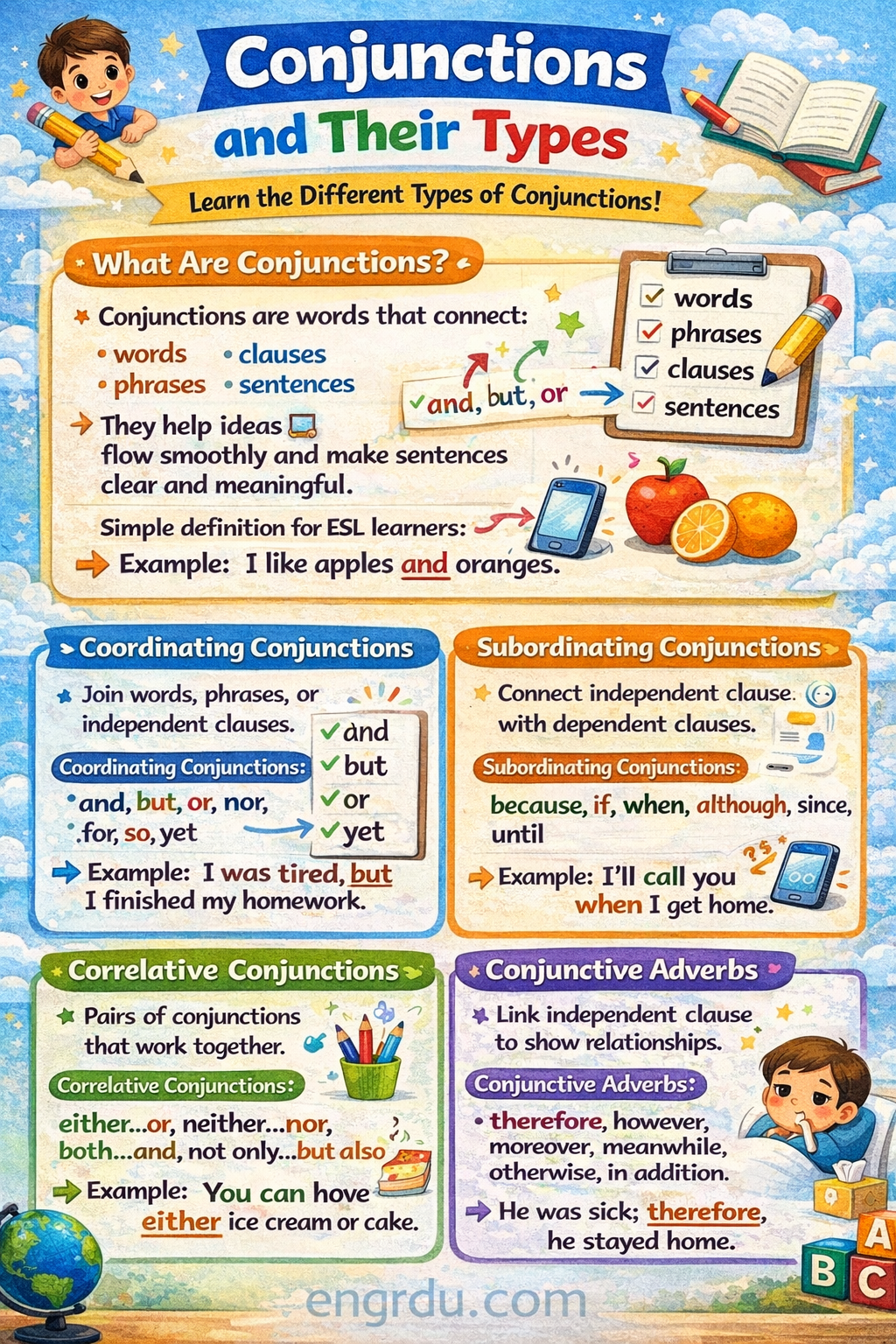
Types of Conjunctions
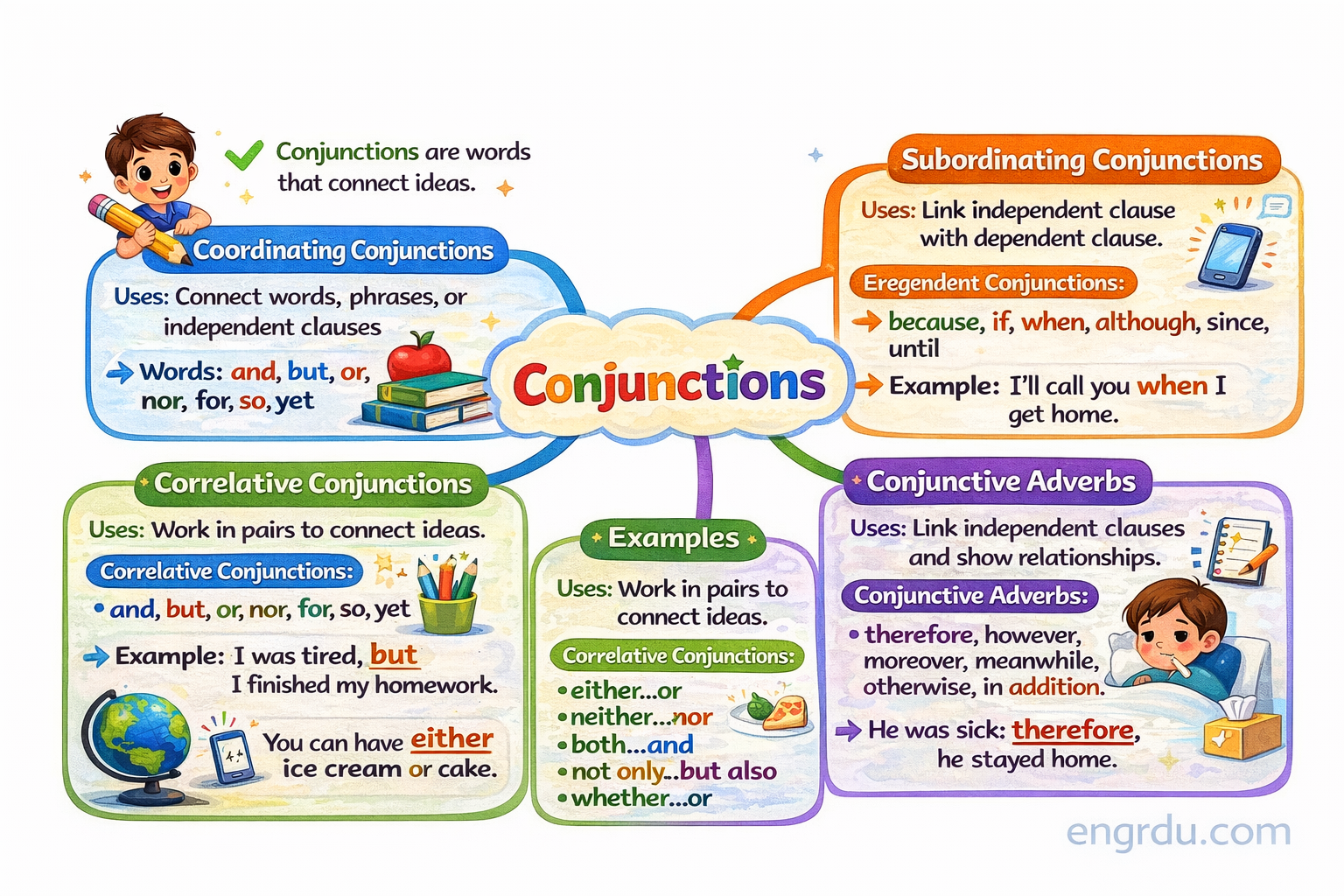
There are three main types of conjunctions in English. Each type has a different job.
1. Coordinating Conjunctions
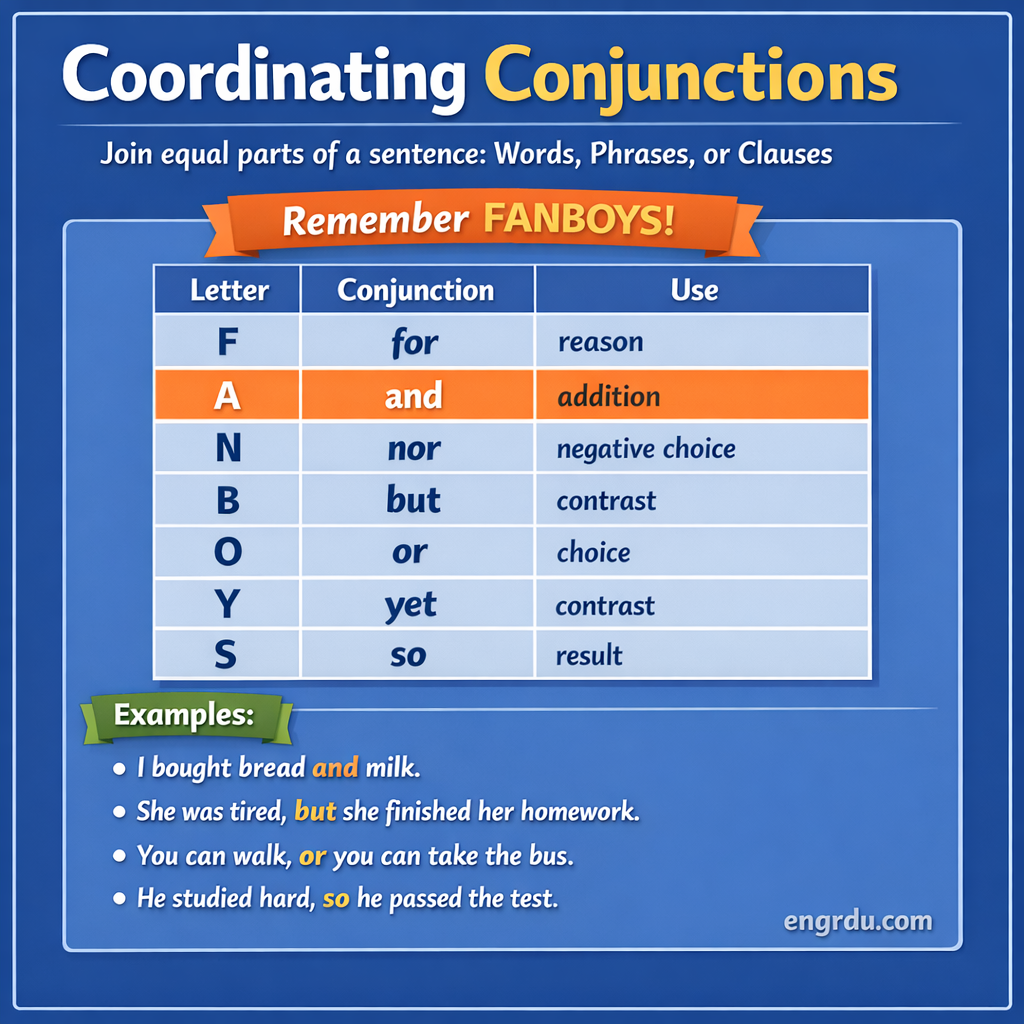
Coordinating conjunctions join equal parts of a sentence. These parts can be words, phrases, or independent clauses.
The most common coordinating conjunctions are remembered by FANBOYS:
| Letter | Conjunction | Use |
|---|---|---|
| F | for | reason |
| A | and | addition |
| N | nor | negative choice |
| B | but | contrast |
| O | or | choice |
| Y | yet | contrast |
| S | so | result |
Examples:
- I bought bread and milk.
- She was tired, but she finished her homework.
- You can walk, or you can take the bus.
- He studied hard, so he passed the test.
2. Subordinating Conjunctions
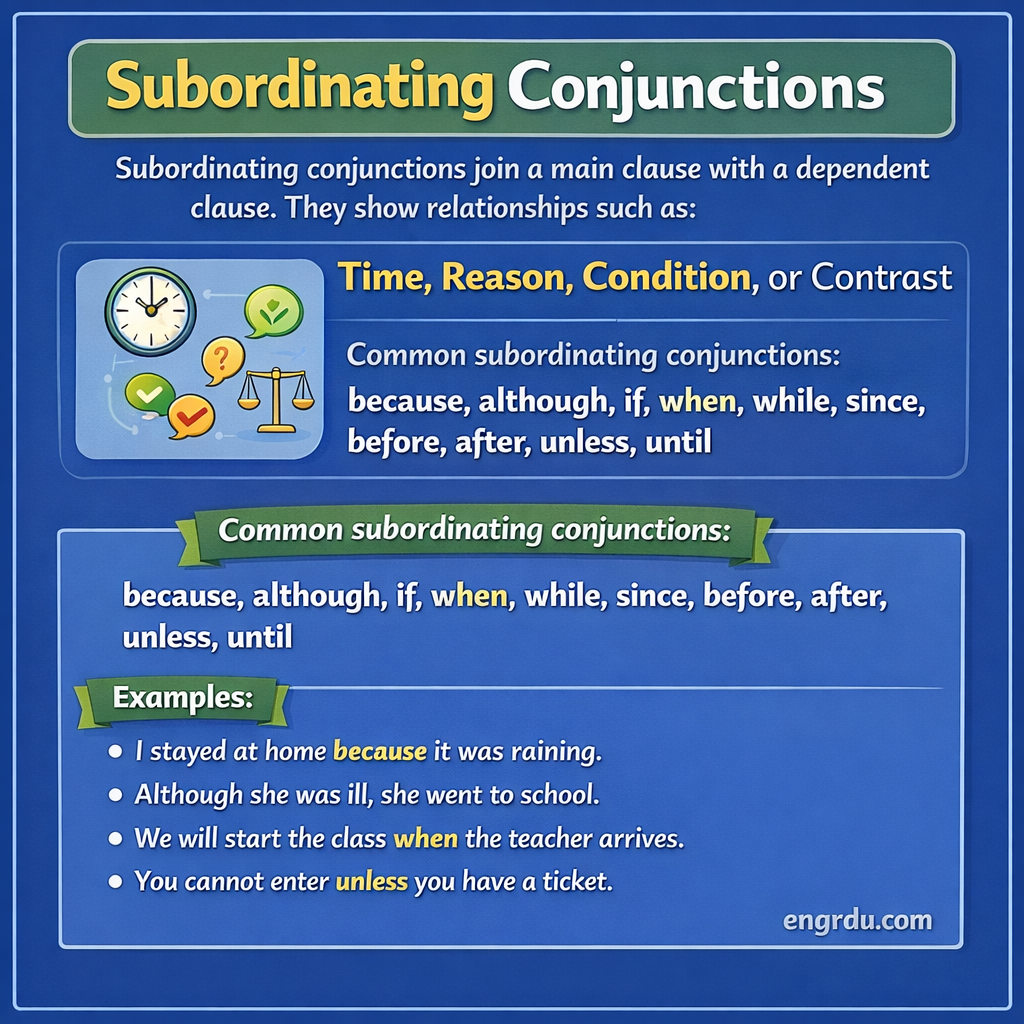
Subordinating conjunctions join a main clause with a dependent clause. They show relationships such as time, reason, condition, or contrast.
Common subordinating conjunctions:
because, although, if, when, while, since, before, after, unless, until
Examples:
- I stayed at home because it was raining.
- Although she was ill, she went to school.
- We will start the class when the teacher arrives.
- You cannot enter unless you have a ticket.
3. Correlative Conjunctions
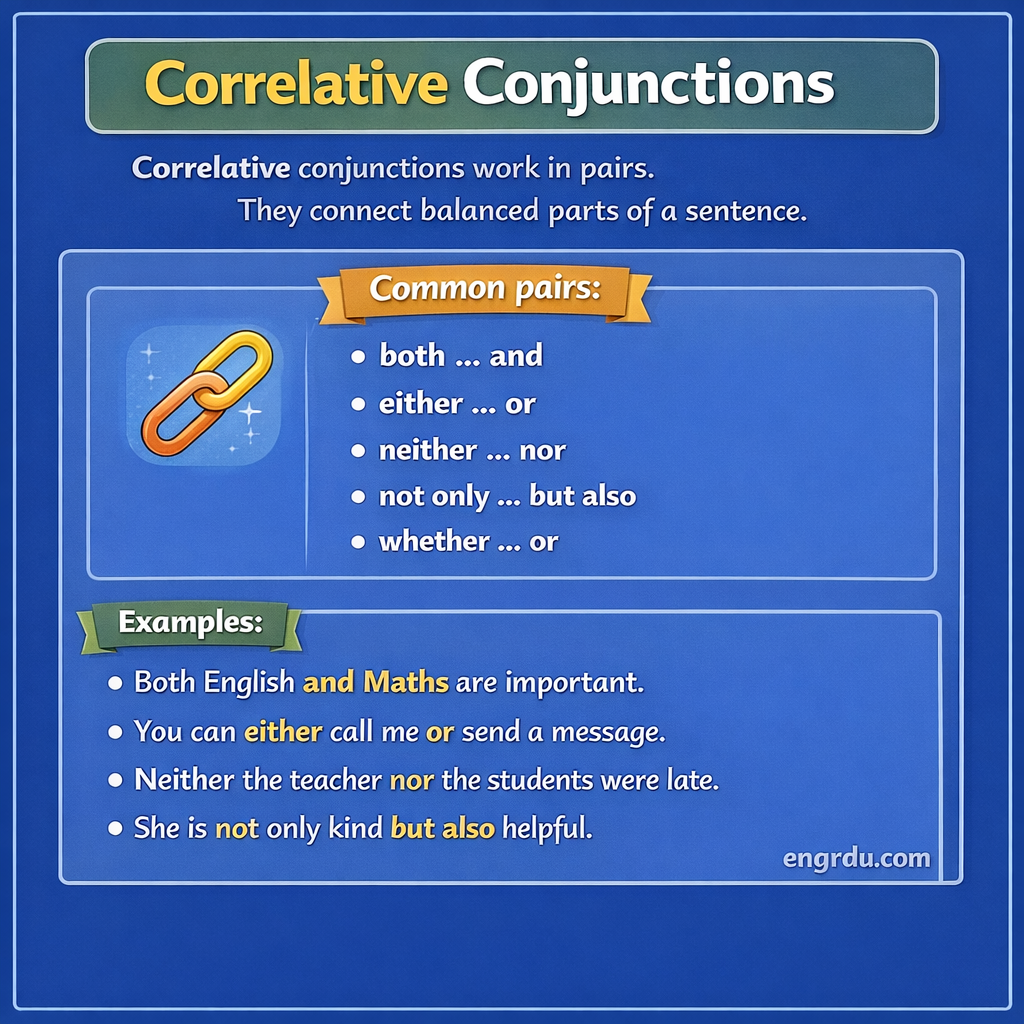
Correlative conjunctions work in pairs. They connect balanced parts of a sentence.
Common pairs:
- both … and
- either … or
- neither … nor
- not only … but also
- whether … or
Examples:
- Both English and Maths are important.
- You can either call me or send a message.
- Neither the teacher nor the students were late.
- She is not only kind but also helpful.
4. Conjunctive Adverbs
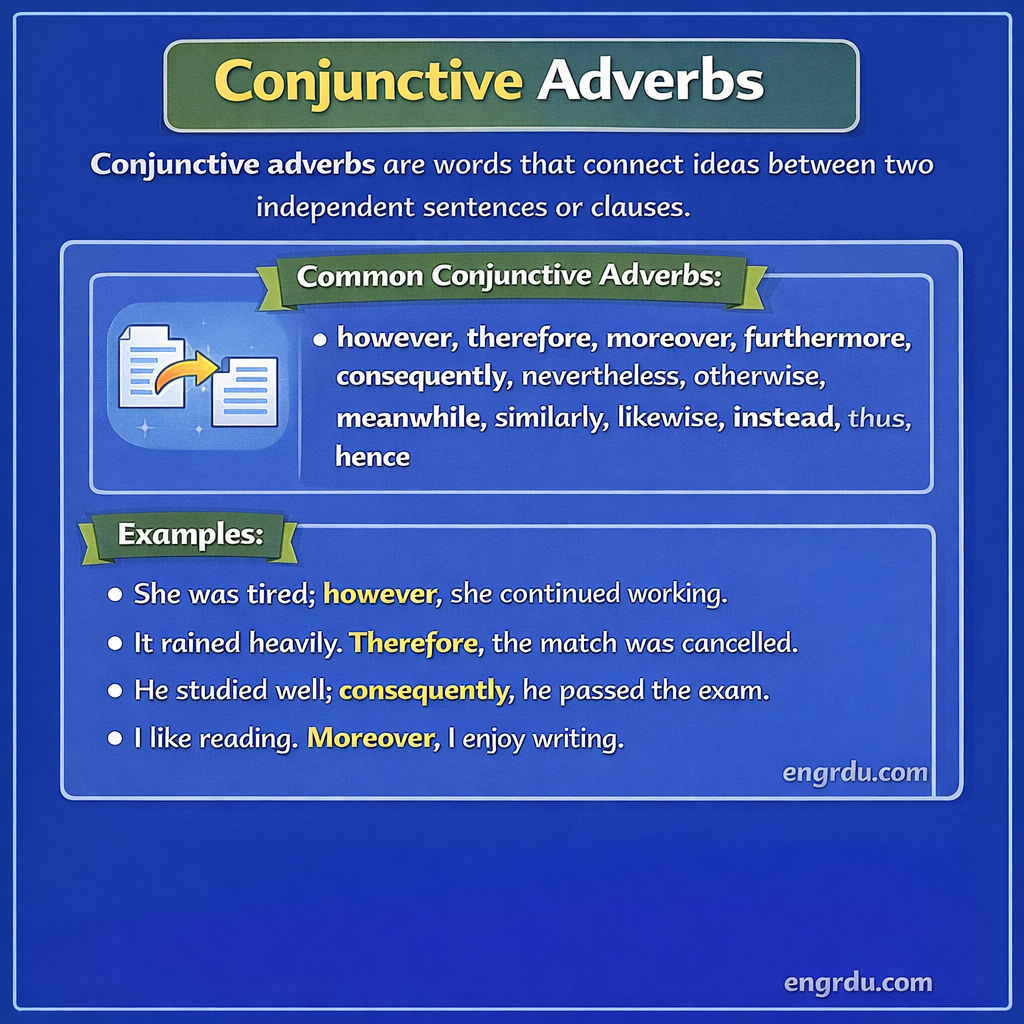
Conjunctive adverbs are words that connect ideas between two independent sentences or clauses. They do not join sentences in the same way as conjunctions like and or but. Instead, they show the relationship between ideas, such as contrast, result, reason, or addition.
Common Conjunctive Adverbs:
however, therefore, moreover, furthermore, consequently, nevertheless, otherwise, meanwhile, similarly, likewise, instead, thus, hence
Examples:
- She was tired; however, she continued working.
- It rained heavily. Therefore, the match was cancelled.
- He studied well; consequently, he passed the exam.
- I like reading. Moreover, I enjoy writing.
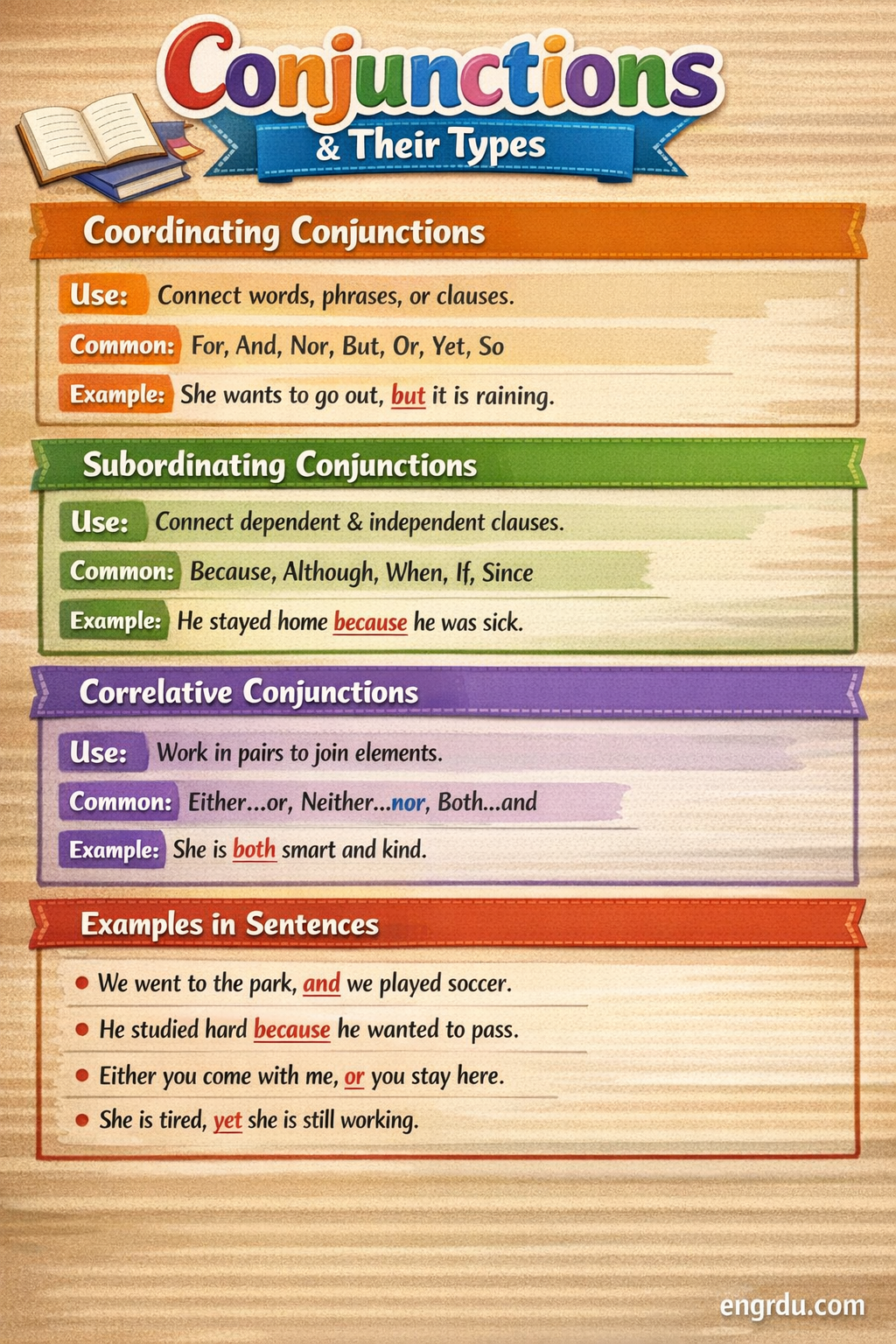
Conjunctions and Their Types Infographic
Rules and Usage of Conjunctions
Using conjunctions correctly is important for clear English. Follow these simple rules.
Rule 1: Do not join sentences without a conjunction
❌ I like coffee I like tea.
✔ I like coffee and I like tea.
Rule 2: Use a comma with coordinating conjunctions (when needed)
When joining two full sentences, use a comma before the conjunction.
✔ I wanted to help, but I was busy.
✔ She studied hard, so she succeeded.
Rule 3: Subordinating conjunctions can start a sentence
When the dependent clause comes first, use a comma.
✔ Because it was late, we went home.
✔ We went home because it was late.
Rule 4: Keep balance with correlative conjunctions
The sentence parts after each word should match.
✔ She likes both reading and writing.
❌ She likes both reading and to write.
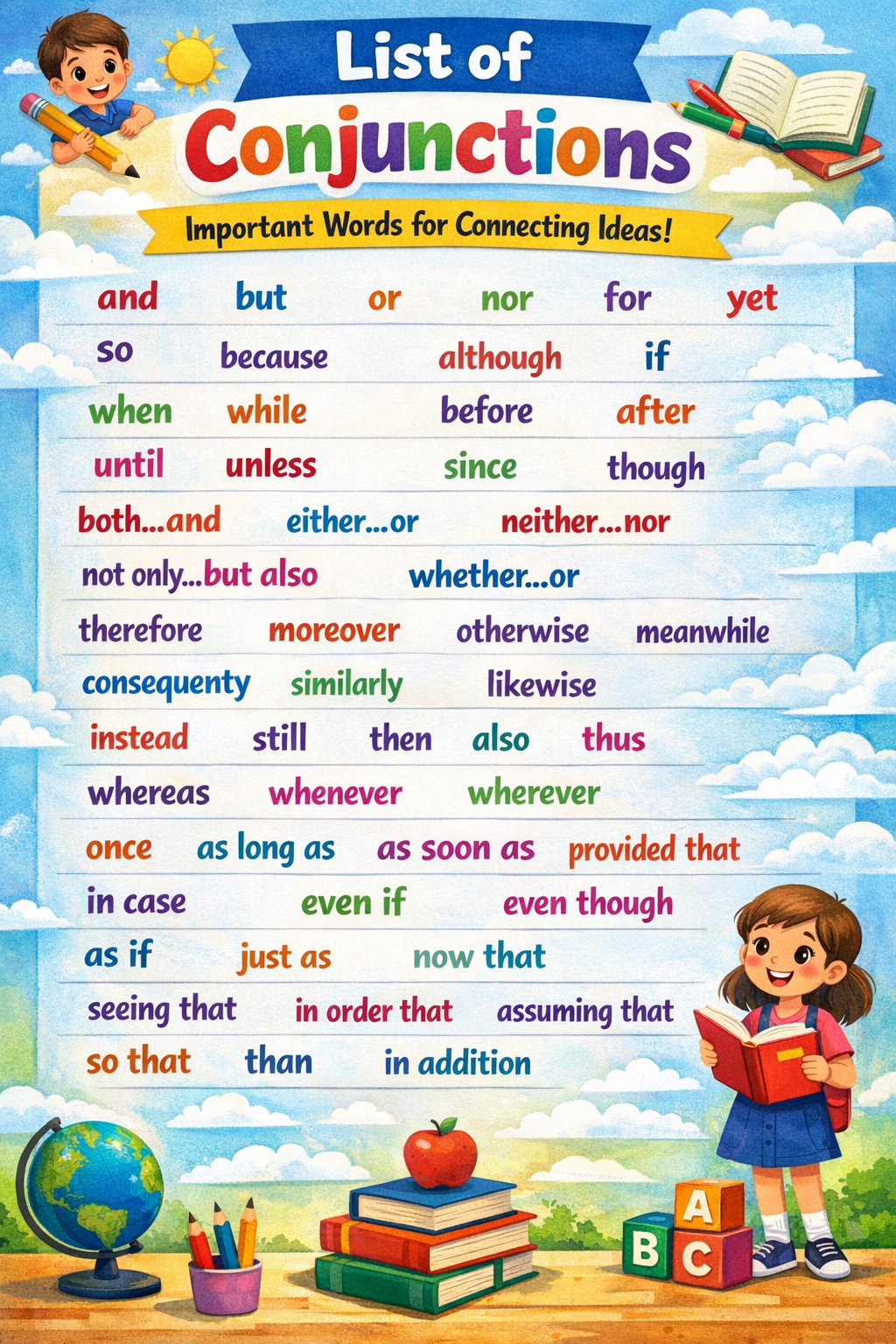
List of Conjunctions
| and | but | or | nor |
| for | yet | so | because |
| although | if | when | while |
| before | after | until | unless |
| since | though | both…and | either…or |
| neither…nor | not only…but also | whether…or | however |
| therefore | moreover | otherwise | meanwhile |
| consequently | similarly | likewise | instead |
| still | then | also | thus |
| hence | whereas | whenever | wherever |
| once | as long as | as soon as | provided that |
| in case | even if | even though | as if |
| just as | now that | seeing that | in order that |
| assuming that | so that | than | than ever |
| lest | for fear that | inasmuch as | in addition |
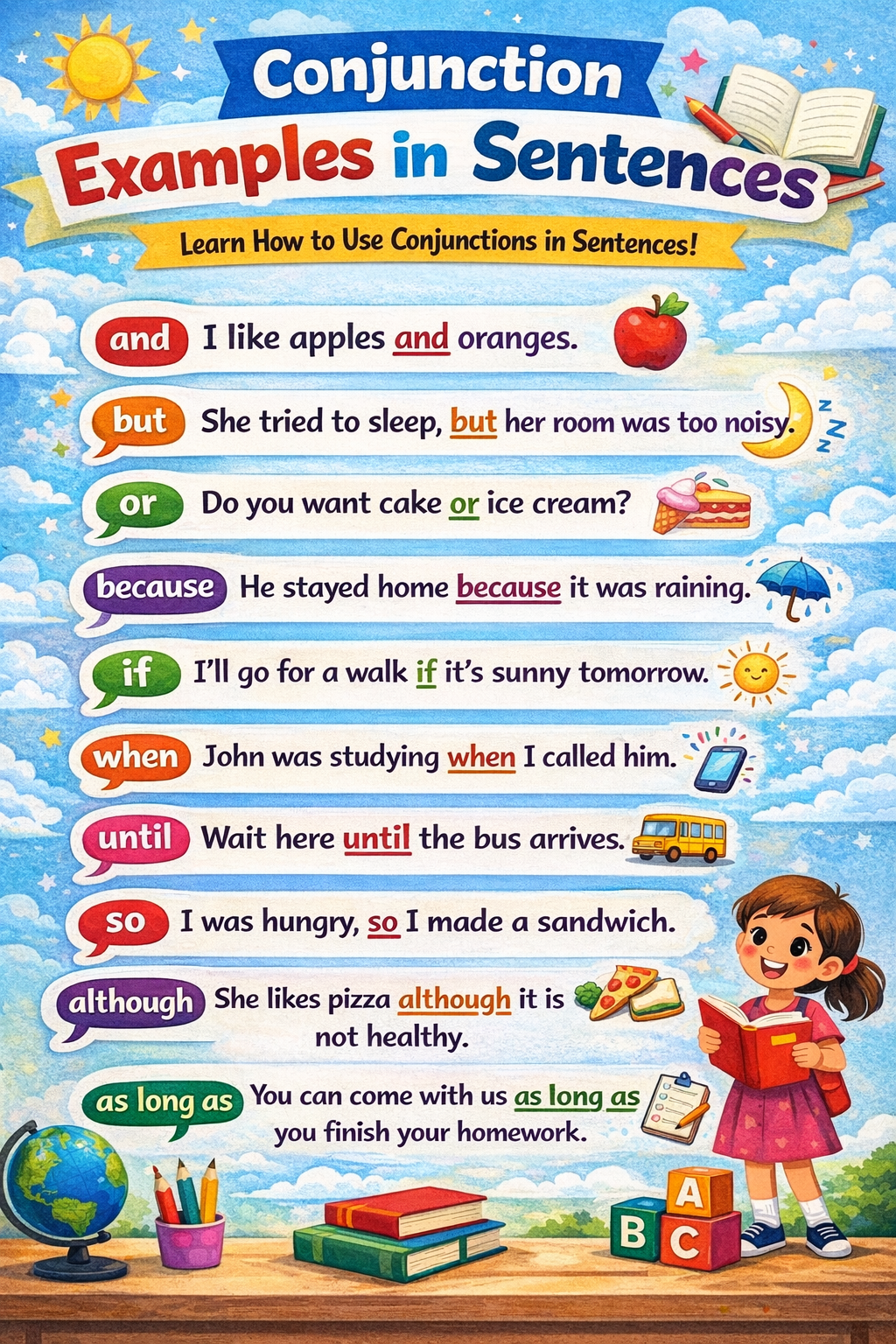
Conjunction Examples in Sentences
| Conjunction | Example Sentence |
|---|---|
| and | I like tea and coffee. |
| but | She was tired, but she finished her homework. |
| or | Do you want tea or coffee? |
| nor | He neither smiled nor spoke. |
| for | I stayed home, for it was raining. |
| yet | He is young, yet very responsible. |
| so | It was cold, so we wore jackets. |
| because | She left early because she was sick. |
| although | Although it rained, we went outside. |
| if | You can play outside if you finish your homework. |
| when | Call me when you arrive. |
| while | I read a book while waiting for the bus. |
| before | Wash your hands before eating. |
| after | We went home after the movie ended. |
| until | Wait here until I return. |
| unless | You cannot enter unless you have a ticket. |
| since | I have known her since childhood. |
| though | He failed the test, though he tried hard. |
| both…and | Both my brother and sister are teachers. |
| either…or | You can either call me or send a message. |
| neither…nor | Neither the teacher nor the students were late. |
| not only…but also | She is not only smart but also kind. |
| whether…or | I don’t know whether I should stay or go. |
| however | I was tired; however, I continued working. |
| therefore | He studied hard; therefore, he passed the exam. |
| moreover | The book is interesting; moreover, it is short. |
| otherwise | Hurry up, otherwise we will miss the bus. |
| meanwhile | She cooked dinner; meanwhile, he set the table. |
| consequently | It rained heavily; consequently, the match was canceled. |
| similarly | She loves painting; similarly, her brother enjoys drawing. |
| likewise | He studied French; likewise, he is learning Spanish. |
| instead | I wanted coffee, but I drank tea instead. |
| still | It was raining; still, they went for a walk. |
| thus | He worked hard; thus, he succeeded. |
| hence | She didn’t prepare; hence, she failed the test. |
| whereas | He is tall, whereas his brother is short. |
| whenever | Call me whenever you need help. |
| wherever | Go wherever you like. |
| once | Once you finish, you can rest. |
| as long as | You can stay out as long as you are careful. |
| as soon as | Call me as soon as you arrive. |
| provided that | You can borrow it provided that you return it. |
| in case | Take an umbrella in case it rains. |
| even if | I will help you even if I am busy. |
| seeing that | Seeing that it’s late, we should leave now. |
Common Mistakes Learners Make
Mistake 1: Using too many conjunctions in one sentence
❌ I went home and because it was raining so I was tired.
✔ I went home because it was raining.
Mistake 2: Confusing because and so
❌ Because it was late, so we left.
✔ Because it was late, we left.
✔ It was late, so we left.
Mistake 3: Forgetting balance in correlative conjunctions
❌ She is not only smart and hardworking.
✔ She is not only smart but also hardworking.
Mistake 4: Starting every sentence with “and” or “but”
This is possible in informal English, but avoid it in exams and formal writing.
✔ Use conjunctions inside sentences for better structure.
Conjunctions vs Linking Words
Many learners confuse conjunctions with other linking words.
| Feature | Conjunction | Linking Word |
|---|---|---|
| Position | Inside a sentence | Often at sentence start |
| Function | Joins clauses | Connects ideas |
| Examples | and, but, because | however, therefore |
Example:
- I was tired, but I worked. (conjunction)
- I was tired. However, I worked. (linking word)
Tips for Learners
- Learn conjunctions in short groups, not all at once.
- Read simple stories and underline conjunctions.
- Practise writing short sentences using one conjunction at a time.
- Say sentences aloud to check if they sound natural.
- Avoid very long sentences in exams.
Conclusion
Conjunctions help connect ideas clearly and naturally in English. They join words, phrases, and clauses to make sentences smooth and meaningful. By learning the types of conjunctions and practising simple rules, you can avoid common mistakes and improve your speaking and writing. Use conjunctions in daily conversations and school work to build strong and confident English skills.
Frequently Asked Questions
What are the 4 types of conjunctions?
The four types of conjunctions are coordinating conjunctions (and, but, or), subordinating conjunctions (because, although, when), correlative conjunctions (both…and, either…or), and conjunctive adverbs (however, therefore). Each type connects ideas in a different way.
What are the 7 main conjunctions with examples?
The 7 main conjunctions are for, and, nor, but, or, yet, so.
Examples:
- I stayed inside because it was cold, but I felt happy.
- She studied hard, so she passed.
- You can choose tea or coffee.
What are the different types of conjunctions Class 8?
For Class 8, students usually learn three main types: coordinating conjunctions, subordinating conjunctions, and correlative conjunctions. These help join words, clauses, and sentences in a clear and correct way.
What are the 12 conjunctions with examples?
Twelve common conjunctions are: and, but, or, so, yet, for, nor, because, although, if, when, while.
Example: I was tired but I finished my work because it was important.
What is the 10 example of conjunction?
Ten example sentences using conjunctions are:
- I like apples and bananas.
- She was late because of traffic.
- He tried hard, but he failed.
- Stay here or come with me.
- We waited until the bus arrived.
- Although it rained, we played.
- She called me, so I answered.
- Both boys and girls joined.
- You will pass if you study.
- He slept while I worked.
What are the 7 basic conjunctions?
The 7 basic conjunctions are for, and, nor, but, or, yet, so. They are also called coordinating conjunctions and are used to join equal ideas in a sentence.
What is this conjunction?
A conjunction is a word used to join words, phrases, or clauses. It helps connect ideas smoothly, such as showing addition, contrast, choice, reason, or result.
What are 50 conjunction examples?
Examples of conjunctions include: and, but, or, so, yet, for, nor, because, although, if, when, while, before, after, until, unless, since, though, both…and, either…or, neither…nor, not only…but also, whether…or, however, therefore, moreover, otherwise, meanwhile, consequently, similarly, likewise, instead, still, then, also, thus, hence, whereas, whenever, wherever, once, as long as, as soon as.
Read More