
Talking about age is a common part of everyday conversation in Spanish. In this Vocabulary lesson, learning how to say your age in Spanish helps you speak, read, and understand the language more confidently. Using the correct phrases makes your communication clear and natural. In this blog post, you will learn how to talk about age in Spanish with examples to practice and use them effectively in daily conversations.
What is Age in Spanish?
In Spanish, talking about age uses the verb tener, which means to have. This is different from English, where we use to be.
Age in Spanish is expressed with short phrases, basic numbers, and simple patterns, making it fast to understand for any learner.
How to Say Your Age in Spanish
The Verb Tener
To talk about age, Spanish uses the verb tener (to have).
Key forms:
| Pronoun | Tener Form |
|---|---|
| I | tengo |
| You (informal) | tienes |
| He/She | tiene |
| We | tenemos |
| You (plural) | tenéis |
| They | tienen |
Basic Sentence Structure
Tener + number + años
Example: I have 15 years (I am 15).
Common Age Phrases
Here are everyday phrases:
- Tengo 10 años = I am 10 years old
- ¿Cuántos años tienes? = How old are you?
- Mi hermano tiene 18 años = My brother is 18 years old
Useful Words and Phrases about Age
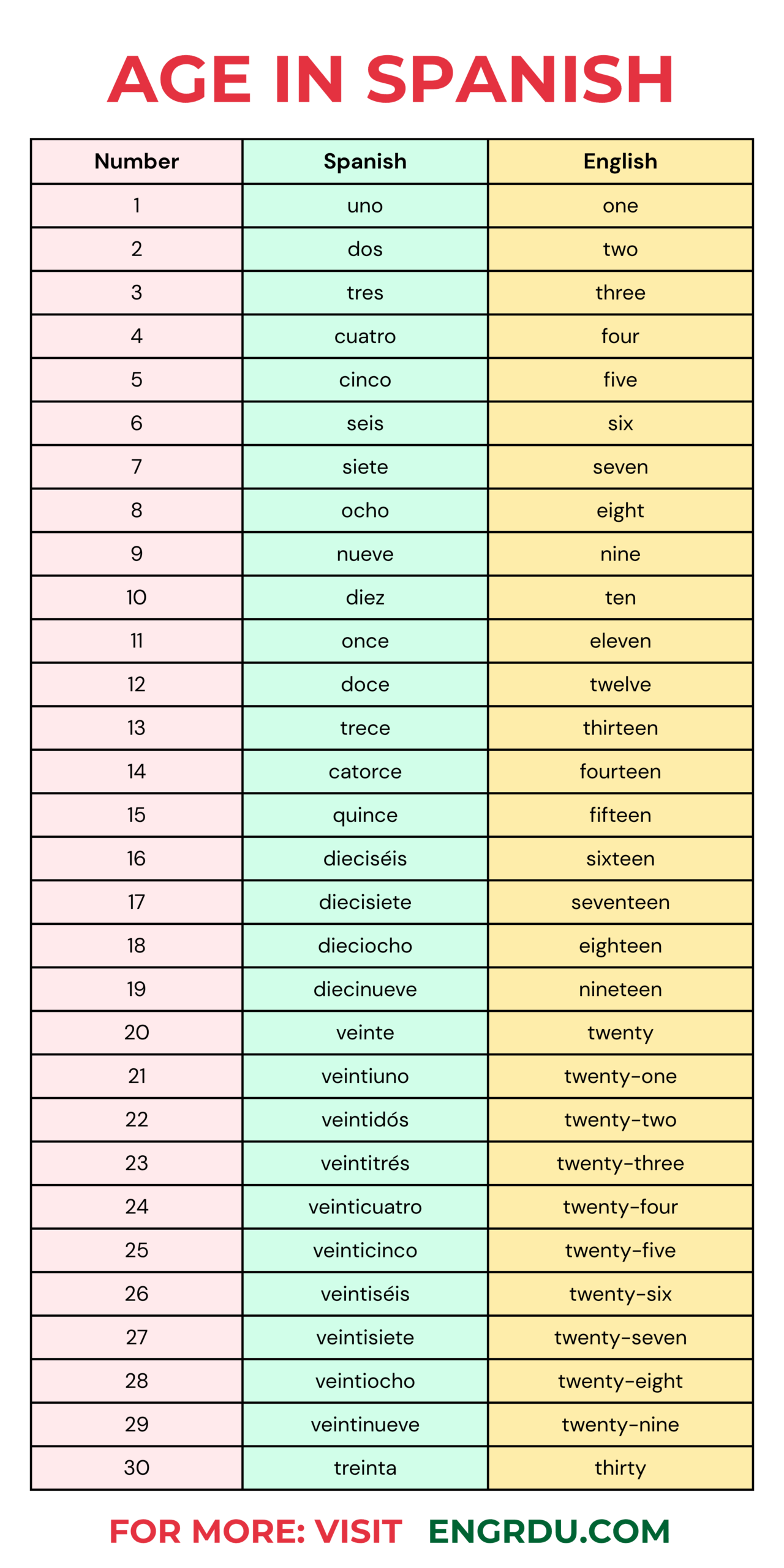
Numbers for Age 1-30
Below are the important numbers used when speaking about age.
| Number | Spanish | English |
|---|---|---|
| 1 | uno | one |
| 2 | dos | two |
| 3 | tres | three |
| 4 | cuatro | four |
| 5 | cinco | five |
| 6 | seis | six |
| 7 | siete | seven |
| 8 | ocho | eight |
| 9 | nueve | nine |
| 10 | diez | ten |
| 11 | once | eleven |
| 12 | doce | twelve |
| 13 | trece | thirteen |
| 14 | catorce | fourteen |
| 15 | quince | fifteen |
| 16 | dieciséis | sixteen |
| 17 | diecisiete | seventeen |
| 18 | dieciocho | eighteen |
| 19 | diecinueve | nineteen |
| 20 | veinte | twenty |
| 21 | veintiuno | twenty-one |
| 22 | veintidós | twenty-two |
| 23 | veintitrés | twenty-three |
| 24 | veinticuatro | twenty-four |
| 25 | veinticinco | twenty-five |
| 26 | veintiséis | twenty-six |
| 27 | veintisiete | twenty-seven |
| 28 | veintiocho | twenty-eight |
| 29 | veintinueve | twenty-nine |
| 30 | treinta | thirty |
Ways to Ask About Age
Here are the main ways to ask about age:
- ¿Cuántos años tienes? = How old are you?
- ¿Qué edad tienes? = What age are you?
Answer Patterns
| Question | Answer |
|---|---|
| ¿Cuántos años tienes? = How old are you? | Tengo 14 años = I am 14 |
| ¿Qué edad tienes? = What age are you? | Tengo 25 años = I am 25 |
Grammar Tips
- Always use tener, not ser.
- Use años after the number.
- Numbers above 30 follow a simple pattern: treinta y uno, cuarenta y dos, cincuenta y tres.
- Spanish does not use hyphens in numbers.
Examples of Age in Daily Life
- Mi madre tiene 45 años.
- Nosotros tenemos 12 años.
- Ellos tienen 33 años.
- ¿Tu hijo tiene 9 años?
- Mi primo tiene la misma edad que yo.
Common Mistakes to Avoid
Saying soy 20 años (incorrect)
Correct: tengo 20 añosForgetting the word años
Incorrect: tengo 12
Correct: tengo 12 añosUsing es for age
Incorrect: él es 13
Correct: él tiene 13 años
Practice Section
Try completing these:
- I am 16 years old → Yo ______ 16 años.
- She is 25 years old → Ella ______ 25 años.
- How old are you? → ¿Cuántos años ______?
Talking about age in Spanish is simple once you learn the basic rule: use the verb tener, the correct number, and the word años. With the phrases, tables, and examples in this guide, you can speak about age clearly and confidently in any daily situation.
FAQs
How do you say your age in Spanish?
You say your age in Spanish with tener + number + años. Example: Tengo 15 años means I am 15 years old.
What verb is used for age in Spanish?
Spanish uses the verb tener (to have) to talk about age, not ser. Example: Tengo 20 años.
How do you ask someone’s age in Spanish?
The most common question is ¿Cuántos años tienes? It means How old are you?
What does “años” mean in Spanish?
Años means years. It is always used when expressing age, such as tengo 10 años.
How do you say “I am 18 years old” in Spanish?
You say Tengo 18 años. This is the correct structure for talking about age.
What is the difference between “tengo 10 años” and “soy 10 años”?
Tengo 10 años is correct. Soy 10 años is wrong because age in Spanish uses tener, not ser.
How do children learn to say age in Spanish easily?
They learn the pattern tengo + number + años, starting with simple numbers like 5, 6, or 7.
Read More