
An adverb is a word that describes a verb, adjective, or another adverb, showing how, when, where, or to what extent something happens, like quickly, very, or yesterday. In this Grammar lesson, learning adverbs helps you speak, write, and understand English more accurately. Using them correctly makes your sentences clearer and more expressive. In this blog post, you will explore the definition, types, uses, and examples of adverbs to practice and use confidently in everyday English.
Adverb Definition and Examples
An adverb is a word that gives more information about a verb, adjective, or another adverb.
In simple words, an adverb tells us more detail about an action or quality.
It can answer questions like:
- How?
- When?
- Where?
- How often?
- How much?
Examples:
- She speaks clearly. (How does she speak?)
- We will meet tomorrow. (When will we meet?)
- He works very hard. (How much?)
Types of Adverbs
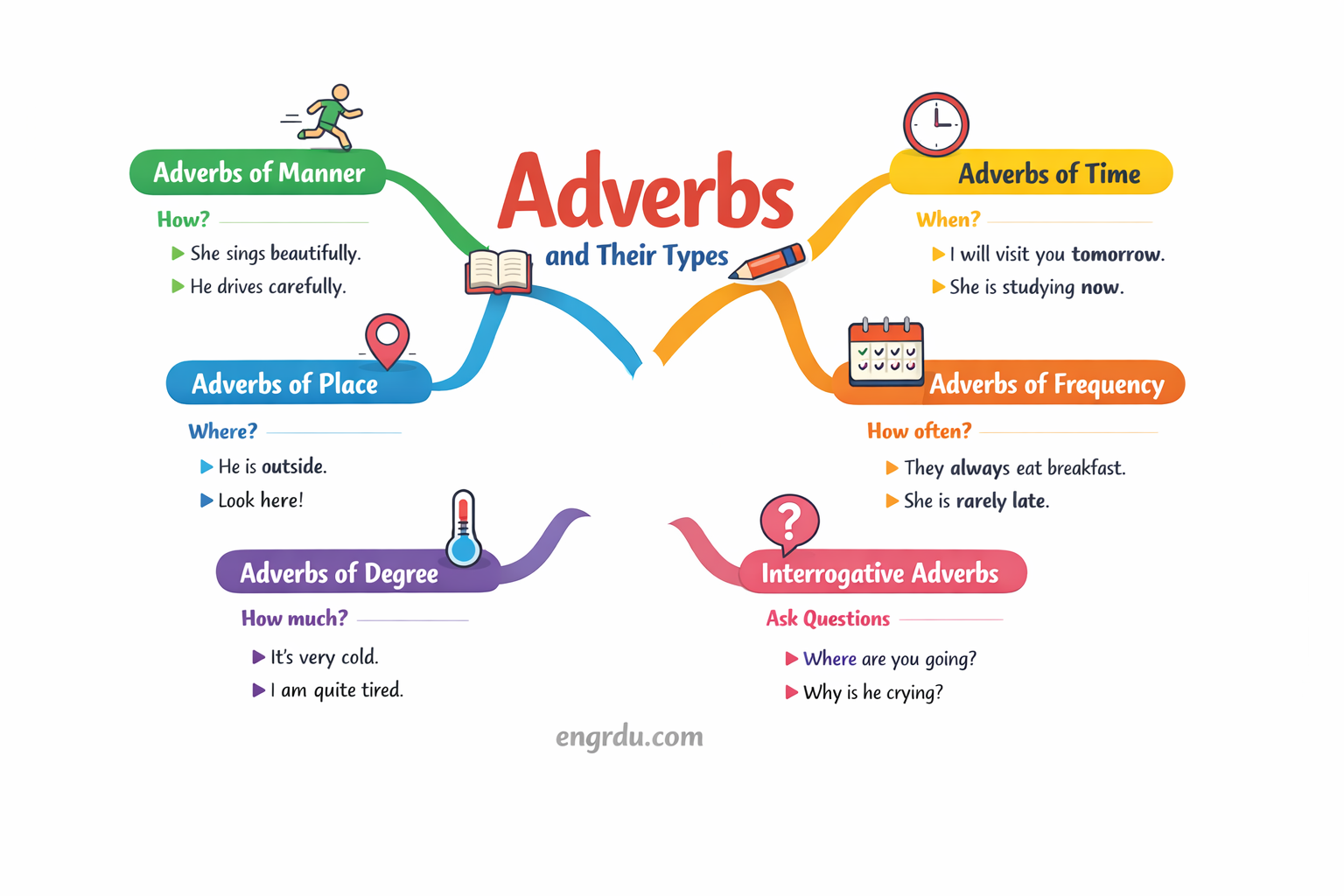
Adverbs are divided into different types based on what they describe. Each type has a clear purpose.
1. Adverbs of Manner (How?)
These adverbs describe how an action is done. Many adverbs of manner end in -ly, but not all.
Examples:
- She sings beautifully.
- He drove carefully.
- The children laughed loudly.
Common adverbs of manner:
slowly, quickly, easily, well, badly, politely
2. Adverbs of Time (When?)
These adverbs tell us when something happens.
Examples:
- I will call you later.
- We met yesterday.
- She is leaving now.
Common adverbs of time:
today, tomorrow, already, soon, recently, finally
3. Adverbs of Place (Where?)
These adverbs show where an action happens.
Examples:
- The dog is waiting outside.
- She looked everywhere.
- Please come here.
Common adverbs of place:
here, there, inside, outside, upstairs, nearby
4. Adverbs of Frequency (How often?)
These adverbs explain how often something happens.
Examples:
- I always drink tea in the morning.
- He usually walks to school.
- They never arrive late.
Common adverbs of frequency:
always, usually, often, sometimes, rarely, never
5. Adverbs of Degree (How much? To what extent?)
These adverbs tell us how strong or weak something is.
Examples:
- The film was very interesting.
- She is quite tired.
- He almost missed the train.
Common adverbs of degree:
very, too, enough, quite, almost, extremely
6. Interrogative Adverbs (Questions)
These adverbs are used to ask questions.
Examples:
- How did you solve the problem?
- When are you leaving?
- Where do they live?

Rules and Usage of Adverbs
Using adverbs correctly makes your English sound natural. Here are the key rules explained step by step.
1. Position of Adverbs
Adverbs can appear in different places in a sentence.
a) After the verb
- She speaks softly.
- He works hard.
b) Before the main verb (but after auxiliary verbs)
- I often read books.
- She has already finished her work.
c) At the beginning or end of a sentence
- Yesterday, we visited the museum.
- We visited the museum yesterday.
2. Adverbs with Adjectives
Adverbs can modify adjectives.
- The weather is very cold.
- This lesson is quite easy.
Forming Adverbs from Adjectives
Many adverbs are formed by adding -ly to adjectives.
| Adjective | Adverb |
|---|---|
| slow | slowly |
| happy | happily |
| careful | carefully |
Note: Some adverbs do not end in -ly.
- fast → fast
- hard → hard
- well → well
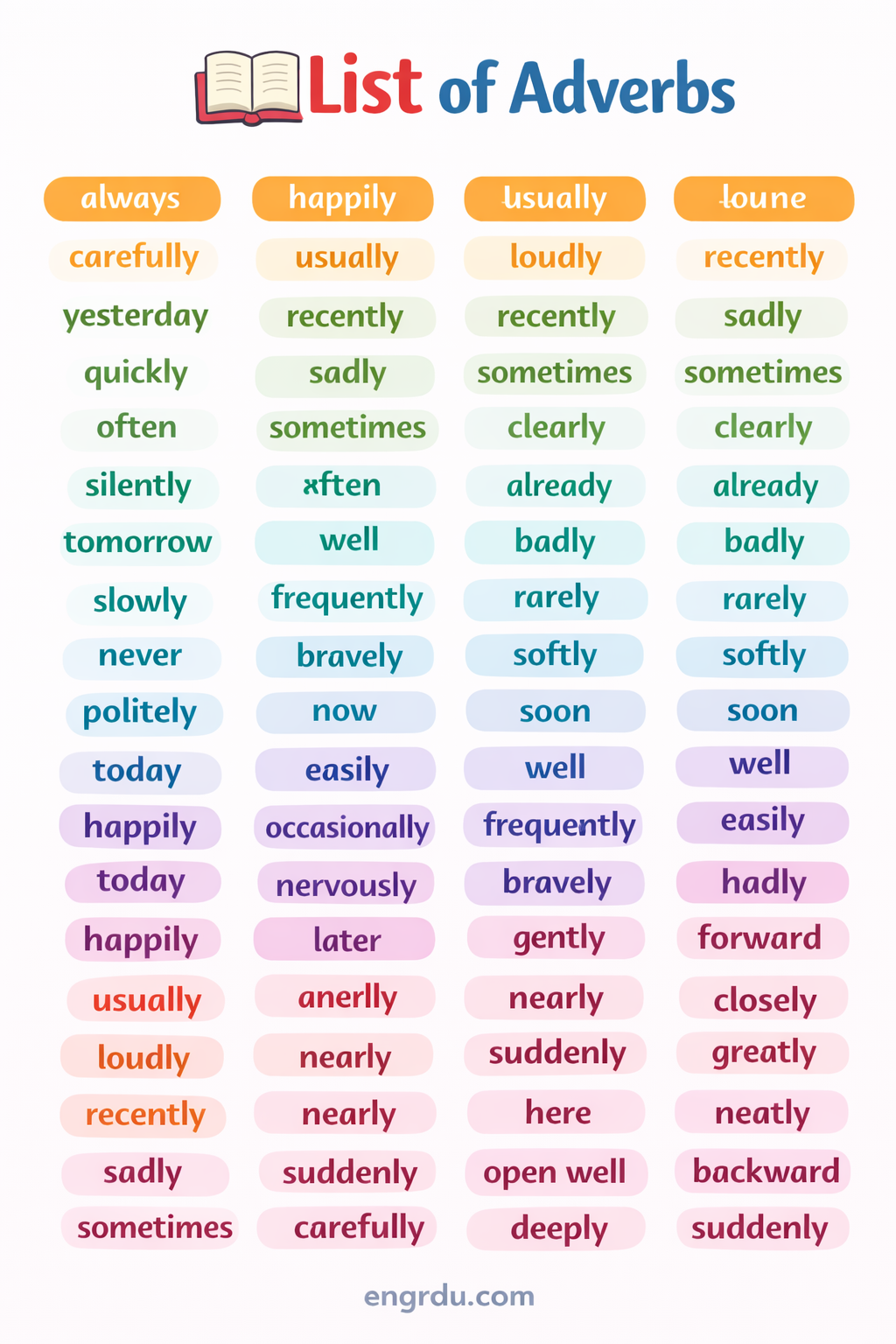
List of Adverbs in English
| always | carefully | yesterday | quickly |
| often | silently | tomorrow | slowly |
| never | politely | today | happily |
| usually | loudly | recently | sadly |
| sometimes | clearly | already | badly |
| rarely | softly | soon | well |
| frequently | bravely | now | easily |
| occasionally | nervously | later | gently |
| hardly | honestly | early | angrily |
| nearly | suddenly | late | calmly |
| completely | patiently | inside | confidently |
| partially | rudely | outside | kindly |
| almost | wisely | upstairs | seriously |
| exactly | foolishly | downstairs | proudly |
| simply | skillfully | nearby | quietly |
| truly | helplessly | everywhere | carefully |
| deeply | secretly | nowhere | openly |
| openly | angrily | somewhere | slowly |
| strongly | warmly | abroad | carefully |
| politely | eagerly | away | correctly |
| fairly | politely | here | freely |
| briefly | respectfully | there | safely |
| equally | badly | forward | closely |
| greatly | neatly | backward | suddenly |
Examples of Adverbs in Sentences
| Adverb | Example Sentence |
|---|---|
| always | She always completes her homework on time. |
| usually | We usually walk to school together. |
| often | He often listens to music while studying. |
| sometimes | I sometimes drink coffee in the evening. |
| never | They never forget their teacher’s advice. |
| carefully | She crossed the road carefully. |
| quickly | He quickly finished his breakfast. |
| slowly | The old man walked slowly. |
| happily | The children played happily in the park. |
| sadly | She sadly closed the door behind her. |
| well | He speaks English well. |
| badly | The team played badly in the final match. |
| clearly | Please speak clearly during the presentation. |
| loudly | The students laughed loudly. |
| politely | She asked the question politely. |
| quietly | The baby slept quietly all night. |
| yesterday | We visited the museum yesterday. |
| today | I am feeling tired today. |
| tomorrow | They will leave for London tomorrow. |
| now | Please sit down now. |
| here | Come here and look at this. |
| there | The keys are over there. |
| inside | The children are playing inside. |
| outside | It is raining outside. |
| very | The lesson was very interesting. |
| quite | She is quite confident about the test. |
| too | The water is too hot to drink. |
| enough | He is tall enough to reach the shelf. |
| already | She has already finished her work. |
| soon | We will meet again soon. |

Common Mistakes with Adverbs
English learners often make small mistakes with adverbs. Here are the most common ones.
Mistake 1: Using an adjective instead of an adverb
❌ She sings beautiful.
✅ She sings beautifully.
Tip: Use an adverb to describe a verb.
Mistake 2: Wrong position of adverbs
❌ He drives always carefully.
✅ He always drives carefully.
Mistake 3: Confusing “good” and “well”
❌ She plays the piano good.
✅ She plays the piano well.
Remember:
- Good = adjective
- Well = adverb
Mistake 4: Overusing “very”
❌ The lesson is very, very easy.
✅ The lesson is quite easy.
Adverbs vs Adjectives
Many learners confuse adverbs with adjectives. This table shows the difference clearly.
| Adjective | Adverb |
|---|---|
| describes a noun | describes a verb |
| a fast car | runs fast |
| a careful driver | drives carefully |
Simple rule:
- Adjectives describe things or people.
- Adverbs describe actions.
Tips for Learners
- Learn adverbs in sentences, not alone.
- Listen to native speakers and notice adverb use.
- Do not translate directly from your first language.
- Practise with short daily sentences.
- Read simple stories and underline adverbs.
- Use fewer adverbs, but use them correctly.

Conclusion
Adverbs help make English clear, natural, and expressive. They tell us how, when, where, and how often actions happen. By learning the types, rules, and common mistakes, learners can improve both speaking and writing. Practise using adverbs in real-life sentences every day. With time and regular practice, adverbs will become an easy and natural part of your English.
Frequently Asked Questions
What is an adverb in English?
An adverb is a word that gives more information about a verb, adjective, or another adverb. It explains how, when, where, how often, or to what extent an action happens.
What are the main types of adverbs?
The main types of adverbs are adverbs of manner, time, place, frequency, degree, and interrogative adverbs. Each type explains a different detail about an action or situation.
How do adverbs change a sentence?
Adverbs make sentences clearer and more meaningful by adding information about how an action is done, when it happens, or how much it occurs. For example, “She runs quickly” shows how she runs.
Can adverbs modify adjectives or other adverbs?
Yes, adverbs can modify adjectives or other adverbs. For example, “very happy” (adverb modifies adjective) or “runs very quickly” (adverb modifies another adverb).
Where should an adverb be placed in a sentence?
Adverbs can be placed before or after the main verb, at the beginning, or at the end of a sentence, depending on the type and meaning. Example: “She always studies” or “She studies always” (less common).
What are common mistakes learners make with adverbs?
Common mistakes include using an adjective instead of an adverb, placing the adverb in the wrong position, or confusing words like good and well. Example: “She sings beautiful” (incorrect) → “She sings beautifully” (correct).
Can adverbs answer questions?
Yes, adverbs answer questions like how, when, where, how often, and to what extent. For example: “How did you do it?” → “I did it carefully.”
Read More