Many English adjectives are formed from nouns. These words describe qualities, characteristics, or relationships connected to a person, place, or thing. For example, “careful” comes from “care,” and “dangerous” comes from “danger.” By adding suffixes like -ful, -less, -ous, or -al, nouns can change into descriptive words. In this blog post, you will learn how to form, identify, and use adjectives formed from nouns in sentences. Understanding these patterns will help you expand your vocabulary and write more accurate and descriptive English.
What Are Adjectives Formed from Nouns?
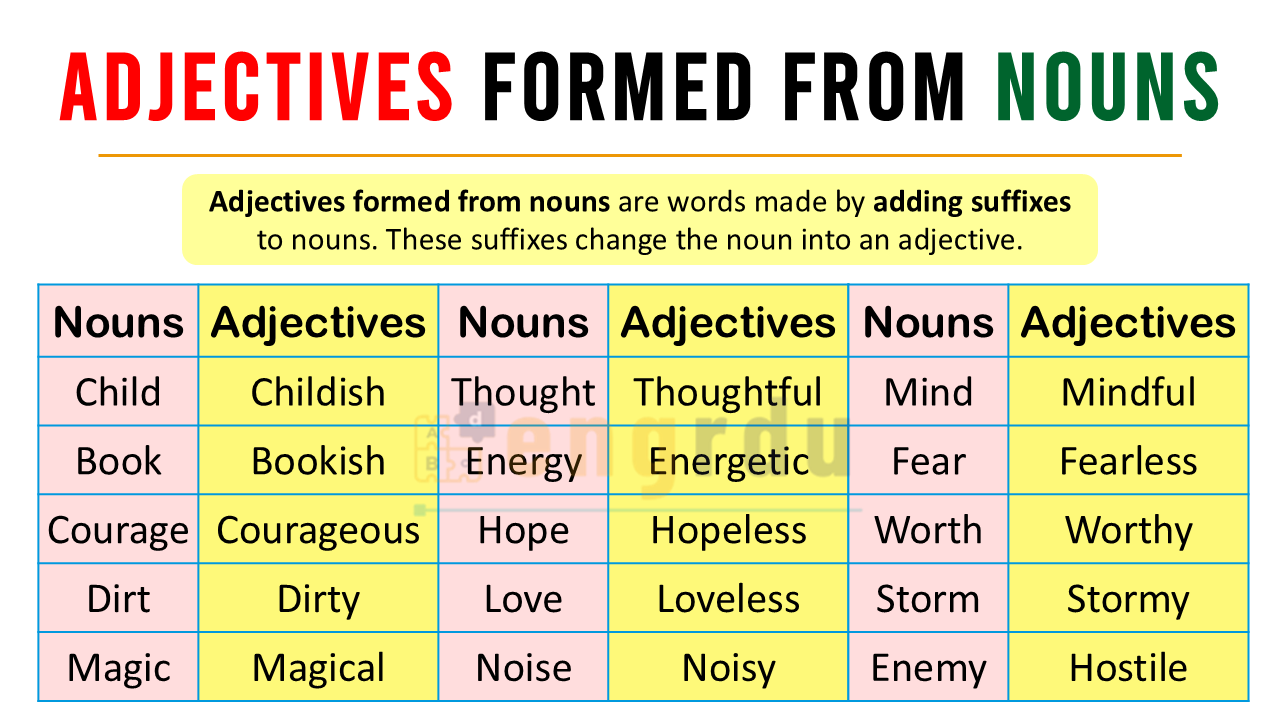
Adjectives formed from nouns are words made by adding suffixes to nouns. These suffixes change the noun into an adjective.
Example:
Beauty → Beautiful
Danger → Dangerous
Here, the nouns “beauty” and “danger” are changed into adjectives that describe something related to them.

How Are Adjectives Formed from Nouns?
There are some common suffixes that we use to make adjectives from nouns. Look at the table below:
| Suffix | Noun | Adjective | Example Sentence |
|---|---|---|---|
| -ful | Hope | Hopeful | She is a hopeful person. |
| -less | Power | Powerless | The bird looked powerless to fly. |
| -ous | Fame | Famous | He is a famous actor. |
| -al | Nation | National | The national team won the match. |
| -ic | Hero | Heroic | That was a heroic act. |
| -y | Fun | Funny | It was a funny joke. |
| -ish | Child | Childish | Don’t be so childish. |
| -able | Comfort | Comfortable | This chair is comfortable. |
| -ary | Vision | Visionary | He has a visionary mind. |
Simple Rule to Remember
- Add a suffix to the noun to form an adjective.
- The suffix depends on the meaning you want to express.
- Some suffixes mean having, some mean without, and others mean related to.
Examples:
- “Care” + “ful” → Careful (having care)
- “Care” + “less” → Careless (without care)
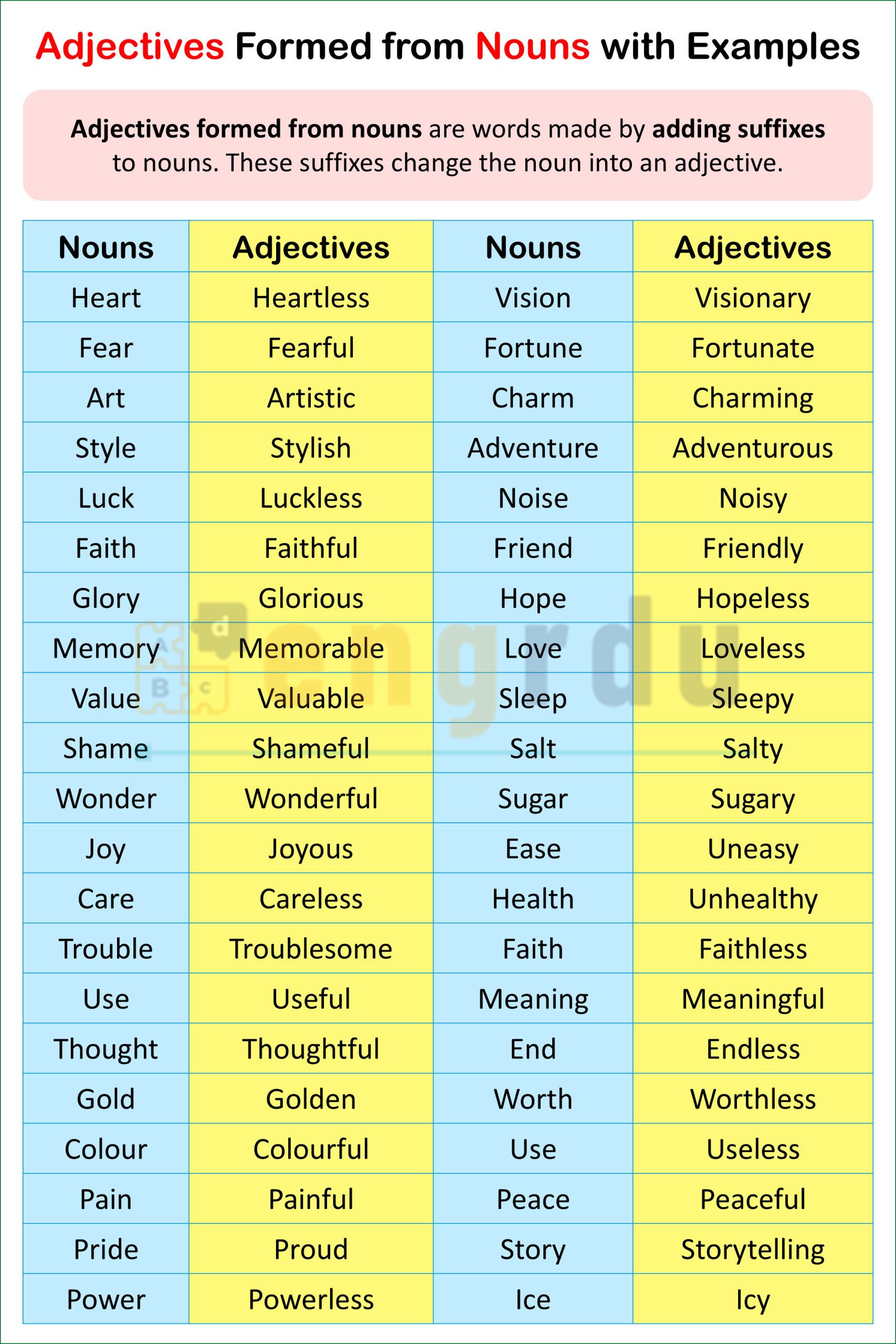
Adjectives Formed from Nouns with Examples
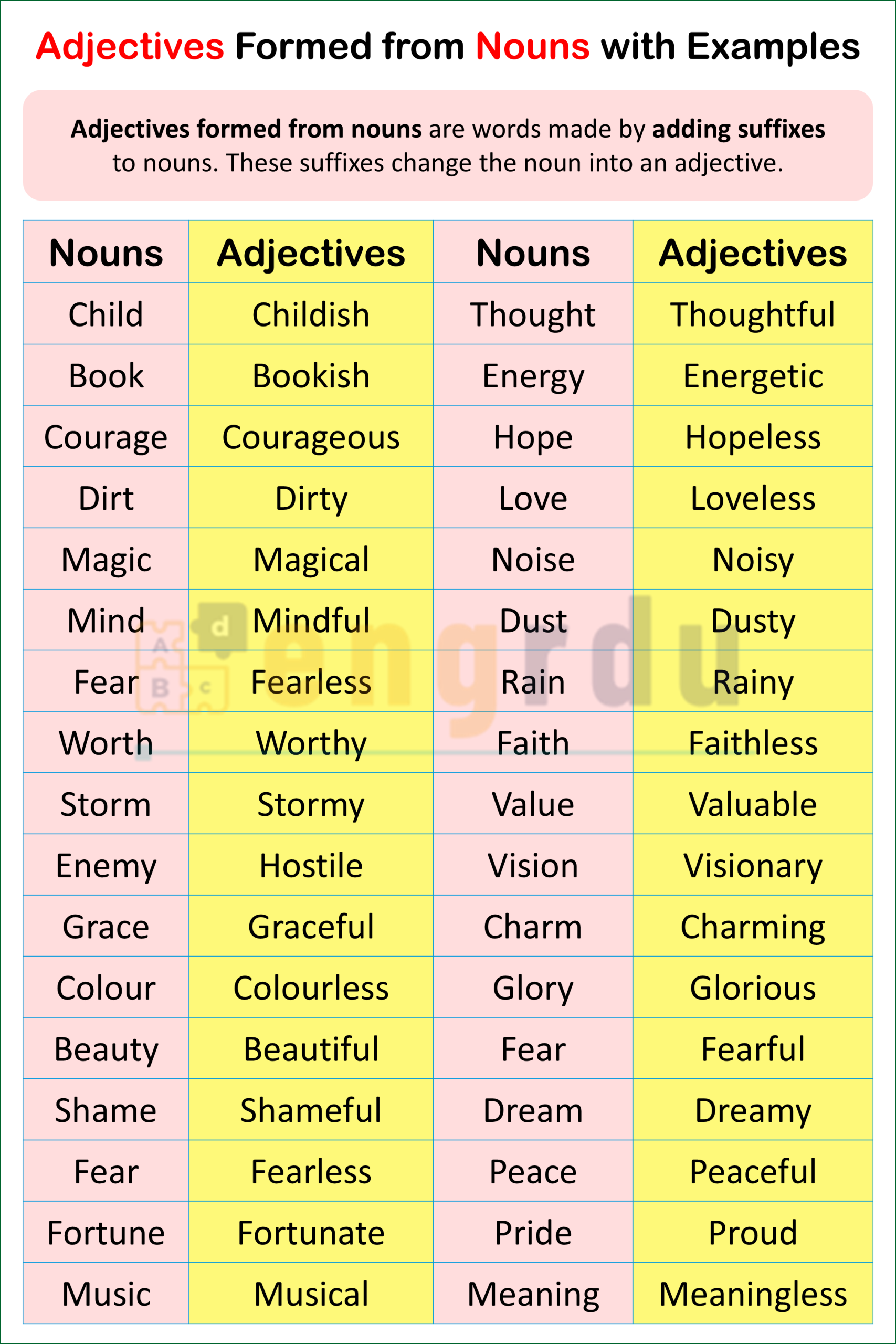
Here is a big list of 100 useful adjectives that are formed from nouns.
| No. | Noun | Adjective | Example Sentence |
|---|---|---|---|
| 1 | Love | Lovely | She wore a lovely dress. |
| 2 | Luck | Lucky | He is a lucky man. |
| 3 | Care | Careful | Be careful with the glass. |
| 4 | Help | Helpful | She is always helpful. |
| 5 | Hope | Hopeful | Stay hopeful for good news. |
| 6 | Power | Powerful | The engine is very powerful. |
| 7 | Beauty | Beautiful | It’s a beautiful view. |
| 8 | Anger | Angry | He looked angry at the noise. |
| 9 | Joy | Joyful | Children are always joyful. |
| 10 | Energy | Energetic | She is an energetic student. |
| 11 | Peace | Peaceful | It’s a peaceful town. |
| 12 | Dream | Dreamy | He gave a dreamy smile. |
| 13 | Rain | Rainy | It’s a rainy day. |
| 14 | Sun | Sunny | The weather is sunny today. |
| 15 | Fame | Famous | She is a famous actress. |
| 16 | Danger | Dangerous | That road is dangerous. |
| 17 | Poison | Poisonous | Some mushrooms are poisonous. |
| 18 | Music | Musical | He has great musical talent. |
| 19 | Health | Healthy | Eat fruit to stay healthy. |
| 20 | Ease | Easy | This exercise is easy. |
| 21 | Dust | Dusty | The table was dusty. |
| 22 | Wind | Windy | It’s a windy afternoon. |
| 23 | Skill | Skilful | He is a skilful player. |
| 24 | Sense | Sensible | That was a sensible choice. |
| 25 | Heart | Heartless | Don’t be heartless. |
| 26 | Fear | Fearful | The boy was fearful of the dark. |
| 27 | Art | Artistic | She made an artistic design. |
| 28 | Style | Stylish | Her dress is stylish. |
| 29 | Luck | Luckless | He was a luckless traveller. |
| 30 | Faith | Faithful | A dog is a faithful pet. |
| 31 | Glory | Glorious | It was a glorious victory. |
| 32 | Memory | Memorable | It was a memorable trip. |
| 33 | Value | Valuable | Time is very valuable. |
| 34 | Shame | Shameful | His behaviour was shameful. |
| 35 | Wonder | Wonderful | What a wonderful day! |
| 36 | Joy | Joyous | They had a joyous celebration. |
| 37 | Care | Careless | Don’t be careless with money. |
| 38 | Trouble | Troublesome | The situation was troublesome. |
| 39 | Use | Useful | This app is very useful. |
| 40 | Thought | Thoughtful | That’s a thoughtful message. |
| 41 | Gold | Golden | She wore a golden necklace. |
| 42 | Colour | Colourful | The garden looks colourful. |
| 43 | Pain | Painful | It was a painful injury. |
| 44 | Pride | Proud | She is proud of her child. |
| 45 | Power | Powerless | The town was powerless during the storm. |
| 46 | Vision | Visionary | He is a visionary leader. |
| 47 | Fortune | Fortunate | We are fortunate to be safe. |
| 48 | Charm | Charming | He is a charming person. |
| 49 | Adventure | Adventurous | They are adventurous travellers. |
| 50 | Noise | Noisy | The street is very noisy. |
| 51 | Friend | Friendly | Our teacher is very friendly. |
| 52 | Hope | Hopeless | He felt hopeless after the loss. |
| 53 | Love | Loveless | It was a loveless marriage. |
| 54 | Sleep | Sleepy | The baby looks sleepy. |
| 55 | Salt | Salty | The soup tastes salty. |
| 56 | Sugar | Sugary | This drink is too sugary. |
| 57 | Ease | Uneasy | He felt uneasy about the test. |
| 58 | Health | Unhealthy | Junk food is unhealthy. |
| 59 | Faith | Faithless | Don’t be faithless in hard times. |
| 60 | Meaning | Meaningful | It was a meaningful gift. |
| 61 | End | Endless | The road seemed endless. |
| 62 | Worth | Worthless | That old phone is worthless. |
| 63 | Use | Useless | This key is useless now. |
| 64 | Peace | Peaceful | It’s a peaceful lake. |
| 65 | Story | Storytelling | He is a good storytelling writer. |
| 66 | Ice | Icy | The path was icy and slippery. |
| 67 | Child | Childish | Don’t be childish. |
| 68 | Book | Bookish | He has a bookish nature. |
| 69 | Courage | Courageous | The firefighter was courageous. |
| 70 | Dirt | Dirty | The floor looks dirty. |
| 71 | Magic | Magical | The night was magical. |
| 72 | Mind | Mindful | Be mindful of your words. |
| 73 | Fear | Fearless | She is a fearless reporter. |
| 74 | Worth | Worthy | His work is worthy of praise. |
| 75 | Storm | Stormy | It was a stormy night. |
| 76 | Enemy | Hostile | The crowd became hostile. |
| 77 | Grace | Graceful | She danced in a graceful way. |
| 78 | Colour | Colourless | Water is colourless. |
| 79 | Beauty | Beautiful | The park looks beautiful. |
| 80 | Shame | Shameful | Lying is a shameful act. |
| 81 | Fear | Fearless | He made a fearless move. |
| 82 | Fortune | Fortunate | We are fortunate to learn. |
| 83 | Music | Musical | He joined a musical band. |
| 84 | Thought | Thoughtful | She gave a thoughtful reply. |
| 85 | Energy | Energetic | The players are very energetic. |
| 86 | Hope | Hopeless | Don’t feel hopeless in life. |
| 87 | Love | Loveless | It’s a loveless relationship. |
| 88 | Noise | Noisy | The kids were noisy. |
| 89 | Dust | Dusty | The shelf is dusty. |
| 90 | Rain | Rainy | It’s a rainy evening. |
| 91 | Faith | Faithless | He is faithless in love. |
| 92 | Value | Valuable | Education is valuable. |
| 93 | Vision | Visionary | He shared a visionary idea. |
| 94 | Charm | Charming | She has a charming smile. |
| 95 | Glory | Glorious | They achieved a glorious success. |
| 96 | Fear | Fearful | The child looked fearful. |
| 97 | Dream | Dreamy | He gave a dreamy look. |
| 98 | Peace | Peaceful | It’s a peaceful place. |
| 99 | Pride | Proud | She is proud of her school. |
| 100 | Meaning | Meaningless | His words were meaningless. |
Practice Tip
When you see a noun, try to think of its adjective form.
For example:
- “Hope” → “Hopeful”
- “Danger” → “Dangerous
- “Child” → “Childish”
This will improve both your vocabulary and sentence writing.
FAQs
What are adjectives formed from nouns?
They are adjectives made by adding suffixes to nouns, like hope → hopeful or beauty → beautiful.
How can we form adjectives from nouns?
Add suffixes like -ful, -less, -ous, -al, or -y to nouns.
Why should we learn adjectives formed from nouns?
They make your writing more expressive and help describe nouns more clearly.
What are the most common suffixes for forming adjectives from nouns?
-ful, -less, -ous, -al, -ic, -y, and -ish.
Can all nouns become adjectives?
No, not all nouns can. Only some nouns can naturally form adjectives with the right suffix.
Read More