

What Is the ABC in Korean?
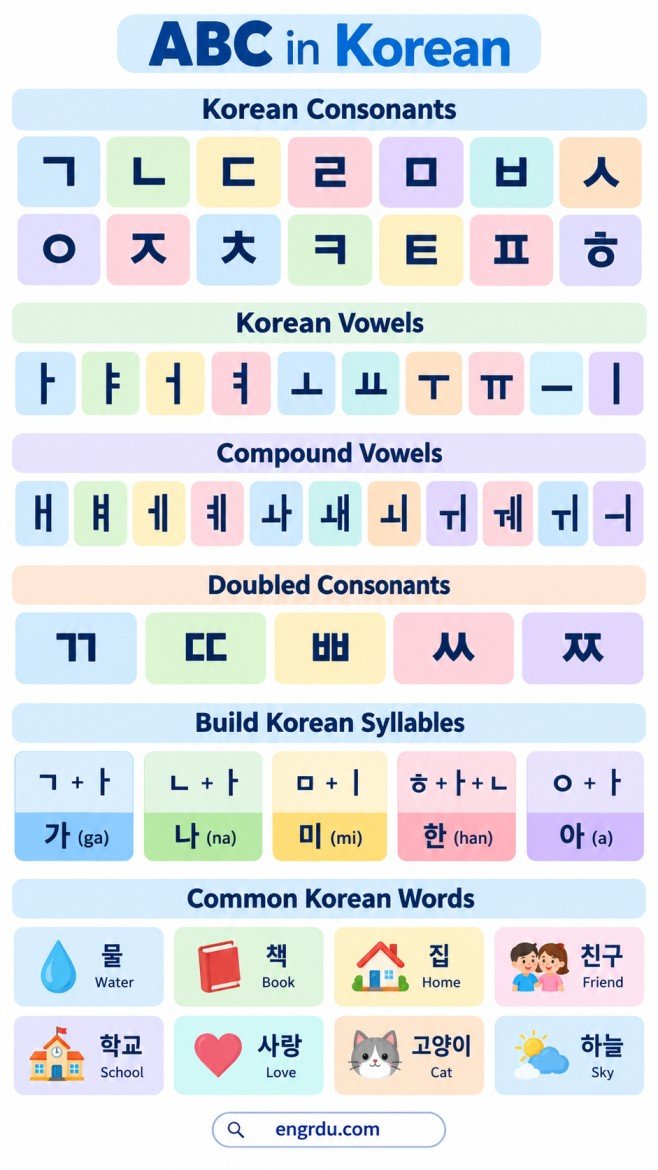
The ABC in Korean refers to the Korean alphabet, known as Hangul or Hangeul (한글). Unlike English, which writes most words using separate letters in a line, Korean combines consonants and vowels into square-shaped syllable blocks.
Hangul is the writing system used for the Korean language in both South Korea and North Korea, although some spelling and vocabulary conventions differ.
For example:
- English: HAN
- Korean: 한
- Romanization: han
- Meaning: One, depending on context
The Korean characters in the example form one syllable block rather than three separate letters.
How Many Letters Are in the Korean Alphabet?
The modern Korean alphabet has 24 basic letters: 14 consonants and 10 vowels. These letters combine to create syllable blocks, while additional compound vowels and doubled consonants expand the number of sounds learners encounter.
| Letter Type | Number of Basic Letters | Korean Term |
|---|---|---|
| Consonants | 14 | 자음 (ja-eum) |
| Vowels | 10 | 모음 (mo-eum) |
| Total basic letters | 24 | 한글 (Hangul) |
Modern Hangul also includes five commonly taught doubled consonants and 11 compound vowels. These are formed from basic letters and are part of the standard modern writing system.
Korean Consonants and Their Sounds
Korean consonants represent sounds used to build Korean syllables. Some have approximate English equivalents, but their pronunciation can change depending on their position in a word and the sounds around them.
The following table lists the 14 basic consonants with their standard Revised Romanization and approximate pronunciation.
| Korean Letter | Romanization | Approximate Sound | Example |
|---|---|---|---|
| ㄱ | g/k | Between g and k | 가 (ga) |
| ㄴ | n | n as in no | 나 (na) |
| ㄷ | d/t | Between d and t | 다 (da) |
| ㄹ | r/l | A Korean sound between r and l in many positions | 라 (ra) |
| ㅁ | m | m as in man | 마 (ma) |
| ㅂ | b/p | Between b and p | 바 (ba) |
| ㅅ | s | s as in sun | 사 (sa) |
| ㅇ | silent/ng | Silent at the beginning; ng at the end | 아 (a), 강 (gang) |
| ㅈ | j | Similar to j in jam | 자 (ja) |
| ㅊ | ch | Aspirated ch sound | 차 (cha) |
| ㅋ | k | Strongly aspirated k | 카 (ka) |
| ㅌ | t | Strongly aspirated t | 타 (ta) |
| ㅍ | p | Strongly aspirated p | 파 (pa) |
| ㅎ | h | h as in hat | 하 (ha) |
Remember: Roman letters provide only an approximation of Korean pronunciation. For example, ㄱ does not always sound exactly like English g or k.
What Are Doubled Korean Consonants?
Korean has five doubled consonants that are written by repeating certain basic consonant shapes. They generally represent tense consonant sounds.
| Doubled Letter | Romanization | Example |
|---|---|---|
| ㄲ | kk | 까 (kka) |
| ㄸ | tt | 따 (tta) |
| ㅃ | pp | 빠 (ppa) |
| ㅆ | ss | 싸 (ssa) |
| ㅉ | jj | 짜 (jja) |
These letters are not simply pronounced as two separate consonants. Their tense pronunciation is an important feature of Korean speech.
Korean Vowels and Their Sounds
Korean vowels combine with consonants to create syllables. The 10 basic vowels include sounds that are familiar to English speakers and others that require practice.
| Korean Letter | Romanization | Approximate Sound | Example |
|---|---|---|---|
| ㅏ | a | a as in father | 아 (a) |
| ㅑ | ya | ya as in yard | 야 (ya) |
| ㅓ | eo | Similar to the vowel in sun, but not identical | 어 (eo) |
| ㅕ | yeo | y followed by ㅓ | 여 (yeo) |
| ㅗ | o | Rounded o sound | 오 (o) |
| ㅛ | yo | yo as in yoga | 요 (yo) |
| ㅜ | u | oo as in moon | 우 (u) |
| ㅠ | yu | Similar to you | 유 (yu) |
| ㅡ | eu | A Korean vowel without an exact English equivalent | 으 (eu) |
| ㅣ | i | ee as in see | 이 (i) |
The vowels ㅓ and ㅡ may be unfamiliar at first. Listen to native Korean speakers and repeat these sounds instead of relying only on English spelling.
What Are Compound Korean Vowels?
Compound vowels combine basic vowel letters into one vowel unit. They are used in many everyday Korean words.
| Korean Vowel | Romanization | Example |
|---|---|---|
| ㅐ | ae | 새 (sae), bird |
| ㅒ | yae | 얘 (yae), this child or that child, depending on context |
| ㅔ | e | 네 (ne), yes |
| ㅖ | ye | 예 (ye), yes |
| ㅘ | wa | 와 (wa), and/wow, depending on context |
| ㅙ | wae | 왜 (wae), why |
| ㅚ | oe | 외 (oe), outside/foreign-related use in compounds |
| ㅝ | wo | 워 (wo), a syllable used in words and names |
| ㅞ | we | 웨 (we), a syllable used in words and names |
| ㅟ | wi | 위 (wi), above |
| ㅢ | ui | 의 (ui), a grammatical particle or part of a word |
In contemporary Korean, some vowels such as ㅐ and ㅔ sound very similar or identical for many speakers. Romanization also cannot represent every pronunciation difference perfectly.
ABC in Korean
Korean Alphabet Letters Compared with English
English and Korean use different writing systems, so there is no exact one-to-one match between all English and Korean letters. Korean letters represent Korean sounds, while English letters may represent different sounds depending on the word.
| English Letter | Possible Korean Sound Match | Important Note |
|---|---|---|
| A | ㅏ (a) | Similar to the vowel in father |
| B | ㅂ (b/p) | Korean ㅂ changes in sound by position |
| C | ㅋ or ㅅ in some borrowed words | Depends on the original sound |
| D | ㄷ (d/t) | Not identical to English d |
| E | ㅔ (e) | Approximate match |
| F | ㅍ in some borrowed words | Korean has no basic native f consonant |
| G | ㄱ (g/k) | Sound depends on context |
| H | ㅎ (h) | A close approximation |
| I | ㅣ (i) | Similar to ee |
| J | ㅈ (j) | Approximate match |
| K | ㅋ or ㄱ | Depends on aspiration and position |
| L | ㄹ (r/l) | Korean ㄹ differs from English l |
| M | ㅁ (m) | A close match |
| N | ㄴ (n) | A close match |
| O | ㅗ or ㅓ in some borrowed words | Depends on the intended sound |
| P | ㅍ or ㅂ | Depends on the intended sound |
| Q | Often represented using combinations such as ㅋ or ㄱ | No exact equivalent |
| R | ㄹ (r/l) | Not identical to English r |
| S | ㅅ (s) | Pronunciation varies by context |
| T | ㅌ or ㄷ | Depends on the intended sound |
| U | ㅜ (u) | Similar to oo |
| V | ㅂ in many loanword adaptations | No exact native consonant equivalent |
| W | Often represented through vowel combinations | Not a separate basic Korean letter |
| X | Often represented by a combination of sounds | No single exact equivalent |
| Y | Often represented through vowels beginning with a y sound | Not a separate basic Korean letter |
| Z | ㅈ in some loanword adaptations | No exact equivalent |
This comparison is useful for understanding borrowed words and names. However, it is not a Korean version of the English ABC chart. To read Korean accurately, learn the actual sounds and spelling rules of Hangul.
How Korean Letters Form Words
Korean letters are arranged into syllable blocks. Each block usually contains at least one consonant and one vowel, and some blocks include a final consonant.
There are three common patterns:
- Consonant + vowel: 나 (na)
- Consonant + vowel + final consonant: 한 (han)
- Vowel-only syllable: 아 (a), which uses silent ㅇ at the beginning
The position of a vowel depends on its shape. Vertical vowels such as ㅏ usually appear to the right of the initial consonant, while horizontal vowels such as ㅗ usually appear below it.
| Letters | Syllable | Romanization |
|---|---|---|
| ㄱ + ㅏ | 가 | ga |
| ㄴ + ㅏ | 나 | na |
| ㅁ + ㅣ | 미 | mi |
| ㅎ + ㅏ + ㄴ | 한 | han |
| ㅎ + ㅏ + ㄴ + ㄱ + ㅡ + ㄹ | 한글 | hangeul |
In the final example, 한글 is written as two syllable blocks: 한 and 글. It is the Korean name for the Hangul writing system.
Common Korean Words and Their Meanings
Learning Korean alphabet letters becomes more useful when you apply them to words you may encounter in everyday life. The examples below show how Hangul spelling, romanization, and English meaning work together.
| Korean Word | Romanization | English Meaning |
|---|---|---|
| 안녕 | annyeong | Hi/bye in informal speech |
| 한국 | Hanguk | Korea |
| 사람 | saram | Person |
| 학교 | hakgyo | School |
| 친구 | chingu | Friend |
| 물 | mul | Water |
| 책 | chaek | Book |
| 집 | jip | House/home |
| 사랑 | sarang | Love |
| 이름 | ireum | Name |
| 밥 | bap | Cooked rice/meal |
| 고양이 | goyangi | Cat |
| 강아지 | gangaji | Puppy/dog |
| 나무 | namu | Tree |
| 하늘 | haneul | Sky |
Examples of Korean Words in Sentences
Short sentences show how vocabulary works in context. Korean word order often differs from English, and particles mark the roles of words in a sentence.
| Korean Sentence | Romanization | English Meaning |
|---|---|---|
| 저는 학생이에요. | Jeoneun haksaeng-ieyo. | I am a student. |
| 물 주세요. | Mul juseyo. | Water, please. |
| 친구가 와요. | Chinguga wayo. | A friend is coming. |
| 여기는 학교예요. | Yeogineun hakgyo-yeyo. | This is a school. |
| 이름이 뭐예요? | Ireumi mwoyeyo? | What is your name? |
These examples use common polite expressions. Romanization is provided to support early reading, but learning to recognize Hangul directly will help you become more confident.
How to Learn the Korean ABC
You can learn Hangul more effectively by practicing letter recognition, syllable building, and short words in stages. Focus on accurate sounds before trying to memorize long vocabulary lists.
Try this learning sequence:
- Memorize the 14 basic consonants. Practice recognizing each letter and its approximate sound.
- Learn the 10 basic vowels. Pay special attention to ㅓ and ㅡ.
- Combine consonants and vowels. Read syllables such as 가, 나, 다, and 마.
- Practice final consonants. Read syllables such as 한, 집, and 물.
- Read common words. Start with 물, 집, 책, and 학교.
- Listen and repeat. Compare your pronunciation with reliable recordings from native speakers.
- Reduce your reliance on romanization. Use it as temporary support rather than a substitute for Hangul.
A Short Daily Practice Routine
Spend about 10 minutes a day reviewing the Korean alphabet.
| Time | Activity |
|---|---|
| 2 minutes | Review consonants |
| 2 minutes | Review vowels |
| 3 minutes | Build syllable blocks |
| 2 minutes | Read common Korean words |
| 1 minute | Review letters you found difficult |
Regular practice helps you recognize letters more quickly and read syllable blocks without translating each character into an English letter.
Common Mistakes When Learning Hangul
Avoid these frequent mistakes when learning the Korean ABC:
- Treating Hangul as a direct copy of English ABC: Korean uses its own writing system.
- Assuming every letter has one exact English equivalent: Korean sounds do not always match English sounds.
- Ignoring syllable blocks: Korean letters combine into organized blocks rather than being written only as separate characters.
- Relying entirely on romanization: Roman letters cannot show every Korean pronunciation accurately.
- Confusing silent ㅇ with final ㅇ: It is silent at the beginning of a syllable but represents an ng sound at the end.
Korean Alphabet Practice Exercises
Test your understanding of basic Korean consonants, vowels, and syllable blocks. Try answering the questions before checking the answer key.
Exercise 1: Identify the Letter
Write the correct Korean letter for each sound or romanization.
- Which Korean letter represents n?
- Which basic vowel is romanized as a?
- Which consonant is commonly romanized as m?
- Which vowel is romanized as i?
- Which consonant is silent at the beginning of a syllable?
Exercise 2: Match the Korean Word
Match each Korean word with its English meaning.
| Korean Word | Meaning Options |
|---|---|
| 1. 물 | A. Friend |
| 2. 친구 | B. Water |
| 3. 학교 | C. Book |
| 4. 책 | D. School |
| 5. 집 | E. Home |
Exercise 3: Build a Syllable
Combine the letters to make the correct Korean syllable.
- ㄱ + ㅏ = ?
- ㄴ + ㅏ = ?
- ㅁ + ㅣ = ?
- ㅎ + ㅏ + ㄴ = ?
- ㅇ + ㅏ = ?
Answer Key
Exercise 1
- ㄴ
- ㅏ
- ㅁ
- ㅣ
- ㅇ
Exercise 2
- B — Water
- A — Friend
- D — School
- C — Book
- E — Home
Exercise 3
- 가 (ga)
- 나 (na)
- 미 (mi)
- 한 (han)
- 아 (a)
FAQs About ABC in Korean
1. What is ABC in Korean?
ABC in Korean refers to Hangul, the Korean writing system. It has 24 basic letters: 14 consonants and 10 vowels.
2. How do you write the English ABC in Korean?
English ABC is not converted letter for letter into Hangul. Korean uses its own alphabet, with different letters and sound combinations.
3. How many letters are there in the Korean alphabet?
Modern Korean has 24 basic alphabet letters, including 14 consonants and 10 vowels. Compound vowels and doubled consonants are also commonly learned.
4. Is Korean alphabet easier than English?
Hangul has consistent, organized letter patterns, which many learners find approachable. However, Korean pronunciation, spelling rules, and grammar still require practice.
5. What is the Korean word for alphabet?
The Korean writing system is called 한글 (Hangul). The word 알파벳 (alpabet) is also used for alphabet, particularly when referring to alphabetic writing systems.
6. Can I learn the Korean alphabet in one day?
You can learn to recognize many basic Hangul letters in one day, but reading fluently and pronouncing Korean words accurately takes continued practice.
7. What is the difference between Hangul and Korean?
Hangul is the writing system, while Korean is the language. Hangul represents Korean words through consonants, vowels, and syllable blocks.
8. Do Korean letters have the same sounds as English letters?
No. Some Korean letters have approximate English sound matches, but others differ in articulation or change depending on their position in a syllable.
Conclusion
Learning the ABC in Korean starts with understanding Hangul, its 14 basic consonants, and its 10 basic vowels. These 24 letters combine into syllable blocks that form Korean words and sentences.
Practice the letters, build syllables, and read everyday words such as 물 (water), 친구 (friend), and 학교 (school). With regular listening and reading practice, you can move from recognizing Korean alphabet letters to reading familiar Korean expressions with greater confidence.