
The ABC in Italian is the starting point for learning Italian letters, pronunciation, spelling, and vocabulary. The Italian alphabet is called alfabeto italiano and traditionally contains 21 letters. It uses the Latin writing system, just like English, but some letter names and sounds are different. Learning the Italian ABC helps you read common words, spell names, recognize written signs, and pronounce familiar expressions more accurately. You will also learn about five additional letters used in foreign words and modern Italian writing. With clear examples and pronunciation tips, you can build a strong foundation for reading and writing Italian.
What Is the ABC in Italian?
The ABC in Italian refers to the letters used to write Italian words. The Italian word for alphabet is alfabeto, and the Italian alphabet is known as alfabeto italiano.
The traditional Italian alphabet has 21 letters. It uses the same basic Latin script as English, but some letters have different names and sounds.
Here are a few useful facts:
Italian name: Alfabeto italiano
Number of traditional letters: 21
Writing system: Latin alphabet
Main purpose: Reading, writing, spelling, and pronouncing Italian words
Additional letters commonly seen in foreign words: J, K, W, X, and Y
For example, amico means “friend,” casa means “house,” and libro means “book.” Recognizing the letters makes it easier to read and learn these words.
The 21 Letters of the Italian Alphabet
The Italian alphabet contains 21 traditional letters, from A to Z, excluding J, K, W, X, and Y. Each letter has an Italian name that learners can practice aloud.
| Capital letter | Small letter | Italian letter name |
|---|---|---|
| A | a | a |
| B | b | bi |
| C | c | ci |
| D | d | di |
| E | e | e |
| F | f | effe |
| G | g | gi |
| H | h | acca |
| I | i | i |
| L | l | elle |
| M | m | emme |
| N | n | enne |
| O | o | o |
| P | p | pi |
| Q | q | cu |
| R | r | erre |
| S | s | esse |
| T | t | ti |
| U | u | u |
| V | v | vi |
| Z | z | zeta |
Notice that the traditional sequence skips J, K, W, X, and Y. These letters still appear in Italian writing, especially in foreign names and borrowed vocabulary.
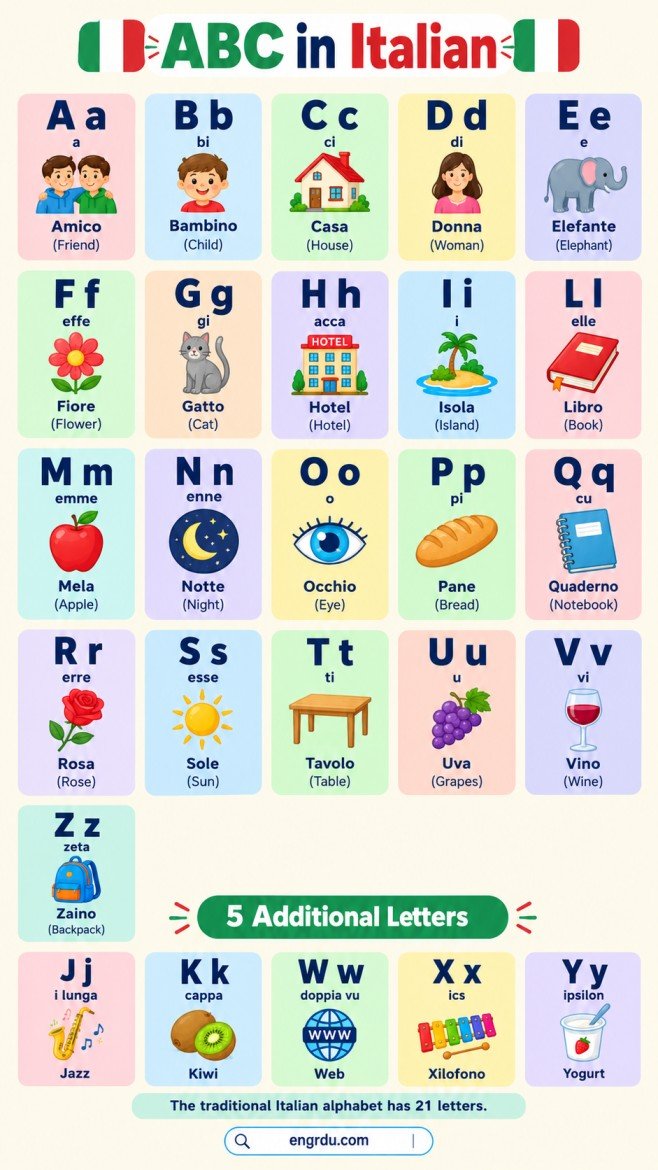
Italian Alphabet Chart
Italian Alphabet Pronunciation
Italian letter names are not always pronounced like their English equivalents. Learning the names and the sounds letters represent inside words will help you read Italian more confidently.
The following table gives approximate English pronunciation cues. These are learning aids rather than exact phonetic transcriptions.
| Letter | Italian name | Approximate pronunciation |
|---|---|---|
| A | a | ah |
| B | bi | bee |
| C | ci | chee |
| D | di | dee |
| E | e | eh |
| F | effe | EF-feh |
| G | gi | jee |
| H | acca | AHK-kah |
| I | i | ee |
| L | elle | EL-leh |
| M | emme | EM-meh |
| N | enne | EN-neh |
| O | o | oh |
| P | pi | pee |
| Q | cu | koo |
| R | erre | ER-reh, with a tapped or rolled r |
| S | esse | ES-seh |
| T | ti | tee |
| U | u | oo |
| V | vi | vee |
| Z | zeta | DZEH-tah or TSEH-tah, approximately |
Important Italian Letter Sounds
Some Italian letters change their sounds depending on the letters that follow them. These patterns are particularly useful when reading unfamiliar words.
C: Before e or i, it usually sounds like English “ch,” as in cena (dinner). Before a, o, or u, it usually has a “k” sound, as in casa (house).
G: Before e or i, it usually sounds like the “j” in “jam,” as in gelato (ice cream). Before a, o, or u, it has a hard sound, as in gatto (cat).
H: The letter H is generally silent in Italian words. However, it helps distinguish some words and changes the pronunciation of C and G in combinations such as che and ghi.
R: Italian R is usually tapped or rolled with the tongue. It differs from the typical English R.
Z: Italian Z can have a sound similar to “ts” or “dz,” depending on the word.
Italian vowels are also important. A, E, I, O, and U are pronounced clearly, and their sounds generally remain more consistent than English vowel sounds.
Italian and English Alphabet Differences
English has 26 standard alphabet letters, while the traditional Italian alphabet has 21. The biggest difference is that five letters are not part of the traditional Italian sequence.
| Feature | Italian alphabet | English alphabet |
|---|---|---|
| Number of traditional letters | 21 | 26 |
| Writing system | Latin alphabet | Latin alphabet |
| Vowels | A, E, I, O, U | A, E, I, O, U |
| Letter names | Italian pronunciation | English pronunciation |
| J, K, W, X, Y | Mainly foreign words and names | Standard alphabet letters |
| Pronunciation | Often follows consistent spelling patterns | Often varies considerably |
| Silent H | Common in Italian spelling | Occurs in many English words |
For example, the letter C in casa has a hard sound, while the C in cena has a “ch” sound. English also has different C sounds, but its spelling patterns are less consistent overall.
Learning these differences helps English speakers avoid transferring English pronunciation habits directly into Italian.
The Five Letters Not Included in the Traditional Italian Alphabet
The letters J, K, W, X, and Y are commonly encountered in Italian, even though they are excluded from the traditional 21-letter alphabet. They appear in foreign words, personal names, brand names, scientific terms, and modern vocabulary.
| Letter | Italian letter name | Example | Meaning |
|---|---|---|---|
| J | i lunga | jazz | A style of music |
| K | cappa | kiwi | A fruit |
| W | doppia vu | web | The internet or an online network |
| X | ics | taxi | A car service |
| Y | ipsilon | yogurt | A fermented milk food |
The names shown are conventional Italian names for these letters. Some speakers may use alternative names or pronunciations, particularly when spelling foreign words.
These five letters are not forbidden in Italian. They simply do not belong to the traditional 21-letter sequence taught for the Italian alphabet.
Italian Words and Examples for Each Letter
One effective way to learn the Italian ABC is to connect every letter with a familiar word. The examples below include common nouns and useful vocabulary with English meanings.
Italian Alphabet Words From A to Z
| Letter | Italian word | English meaning |
|---|---|---|
| A | Amico | Friend |
| B | Bambino | Child |
| C | Casa | House |
| D | Donna | Woman |
| E | Elefante | Elephant |
| F | Fiore | Flower |
| G | Gatto | Cat |
| H | Hotel | Hotel |
| I | Isola | Island |
| J | Jazz | A style of music |
| K | Kiwi | Kiwi fruit |
| L | Libro | Book |
| M | Mela | Apple |
| N | Notte | Night |
| O | Occhio | Eye |
| P | Pane | Bread |
| Q | Quaderno | Notebook |
| R | Rosa | Rose |
| S | Sole | Sun |
| T | Tavolo | Table |
| U | Uva | Grapes |
| V | Vino | Wine |
| W | Web | Online network |
| X | Xilofono | Xylophone |
| Y | Yogurt | Yogurt |
| Z | Zaino | Backpack |
Remember: The table includes all 26 letters for comparison and vocabulary practice. The traditional Italian alphabet consists of the 21 letters listed earlier. Words such as hotel, jazz, kiwi, web, xilofono, and yogurt illustrate how the additional letters appear in Italian writing.
Example Sentences Using Italian Alphabet Words
Reading words in context helps you understand their meanings and remember their spelling.
| Italian sentence | English translation |
|---|---|
| Il mio amico è gentile. | My friend is kind. |
| Il bambino legge un libro. | The child reads a book. |
| La casa è grande. | The house is big. |
| La donna compra una mela. | The woman buys an apple. |
| Il gatto dorme sul tavolo. | The cat sleeps on the table. |
| Il sole splende oggi. | The sun shines today. |
| Scrivo sul quaderno. | I write in the notebook. |
| Lo zaino è nero. | The backpack is black. |
These examples demonstrate how individual letters form words and how words work together in Italian sentences.
How to Use the Italian ABC in Everyday Situations
Knowing the Italian alphabet is useful when you need to spell a name, understand written information, or communicate with Italian speakers. Letter names are especially helpful when a word is unfamiliar or difficult to hear.
1. Spelling Your Name
When introducing yourself, you may need to spell your name for someone.
Useful expressions include:
Come ti chiami? — What is your name?
Mi chiamo Luca. — My name is Luca.
Come si scrive? — How is it spelled?
Si scrive L-U-C-A. — It is spelled L-U-C-A.
When spelling a name, pronounce each letter using its Italian name.
2. Asking Someone to Spell a Word
If you do not understand a name or unfamiliar word, you can ask the speaker to spell it.
Puoi fare lo spelling? — Can you spell it out?
Puoi ripetere, per favore? — Can you repeat that, please?
Come si scrive questa parola? — How is this word spelled?
These phrases are useful in classrooms, conversations, travel situations, and language-learning activities.
3. Reading Signs and Written Information
Recognizing Italian letters helps you read place names, street signs, menus, labels, and public notices.
For example:
Uscita — Exit
Entrata — Entrance
Stazione — Station
Farmacia — Pharmacy
Aperto — Open
Practicing familiar words makes it easier to connect Italian spelling with meaning.
4. Learning Italian Vocabulary
The alphabet provides a foundation for organizing and remembering new words. You can group vocabulary by its first letter, create flashcards, or keep an alphabetical notebook.
For example:
A — acqua (water)
C — cane (dog)
F — famiglia (family)
L — latte (milk)
S — scuola (school)
Review a few words each day and say them aloud to strengthen spelling and pronunciation skills.
Common Italian Alphabet Mistakes
English speakers may assume that Italian letter names and sounds work exactly like English. A few corrections can prevent common spelling and pronunciation errors.
Counting 26 letters: The traditional Italian alphabet has 21 letters, although all 26 Latin letters appear in modern Italian writing.
Pronouncing every C the same way: C usually has a “k” sound before A, O, and U, but a “ch” sound before E and I.
Pronouncing H aloud: H is generally silent, although it affects spelling and pronunciation in certain combinations.
Using English letter names: Italian letter names such as bi, ci, and gi differ from their English counterparts.
Ignoring double consonants: Italian distinguishes single and double consonants, which can change a word’s meaning or pronunciation.
Practice Exercises With Answers
Practice helps you remember the Italian letter names, identify the traditional alphabet, and connect letters with vocabulary. Try answering the questions before checking the answer key.
Exercise 1: Complete the Missing Letters
Fill in the missing letters from the traditional Italian alphabet.
A, B, __, D, E
F, G, __, I, L
M, N, __, P, Q
R, S, __, U, V
A, E, I, __, U
Exercise 2: Match the Italian Words With Their Meanings
Match each Italian word with its correct English meaning.
| Italian word | Answer choices |
|---|---|
| 1. Casa | A. Bread |
| 2. Gatto | B. Flower |
| 3. Fiore | C. House |
| 4. Pane | D. Cat |
| 5. Libro | E. Book |
Exercise 3: True or False
The traditional Italian alphabet contains 21 letters.
The letter H is usually pronounced aloud in Italian words.
J, K, W, X, and Y are excluded from the traditional Italian alphabet.
The Italian word mela means apple.
The letter C always has the same sound in Italian.
Answer Key
Exercise 1
C
H
O
T
O
Exercise 2
C — House
D — Cat
B — Flower
A — Bread
E — Book
Exercise 3
True
False
True
True
False
FAQs About ABC in Italian
1. How do you say ABC in Italian?
The Italian word for alphabet is alfabeto. The traditional Italian alphabet is called alfabeto italiano and contains 21 letters.
2. How many letters are in the Italian alphabet?
The traditional Italian alphabet contains 21 letters. J, K, W, X, and Y are commonly used in foreign words and names.
3. What are the 21 letters of the Italian alphabet?
The letters are A, B, C, D, E, F, G, H, I, L, M, N, O, P, Q, R, S, T, U, V, and Z.
4. Does the Italian alphabet have the letter J?
J is not part of the traditional Italian alphabet. However, it appears in foreign words, personal names, and some borrowed vocabulary.
5. Is Italian pronunciation easier than English pronunciation?
Italian spelling generally follows more consistent pronunciation patterns than English. However, sounds such as rolled R and differences between C and G require practice.
6. How do you pronounce C in Italian?
C usually sounds like K before A, O, and U, and like English CH before E and I.
7. What is the Italian word for alphabet?
The Italian word for alphabet is alfabeto. The phrase alfabeto italiano means “Italian alphabet.”
8. How can I learn the Italian ABC quickly?
Practice the 21 traditional letters aloud, learn one familiar word for each letter, review pronunciation patterns, and complete short spelling exercises daily.
Conclusion
Learning the ABC in Italian gives you a foundation for reading, writing, spelling, and understanding Italian vocabulary. The traditional Italian alphabet has 21 letters, while J, K, W, X, and Y appear mainly in foreign words and borrowed terms.
Practice the Italian letter names, learn familiar words, and pay attention to sounds such as C, G, and R. With regular practice, you will become more comfortable recognizing Italian words and spelling them correctly.
For further practice, explore related learning topics such as the French alphabet, the Spanish alphabet, and basic Italian vocabulary.