
Learning the ABC in French helps you spell names, read French words, recognize letter sounds, and communicate more confidently. Whether you are learning French at school or exploring another language, understanding the French alphabet is a useful starting point.
What Does ABC Mean in French?
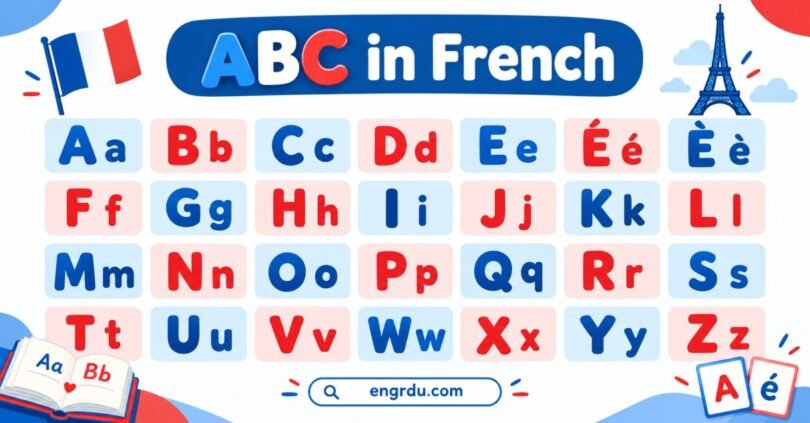
The ABC in French refers to the French alphabet, which is called l’alphabet français. It contains 26 letters, from A to Z, just like the English alphabet.
The French word for alphabet is alphabet, pronounced differently from its English equivalent.
Here are a few useful French alphabet terms:
| English | French | Meaning |
|---|---|---|
| Alphabet | Alphabet | A set of letters used in a language |
| Letter | Lettre | A written symbol |
| Vowel | Voyelle | A, E, I, O, or U |
| Consonant | Consonne | A letter other than a vowel |
| Capital letter | Majuscule | An uppercase letter |
| Small letter | Minuscule | A lowercase letter |
| To spell | Épeler | To say or name the letters in a word |
| Pronunciation | Prononciation | The way a word or letter is spoken |
For example, if someone asks you to spell your name in French, you can use the French names of the alphabet letters.
Example:
French: Comment épellez-vous votre nom ?
English: How do you spell your name?
The French Alphabet: All 26 Letters
The French alphabet has 26 letters. Although the written letters match those in English, their French names often sound different.
The table below lists every letter, its French name pronunciation in an approximate English-friendly form, and an example French word.
| Letter | French Name | Example Word | English Meaning |
|---|---|---|---|
| A | ah | Ami | Friend |
| B | bay | Bébé | Baby |
| C | say | Chat | Cat |
| D | day | Danse | Dance |
| E | uh | École | School |
| F | eff | Fleur | Flower |
| G | zhay | Girafe | Giraffe |
| H | ash | Hôtel | Hotel |
| I | ee | Image | Image |
| J | zhee | Jardin | Garden |
| K | kah | Kiwi | Kiwi |
| L | ell | Livre | Book |
| M | em | Maison | House |
| N | en | Nez | Nose |
| O | oh | Orange | Orange |
| P | pay | Pomme | Apple |
| Q | koo | Quatre | Four |
| R | air (French R) | Robot | Robot |
| S | ess | Soleil | Sun |
| T | tay | Table | Table |
| U | French u sound | Usine | Factory |
| V | vay | Vélo | Bicycle |
| W | doo-bluh-vay | Wagon | Wagon |
| X | eeks | Xylophone | Xylophone |
| Y | ee-grek | Yaourt | Yogurt |
| Z | zed | Zèbre | Zebra |
Pronunciation note: These spellings are approximate learning aids, not exact phonetic transcriptions. French sounds such as U, R, and the nasal vowels in some letter names need listening and speaking practice.
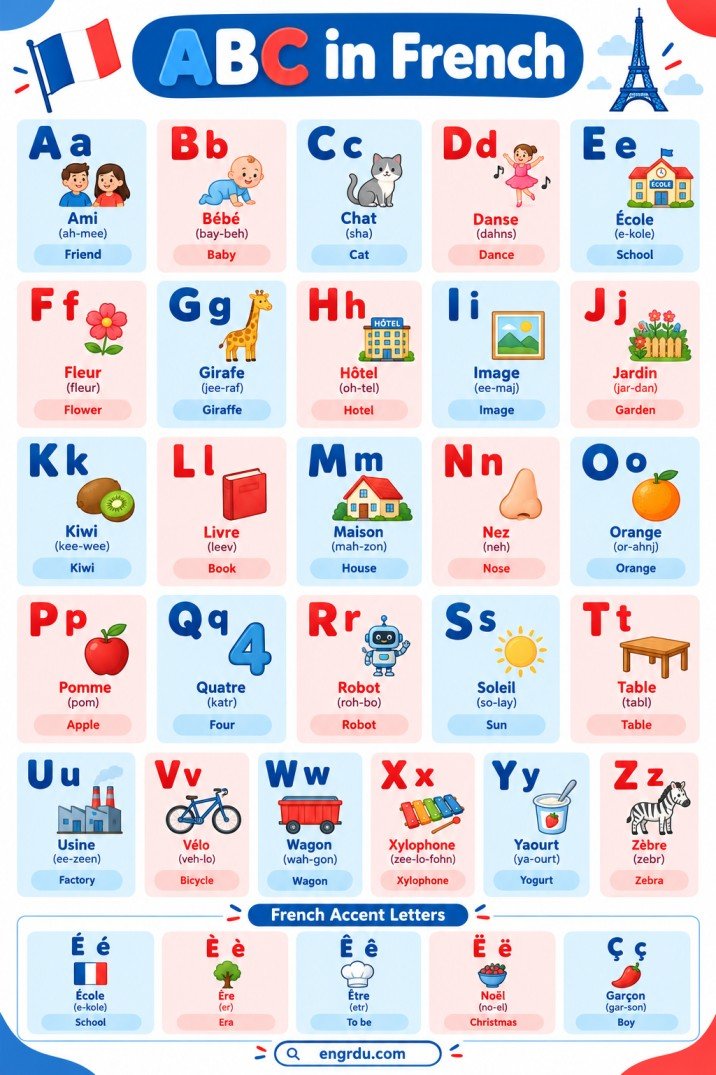
ABC in French_ A Colorful Alphabet Guide
Vowels in the French Alphabet
French has six commonly recognized vowel letters when Y is included as a vowel in some contexts: A, E, I, O, U, and sometimes Y.
The five primary vowel letters are:
A — as in ami (friend)
E — as in école (school)
I — as in ici (here)
O — as in orange (orange)
U — as in lune (moon)
The letter Y is called i grec in French. It can function as a vowel in words such as stylo (pen).
Consonants in the French Alphabet
The other 20 letters are generally classified as consonants.
Examples include:
B — bébé (baby)
C — café (coffee)
M — maman (mom)
P — père (father)
S — soleil (sun)
The sound of a consonant can change depending on the letters that follow it. For example, C often sounds like /k/ in café but like /s/ in citron (lemon).
How to Pronounce the ABCs in French
French letter names are different from English letter names, so memorizing the French pronunciation helps you spell words accurately. Focus first on the letter names, then practice recognizing those letters inside words.
French Alphabet Pronunciation Chart
Use this quick chart to practice saying the letters aloud.
| Letters | French Letter Names |
|---|---|
| A, B, C, D | ah, bay, say, day |
| E, F, G, H | uh, eff, zhay, ash |
| I, J, K, L | ee, zhee, kah, ell |
| M, N, O, P | em, en, oh, pay |
| Q, R, S, T | koo, French R, ess, tay |
| U, V, W, X | French U, vay, doo-bluh-vay, eeks |
| Y, Z | ee-grek, zed |
Tips for Learning French Letter Sounds
Listen and repeat: Hear each letter name and repeat it several times.
Learn similar sounds together: Compare English and French letter names to notice their differences.
Practice the French U: Round your lips as if saying “oo,” but position your tongue closer to the sound of “ee.”
Practice the French R: The sound is usually made toward the back of the mouth rather than with an English-style R.
Spell familiar words: Practice with your name, your school, or the names of everyday objects.
Remember that letter names and letter sounds are not the same thing. The name of C is cé, but its sound inside a word depends on its spelling and surrounding letters.
French Alphabet Letters with Example Words
Learning a letter alongside a French word helps you connect the written alphabet with everyday vocabulary. The examples below include familiar words that are useful for school learners and people beginning to study French.
| Letter | French Word | English Meaning | Example Sentence |
|---|---|---|---|
| A | Ami | Friend | Mon ami est gentil. (My friend is kind.) |
| B | Bonjour | Hello | Bonjour, Marie ! (Hello, Marie!) |
| C | Chat | Cat | Le chat dort. (The cat is sleeping.) |
| D | Danse | Dance | Elle aime la danse. (She likes dancing.) |
| E | École | School | Je vais à l’école. (I go to school.) |
| F | Fleur | Flower | La fleur est rouge. (The flower is red.) |
| G | Girafe | Giraffe | La girafe est grande. (The giraffe is tall.) |
| H | Hôtel | Hotel | L’hôtel est grand. (The hotel is large.) |
| I | Image | Image | Voici une image. (Here is an image.) |
| J | Jardin | Garden | Le jardin est beau. (The garden is beautiful.) |
| K | Kiwi | Kiwi | Je mange un kiwi. (I am eating a kiwi.) |
| L | Livre | Book | J’ai un livre. (I have a book.) |
| M | Maison | House | Ma maison est petite. (My house is small.) |
| N | Nez | Nose | Mon nez est froid. (My nose is cold.) |
| O | Orange | Orange | Je mange une orange. (I am eating an orange.) |
| P | Pomme | Apple | La pomme est verte. (The apple is green.) |
| Q | Quatre | Four | J’ai quatre crayons. (I have four pencils.) |
| R | Robot | Robot | Le robot est nouveau. (The robot is new.) |
| S | Soleil | Sun | Le soleil brille. (The sun is shining.) |
| T | Table | Table | La table est ronde. (The table is round.) |
| U | Usine | Factory | L’usine est grande. (The factory is large.) |
| V | Vélo | Bicycle | Mon vélo est bleu. (My bicycle is blue.) |
| W | Wagon | Wagon | Le wagon est vide. (The wagon is empty.) |
| X | Xylophone | Xylophone | Le xylophone est ici. (The xylophone is here.) |
| Y | Yaourt | Yogurt | Je mange un yaourt. (I am eating yogurt.) |
| Z | Zèbre | Zebra | Le zèbre court. (The zebra runs.) |
Some French words begin with letters that are less common in everyday vocabulary, such as K, W, X, and Y. Many such words are borrowed from other languages or used in specialized contexts.
English Alphabet vs. French Alphabet
The English and French alphabets both use 26 basic letters, but their letter names and some pronunciation rules differ.
Understanding these differences can help English speakers avoid spelling mistakes and recognize French words more easily.
| Feature | English Alphabet | French Alphabet |
|---|---|---|
| Number of basic letters | 26 | 26 |
| Letter A | Usually called “ay” | Called a |
| Letter G | Usually called “jee” | Called gé |
| Letter J | Usually called “jay” | Called ji |
| Letter R | English R sound | French R sound |
| Letter U | English U name | French U sound |
| Letter W | “Double-u” | Double vé |
| Letter Z | “Zee” or “zed” | Zède |
| Accent marks | Used in some borrowed words and names | Common in French spelling |
| Word pronunciation | Depends on English spelling rules | Depends on French spelling rules |
Why Do the Letter Names Sound Different?
The French and English languages developed their own pronunciation conventions over time. As a result, the same written letter may have a different spoken name in each language.
For example:
English B is called “bee,” while French B is bé.
English J is called “jay,” while French J is ji.
English W is called “double-u,” while French W is double vé.
When spelling a word in French, use the French letter names rather than the English ones.
How Are French Alphabet Letters Used?
Knowing the French ABCs is useful for spelling words, reading signs, understanding dictionaries, and communicating information clearly. The alphabet also provides the foundation for learning French vocabulary and pronunciation.
Here are four common situations where the French alphabet is used.
1. Spelling Names and Words
You may need to spell a name when introducing yourself, filling out a form, or speaking on the phone.
Useful French expressions:
Je m’appelle Paul. — My name is Paul.
Comment épelle-t-on ce mot ? — How do you spell this word?
Ça s’écrit comment ? — How is that spelled?
2. Reading Dictionaries
French dictionaries often arrange words alphabetically, just like English dictionaries. Learning the letter sequence makes it easier to locate vocabulary and understand alphabetical word lists.
For example, chat comes before chien because A–Z ordering compares the letters from left to right, and the third letter of chat comes before the third letter of chien.
3. Recognizing Abbreviations
French uses letters in abbreviations, initials, and shortened forms.
Examples include:
M. — Monsieur (Mr.)
Mme — Madame (Mrs. or Ms.)
TGV — Train à grande vitesse (high-speed train)
Knowing French letter names helps you read and spell these abbreviations aloud.
4. Learning New French Vocabulary
Each letter can help you organize new vocabulary into manageable groups.
For example:
A — amour (love)
B — boulangerie (bakery)
C — chocolat (chocolate)
D — dimanche (Sunday)
E — enfant (child)
You can build your own A–Z vocabulary notebook and add words as you learn them.
French Accents and Special Characters
Although the French alphabet has 26 basic letters, French writing uses accent marks and a few additional signs that affect spelling and sometimes pronunciation. These marks are part of French orthography, not separate letters added to the basic A–Z alphabet.
| Mark | Name in French | Example | Purpose |
|---|---|---|---|
| é | Accent aigu | école | Marks a particular E sound |
| è | Accent grave | père | Marks a different E sound |
| ê | Accent circonflexe | forêt | Can reflect historical spelling and affect pronunciation |
| ë | Tréma | Noël | Shows that a vowel is pronounced separately from the preceding vowel |
| ç | Cédille | garçon | Makes C sound like /s/ before A, O, or U |
What Is the Difference Between E, É, È, and Ê?
The letter E can appear in several forms in French. These forms are not interchangeable, and the accent can change the pronunciation or distinguish the correct spelling of a word.
E: le — the
É: été — summer
È: père — father
Ê: tête — head
The exact sound depends on the word and the French pronunciation pattern. Learning accents together with vocabulary helps you spell and read French more accurately.
Is Ç a Separate Letter?
No. The cedilla in ç is a diacritic, a mark added to a letter. It changes the pronunciation of C in particular contexts.
For example:
garçon — boy
français — French
leçon — lesson
Without the cedilla, C before A, O, or U would normally have a hard /k/ sound in standard French spelling.
Common Mistakes When Learning French ABCs
Learners can recognize the letters quickly but still make mistakes when saying their names or using them in words.
Watch out for these common problems:
Using English letter names: Remember that French B is bé, not “bee.”
Confusing letter names with word sounds: C is named cé, but it can sound like /k/ or /s/ in words.
Pronouncing French U like English “oo”: French U requires a different tongue position.
Ignoring accent marks: é, è, and ê are written differently and may sound different.
Treating accent marks as extra alphabet letters: They modify letters rather than expanding the basic 26-letter alphabet.
Practice Exercises: ABC in French
Practice helps you remember the French letter names, recognize example words, and distinguish French spelling from English spelling. Try the questions before checking the answers.
Exercise 1: Complete the French Alphabet
Fill in the missing letters.
A, B, __, D, E
F, G, __, I, J
K, L, M, __, O
P, Q, __, S, T
U, V, __, X, Y, Z
Exercise 2: Match the French Words to Their Meanings
Match each French word with the correct English meaning.
| French Word | Answer Choices |
|---|---|
| 1. Chat | A. Garden |
| 2. Livre | B. Sun |
| 3. Jardin | C. Cat |
| 4. Soleil | D. Book |
| 5. Pomme | E. Apple |
Exercise 3: Choose the Correct Answer
1. How many basic letters are in the French alphabet?
A. 24
B. 26
C. 28
2. What is the French word for “letter”?
A. Lettre
B. Livre
C. Langue
3. Which mark appears in the word garçon?
A. Tréma
B. Cédille
C. Accent aigu
4. What is the French name for W?
A. Double vé
B. Double-u
C. Zède
5. Which word means “school” in French?
A. Soleil
B. École
C. Maison
Exercise 4: Spell a Word in French
Choose one word from the list and practice saying its letters using French letter names.
Chat
Livre
Pomme
Jardin
Soleil
For example, chat is spelled C–H–A–T. Say the French name of each letter rather than its English name.
Practice Answers
Check your work after completing the exercises.
Exercise 1
C
H
N
R
W
Exercise 2
C — Cat
D — Book
A — Garden
B — Sun
E — Apple
Exercise 3
B — 26
A — Lettre
B — Cédille
A — Double vé
B — École
Exercise 4
Answers will vary depending on the word you choose. Check that you say all the French letter names in the correct order.
FAQs About ABC in French
1. What is the ABC in French?
The ABC in French is called l’alphabet français. It contains 26 basic letters, from A to Z, with French-specific letter names and pronunciation.
2. Are the French and English alphabets the same?
Both alphabets contain the same 26 basic letters, but the names of letters and the pronunciation rules used in French differ from English.
3. How do you say the alphabet in French?
The French word for alphabet is alphabet, and the complete alphabet is called l’alphabet français. French speakers name each letter using French pronunciation.
4. How many letters are in the French alphabet?
The French alphabet contains 26 basic letters, from A through Z. Accent marks such as é and ç do not count as additional alphabet letters.
5. What is the French letter W called?
The letter W is called double vé in French, meaning “double V.” Its French name differs from the English name “double-u.”
6. What is the difference between French U and English U?
French U has a rounded vowel sound that English does not use in the same way. Practice rounding your lips while keeping your tongue forward.
7. Does French use accent marks in the alphabet?
French uses accent marks such as é, è, ê, and ë, as well as the cedilla ç. These marks affect spelling and sometimes pronunciation.
8. What is the best way to learn the French ABCs?
Practice the letters in order, listen to native French pronunciation, spell familiar words aloud, and review a few letters and example words every day.
Conclusion
Learning the ABC in French gives you a foundation for reading, spelling, and speaking the language. The French alphabet contains the same 26 basic letters as English, but the names of those letters and their sounds can differ.
Start by memorizing the alphabet, practicing the French letter names, and learning a familiar word for each letter. Pay attention to French U, R, and accent marks as you build your vocabulary. With regular practice, you will become more confident spelling French words and recognizing them in everyday reading.