In this blog post, we will learn about plural nouns. These are words that show when there is more than one person, place, thing, or idea. Knowing how to use them is very important because they appear in everyday English. When you understand plural nouns, your speaking, reading, writing, and listening all become stronger. You can describe groups of people, talk about objects around you, and ask questions more naturally. Learning plurals step by step will help you build confidence and use English more effectively in school, at work, and in daily life.
Plural Nouns Definition and Examples
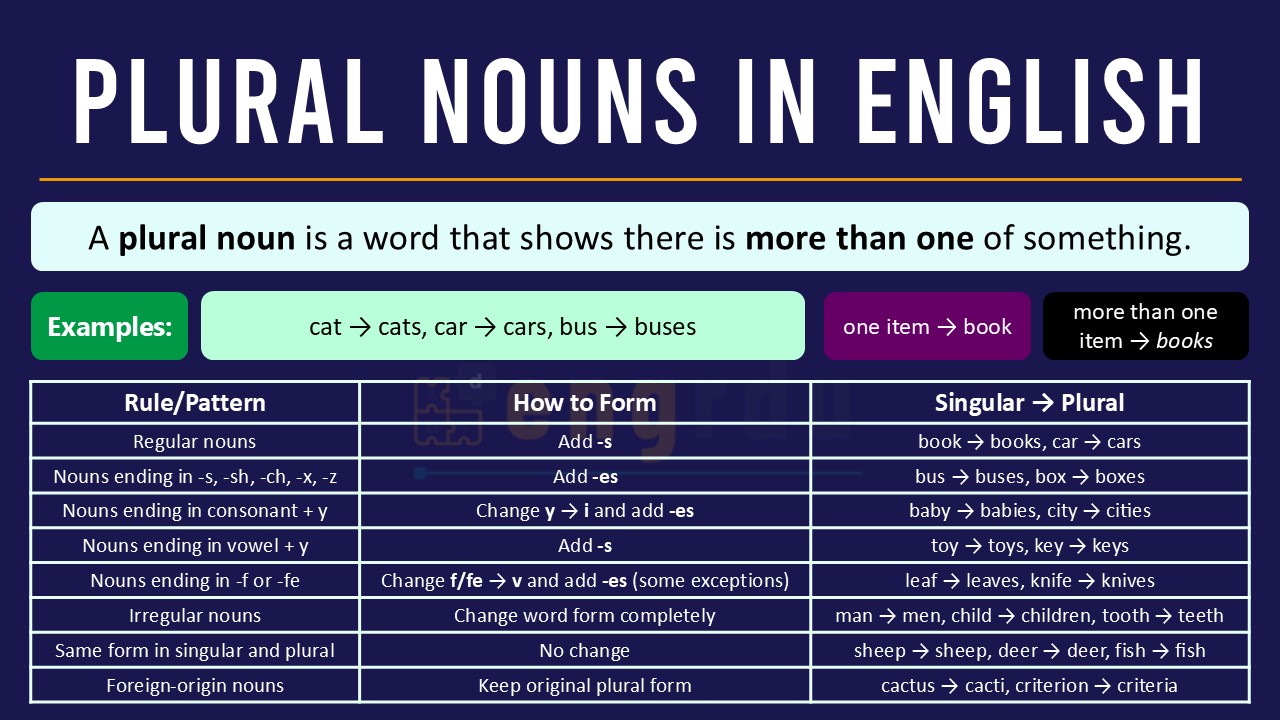
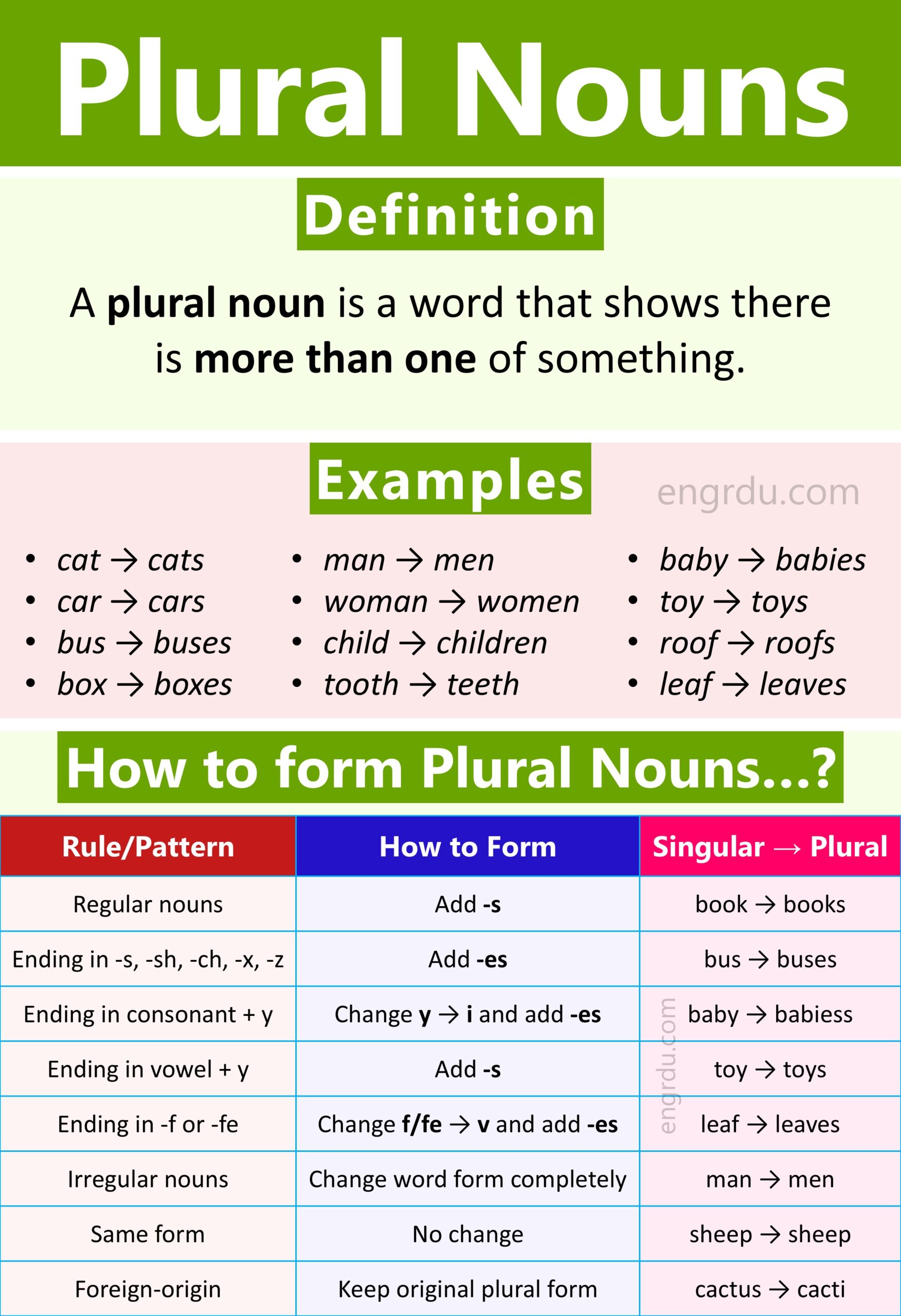
A plural noun is a word that shows there is more than one of something.
- Singular noun: one item → book
- Plural noun: more than one item → books
In English, most plurals are made by adding -s or -es to the singular form. But there are many exceptions and special rules.
Formation of Plural Forms in English
| Rule/Pattern | How to Form | Example (Singular → Plural) |
|---|---|---|
| Regular nouns | Add -s | book → books car → cars |
| Nouns ending in -s, -sh, -ch, -x, -z | Add -es | bus → buses box → boxes |
| Nouns ending in consonant + y | Change y → i and add -es | baby → babies city → cities |
| Nouns ending in vowel + y | Add -s | toy → toys key → keys |
| Nouns ending in -f or -fe | Change f/fe → v and add -es (some exceptions) | leaf → leaves knife → knives |
| Irregular nouns | Change word form completely | man → men child → children tooth → teeth |
| Same form in singular and plural | No change | sheep → sheep deer → deer fish → fish |
| Foreign-origin nouns | Keep original plural form | cactus → cacti phenomenon → phenomena criterion → criteria |
Types of Plural Nouns
Plural nouns can be grouped into different types based on how they are formed.
1. Regular Plurals
Most nouns follow simple rules.
- Add -s: cat → cats, car → cars
- Add -es if the word ends in -s, -sh, -ch, -x, -z: bus → buses, box → boxes
2. Irregular Plurals
Some nouns change completely or do not follow the regular rules.
- man → men
- woman → women
- child → children
- tooth → teeth
- mouse → mice
3. Nouns Ending in -y
- If a noun ends in a consonant + y, change y → i and add -es: baby → babies
- If a noun ends in a vowel + y, just add -s: toy → toys
4. Nouns Ending in -f or -fe
Some nouns change f → v and add -es.
- leaf → leaves
- knife → knives But some just add -s: roof → roofs
5. Same Form in Singular and Plural
Certain nouns do not change at all.
- sheep → sheep
- deer → deer
- fish → fish (though fishes is used in scientific contexts)
6. Foreign-Origin Plurals
Words borrowed from Latin or Greek often keep their original plural forms.
- cactus → cacti
- phenomenon → phenomena
- criterion → criteria
Rules or Usage of Plural Nouns
Here are step-by-step rules to help learners use plural nouns correctly.
- Most nouns → add -s.
- Nouns ending in -s, -sh, -ch, -x, -z → add -es.
- Nouns ending in consonant + y → change y → i and add -es.
- Nouns ending in vowel + y → add -s.
- Nouns ending in -f or -fe → change to -ves (but check exceptions).
- Irregular nouns → learn individually (man → men, child → children).
- Unchanging nouns → same in singular and plural (sheep, deer).
- Foreign words → may keep original plural (cactus → cacti).
Examples of Plural Nouns in Sentences
| No. | Sentence |
|---|---|
| 1 | The books on the shelf belong to the library. |
| 2 | My friends are waiting outside the classroom. |
| 3 | We saw many cars parked near the stadium. |
| 4 | The children are playing football in the park. |
| 5 | Several countries joined the meeting last week. |
| 6 | The boxes are full of old clothes. |
| 7 | Her shoes are under the bed. |
| 8 | The teachers explained the lesson clearly. |
| 9 | Our neighbours invited us to their party. |
| 10 | The leaves fell from the trees in autumn. |
| 11 | Many students passed the exam successfully. |
| 12 | The wolves live in the forest nearby. |
| 13 | His glasses are on the table. |
| 14 | The babies are sleeping peacefully in their cribs. |
| 15 | We bought fresh vegetables from the market. |
| 16 | The pictures on the wall are very colourful. |
| 17 | Several knives are kept in the kitchen drawer. |
| 18 | The men are working on the construction site. |
| 19 | The women discussed the project together. |
| 20 | The sheep are grazing in the field. |
Common Mistakes
Learners often make errors with plural nouns. Here are some examples:
- Adding -s to irregular nouns
- Wrong: childs
- Correct: children
- Forgetting to change -y to -ies
- Wrong: babys
- Correct: babies
- Confusing unchanging nouns
- Wrong: sheeps
- Correct: sheep
- Mixing foreign plurals
- Wrong: cactuses (acceptable in informal English but less common)
- Correct: cacti
Comparisons
Plural nouns can be confusing when compared to similar grammar points.
| Singular | Plural | Notes |
|---|---|---|
| book | books | Regular plural |
| baby | babies | Change y → i |
| leaf | leaves | f → v |
| sheep | sheep | No change |
| cactus | cacti | Latin origin |
Tips for Learners
- Learn irregular plurals separately. Make a list and practise.
- Notice endings. Pay attention to -y, -f, -fe, and foreign words.
- Read often. Exposure to real English helps you see plurals in use.
- Practise writing sentences. Use plural nouns in affirmative, negative, and questions.
- Check dictionaries. Many plurals are listed with pronunciation.
Conclusion
Plural nouns show when we talk about more than one person, place, thing, or idea. Most plurals are formed by adding -s or -es, but many irregular forms exist. Learners should practise rules, study exceptions, and use plural nouns in everyday sentences. With careful practice, plural nouns become natural and easy to use.
Read More