


In this blog post, you will learn about collective nouns, words that name a group of people, animals, or things as one unit. These words are common in everyday English, such as team, family, and class. When you understand how they work, you can speak more naturally and write with better accuracy. They also help you follow conversations, read stories with confidence, and build stronger grammar skills. By learning their definition, types, uses, and examples, you will master an important part of English vocabulary and improve all four language skills.
Collective Nouns Definition and Examples
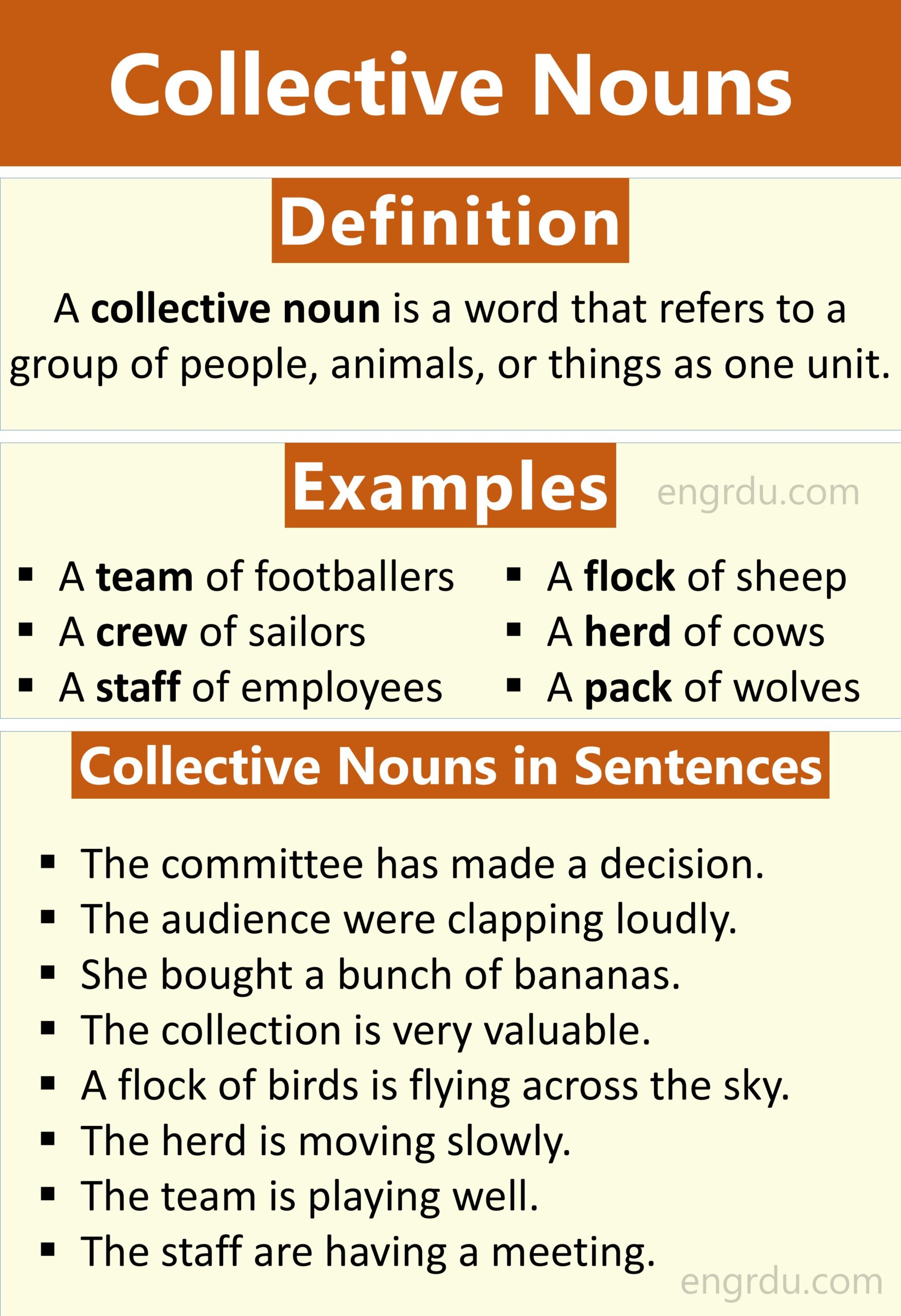
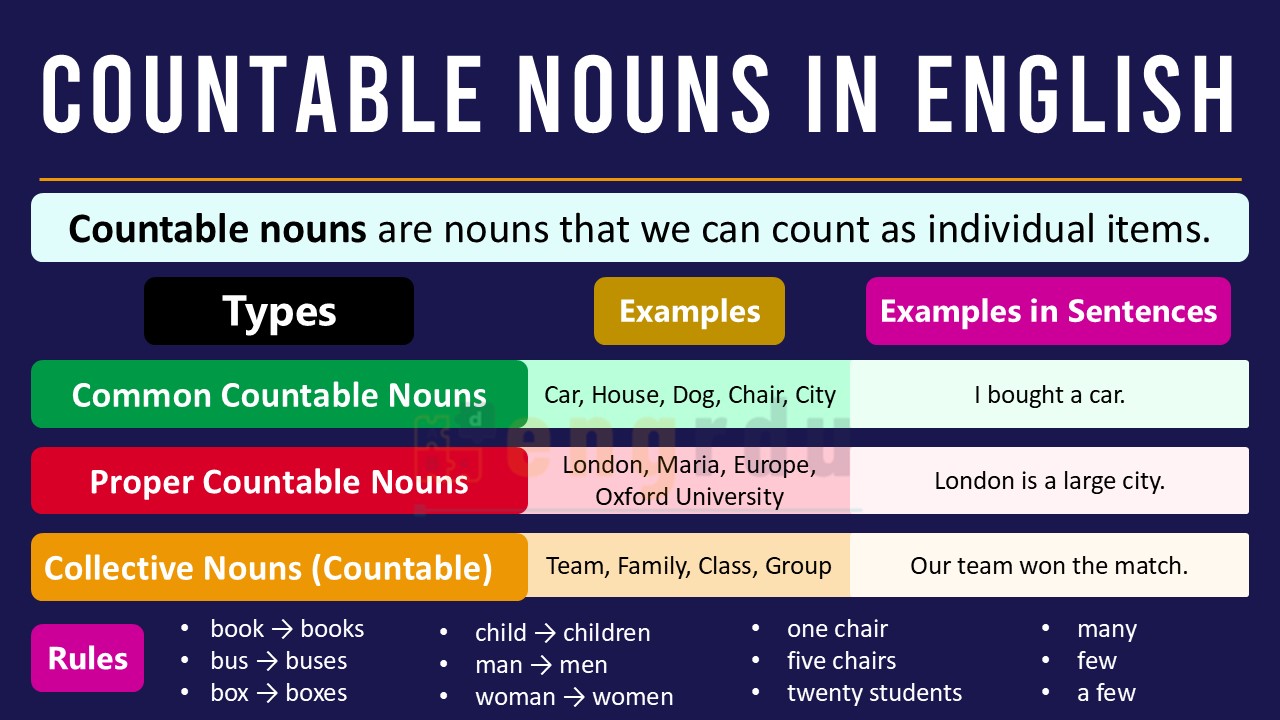
A collective noun is a word that refers to a group of people, animals, or things as one unit. Even though it describes many members, the word itself is usually singular in form.
A collective noun = one word for a group
- A team of players
- A family of five people
- A class of students
- A flock of birds
- A bouquet of flowers
In each example, the word (team, family, class, flock, bouquet) represents many members, but we treat it as one group.
Collective Nouns in English
Types of Collective Nouns
Collective nouns can be divided into different categories. Let us look at the most common types.
Collective Nouns for People
These refer to groups of people.
Examples:
- A team of footballers
- A crew of sailors
- A staff of employees
- A band of musicians
- A jury of judges
Example sentences:
- The team is playing well.
- The staff are having a meeting. (British English usage – explained later)
Collective Nouns for Animals
These are often interesting and sometimes creative.
Examples:
- A flock of sheep
- A herd of cows
- A pack of wolves
- A swarm of bees
- A school of fish
Example sentences:
- A flock of birds is flying across the sky.
- The herd is moving slowly.
Collective Nouns for Things
These refer to groups of objects.
Examples:
- A bunch of grapes
- A pile of clothes
- A set of tools
- A collection of stamps
- A series of events
Example sentences:
- She bought a bunch of bananas.
- The collection is very valuable.
Formal or Special Collective Nouns
Some collective nouns are more formal or traditional.
Examples:
- A committee of members
- A panel of experts
- A board of directors
- An audience of listeners
Example sentence:
- The committee has made a decision.
- The audience were clapping loudly. (British English)
Rules and Usage of Collective Nouns
Understanding how to use collective nouns correctly is very important. Let us study the main rules step by step.
Singular or Plural Verb?
This is the most common question.
- In British English, collective nouns can take either a singular or plural verb depending on meaning.
- In American English, they usually take a singular verb.
When to Use a Singular Verb
Use a singular verb when the group acts as one unit.
Examples:
- The team is winning.
- The family lives in London.
- The committee has decided.
Here, the group acts together.
When to Use a Plural Verb (Common in British English)
Use a plural verb when members act individually.
Examples:
- The team are wearing different uniforms.
- The family are arguing among themselves.
- The staff are preparing their reports.
Here, we think about the members, not the group as one.
Tip: In exams, follow the version of English you are learning (British or American).
Pronouns with Collective Nouns
Pronouns should match the meaning.
Singular meaning:
- The team has won its match.
Plural meaning:
- The team have taken their seats.
Do Not Add “s” to Make It Plural (Usually)
The collective noun itself is singular:
Correct:
- The team is ready.
Incorrect:
- The teams is ready. (Wrong verb agreement)
However, if you are talking about more than one group:
- Two teams are playing today.
- Several families live here.
Use “of” Structure
Most collective nouns follow this pattern:
Collective noun + of + plural noun
Examples:
- A flock of birds
- A group of students
- A bunch of keys
- A pack of dogs
Examples of Collective Nouns in Sentences
Let us look at different types of sentences.
Affirmative Sentences
- The class is quiet today.
- A swarm of bees is near the tree.
- The jury has reached its decision.
- The family are enjoying their holiday.
Negative Sentences
- The team is not practising today.
- The committee has not announced the results.
- The audience were not happy with the performance.
Question Sentences
- Is the team ready?
- Has the committee finished its work?
- Are the staff attending the meeting?
Real-Life Situations
At school:
- Our class is preparing for the exam.
- The staff are organising a school event.
At home:
- My family is planning a trip.
- A bunch of keys is on the table.
In nature:
- A flock of birds is flying south.
- A herd of deer is running across the field.
Common Mistakes with Collective Nouns
Many learners make similar errors. Let us correct them.
Mistake 1: Using Wrong Verb Agreement
Incorrect:
- The team are winning. (American English exam)
Correct:
- The team is winning. (American English)
- The team are winning. (British English – acceptable)
Always follow the style you are using.
Mistake 2: Confusing Collective Nouns with Plural Nouns
Incorrect:
The family are five people.
Correct:
The family has five members.
Remember: family is one group.
Mistake 3: Forgetting the “of” Structure
Incorrect:
A flock birds
Correct:
A flock of birds
Mistake 4: Using Them for Uncountable Nouns Incorrectly
Incorrect:
A herd of water
Correct:
A glass of water
Collective nouns are usually used with countable nouns.
Collective Nouns vs Plural Nouns
Students often confuse these two.
| Feature | Collective Noun | Plural Noun |
|---|---|---|
| Meaning | A group as one unit | More than one item |
| Example | Team | Players |
| Verb (British English) | Singular or plural | Always plural |
| Example sentence | The team is ready. | The players are ready. |
- The team is strong. (Group as one)
- The players are strong. (Many individuals)
Tips for Learners
Here are practical tips to improve your understanding:
- Learn common collective nouns in groups (people, animals, things).
- Notice verb agreement when reading English books or news.
- Practise writing sentences in both British and American styles.
- Listen carefully to how native speakers use words like family and team.
- Make your own list of common collective nouns.
- Write short paragraphs using at least five collective nouns.
Conclusion
Collective nouns are important in everyday English. They describe a group using one word. Words like team, family, herd, and committee help us speak clearly and naturally. Remember to check verb agreement carefully, especially in British and American English. Practise using them in sentences, and soon they will feel easy and natural. The more you use collective nouns, the more confident your English will become.
Read More

Leave a Comment