


An adjective is a word that describes a noun or pronoun, giving more information about its quality, quantity, or state, such as beautiful, tall, or many. In this Grammar lesson, learning adjectives helps you speak, write, and understand English more clearly. Using them correctly makes your sentences more vivid and precise. In this blog post, you will explore the definition, types, uses, and examples of adjectives to practice and use confidently in everyday English.
Adjective Definition and Examples
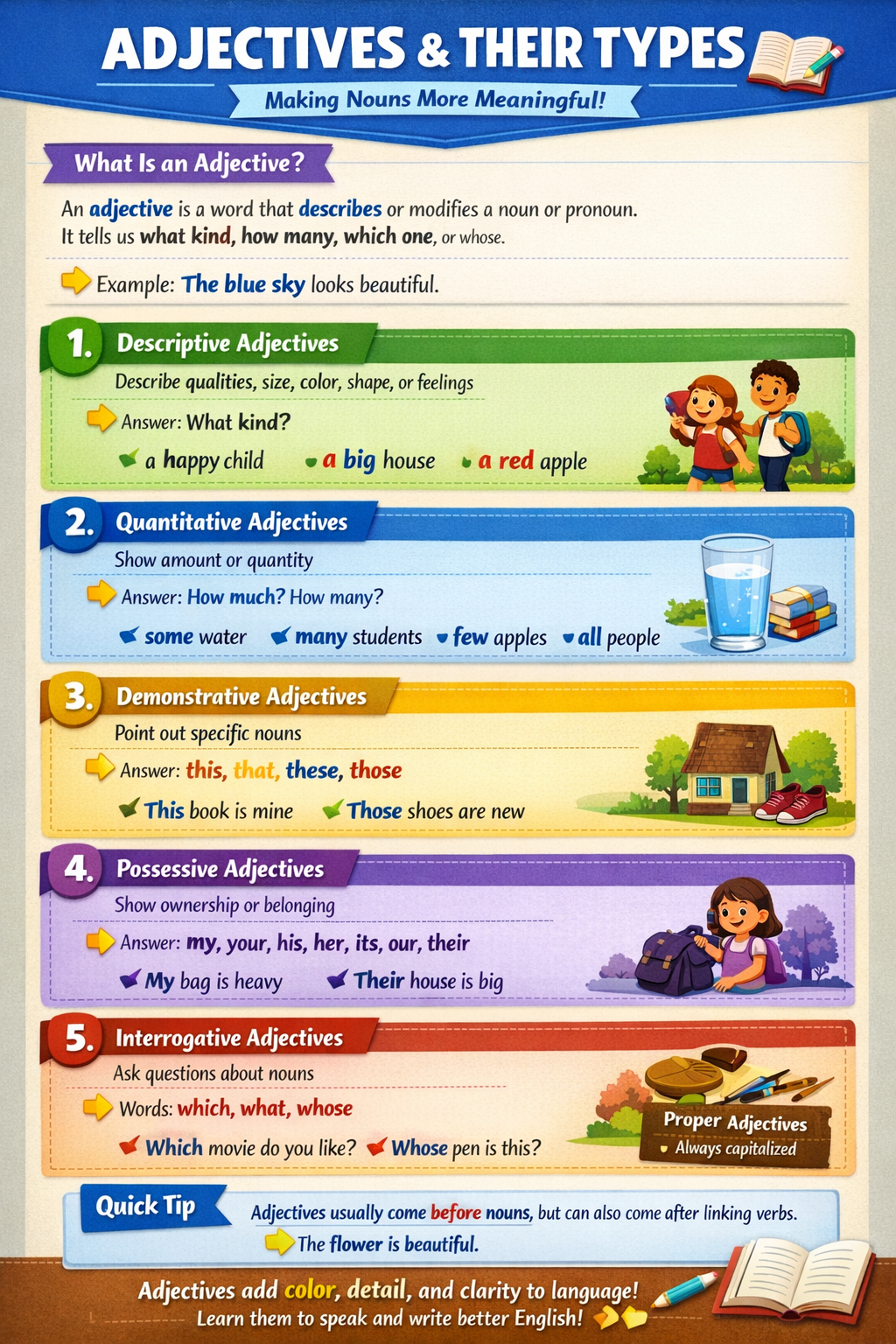
An adjective is a word that describes or gives more information about a noun or pronoun. It tells us what kind, which one, or how many.
Adjectives can describe:
| Size | Colour | Shape | Quality | Feeling | Quantity |
|---|---|---|---|---|---|
| big | red | round | good | happy | many |
| small | blue | square | bad | sad | few |
| large | green | oval | useful | angry | some |
| tiny | yellow | flat | important | excited | several |
| tall | black | long | helpful | nervous | all |
| short | white | curved | dangerous | calm | enough |

Types of Adjectives Chart
Simple definition
An adjective is a describing word that makes a noun clearer.
Examples:
- She has a blue bag.
- It is a cold day.
- He is a kind teacher.
In all these sentences, the adjective adds meaning to the noun.
Types of Adjectives
There are several types of adjectives in English. Each type has a special role. Below are the most common ones explained:
1. Descriptive Adjectives
These adjectives describe the quality or nature of a noun.
Examples:
- She lives in a quiet neighbourhood.
- He bought a new phone yesterday.
- The teacher is very kind to students.
- We stayed in a small hotel.
- It was a long journey.
These are the most common adjectives used in daily English.
2. Quantitative Adjectives
These adjectives show how much or how many.
Examples:
- She drank some water after the walk.
- Many students joined the class.
- I have few friends in this city.
- All children need care and support.
- There is enough time to finish the task.
They help us understand quantity, even when the exact number is not known.
3. Demonstrative Adjectives
These adjectives point out which noun we are talking about.
Common demonstrative adjectives:
- this
- that
- these
- those
Examples:
- This book is easy to read.
- That house looks old.
- These apples are fresh.
- Those shoes are expensive.
They are always placed before the noun.
4. Possessive Adjectives
These adjectives show ownership or belonging.
Common possessive adjectives:
- my
- your
- his
- her
- its
- our
- their
Examples:
- My bag is on the table.
- She forgot her keys at home.
- He likes his new job.
- We finished our homework early.
- The dog lost its collar.
They come before the noun and never stand alone.
5. Interrogative Adjectives
These adjectives are used to ask questions.
Common interrogative adjectives:
- which
- what
- whose
Examples:
- Which subject do you like most?
- What colour dress are you wearing?
- Whose book is on the desk?
- Which road should we take?
- What time is the meeting?
They are followed by a noun.
6. Proper Adjectives
Proper adjectives come from proper nouns and usually begin with a capital letter.
Examples:
- She enjoys Italian food.
- He studies British history.
- They visited French museums.
- We learned about Islamic culture.
- She reads American novels.
They describe something related to a specific place, person, or culture.
Adjectives Definition Types and Examples
Rules and Usage of Adjectives
Learning some basic rules will help you use adjectives correctly.
Rule 1: Position of Adjectives
In English, adjectives usually come before the noun.
Examples:
- a red apple
- a long journey
They do not change form for plural nouns.
Correct:
two small houses
Incorrect:
two smalls houses
Rule 2: Adjectives After Linking Verbs
Adjectives can also come after linking verbs such as:
- be (is, am, are, was, were)
- seem
- look
- feel
- sound
Examples:
- The food is delicious.
- She looks tired.
Rule 3: No Plural or Gender Form
Adjectives do not change for gender or number.
Correct:
- a happy boy
- a happy girl
- happy children
Rule 4: Order of Adjectives
When more than one adjective is used, there is a natural order.
General order:
Opinion → Size → Age → Shape → Colour → Origin → Material → Noun
Example:
a beautiful small old round brown Italian wooden table
In daily English, two or three adjectives are enough.
Common Mistakes with Adjectives
English learners often make small mistakes with adjectives. Here are the most common ones.
Mistake 1: Using Plural Adjectives
Incorrect:
She has bigs dreams.
Correct:
She has big dreams.
Mistake 2: Confusing Adjectives and Adverbs
Incorrect:
She sings beautiful.
Correct:
She sings beautifully.
Tip: Adjectives describe nouns. Adverbs describe verbs.
Mistake 3: Wrong Order of Adjectives
Incorrect:
a red big car
Correct:
a big red car
Mistake 4: Using Adjective Instead of Noun
Incorrect:
The poor needs help.
Correct:
The poor people need help.
List of Adjectives in English
| active | amazing | ancient | angry |
| beautiful | brave | bright | busy |
| calm | careful | cheap | clean |
| clear | clever | comfortable | confident |
| creative | curious | dangerous | dark |
| delicious | different | difficult | dirty |
| easy | excited | famous | fast |
| friendly | fresh | funny | generous |
| gentle | happy | healthy | helpful |
| honest | important | interesting | kind |
| lazy | modern | noisy | polite |
| quiet | ready | safe | simple |
| strong | successful | useful | young |
Examples of Adjectives in Sentences
| Adjective | Example Sentence |
|---|---|
| happy | I feel happy when I spend time with my family. |
| busy | I’m busy right now, but I’ll call you later. |
| tired | She looks tired after a long day at work. |
| easy | This lesson is easy to understand. |
| difficult | The exam was difficult for many students. |
| friendly | Our new neighbour is very friendly. |
| hungry | I’m hungry, so let’s eat something. |
| ready | I’m ready to leave now. |
| interesting | That podcast was really interesting. |
| important | It’s important to arrive on time. |
| clean | The room is clean and well organised. |
| noisy | This street is too noisy at night. |
| quiet | I prefer a quiet place to study. |
| comfortable | These shoes are very comfortable. |
| useful | This app is useful for learning English. |
| expensive | That restaurant is too expensive for me. |
| cheap | I bought a cheap jacket on sale. |
| polite | He is always polite with everyone. |
| helpful | The teacher was very helpful today. |
| late | Sorry, I’m late because of traffic. |
| early | She arrived early for the meeting. |
| strong | He feels strong after regular exercise. |
| weak | I felt weak because I skipped breakfast. |
| safe | This area is safe at night. |
| dangerous | Driving fast is dangerous. |
| excited | I’m excited about the weekend trip. |
| nervous | She feels nervous before speaking in public. |
| simple | The instructions are simple to follow. |
| fresh | Let’s buy some fresh vegetables. |
| proud | I’m proud of your hard work. |

Adjectives Examples in Sentences
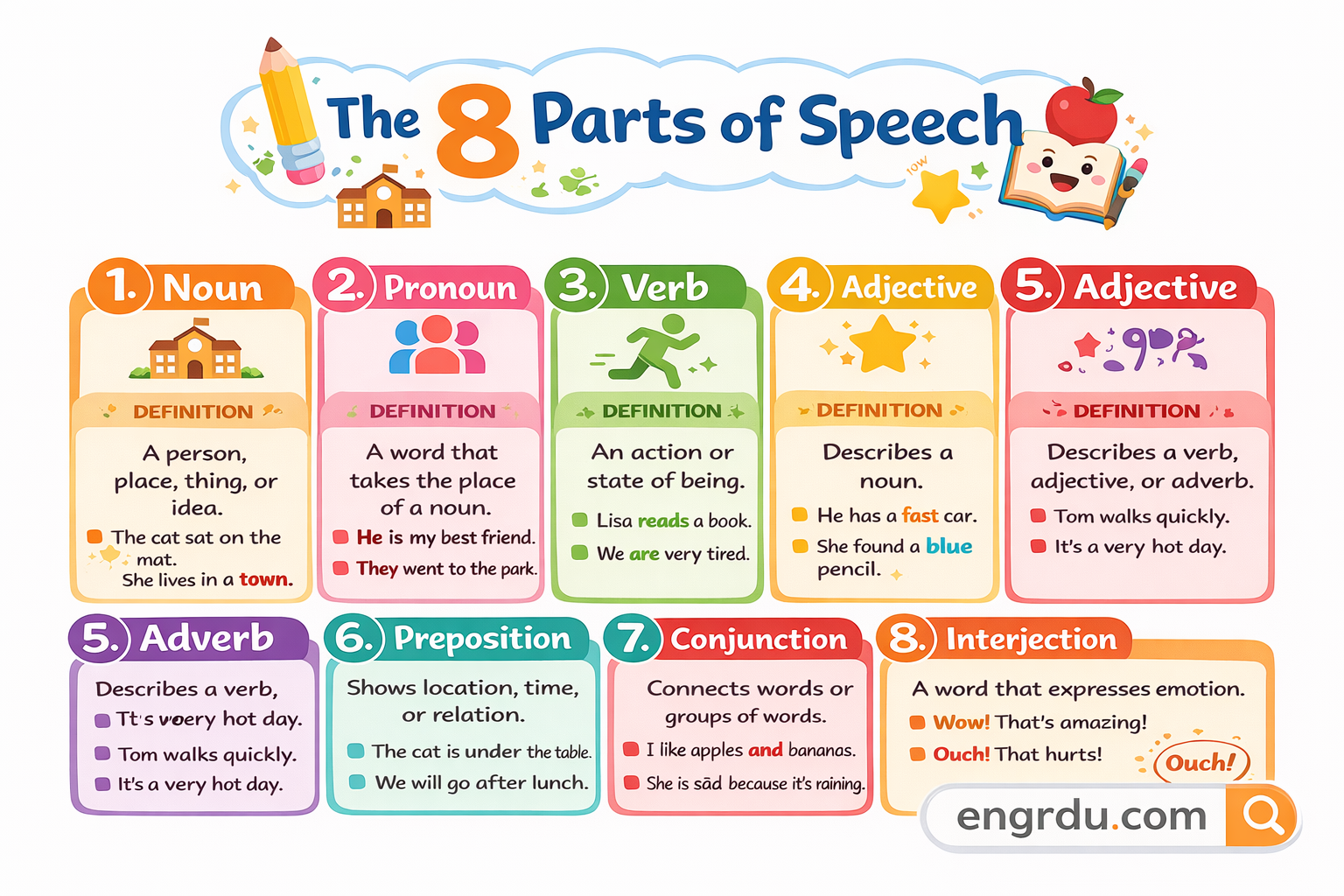
Comparison: Adjectives vs Adverbs
Many learners confuse adjectives with adverbs. This table shows the difference clearly.
| Feature | Adjective | Adverb |
|---|---|---|
| Describes | Noun or pronoun | Verb, adjective, adverb |
| Answers | What kind? | How? When? Where? |
| Example | a quick runner | runs quickly |
Tips for Learners
- Learn adjectives with example sentences.
- Read simple stories and notice describing words.
- Practise by describing people and places around you.
- Do not use too many adjectives in one sentence.
- Check adjective order when using more than one.
- Listen to native speakers to learn natural usage.
Conclusion
Adjectives help make English clear and expressive. They describe nouns and give important details about size, colour, number, and quality. Learning different types of adjectives and their rules improves both writing and speaking. With regular practice and real-life examples, adjectives become easy to use. Try using new adjectives in daily sentences to build confidence and improve your English skills.
Frequently Asked Questions
What is an adjective in English?
An adjective is a word that describes or gives more information about a noun or pronoun. It tells us what kind, how many, or which one. Words like big, happy, blue, and useful are common adjectives used in daily English.
What are the main types of adjectives?
The main types of adjectives include descriptive adjectives, quantitative adjectives, demonstrative adjectives, possessive adjectives, interrogative adjectives, and proper adjectives. Each type helps describe nouns in a clear and specific way.
Where do adjectives usually come in a sentence?
Adjectives usually come before the noun they describe, such as a beautiful place or an easy task. They can also come after linking verbs like is, seems, or feels, for example, The food is delicious.
Do adjectives change for plural or gender?
No, adjectives do not change for plural or gender in English. The same adjective is used for singular and plural nouns, such as a small room and small rooms, or a kind boy and a kind girl.
What is the difference between an adjective and an adverb?
An adjective describes a noun or pronoun, while an adverb describes a verb, adjective, or another adverb. For example, a quick learner uses an adjective, but learns quickly uses an adverb.
What are some common mistakes learners make with adjectives?
Common mistakes include adding plural endings to adjectives, using the wrong adjective order, or confusing adjectives with adverbs. For example, learners may say a big red car correctly but make mistakes like a red big car.
How can I improve my use of adjectives in English?
You can improve by learning adjectives with examples, reading simple English texts, listening to native speakers, and practising by describing people, places, and everyday situations using clear and natural adjectives.
Read More


Leave a Comment