10 minutes readPublished November 6, 2025Updated June 19, 2026
Learning complete sentences is one of the fastest ways to start speaking Spanish with confidence. Instead of memorizing individual words, practicing common sentences helps you understand sentence structure, improve pronunciation, and communicate in everyday situations. In this article, you’ll find 150+ easy Spanish sentences for beginners with English translations, covering greetings, introductions, daily conversations, travel, shopping, and more. You’ll also find a PDF version for convenient offline practice.
On this page
11mn read
Easy Spanish Sentences
Easy Spanish sentences are short and simple expressions used in daily conversations. These sentences help beginners communicate basic ideas clearly and improve pronunciation. Learning them also helps you build strong vocabulary and understand how Spanish grammar works in real life.
Why Learn Simple Spanish Sentences?
They are quick to learn and easy to use.
You can use them in real conversations.
They help improve listening and speaking skills.
You build a strong language base for grammar and vocabulary.
100+ Easy Spanish Sentences with Pronunciation
1. Basic Greetings in Spanish
Spanish Sentence
English Meaning
Pronunciation
Hola
Hello
(OH-lah)
Buenos días
Good morning
(BWEH-nos DEE-as)
Buenas tardes
Good afternoon
(BWEH-nas TAR-des)
Buenas noches
Good night
(BWEH-nas NOH-ches)
¿Cómo estás? → I am asking How are you?
How are you?
(KOH-mo es-TAS)
Estoy bien, gracias → Simple reply
I’m fine, thank you
(es-TOY BYEN, GRA-syas)
¿Y tú?
And you?
(ee TOO)
Mucho gusto → Used in introductions
Nice to meet you
(MOO-cho GOOS-to)
2. Everyday Sentences at Home
Spanish Sentence
English Meaning
Pronunciation
Esta es mi casa
This is my house
(ES-tah es mee KAH-sah)
Cierra la puerta
Close the door
(SYE-rrah lah PWER-tah)
Abre la ventana
Open the window
(AH-breh lah ben-TAH-nah)
Tengo hambre
I’m hungry
(TEN-go AM-breh)
Tengo sed
I’m thirsty
(TEN-go sed)
Es hora de dormir
It’s time to sleep
(ES OH-rah de dor-MEER)
Enciende la luz
Turn on the light
(en-SYEN-deh lah looz)
3. Eating and Drinking Sentences
Spanish Sentence
English Meaning
Pronunciation
Tengo hambre
I’m hungry
(TEN-go AM-breh)
Quiero comer algo
I want to eat something
(KYE-ro ko-MER AL-go)
¿Qué quieres beber?
What do you want to drink?
(keh KYE-res beh-BER)
El desayuno está listo
Breakfast is ready
(el de-sah-YOO-no es-TAH LEES-to)
Me gusta el café
I like coffee
(meh GOOS-tah el kah-FEH)
La comida está deliciosa
The food is delicious
(lah ko-MEE-dah es-TAH de-lee-SYO-sah)
4. Talking About Daily Routine
Spanish Sentence
English Meaning
Pronunciation
Me levanto temprano
I wake up early
(meh leh-VAN-to tem-PRA-no)
Me cepillo los dientes
I brush my teeth
(meh seh-PEE-yo los DYEN-tes)
Voy al trabajo
I go to work
(boy al trah-BA-ho)
Regreso a casa
I return home
(reh-GRE-so ah KAH-sah)
Me ducho por la noche
I take a shower at night
(meh DOO-cho por lah NOH-che)
5. School Sentences
Spanish Sentence
English Meaning
Pronunciation
Voy a la escuela
I go to school
(boy ah lah es-KWEH-lah)
Tengo clase de inglés
I have English class
(TEN-go KLA-se de een-GLES)
Estudio todos los días
I study every day
(es-TOO-dyo TO-dos los DEE-as)
Me gusta aprender
I like to learn
(meh GOOS-tah ah-pren-DER)
Mi profesor es amable
My teacher is kind
(mee pro-fe-SOR es ah-MAH-bleh)
6. Shopping Sentences
Spanish Sentence
English Meaning
Pronunciation
¿Cuánto cuesta esto?
How much is this?
(KWAN-toh KWES-tah ES-toh)
Es muy caro
It’s very expensive
(es MOOY KAH-ro)
Quiero comprar una camisa
I want to buy a shirt
(KYE-ro kom-PRAR oo-nah kah-MEE-sah)
¿Acepta tarjeta?
Do you accept card?
(ah-SEP-tah tar-HEH-tah)
Gracias por su ayuda
Thank you for your help
(GRA-syas por soo ah-YOO-dah)
7. Travel Sentences
Spanish Sentence
English Meaning
Pronunciation
¿Dónde está el hotel?
Where is the hotel?
(DON-deh es-TAH el oh-TEL)
Necesito un taxi
I need a taxi
(neh-se-SEE-toh oon TAK-see)
Quiero un billete de tren
I want a train ticket
(KYE-ro oon bee-YE-te de tren)
Mi equipaje está perdido
My luggage is lost
(mee eh-kee-PA-he es-TAH per-DEE-do)
¿Cuánto tarda el viaje?
How long is the trip?
(KWAN-to TAR-dah el BYA-he)
8. Expressing Feelings
Spanish Sentence
English Meaning
Pronunciation
Estoy feliz
I am happy
(es-TOY fe-LEES)
Estoy triste
I am sad
(es-TOY TREES-te)
Estoy cansado
I am tired
(es-TOY kan-SAH-do)
Estoy ocupado
I am busy
(es-TOY oh-koo-PA-do)
Te quiero mucho
I love you a lot
(te KYE-ro MOO-cho)
9. Talking About Time and Days
Spanish Sentence
English Meaning
Pronunciation
Hoy es lunes
Today is Monday
(OY es LOO-nes)
Mañana es martes
Tomorrow is Tuesday
(ma-NYA-nah es MAR-tes)
Ayer fue domingo
Yesterday was Sunday
(a-YER fweh do-MEEN-go)
Son las tres
It’s three o’clock
(son las tres)
¿Qué hora es?
What time is it?
(keh OH-rah es)
10. At the Doctor
Spanish Sentence
English Meaning
Pronunciation
Me siento mal
I feel bad
(meh SYEN-to mal)
Tengo fiebre
I have fever
(TEN-go FYE-breh)
Me duele la cabeza
My head hurts
(meh DWEH-le lah kah-BEH-sah)
Necesito un médico
I need a doctor
(neh-se-SEE-toh oon MEH-dee-ko)
¿Dónde está el hospital?
Where is the hospital?
(DON-deh es-TAH el os-pee-TAL)
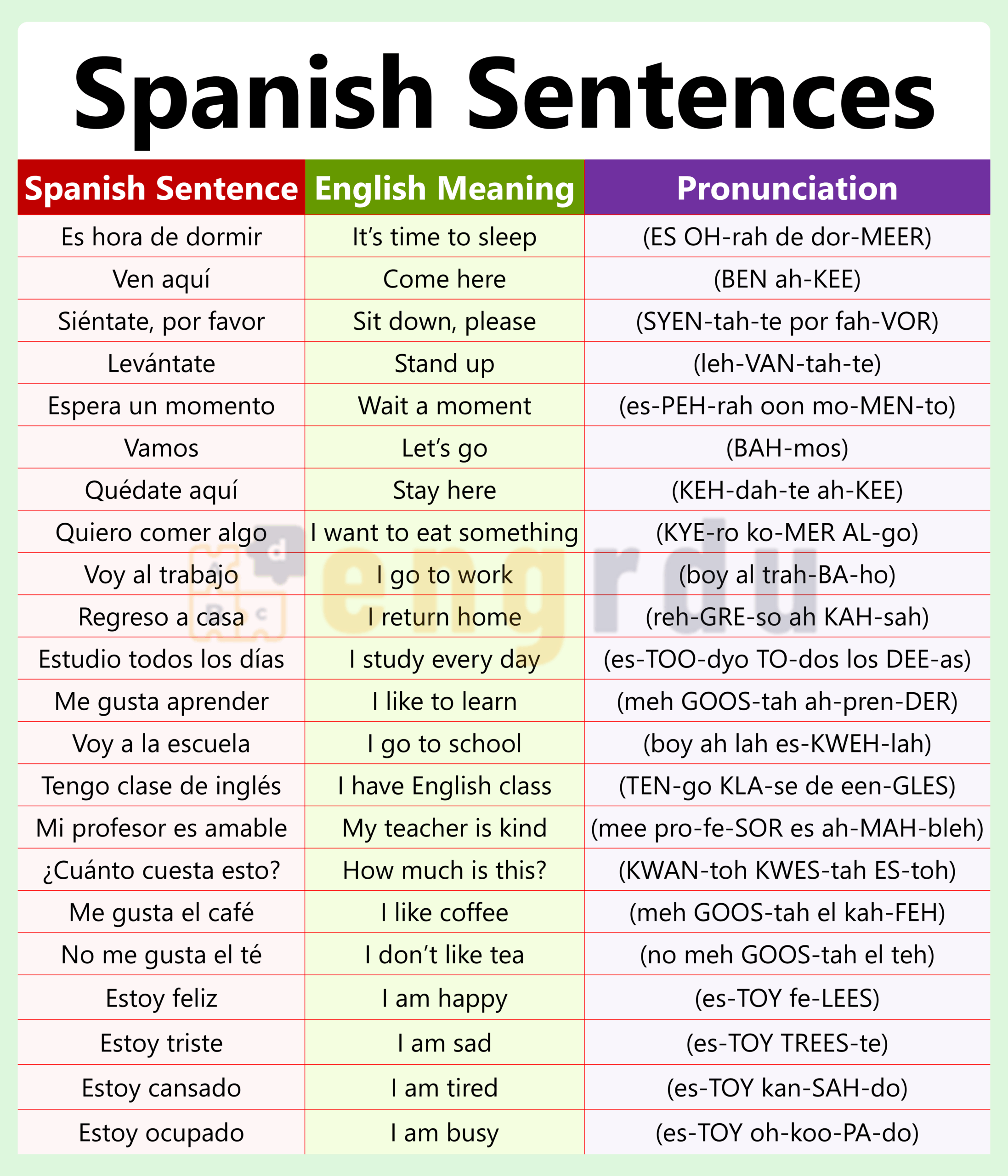
Easy Spanish Sentences
Spanish Sentences with English Meaning
Spanish Sentence
English Meaning
Pronunciation
Hola
Hello
(OH-lah)
Buenos días
Good morning
(BWEH-nos DEE-as)
Buenas tardes
Good afternoon
(BWEH-nas TAR-des)
Buenas noches
Good night
(BWEH-nas NOH-ches)
¿Cómo estás?
How are you?
(KOH-mo es-TAS)
Estoy bien, gracias
I’m fine, thank you
(es-TOY BYEN, GRA-syas)
¿Y tú?
And you?
(ee TOO)
Mucho gusto
Nice to meet you
(MOO-cho GOOS-to)
Adiós
Goodbye
(ah-DYOS)
Por favor
Please
(por fah-VOR)
Gracias
Thank you
(GRA-syas)
De nada
You’re welcome
(deh NAH-dah)
Lo siento
I’m sorry
(loh SYEN-to)
Perdón
Excuse me / Sorry
(per-DON)
Bienvenido
Welcome
(byen-veh-NEE-doh)
Esta es mi casa
This is my house
(ES-tah es mee KAH-sah)
Abre la puerta
Open the door
(AH-breh lah PWER-tah)
Cierra la ventana
Close the window
(SYE-rrah lah ben-TAH-nah)
Enciende la luz
Turn on the light
(en-SYEN-deh lah looz)
Apaga la luz
Turn off the light
(ah-PAH-gah lah looz)
Tengo hambre
I’m hungry
(TEN-go AM-breh)
Tengo sed
I’m thirsty
(TEN-go sed)
Tengo sueño
I’m sleepy
(TEN-go SWEN-yo)
Es hora de dormir
It’s time to sleep
(ES OH-rah de dor-MEER)
Ven aquí
Come here
(BEN ah-KEE)
Siéntate, por favor
Sit down, please
(SYEN-tah-te por fah-VOR)
Levántate
Stand up
(leh-VAN-tah-te)
Espera un momento
Wait a moment
(es-PEH-rah oon mo-MEN-to)
Vamos
Let’s go
(BAH-mos)
Quédate aquí
Stay here
(KEH-dah-te ah-KEE)
Quiero comer algo
I want to eat something
(KYE-ro ko-MER AL-go)
¿Qué quieres beber?
What do you want to drink?
(keh KYE-res beh-BER)
Me gusta el café
I like coffee
(meh GOOS-tah el kah-FEH)
No me gusta el té
I don’t like tea
(no meh GOOS-tah el teh)
La comida está deliciosa
The food is delicious
(lah ko-MEE-dah es-TAH de-lee-SYO-sah)
El desayuno está listo
Breakfast is ready
(el de-sah-YOO-no es-TAH LEES-to)
Tengo que cocinar
I have to cook
(TEN-go keh ko-see-NAR)
¿Tienes hambre?
Are you hungry?
(TYE-nes AM-breh)
Pásame la sal
Pass me the salt
(PAH-sah-me lah sal)
Me levanto temprano
I wake up early
(meh leh-VAN-to tem-PRA-no)
Me cepillo los dientes
I brush my teeth
(meh seh-PEE-yo los DYEN-tes)
Me ducho por la mañana
I take a shower in the morning
(meh DOO-cho por lah ma-NYA-nah)
Voy al trabajo
I go to work
(boy al trah-BA-ho)
Regreso a casa
I return home
(reh-GRE-so ah KAH-sah)
Estudio todos los días
I study every day
(es-TOO-dyo TO-dos los DEE-as)
Me gusta aprender
I like to learn
(meh GOOS-tah ah-pren-DER)
Voy a la escuela
I go to school
(boy ah lah es-KWEH-lah)
Tengo clase de inglés
I have English class
(TEN-go KLA-se de een-GLES)
Mi profesor es amable
My teacher is kind
(mee pro-fe-SOR es ah-MAH-bleh)
¿Cuánto cuesta esto?
How much is this?
(KWAN-toh KWES-tah ES-toh)
Es muy caro
It’s very expensive
(es MOOY KAH-ro)
Quiero comprar una camisa
I want to buy a shirt
(KYE-ro kom-PRAR oo-nah kah-MEE-sah)
¿Acepta tarjeta?
Do you accept card?
(ah-SEP-tah tar-HEH-tah)
No tengo dinero
I don’t have money
(no TEN-go dee-NEH-ro)
Gracias por su ayuda
Thank you for your help
(GRA-syas por soo ah-YOO-dah)
¿Dónde está el hotel?
Where is the hotel?
(DON-deh es-TAH el oh-TEL)
Necesito un taxi
I need a taxi
(neh-se-SEE-toh oon TAK-see)
Quiero un billete de tren
I want a train ticket
(KYE-ro oon bee-YE-te de tren)
Mi equipaje está perdido
My luggage is lost
(mee eh-kee-PA-he es-TAH per-DEE-do)
¿Cuánto tarda el viaje?
How long is the trip?
(KWAN-to TAR-dah el BYA-he)
Estoy feliz
I am happy
(es-TOY fe-LEES)
Estoy triste
I am sad
(es-TOY TREES-te)
Estoy cansado
I am tired
(es-TOY kan-SAH-do)
Estoy ocupado
I am busy
(es-TOY oh-koo-PA-do)
Te quiero mucho
I love you a lot
(te KYE-ro MOO-cho)
Me gusta estar contigo
I like being with you
(meh GOOS-tah es-TAR kon-TEE-go)
Te extraño
I miss you
(te eks-TRA-nyo)
Estoy nervioso
I am nervous
(es-TOY ner-BYO-so)
Estoy emocionado
I am excited
(es-TOY e-mo-syo-NA-do)
Hoy es lunes
Today is Monday
(OY es LOO-nes)
Mañana es martes
Tomorrow is Tuesday
(ma-NYA-nah es MAR-tes)
Ayer fue domingo
Yesterday was Sunday
(a-YER fweh do-MEEN-go)
Son las tres
It’s three o’clock
(son las tres)
¿Qué hora es?
What time is it?
(keh OH-rah es)
Es temprano
It’s early
(es tem-PRA-no)
Es tarde
It’s late
(es TAR-deh)
Hoy hace calor
It’s hot today
(OY AH-se kah-LOR)
Hoy hace frío
It’s cold today
(OY AH-se FREE-oh)
Está lloviendo
It’s raining
(es-TAH yoh-BYEN-do)
Está soleado
It’s sunny
(es-TAH soh-LEH-ah-do)
Me siento mal
I feel bad
(meh SYEN-to mal)
Tengo fiebre
I have fever
(TEN-go FYE-breh)
Me duele la cabeza
My head hurts
(meh DWEH-le lah kah-BEH-sah)
Necesito un médico
I need a doctor
(neh-se-SEE-toh oon MEH-dee-ko)
¿Dónde está el hospital?
Where is the hospital?
(DON-deh es-TAH el os-pee-TAL)
No me siento bien
I don’t feel well
(no meh SYEN-to byehn)
Estoy enfermo
I am sick
(es-TOY en-FER-mo)
Necesito medicina
I need medicine
(neh-se-SEE-to meh-dee-SEE-nah)
Llame a una ambulancia
Call an ambulance
(YAH-me ah OO-nah am-boo-LAN-syah)
¿Qué pasó?
What happened?
(keh pah-SOH)
No entiendo
I don’t understand
(no en-TYEN-do)
¿Puedes repetir, por favor?
Can you repeat, please?
(PWE-des reh-pe-TEER por fah-VOR)
Habla más despacio
Speak more slowly
(AH-blah mas des-PA-syo)
Estoy aprendiendo español
I’m learning Spanish
(es-TOY ah-pren-DYEN-do es-pah-NYOL)
¿Hablas inglés?
Do you speak English?
(AH-blas een-GLES)
Un momento, por favor
One moment, please
(oon mo-MEN-to por fah-VOR)
Claro que sí
Of course
(KLA-ro keh see)
No lo sé
I don’t know
(no lo seh)
Está bien
It’s okay
(es-TAH byehn)
Nos vemos pronto
See you soon
(nos BEH-mos PRON-to)
Que tengas un buen día
Have a nice day
(keh TEN-gas oon BWEHN DEE-ah)
Cuídate
Take care
(KWEE-dah-te)
Hasta mañana
See you tomorrow
(AHS-tah ma-NYA-nah)
Buen trabajo
Good job
(BWEHN trah-BA-ho)
Buena suerte
Good luck
(BWEH-nah SWER-te)
Spanish Sentences for Beginners
Tips to Practise These Sentences
Repeat each sentence aloud every day.
Listen to Spanish speakers and note pronunciation.
Practise with friends or language apps.
Use these phrases in real conversations.
Learning easy Spanish sentences is the first step to mastering the language naturally. Start with these simple expressions and practise them daily. You’ll soon feel confident speaking and understanding Spanish in everyday life.
What are basic Spanish sentences for beginners? Basic Spanish sentences are short phrases used in daily life, such as greetings or common expressions. Examples include “Hola” (Hello), “Gracias” (Thank you), and “¿Cómo estás?” (How are you?). These help beginners start speaking Spanish quickly and confidently.
How can I learn Spanish sentences easily? You can learn Spanish sentences easily by practising daily, listening to native speakers, and repeating simple phrases. Start with everyday topics like greetings, food, travel, and family conversations to build confidence and vocabulary.
What are the most useful Spanish sentences to know? Some of the most useful Spanish sentences are “¿Dónde está el baño?” (Where is the bathroom?), “Quiero comer algo” (I want to eat something), and “Necesito ayuda” (I need help). These are commonly used in real-life situations.
How many Spanish sentences should I learn first? For beginners, learning 100 to 150 easy Spanish sentences is a great start. It helps you handle daily conversations, improve pronunciation, and understand common sentence patterns.
Are Spanish sentences easy to remember? Yes, Spanish sentences are easy to remember if you practise regularly and use them in context. Repeating short sentences every day makes pronunciation and grammar feel natural over time.
Japanese idioms and phrases are commonly used in daily conversations, media, and written communication. Learning these expressions can help you understand native…