


Modal verbs and auxiliary verbs are important in English, but they serve different purposes. Modal verbs (like can, should, may) show possibility, ability, necessity, or permission, while auxiliary verbs (like be, have, do) help form tenses, questions, and negatives. In this Grammar lesson, understanding their differences helps you speak, write, and understand English more accurately. In this blog post, you will learn the difference between modal and auxiliary verbs with examples to practice and use confidently in everyday English.
Modal Verbs vs Auxiliary Verbs
Auxiliary Verbs
Auxiliary verbs, also called helping verbs, are verbs that help the main verb to show tense, aspect, voice, or emphasis.
The main auxiliary verbs in English are:
- Be
- Have
- Do
They do not usually show ability, permission, or possibility. Their job is to support the main verb grammatically.
Example:
- She is reading a book.
- They have finished the work.
- Do you like coffee?
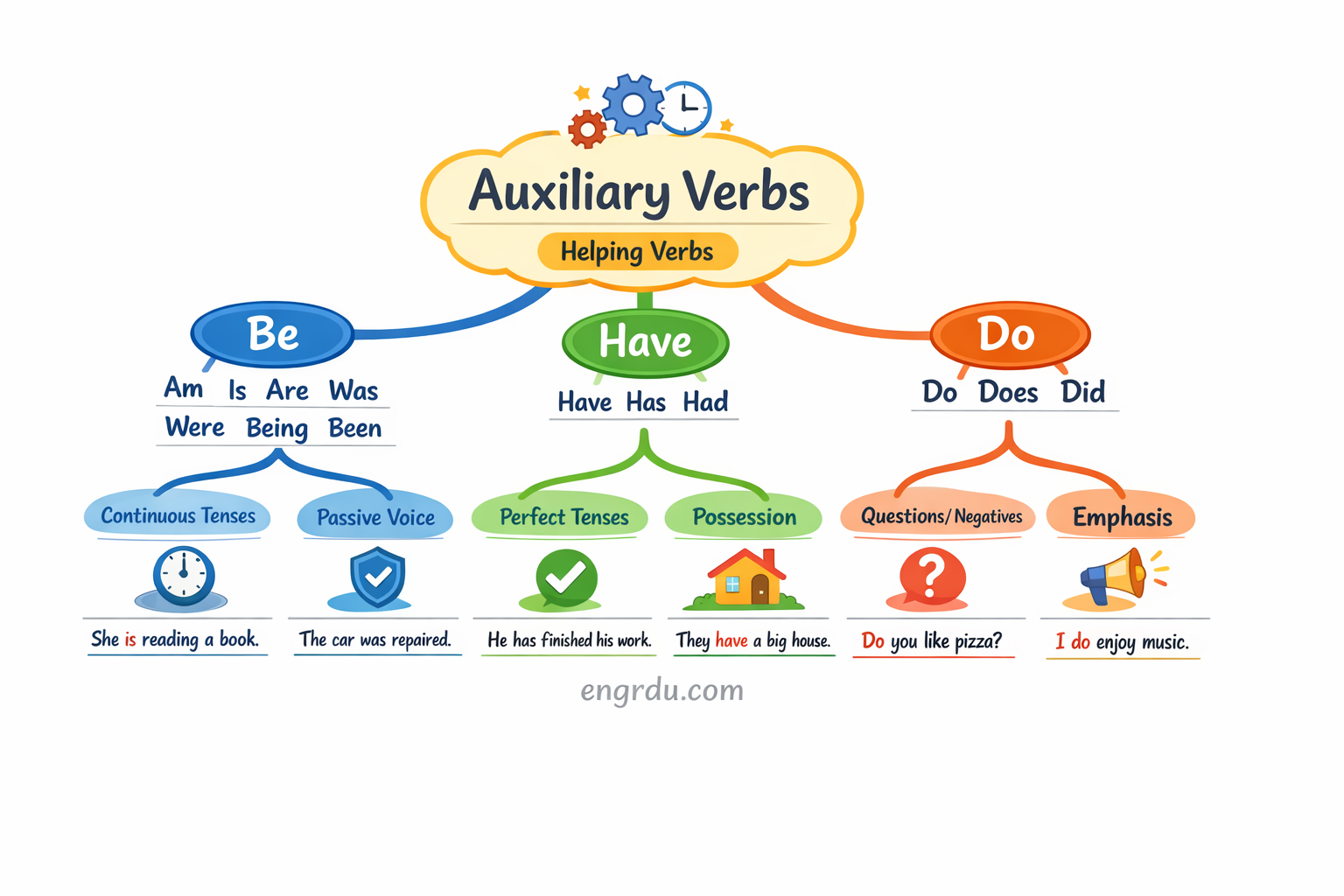
Auxiliary Verbs
Modal Verbs
Modal verbs are special helping verbs that show the speaker’s attitude, ability, permission, advice, possibility, necessity, or obligation.
Common modal verbs are:
- can, could
- may, might
- will, would
- shall, should
- must, ought to
Modal verbs add meaning, not tense.
Example:
- She can swim.
- You should study more.
- He might come today.
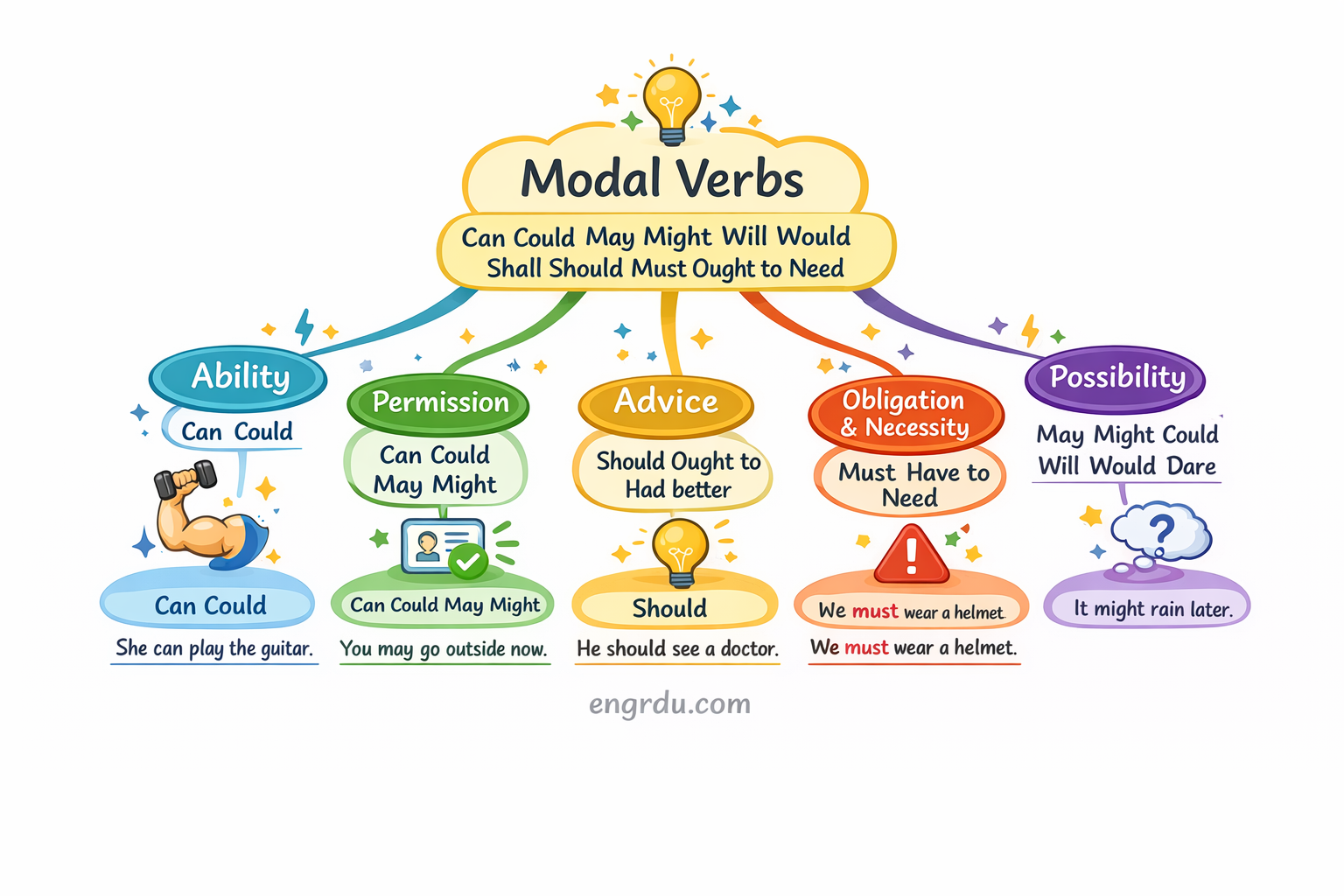
Modal Verbs
Types of Auxiliary Verbs
Auxiliary verbs are divided into three main types.
1. Be (am, is, are, was, were, being, been)
Used for continuous tenses and passive voice.
- She is cooking dinner.
- The letter was written yesterday.
2. Have (has, have, had)
Used for perfect tenses.
- I have completed my homework.
- They had left before noon.
3. Do (do, does, did)
Used for questions, negatives, and emphasis.
- Do you like tea?
- She does not agree.
- I did try my best.
Types of Modal Verbs
1. Ability
can, could
- I can drive.
- She could read at age five.
2. Permission
may, can
- May I come in?
- You can use my phone.
3. Advice
should, ought to
- You should rest.
- You ought to apologise.
4. Obligation and Necessity
must, have to
- You must wear a helmet.
- I have to leave early.
5. Possibility
might, may, could
- It might rain.
- She may call later.
Rules for Auxiliary Verbs
Auxiliary verbs come before the main verb.
- She is learning English.
They change form according to tense and subject.
- He is, They are
“Do” is used to make questions and negatives in the present and past simple.
- Do you work here?
- She did not understand.
Rules for Modal Verbs
Modal verbs do not change form.
- He can, She can, They can
Modal verbs are always followed by the base form of the verb.
- She can dance (not dances)
Modal verbs do not use “to” (except ought to).
- You should study.
- You ought to study.
Questions are formed without “do”.
- Can you help me?

Modal and Auxiliary Verbs
List of Modal Verbs
| Modal Verb | Usage / Function | Example Sentence |
|---|---|---|
| Can | Ability, permission, possibility | She can speak English well. |
| Could | Past ability, polite request, possibility | Could you help me with this? |
| May | Permission, possibility (formal) | You may leave early today. |
| Might | Weak possibility | He might come later. |
| Will | Future intention, promise, decision | I will call you tomorrow. |
| Would | Polite request, habit in the past | She would read every night. |
| Shall | Suggestion, offer (mainly British English) | Shall we start the class? |
| Should | Advice, recommendation | You should study regularly. |
| Must | Strong obligation, certainty | You must wear a seatbelt. |
| Ought to | Moral duty, advice | You ought to respect others. |
| Need (modal use) | Lack of necessity | You need not worry about it. |
| Dare (modal use) | Courage, challenge (rare modal use) | How dare he speak to you like that? |
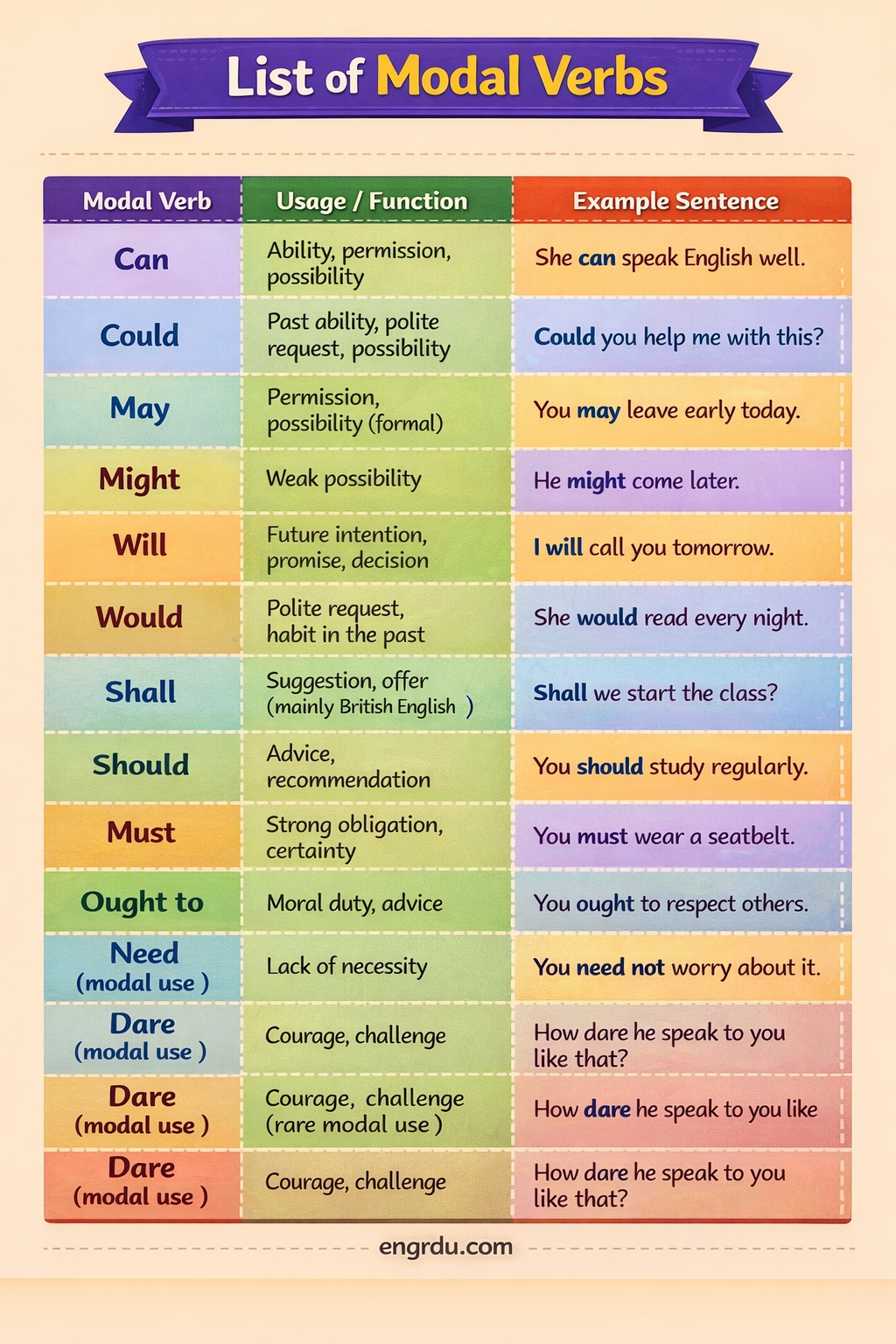
List of Modal Verbs
List of Auxiliary Verbs
| Auxiliary Verb | Usage / Function | Example Sentence |
|---|---|---|
| Am | Forms present continuous tense | I am studying English. |
| Is | Forms present continuous / passive voice | She is writing a letter. |
| Are | Forms present continuous / questions | They are waiting outside. |
| Was | Forms past continuous tense | He was sleeping late. |
| Were | Forms past continuous / passive voice | We were invited to the event. |
| Being | Used in continuous passive forms | The bridge is being repaired. |
| Been | Used in perfect tenses and passive voice | She has been very helpful. |
| Have | Forms present perfect tense | I have completed the task. |
| Has | Forms present perfect (third person) | He has finished his work. |
| Had | Forms past perfect tense | They had left early. |
| Do | Forms questions and emphasis | Do you like tea? |
| Does | Forms present simple questions/negatives | Does she understand? |
| Did | Forms past simple questions/negatives | Did you call him? |

List of Auxiliary Verbs
Common Mistakes
Mistake 1: Adding “to” after modal verbs
❌ She can to swim.
✅ She can swim.
Mistake 2: Using “do” with modal verbs
❌ Do you can help me?
✅ Can you help me?
Mistake 3: Changing the form of modal verbs
❌ He cans drive.
✅ He can drive.
Mistake 4: Confusing “have to” with “have”
❌ I have go now.
✅ I have to go now.
Modal Verbs vs Auxiliary Verbs
| Feature | Auxiliary Verbs | Modal Verbs |
|---|---|---|
| Main purpose | Grammar support | Show meaning or attitude |
| Change with tense | Yes | No |
| Use “do” for questions | Yes | No |
| Followed by base verb | Sometimes | Always |
| Examples | be, have, do | can, must, should |
Simple way to remember:
- Auxiliary verbs help grammar.
- Modal verbs help meaning.
Tips for Learners
- Learn modal verbs in groups by meaning, not one by one.
- Remember: modal verbs never change form.
- Practise making questions without “do” when using modals.
- Read short dialogues and notice how native speakers use modals.
- Write your own sentences about daily life using both types.
Conclusion
The difference between modal and auxiliary verbs is easy when you focus on their purpose. Auxiliary verbs help form tenses, questions, and negatives. Modal verbs show ability, advice, permission, or possibility. Both are important for correct English. Practise them in real-life sentences, and your confidence in speaking and writing will improve step by step.
Frequently Asked Questions
What is the difference between modal and nonmodal auxiliary verbs?
Modal auxiliary verbs show meaning like ability or necessity and never change form, such as can or must. Nonmodal auxiliary verbs, like be, have, and do, change form and mainly help with grammar structure.
What are the 10 examples of auxiliary verbs?
Examples of auxiliary verbs are: am, is, are, was, were, have, has, had, do, did.
What are the 10 examples of modal verbs?
Examples of modal verbs are: can, could, may, might, will, would, shall, should, must, ought to.
Are modals and auxiliaries the same thing?
No. Modal verbs are a type of auxiliary verb, but not all auxiliary verbs are modals. Auxiliary verbs help form tense, questions, and negatives, while modal verbs show meaning such as ability, advice, permission, or obligation.
What are the 23 auxiliary verbs?
In traditional grammar teaching, the 23 auxiliary verbs include forms of be (am, is, are, was, were, being, been), have (have, has, had), do (do, does, did), and nine modal verbs (can, could, may, might, will, would, shall, should, must).
What is the difference between auxiliary verbs and main verbs?
Auxiliary verbs support the main verb by showing tense, voice, or sentence type, while main verbs carry the main meaning of the action or state. For example, in “She is reading,” is is the auxiliary verb and reading is the main verb.
What is an example of a modal verb and an auxiliary verb?
In the sentence “She can swim,” can is a modal verb. In the sentence “She is swimming,” is is an auxiliary verb helping the main verb swimming.
Read More


Leave a Comment