In this blog post, you will learn a dialogue between a customer and a shopkeeper in English. Knowing this dialogue helps you understand how to communicate during shopping, ask questions about products, and make purchases confidently. It also improves your speaking and listening skills because you can practice real-life conversations. By studying and practicing this dialogue, you can use similar sentences in your own shopping experiences. Learning customer and shopkeeper dialogues will make your English more practical and useful for everyday life.
Key points in dialogues:
- Asking politely for items.
- Talking about price and quality.
- Requesting discounts or help.
- Paying money and saying thanks.
Contexts of Dialogue Between Customer and Shopkeeper
The dialogue between the customer and the shopkeeper can be used in different contexts:
- Asking about prices: “How much is this shirt?”
- Requesting help: “Can you show me a smaller size?”
- Discussing quality: “Is this fresh fruit?”
- Buying and paying: “I will take two kilos of apples.”
Dialogue Between Customer and Shopkeeper for Asking Questions
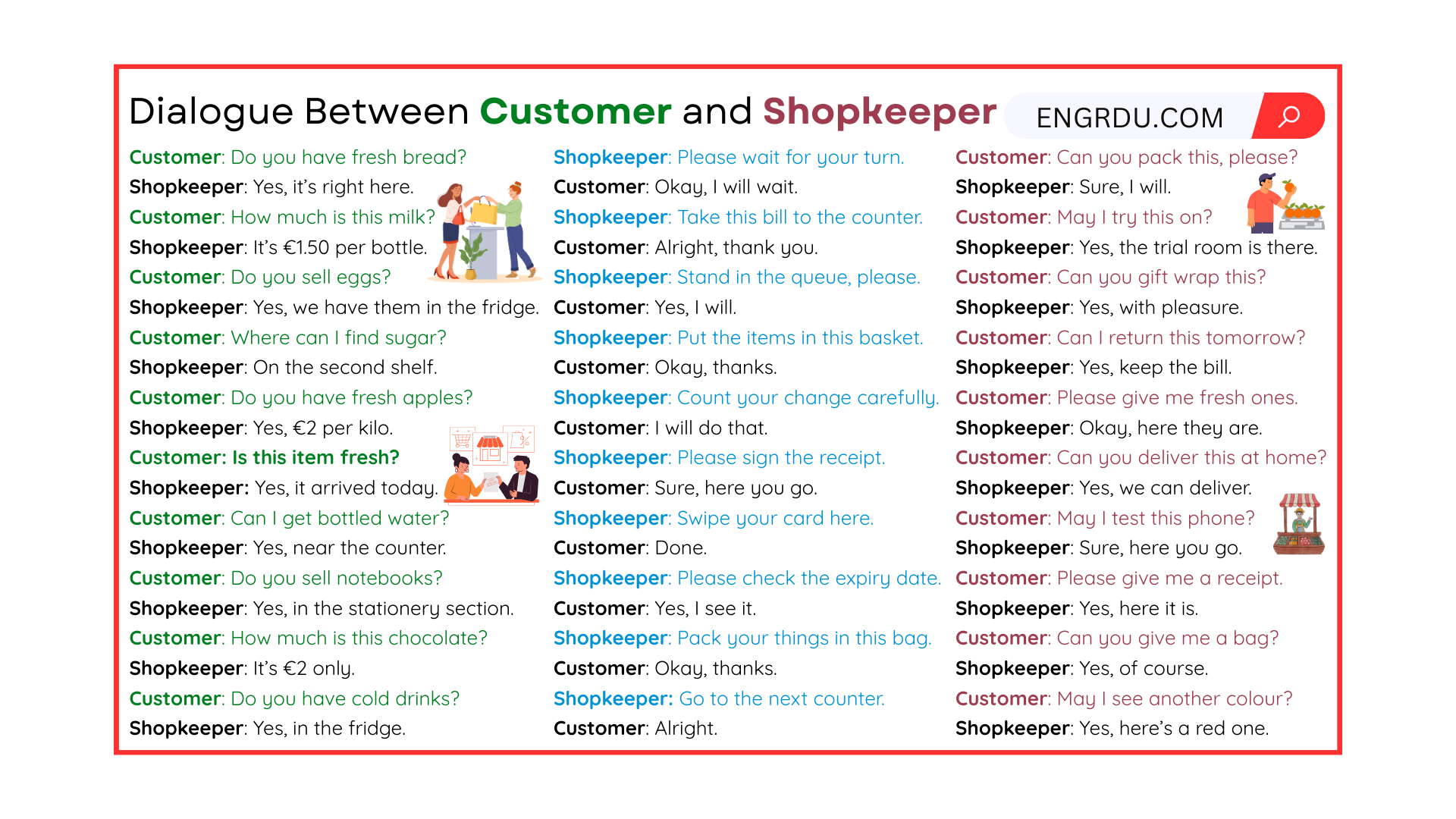
Customer: Do you have fresh bread?
Shopkeeper: Yes, it’s right here.
Customer: How much is this milk?
Shopkeeper: It’s €1.50 per bottle.
Customer: Do you sell eggs?
Shopkeeper: Yes, we have them in the fridge.
Customer: Where can I find sugar?
Shopkeeper: On the second shelf.
Customer: Do you have fresh apples?
Shopkeeper: Yes, €2 per kilo.
Customer: Is this shirt available in medium size?
Shopkeeper: Yes, here it is.
Customer: Can I get bottled water?
Shopkeeper: Yes, near the counter.
Customer: Do you sell notebooks?
Shopkeeper: Yes, in the stationery section.
Customer: How much is this chocolate?
Shopkeeper: It’s €2 only.
Customer: Do you have cold drinks?
Shopkeeper: Yes, in the fridge.
Customer: Is this item fresh?
Shopkeeper: Yes, it arrived today.
Customer: Do you sell mobile chargers?
Shopkeeper: Yes, right behind the counter.
Customer: Can you show me this in blue?
Shopkeeper: Yes, we have it in blue.
Customer: Do you have change for €20?
Shopkeeper: Yes, I do.
Customer: Can I get a bag?
Shopkeeper: Yes, here you go.
Customer: Do you sell newspapers?
Shopkeeper: Yes, on that rack.
Customer: How much is one kilo of bananas?
Shopkeeper: €1.80 per kilo.
Customer: Do you have cooking oil?
Shopkeeper: Yes, which brand do you want?
Customer: Is this phone charger original?
Shopkeeper: Yes, it’s original.
Customer: Do you sell pens?
Shopkeeper: Yes, we have many types.

Dialogue Between Customer and Shopkeeper for Giving Instructions
Shopkeeper: Please wait for your turn.
Customer: Okay, I will wait.
Shopkeeper: Take this bill to the counter.
Customer: Alright, thank you.
Shopkeeper: Stand in the queue, please.
Customer: Yes, I will.
Shopkeeper: Put the items in this basket.
Customer: Okay, thanks.
Shopkeeper: Count your change carefully.
Customer: I will do that.
Shopkeeper: Please sign the receipt.
Customer: Sure, here you go.
Shopkeeper: Swipe your card here.
Customer: Done.
Shopkeeper: Please check the expiry date.
Customer: Yes, I see it.
Shopkeeper: Pack your things in this bag.
Customer: Okay, thanks.
Shopkeeper: Wait one moment, I’ll check the stock.
Customer: Sure, I will wait.
Shopkeeper: Go to the next counter.
Customer: Alright.
Shopkeeper: Follow the shop rules.
Customer: Yes, I understand.
Shopkeeper: Collect your change from here.
Customer: Thank you.
Shopkeeper: Show me your membership card.
Customer: Here it is.
Shopkeeper: Keep the receipt safe.
Customer: Yes, I will.
Shopkeeper: Please take this order tomorrow.
Customer: Okay, I will come.
Shopkeeper: Check the price before buying.
Customer: Yes, I will.
Shopkeeper: Take the items to the cashier.
Customer: Sure.
Shopkeeper: Please put your bag on the counter.
Customer: Alright.
Shopkeeper: Collect your parcel from that side.
Customer: Thank you very much.
Dialogue Between Customer and Shopkeeper for Discussing Prices / Items
Customer: How much is this bag?
Shopkeeper: €25 only.
Customer: Is the price fixed?
Shopkeeper: Yes, it is.
Customer: Can you give me a discount?
Shopkeeper: Yes, 10% off.
Customer: Do you have something cheaper?
Shopkeeper: Yes, here it is.
Customer: Are these on sale?
Shopkeeper: Yes, 20% discount today.
Customer: Why is this so expensive?
Shopkeeper: Because it is high quality.
Customer: Can I get it for less?
Shopkeeper: Sorry, the price is fixed.
Customer: How much for two shirts?
Shopkeeper: €40 for both.
Customer: Is there a student discount?
Shopkeeper: Yes, 5% off.
Customer: How much after discount?
Shopkeeper: €18 only.
Customer: What is the total cost?
Shopkeeper: €52 in total.
Customer: Is this price correct?
Shopkeeper: Yes, it is correct.
Customer: Can I get a better deal?
Shopkeeper: If you buy more, yes.
Customer: Is this price final?
Shopkeeper: Yes, it is.
Customer: Do you have a cheaper brand?
Shopkeeper: Yes, this one costs less.
Customer: How much is this fruit?
Shopkeeper: €3 per kilo.
Customer: Can I pay later?
Shopkeeper: Sorry, payment is now.
Customer: What’s the final amount?
Shopkeeper: €75 only.
Customer: Is tax included?
Shopkeeper: Yes, tax is included.

Dialogue Between Customer and Shopkeeper for Requesting Service / Permission
Customer: Can you pack this, please?
Shopkeeper: Sure, I will.
Customer: May I try this on?
Shopkeeper: Yes, the trial room is there.
Customer: Can you gift wrap this?
Shopkeeper: Yes, with pleasure.
Customer: Can I return this tomorrow?
Shopkeeper: Yes, keep the bill.
Customer: Please give me fresh ones.
Shopkeeper: Okay, here they are.
Customer: Can you deliver this at home?
Shopkeeper: Yes, we can deliver.
Customer: May I test this phone?
Shopkeeper: Sure, here you go.
Customer: Please give me a receipt.
Shopkeeper: Yes, here it is.
Customer: Can you give me a bag?
Shopkeeper: Yes, of course.
Customer: May I see another colour?
Shopkeeper: Yes, here’s a red one.
Customer: Can you check the weight?
Shopkeeper: Yes, it’s 2 kilos.
Customer: Please give me a new piece.
Shopkeeper: Sure, I will.
Customer: Can I exchange it later?
Shopkeeper: Yes, within 7 days.
Customer: Can you write the bill?
Shopkeeper: Yes, I will.
Customer: May I order this online?
Shopkeeper: Yes, it’s available online.
Customer: Can you cut this in half?
Shopkeeper: Yes, no problem.
Customer: Please pack it separately.
Shopkeeper: Sure, I will do it.
Customer: Can I use my card?
Shopkeeper: Yes, card is accepted.
Customer: Please give me extra packing.
Shopkeeper: Okay, I will add more.
Customer: Can I try another size?
Shopkeeper: Yes, here it is.

FAQs
What is a dialogue between customer and shopkeeper?
It is a short conversation between a customer buying goods and a shopkeeper selling them, usually about prices, items, or service.
Why should students learn customer and shopkeeper dialogues?
Because these dialogues are very common in daily life and help students practise English in real shopping situations.
Can you give an example of a shopkeeper and customer dialogue?
Yes. Example:
→ Customer: How much is this bag?
→ Shopkeeper: It’s €20. Do you want it?
What are common topics in customer and shopkeeper dialogues?
Common topics are asking about items, discussing prices, requesting discounts, and paying the bill.
How can learners practise customer and shopkeeper dialogues?
They can practise by reading examples, role-playing in class, or speaking with friends using simple shop dialogues.
Read More