English has 8 parts of speech, and each plays an important role in forming sentences. These include nouns, pronouns, verbs, adjectives, adverbs, prepositions, conjunctions, and interjections. In this Grammar lesson, learning the 8 parts of speech helps you speak, write, and understand English more accurately. Using them correctly makes your sentences clear, precise, and expressive. In this blog post, you will explore all 8 parts of speech with a chart, definitions, uses, and examples to practice and use confidently in daily English.
Parts of Speech Definition
Parts of speech are categories of words based on their function in a sentence. In simple words, they tell us:
- What a word is
- What a word does
- How a word works with other words
English has eight main parts of speech, and every sentence uses some of them.
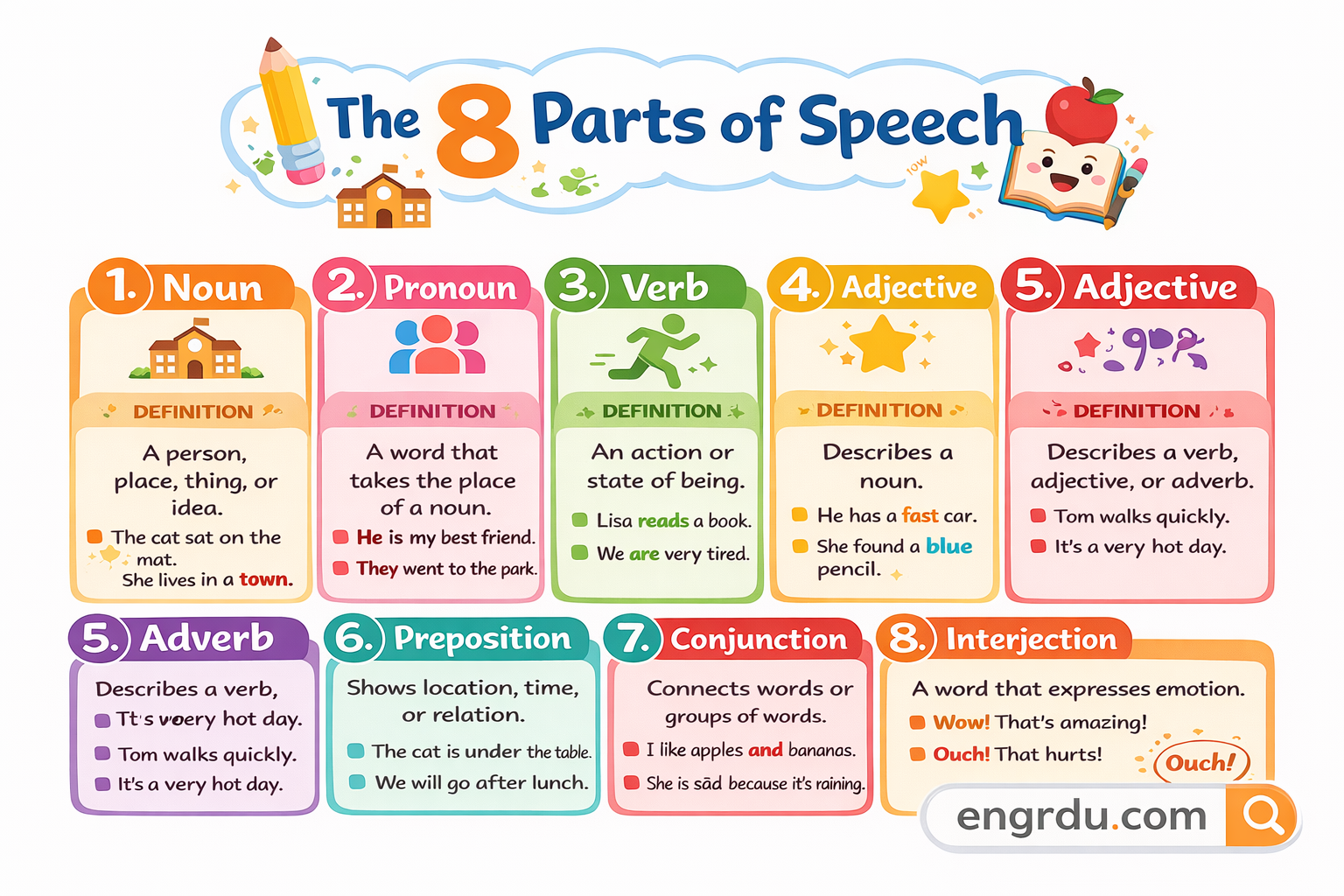
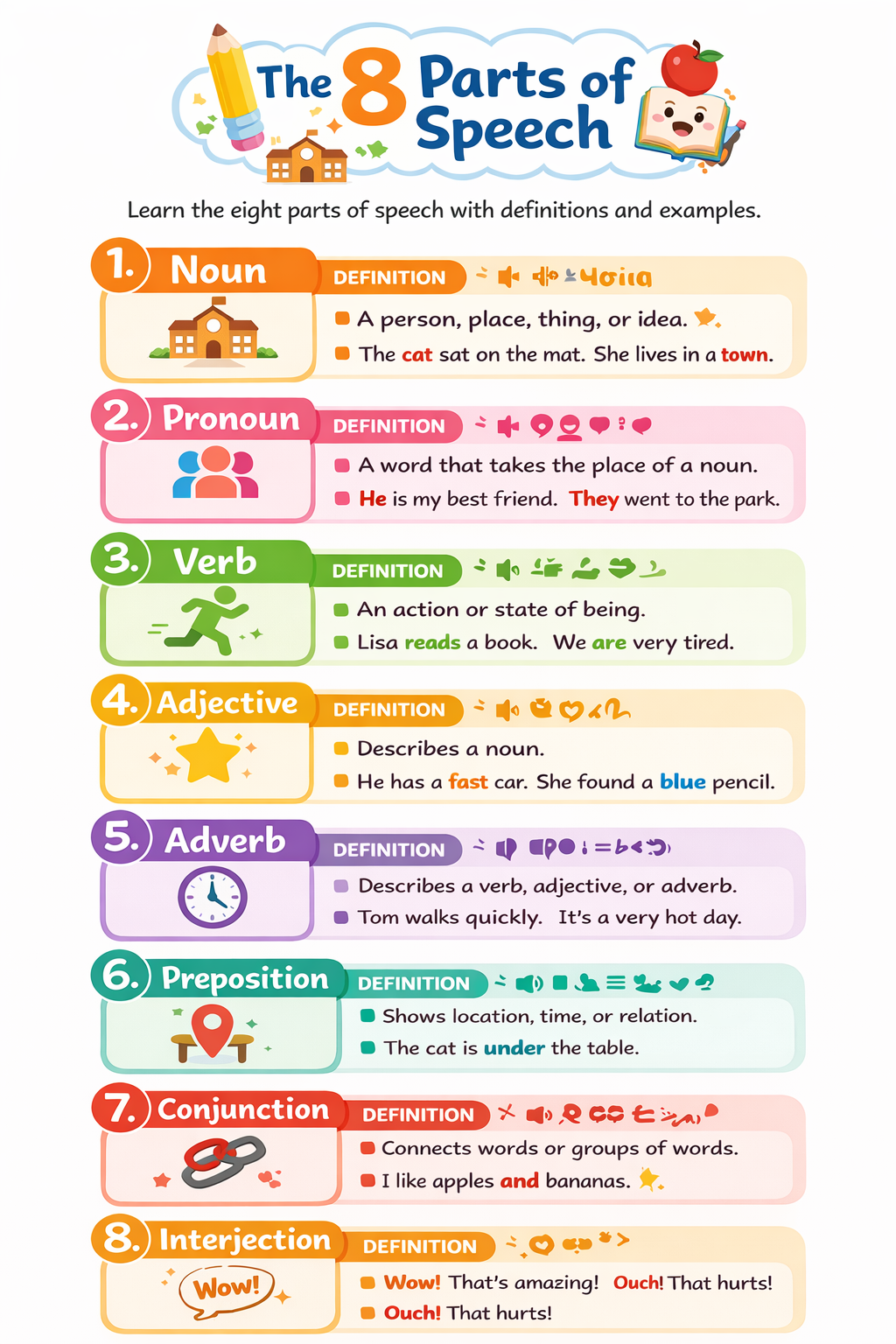
The 8 Parts of Speech Chart

| Part of Speech | What It Does | Example |
|---|---|---|
| Noun | Names a person, place, or thing | teacher, city |
| Pronoun | Replaces a noun | he, they |
| Verb | Shows action or state | run, is |
| Adjective | Describes a noun | happy, blue |
| Adverb | Describes a verb, adjective, or adverb | quickly, very |
| Preposition | Shows relation (place, time, direction) | in, on, at |
| Conjunction | Joins words or sentences | and, but |
| Interjection | Shows emotion | wow, oh |
Now, let us understand each one clearly.
1. Noun
A noun is a naming word.
Uses of nouns:
- Name people: boy, doctor
- Name places: school, London
- Name things: book, phone
- Name ideas: freedom, happiness
Examples:
- The teacher is kind.
- My city is clean.
- This book is interesting.
Read More: Noun: Definition, Types, Uses, and Examples
2. Pronoun
A pronoun replaces a noun to avoid repetition.
Common pronouns:
I, you, he, she, it, we, they, this, that
Examples:
- Sarah is my friend. She is helpful.
- The books are new. They are expensive.
Read More: Pronoun: Definition, Types, Uses, and Examples
3. Verb
A verb shows an action or a state of being.
Types of verbs (basic):
- Action verbs: run, eat, write
- Linking verbs: is, am, are
Examples:
- I study English.
- She is tired.
- They are playing football.
Read More: Verb: Definition, Types, Uses, and Examples
4. Adjective
An adjective describes a noun.
It tells us:
- How something looks
- How many
- What kind
Examples:
- She has a beautiful dress.
- I bought two apples.
- It is a cold day.
Read More: Adjective: Definition, Types, Uses, and Examples
5. Adverb
An adverb describes a verb, adjective, or another adverb.
Many adverbs end in -ly, but not all.
Examples:
- He runs quickly.
- She speaks very clearly.
- We arrived early.
Read More: Adverb: Definition, Types, Uses, and Examples
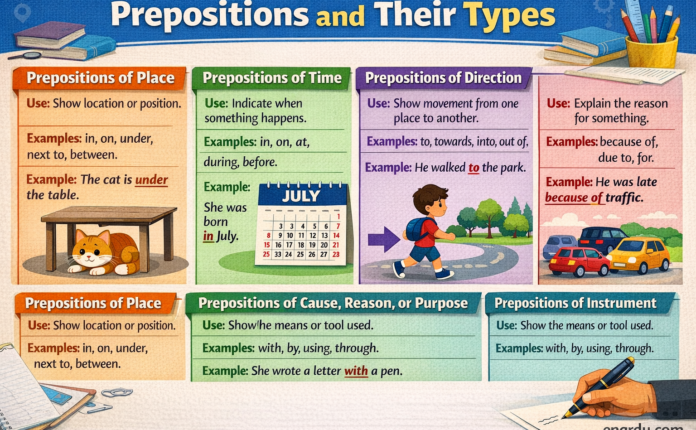
6. Preposition
A preposition shows the relationship between a noun and another word.
It often shows:
- Place
- Time
- Direction
Common prepositions:
in, on, at, under, before, after
Examples:
- The book is on the table.
- We meet at noon.
- She walked into the room.
Read More: Preposition: Definition, Types, Uses, and Examples
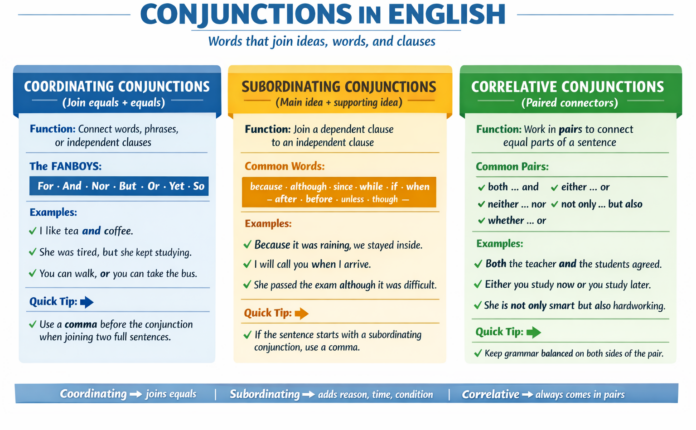
7. Conjunction
A conjunction joins words, phrases, or sentences.
Common conjunctions:
and, but, or, because, so
Examples:
- I like tea and coffee.
- He was tired but happy.
- She stayed home because it rained.
Read More: Conjunction: Definition, Types, Uses, and Examples
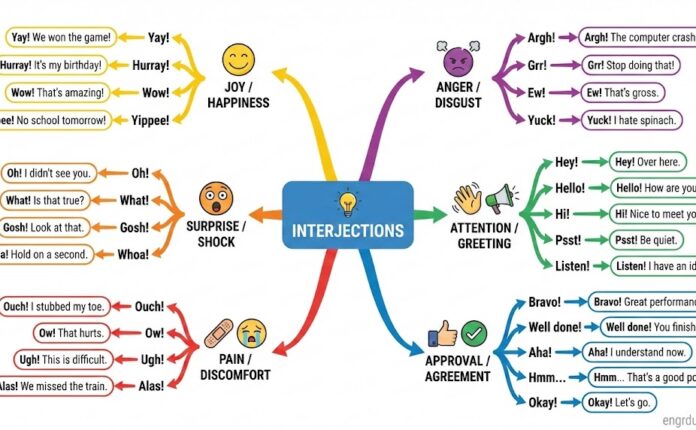
8. Interjection
An interjection shows strong feeling or emotion.
It often stands alone and uses an exclamation mark.
Examples:
- Wow! That is amazing.
- Oh! I forgot my keys.
- Oops! I made a mistake.
Read More: Interjection: Definition, Types, Uses, and Examples
Rules and Uses of Parts of Speech
Every sentence needs at least one noun and one verb.
Adjectives come before nouns in English.
- a small house
Adverbs often come after verbs.
- run fast
Prepositions are always followed by a noun.
- in the room
Conjunctions connect ideas smoothly.
Common Mistakes and How to Avoid Them
Mistake 1: Using adjective instead of adverb
❌ She sings beautiful.
✔ She sings beautifully.
Mistake 2: Wrong preposition
❌ He is good in maths.
✔ He is good at maths.
Mistake 3: Repeating nouns
❌ Anna is my friend. Anna is kind.
✔ Anna is my friend. She is kind.
Mistake 4: Forgetting verbs
❌ She very happy.
✔ She is very happy.
Comparisons
Adjective vs Adverb
| Feature | Adjective | Adverb |
|---|---|---|
| Describes | Noun | Verb, adjective, adverb |
| Example | a fast car | runs fast |
| Position | Before noun | After verb |
Noun vs Pronoun
- Noun: names something (teacher)
- Pronoun: replaces it (he, she)
Understanding these differences avoids many grammar errors.
8 Parts of Speech Chart
Tips for Learners
- Learn one part of speech each day.
- Read simple English stories and identify word types.
- Make your own sentences for practice.
- Use colour coding for nouns, verbs, and adjectives.
- Speak aloud to remember word functions better.
- Practise with real-life topics like school, travel, or food.
Conclusion
The 8 parts of speech are the foundation of English grammar. They help learners understand how sentences work and how words connect. By learning their definitions, uses, and examples, you can improve reading, writing, listening, and speaking skills. Practise daily, use simple sentences, and apply grammar in real life. With time, English will feel natural and clear.
Frequently Asked Questions
What are the 8 parts of speech in English?
The 8 parts of speech in English are noun, pronoun, verb, adjective, adverb, preposition, conjunction, and interjection. Each part shows the role a word plays in a sentence.
What is the difference between a noun and a pronoun?
A noun names a person, place, thing, or idea, while a pronoun replaces a noun to avoid repetition. For example, teacher is a noun, and she is a pronoun.
How do adjectives and adverbs differ in English?
Adjectives describe nouns, while adverbs describe verbs, adjectives, or other adverbs. For example, a happy child uses an adjective, and runs quickly uses an adverb.
Can one word belong to more than one part of speech?
Yes, some words can belong to different parts of speech depending on how they are used in a sentence. For example, play can be a noun or a verb.
Which part of speech shows relationships between words?
Prepositions show the relationship between a noun and another word, often expressing place, time, or direction, such as in, on, and at.
What is the easiest way to learn the 8 parts of speech?
The easiest way is to learn them with simple definitions, real-life examples, and regular practice by making short sentences and identifying each part of speech.