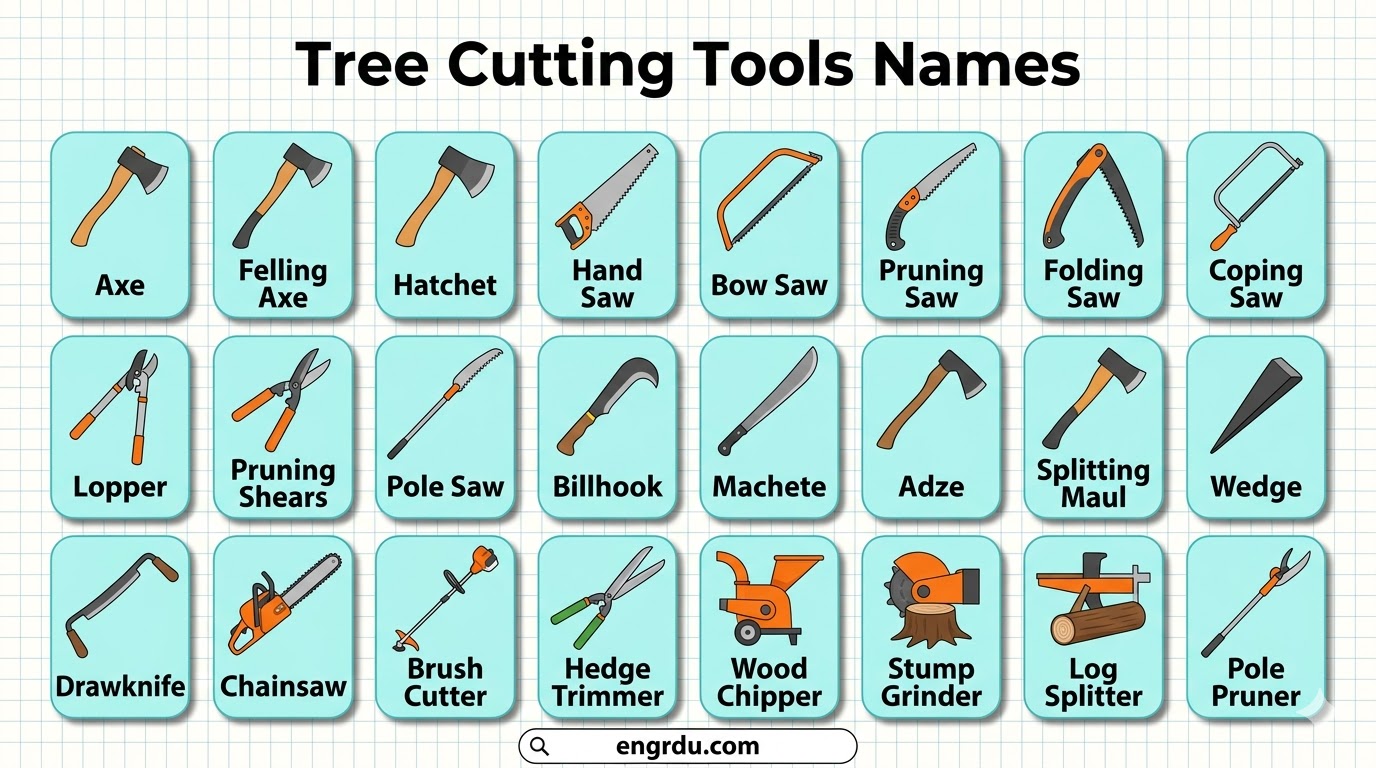
In this blog post, you will learn tree cutting tools names in English. These are words used for tools like axe, saw, and chainsaw that people use to cut and trim trees. Knowing this vocabulary helps you understand real-life activities, especially in farming, gardening, and daily work. When you practice these words, you can learn how to speak about tools correctly, read better, and listen with more confidence. You will also improve your writing by using the right words in sentences. Step by step, you will master important tool names and their uses, so you can use English in a more practical and meaningful way.
What Are Tree Cutting Tools?
Tree cutting tools are special tools used to cut trees, branches, and wood. People like farmers, gardeners, and workers use these tools every day. Each tool has a different shape and purpose.
Why Learn Tree Cutting Tools Vocabulary?
Learning these words helps you:
- Understand everyday English better
- Speak clearly about tools and work
- Improve reading and listening skills
- Build strong practical vocabulary
Common Tree Cutting Tools Names and Uses
Here are important tree cutting tools with simple meanings and uses:
- Axe – A heavy tool used to cut big trees and thick wood.
- Hatchet – A small axe used for cutting small branches.
- Chainsaw – A powerful machine used to cut large trees quickly.
- Hand Saw – A simple tool used to cut wood by hand.
- Bow Saw – A curved saw used for cutting green wood and branches.
- Pruning Saw – A small saw used to trim plants and trees.
- Lopper – A tool with long handles used to cut thick branches.
- Pruning Shears – Small scissors-like tools for cutting small stems.
- Pole Saw – A saw attached to a long pole for cutting high branches.
- Wedge – A tool used to help split wood easily.
- Machete – A long blade used for cutting plants and small trees.
- Billhook – A curved blade used for cutting shrubs and branches.
- Felling Axe – A special axe used to cut down large trees.
- Crosscut Saw – A large saw used by two people to cut trees.
- Splitting Maul – A heavy tool used to split wood pieces.
- Wood Chipper – A machine that turns branches into small chips.
- Brush Cutter – A tool used to clear thick grass and small trees.
- Adze – A tool used to shape and smooth wood.
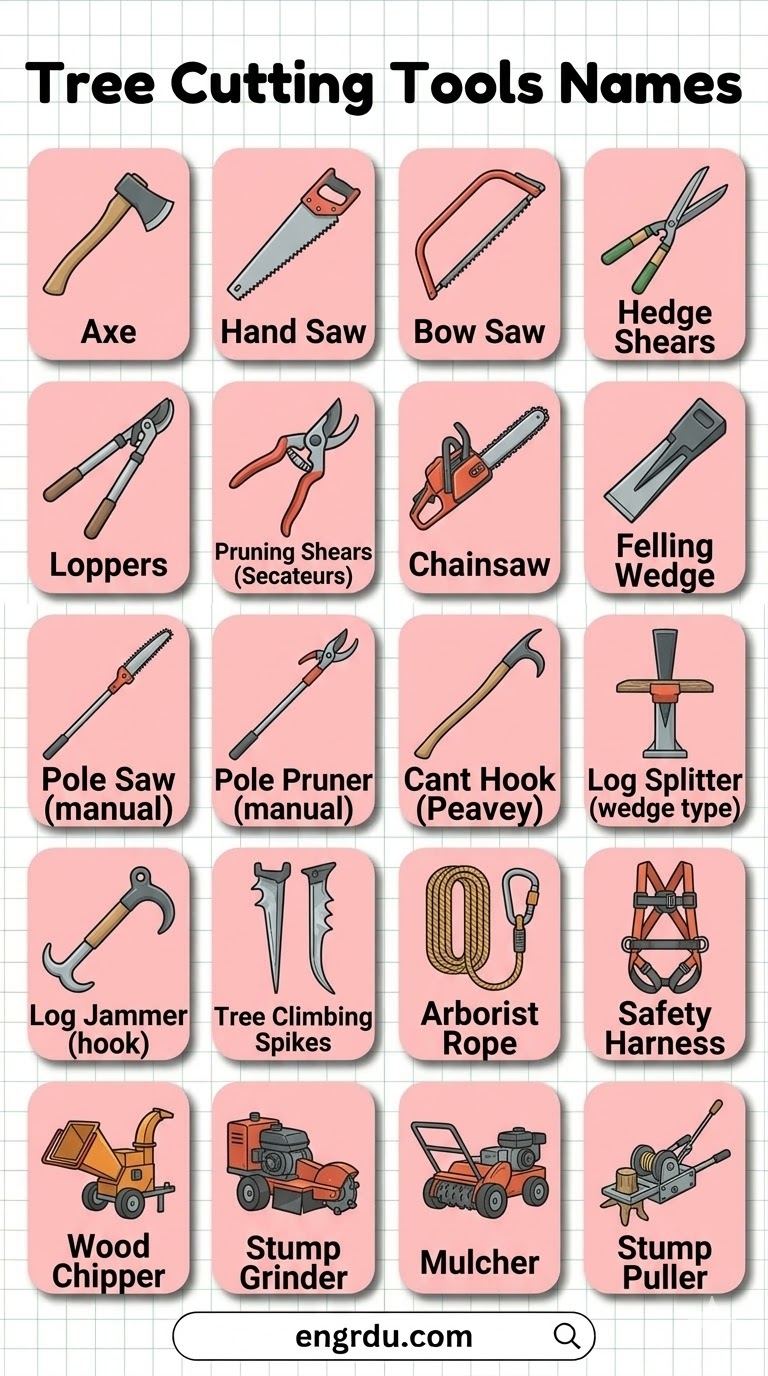
Types of Tree Cutting Tools
Manual Tree Cutting Tools (Hand Tools)
These tools work without electricity.
- Axe
- Felling Axe
- Hatchet
- Hand Saw
- Crosscut Saw
- Bow Saw
- Pruning Saw
- Folding Saw
- Coping Saw
- Lopper
- Pruning Shears (Secateurs)
- Pole Saw (Manual)
- Billhook
- Machete
- Adze
- Splitting Maul
- Wedge
- Drawknife
Power Tree Cutting Tools (Machine Tools)
These tools use electricity, battery, or fuel.
- Chainsaw
- Electric Chainsaw
- Battery Chainsaw
- Gas Chainsaw
- Pole Chainsaw
- Brush Cutter
- Hedge Trimmer
- Wood Chipper
- Stump Grinder
- Log Splitter
Cutting and Trimming Tools
Used for shaping trees and cutting branches.
- Pruning Saw
- Lopper
- Pruning Shears
- Hedge Shears
- Pole Pruner
- Tree Pruner
- Branch Cutter
Heavy-Duty Tree Cutting Tools
Used for large trees and hard wood.
- Felling Axe
- Crosscut Saw
- Chainsaw
- Splitting Maul
- Log Splitter
- Wedge
Climbing and Support Tools (Tree Work)
These tools help workers cut trees safely.
- Climbing Rope
- Safety Harness
- Tree Climbing Spikes
- Helmet
- Safety Gloves
Traditional and Special Tools
- Billhook
- Machete
- Adze
- Drawknife
- Two-Man Saw
- Cant Hook (used to move logs)
- Peavey (used to handle logs)
Try to learn these tools in small groups. For example, learn 5 tools each day and use them in short sentences.
Daily Use Sentences for Practice
- He cut the tree with an axe.
- The farmer used a chainsaw to cut wood quickly.
- She trimmed the plant with pruning shears.
- They used a pole saw to cut high branches.
- The worker carried a hatchet in his bag.
Tips to Remember Vocabulary
- Learn 3–5 words daily
- Use words in simple sentences
- Practice speaking with friends
- Look at real tools or pictures
- Repeat words regularly
Related Articles:
FAQs
What are tree cutting tools in English?
Tree cutting tools are tools used to cut, trim, or shape trees and wood. Examples include axe, chainsaw, saw, and pruning shears used in gardening and forestry.
What are the most common tree cutting tools names?
Common tree cutting tools names include axe, hatchet, chainsaw, hand saw, lopper, pruning shears, and pole saw. These tools help cut wood, branches, and trees safely.
What is the use of a chainsaw in tree cutting?
A chainsaw is a power tool used to cut large trees and thick wood quickly. It works with a moving chain and is widely used in forestry work.
What is the difference between an axe and a hatchet?
An axe is larger and used for cutting big trees, while a hatchet is smaller and used for cutting small branches or light wood work.
Which tools are used for cutting tree branches?
Tools like lopper, pruning shears, pruning saw, and pole saw are used to cut tree branches. They help trim trees and keep plants healthy.
What are manual and power tree cutting tools?
Manual tools like axe and hand saw work by hand, while power tools like chainsaw and wood chipper use electricity or fuel for faster cutting work.
Which tree cutting tool is best for beginners?
Hand tools like hand saw or pruning shears are best for beginners. They are simple, safe, and easy to control while learning basic cutting skills.
Conclusion
Tree cutting tools names are useful English words for daily life. When you learn these words with their uses, you improve your vocabulary and communication skills. Start using these words in sentences, and you will feel more confident in English.