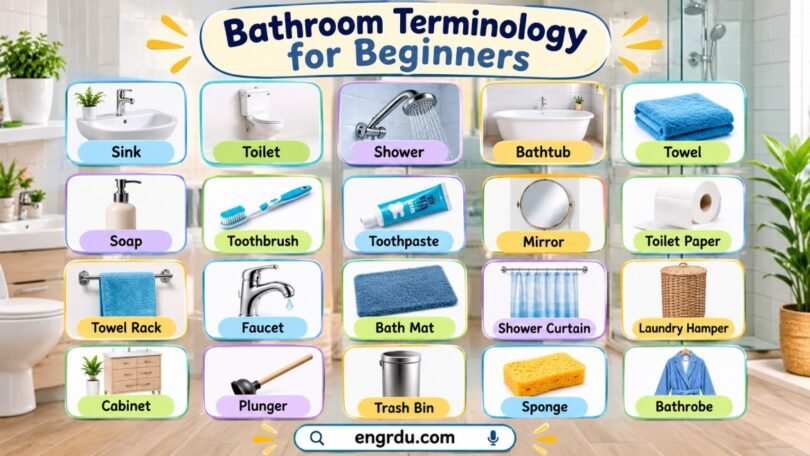

When you visit someone’s home, stay at a hotel, or use a public restroom, knowing the right bathroom words makes communication easier. Bathroom Terminology for Beginners introduces the names of bathroom fixtures, toiletries, personal care items, and common actions in clear, everyday English.
Bathroom vocabulary includes words such as sink, faucet, bathtub, shower, toilet, towel, soap, and toothbrush. It also includes useful expressions for asking to use the bathroom, describing a problem, requesting supplies, and talking about personal hygiene.
This article covers common bathroom terms, their meanings, and practical English sentences that beginners and intermediate learners can use in everyday conversations.
What Is Bathroom Terminology?
Bathroom terminology refers to the words and expressions used to describe bathroom spaces, fixtures, equipment, toiletries, cleaning supplies, and personal hygiene activities.
These terms help people communicate when using a bathroom at home, school, work, a hotel, or a public place.
Here are some common examples:
- Sink: A fixture used for washing hands and face.
- Faucet: A device that controls the flow of water from a sink or bathtub.
- Toilet: A fixture used for urination and bowel movements.
- Shower: A place or device used for washing the body with running water.
- Bathtub: A large container used for bathing.
- Towel: A piece of fabric used for drying the body.
- Toothbrush: A small brush used to clean teeth.
- Soap: A product used for washing the body and hands.
Common Bathroom Names and Their Meanings
Bathrooms contain different fixtures, personal care products, and everyday supplies. Learning their names helps you identify objects and talk about them naturally.
The following bathroom terms are among the most frequently used in everyday English.
- Bathroom – A room containing a toilet, sink, and other washing facilities.
- Restroom – A polite word for a public bathroom.
- Washroom – A room with facilities for washing and using the toilet.
- Toilet – A fixture used for urination and bowel movements.
- Lavatory – A formal term for a toilet or washroom.
- Powder Room – A small guest bathroom, usually containing a toilet and sink.
- Half-Bath – A bathroom with a toilet and sink but no bathtub or shower.
- Full Bathroom – A bathroom containing a toilet, sink, and bathing facilities.
- Ensuite Bathroom – A bathroom directly connected to a bedroom.
- Public Restroom – A bathroom available for public use.
- Guest Bathroom – A bathroom intended for visitors.
- Master Bathroom – A bathroom connected to the main bedroom.
- Shared Bathroom – A bathroom used by multiple people.
- Private Bathroom – A bathroom reserved for one person, family, or household.
- Accessible Bathroom – A bathroom designed for people with mobility needs.
Bathroom Fixtures and Fittings
Bathroom fixtures are the main installed objects used for washing, bathing, and personal hygiene. Some are connected to water pipes, while others provide storage or support.
Sink and Washing Area
- Sink – A basin used for washing hands and face.
- Washbasin – A basin designed for washing.
- Faucet – A device that controls water flow.
- Tap – Another word for faucet, commonly used in British English.
- Drain – An opening through which water flows away.
- Drain Plug – A stopper used to close the drain.
- Basin Mixer – A faucet that mixes hot and cold water.
- Soap Dispenser – A container that releases liquid soap.
- Mirror – A reflective surface used for looking at yourself.
- Medicine Cabinet – A small cabinet used to store medicines and toiletries.
- Vanity – A bathroom unit containing a sink and storage space.
- Vanity Cabinet – A cabinet installed beneath or around a bathroom sink.
- Backsplash – A protective surface behind a sink.
- Splash Guard – A barrier that helps prevent water from splashing.
- Sink Overflow – An opening that prevents a basin from overflowing.
Shower and Bathing Area
- Shower – A fixture that sprays water for bathing.
- Showerhead – The part that releases water during a shower.
- Shower Hose – A flexible pipe connecting a handheld showerhead to the water supply.
- Handheld Shower – A showerhead that can be held in the hand.
- Shower Arm – A pipe connecting the showerhead to the wall.
- Shower Valve – A control that regulates shower water.
- Shower Handle – A handle used to control water flow or temperature.
- Shower Door – A door separating the shower area from the rest of the bathroom.
- Shower Curtain – A waterproof curtain used around a shower or bathtub.
- Shower Rod – A rod used to hang a shower curtain.
- Shower Tray – A base that collects and drains shower water.
- Shower Niche – A recessed shelf built into a shower wall.
- Shower Enclosure – An enclosed space containing a shower.
- Bathtub – A large container used for bathing.
- Bath Mat – A mat placed near a bathtub or shower.
- Bath Spout – An outlet through which water enters a bathtub.
- Bathtub Drain – An opening that allows bathwater to leave the tub.
- Overflow Drain – An opening that prevents a bathtub from overflowing.
- Bath Plug – A stopper used to keep water inside a bathtub.
- Grab Bar – A safety handle that helps people maintain balance.
- Non-Slip Mat – A mat designed to reduce slipping.
- Bath Screen – A glass or plastic panel that prevents water from splashing outside the bathtub.
Bathroom Storage and Furniture
- Bathroom Cabinet – A storage unit for bathroom supplies.
- Wall Cabinet – A cabinet attached to the bathroom wall.
- Storage Shelf – A flat surface used to store bathroom items.
- Towel Rack – A fixture used to hold towels.
- Towel Bar – A horizontal bar for hanging towels.
- Towel Ring – A circular holder for hand towels.
- Toilet Paper Holder – A fixture that holds a toilet paper roll.
- Robe Hook – A hook used for hanging bathrobes.
- Wall Hook – A hook attached to the wall for hanging items.
- Laundry Hamper – A container used to collect dirty clothes.
- Bathroom Stool – A small seat used in the bathroom.
- Storage Basket – A container for organizing bathroom supplies.
Toilet and Restroom Terminology
Toilet-related vocabulary is useful when asking for directions, using public facilities, or explaining problems. These terms also appear frequently in everyday conversations.
Toilet Parts and Accessories
- Toilet Bowl – The bowl-shaped part of a toilet.
- Toilet Seat – The seat attached to the toilet.
- Toilet Lid – The cover placed over the toilet seat and bowl.
- Toilet Tank – The container that holds water for flushing.
- Flush – The mechanism or action used to remove waste from a toilet.
- Flush Button – A button pressed to flush a toilet.
- Flush Handle – A handle used to activate the flushing mechanism.
- Toilet Cistern – The water tank of a toilet, commonly called a cistern in British English.
- Toilet Brush – A brush used to clean the toilet bowl.
- Toilet Brush Holder – A container that holds a toilet brush.
- Toilet Paper – Soft paper used after using the toilet.
- Toilet Roll – A roll of toilet paper.
- Toilet Paper Dispenser – A device that holds and releases toilet paper.
- Bidet – A bathroom fixture used to clean the intimate areas with water.
- Bidet Spray – A handheld water sprayer used for personal cleaning.
- Toilet Plunger – A tool used to clear a blocked toilet or drain.
- Toilet Cleaner – A cleaning product used to clean toilet surfaces.
- Toilet Freshener – A product used to reduce unpleasant toilet odors.
- Urinal – A fixture designed mainly for urination, commonly found in public men’s restrooms.
- Stall – A small enclosed area containing a toilet.
- Cubicle – An enclosed toilet area, commonly used in British English.
- Toilet Partition – A divider between toilet stalls.
- Public Toilet – A toilet facility available for public use.
- Disabled Toilet – A toilet designed or adapted for people with disabilities.
Useful Toilet-Related Words
- Flushable: Suitable for flushing down a toilet, according to product instructions.
- Clogged: Blocked so that water cannot flow properly.
- Unclog: To remove a blockage.
- Overflow: When water rises above the normal level and spills out.
- Leak: An unwanted escape of water.
- Sewer: An underground system that carries wastewater away.
- Drainpipe: A pipe that carries wastewater away.
- Toilet Seat Cover: A disposable or reusable covering placed on a toilet seat.
- Sanitary Bin: A container for disposing of sanitary products.
- Air Freshener: A product used to improve the smell of a room.
Bathroom Accessories and Supplies
Bathroom accessories are everyday items used for comfort, convenience, storage, and personal care. They may sit on the sink, hang on a wall, or remain inside a cabinet.
Towels and Bath Accessories
- Bath Towel – A large towel used to dry the body after bathing.
- Hand Towel – A small towel used for drying hands.
- Face Towel – A small towel used for drying or cleaning the face.
- Washcloth – A small cloth used for washing the body.
- Bathrobe – A loose garment worn after bathing.
- Bath Slippers – Slippers worn inside a bathroom.
- Shower Cap – A waterproof cap that protects hair from water.
- Loofah – A textured bathing tool used to scrub the skin.
- Bath Sponge – A soft sponge used for washing the body.
- Bath Brush – A brush used for cleaning the body.
- Body Scrubber – A tool used to scrub the skin.
- Bath Pillow – A cushion that supports the head during a bath.
- Bath Mat – A mat that absorbs water near the shower or bathtub.
- Shower Caddy – A holder used to organize shower products.
- Soap Dish – A small tray used to hold a bar of soap.
Bathroom Electrical Appliances
- Hair Dryer – An electrical device used to dry hair.
- Electric Shaver – A powered device used for shaving.
- Electric Toothbrush – A powered toothbrush used to clean teeth.
- Hair Straightener – An appliance used to straighten hair.
- Curling Iron – An appliance used to curl hair.
- Exhaust Fan – A fan that removes moisture and odors from the bathroom.
- Bathroom Heater – A device used to warm the bathroom.
- Electric Towel Warmer – A device that heats towels.
- Bathroom Scale – A device used to measure body weight.
- Water Heater – A device that heats water for bathing and washing.
Personal Hygiene and Toiletry Vocabulary
Toiletries are products used for personal cleaning, grooming, and hygiene. Most people keep these products near the sink, in a bathroom cabinet, or inside a toiletry bag.
Oral Hygiene Products
- Toothbrush – A brush used to clean teeth.
- Toothpaste – A paste used with a toothbrush.
- Dental Floss – A thin thread used to clean between teeth.
- Mouthwash – A liquid used to rinse the mouth.
- Tongue Scraper – A tool used to clean the surface of the tongue.
- Toothbrush Holder – A container used to store toothbrushes.
- Dental Pick – A small tool used to remove food particles between teeth.
Hair Care Products
- Shampoo – A liquid or cream used to wash hair.
- Conditioner – A product used to soften and smooth hair.
- Hair Oil – Oil applied to the hair and scalp.
- Hair Gel – A styling product used to shape hair.
- Hair Spray – A spray used to hold a hairstyle in place.
- Hair Serum – A product used to smooth and protect hair.
- Hair Comb – A tool with teeth used to arrange hair.
- Hairbrush – A brush used to groom hair.
- Hair Ties – Small bands used to hold hair together.
- Hair Clips – Accessories used to secure sections of hair.
Skin and Body Care Products
- Body Wash – A liquid product used to clean the body.
- Body Soap – Soap used for washing the skin.
- Hand Soap – Soap specifically used for cleaning hands.
- Hand Sanitizer – A product used to reduce germs on the hands.
- Face Wash – A product used to clean the face.
- Facial Cleanser – A product designed to remove dirt and oil from the face.
- Moisturizer – A cream or lotion used to keep skin hydrated.
- Body Lotion – A moisturizing product applied to the body.
- Sunscreen – A product that protects skin from harmful ultraviolet rays.
- Face Cream – A cream applied to the face.
- Deodorant – A product used to reduce body odor.
- Antiperspirant – A product that reduces sweating.
- Shaving Cream – A cream used to make shaving easier.
- Aftershave – A product applied to the skin after shaving.
- Body Spray – A scented spray used on the body.
- Perfume – A scented liquid applied to the body.
- Lip Balm – A product used to moisturize the lips.
- Petroleum Jelly – A thick substance used to protect dry skin.
- Cotton Pads – Soft pads used for cleaning or applying skincare products.
- Cotton Swabs – Small sticks with cotton tips used for certain cleaning and cosmetic tasks.
Shaving and Grooming Items
- Razor – A tool used to remove hair.
- Razor Blade – The sharp cutting part of a razor.
- Disposable Razor – A razor designed for limited use.
- Shaving Brush – A brush used to apply shaving cream.
- Shaving Gel – A gel applied before shaving.
- Beard Trimmer – An electric tool used to trim facial hair.
- Nail Clipper – A tool used to cut fingernails and toenails.
- Nail File – A tool used to shape nails.
- Nail Brush – A small brush used to clean nails.
- Tweezers – A small tool used to remove individual hairs.
- Manicure Kit – A set of tools used for nail care.
- Pedicure Kit – A set of tools used for foot and toenail care.
Bathroom Cleaning Terms
Bathroom cleaning vocabulary helps you discuss household chores, request cleaning supplies, and explain problems with bathroom surfaces.
Bathroom Cleaning Supplies
- Toilet Cleaner – A liquid or gel used to clean toilets.
- Bathroom Cleaner – A product used to clean bathroom surfaces.
- Disinfectant – A product used to kill or reduce harmful microorganisms on surfaces.
- Bleach – A chemical cleaning product used for whitening and disinfecting.
- Scrub Brush – A stiff brush used for removing dirt.
- Cleaning Sponge – A sponge used to clean surfaces.
- Microfiber Cloth – A soft cloth used for wiping and cleaning.
- Cleaning Gloves – Gloves worn to protect hands during cleaning.
- Mop – A tool used to clean floors.
- Bucket – A container used to hold water or cleaning solutions.
- Squeegee – A tool with a flat rubber blade used to remove water from glass.
- Glass Cleaner – A product used to clean mirrors and glass.
- Grout Cleaner – A product used to clean the material between tiles.
- Floor Cleaner – A liquid used to clean floors.
- Drain Cleaner – A product used to help clear certain drain blockages.
Bathroom Cleaning Actions
- Wipe – To clean a surface using a cloth.
- Scrub – To clean by rubbing firmly.
- Rinse – To wash away soap or cleaning products with water.
- Mop – To clean a floor using a mop.
- Sweep – To remove dust and dirt using a broom.
- Disinfect – To kill or reduce harmful microorganisms.
- Sanitize – To reduce germs to a safer level.
- Polish – To make a surface smooth and shiny.
- Unclog – To remove something blocking a drain.
- Dry – To remove moisture from a surface.
Bathroom Actions and Verbs
Bathroom action words describe what people do when washing, bathing, grooming, and using bathroom facilities. Learning these verbs helps you form natural English sentences.
Washing and Bathing Actions
- Bathe – To wash your body, usually in a bathtub.
- Shower – To wash your body under running water.
- Wash – To clean something with water and soap.
- Rinse – To remove soap or shampoo with water.
- Lather – To produce foam by rubbing soap or shampoo.
- Scrub – To clean by rubbing firmly.
- Soak – To leave something in water for a period of time.
- Dry – To remove water from your body or an object.
- Towel Off – To dry yourself using a towel.
- Splash – To scatter or throw small amounts of water.
Personal Care Actions
- Brush – To clean teeth or arrange hair using a brush.
- Floss – To clean between teeth using dental floss.
- Shave – To remove facial or body hair with a razor.
- Comb – To arrange hair using a comb.
- Trim – To cut a small amount of hair or nails.
- Moisturize – To apply a product that keeps skin hydrated.
- Apply – To put a product onto your skin or hair.
- Groom – To take care of your appearance.
- Style – To arrange hair in a particular way.
- Spritz – To spray a small amount of liquid.
Toilet-Related Actions
- Flush – To remove waste from a toilet using water.
- Urinate – To pass urine from the body.
- Pee – An informal word for urinate.
- Defecate – To pass solid waste from the body.
- Use the Toilet – To go to the toilet.
- Wipe – To clean yourself with toilet paper.
- Unclog – To remove a blockage from a toilet or drain.
- Refill – To fill a container again.
- Empty – To remove everything from a container.
- Dispose – To throw something away properly.
Bathroom Terminology for Everyday Conversations
Knowing the names of bathroom objects is useful, but learners also need to know how to use these words in sentences. These expressions help you communicate naturally at home, school, work, hotels, and public places.
Asking Where the Bathroom Is
Use these polite questions when you need to find a bathroom.
- Excuse me, where is the bathroom?
- Could you tell me where the restroom is?
- Is there a public toilet nearby?
- Where can I wash my hands?
- Is the washroom on this floor?
- Could you show me the way to the nearest restroom?
- Is there a bathroom inside this building?
- Where is the nearest ladies’ room?
- Where can I find the men’s restroom?
- Is the bathroom upstairs or downstairs?
Asking Permission to Use the Bathroom
These expressions are useful at home, school, work, or someone else’s house.
- May I use the bathroom?
- Can I use your restroom, please?
- Is it okay if I use the washroom?
- May I go to the toilet?
- Could I use your bathroom for a moment?
- Do you mind if I use the restroom?
- Can I freshen up in the bathroom?
- Would you mind showing me where the bathroom is?
Talking About Taking a Shower or Bath
Use these sentences to talk about bathing routines and preferences.
- I need to take a shower.
- I’m going to have a bath.
- The water is too hot.
- The shower water is too cold.
- Can you turn on the shower?
- Please turn off the faucet.
- I prefer taking showers to having baths.
- The bathtub is full of water.
- I need a clean towel.
- Where is the shower gel?
- I have already washed my hair.
- The shower is not working properly.
- I will take a quick shower.
- The bathroom floor is wet.
- Please leave the shower curtain open.
Talking About Brushing Teeth and Washing Your Face
These expressions are commonly used when describing morning and evening routines.
- I need to brush my teeth.
- Where is my toothbrush?
- Have you seen my toothpaste?
- I am out of toothpaste.
- Please pass me the mouthwash.
- I need to floss my teeth.
- I wash my face twice a day.
- The face wash is on the shelf.
- I forgot to bring my toothbrush.
- Please put the toothbrush back in its holder.
- I need a clean hand towel.
- My toothbrush is still wet.
Asking for Bathroom Supplies
These sentences help you request toiletries and other bathroom items.
- Could you give me a clean towel?
- Where do you keep the shampoo?
- Do we have any extra toilet paper?
- Can I borrow your hair dryer?
- Please pass me the soap.
- Where is the shaving cream?
- I need a new toothbrush.
- Could you refill the soap dispenser?
- Is there any clean bathwater?
- Do you have an extra shower cap?
- Can you bring me a fresh towel?
- The bathroom cabinet is empty.
Talking About Bathroom Problems
Use these expressions when something is damaged, blocked, dirty, or not working properly.
- The toilet is clogged.
- The sink is leaking.
- The faucet is dripping.
- The shower is not working.
- There is no hot water.
- The drain is blocked.
- The toilet won’t flush.
- The showerhead is broken.
- The bathroom light is not working.
- The bathtub is overflowing.
- The bathroom smells unpleasant.
- There is water on the floor.
- The mirror is dirty.
- The toilet paper has run out.
- The bathroom needs cleaning.
Talking About Bathroom Cleaning
These sentences are useful when discussing household chores.
- I need to clean the bathroom.
- Please scrub the bathtub.
- Don’t forget to clean the toilet.
- The bathroom mirror needs wiping.
- I will mop the bathroom floor.
- Please replace the empty toilet paper roll.
- The shower curtain needs washing.
- Put the cleaning supplies in the cabinet.
- The sink needs to be disinfected.
- Please empty the bathroom bin.
- The bathroom tiles are dirty.
- I have finished cleaning the bathroom.
Bathroom Terminology Examples by Situation
The same bathroom words can appear in different conversations depending on the situation. These short dialogues show how learners can use bathroom vocabulary naturally.
Conversation 1: Asking for the Bathroom at a Restaurant
Customer: Excuse me, where is the restroom?
Staff: It’s down the hallway, on your left.
Customer: Thank you. Is it open to customers?
Staff: Yes, of course.
Conversation 2: Asking to Use Someone’s Bathroom
Guest: May I use your bathroom?
Host: Certainly. It’s next to the kitchen.
Guest: Thank you. Could I also have a hand towel?
Host: Sure. There’s one beside the sink.
Conversation 3: Taking a Shower at Home
Person A: Are you using the bathroom?
Person B: No, I’m finished.
Person A: Great. I need to take a shower.
Person B: The hot water is already running.
Conversation 4: Looking for Toiletries
Person A: Have you seen my shampoo?
Person B: It’s on the shelf in the shower.
Person A: Where is the conditioner?
Person B: It’s beside the shampoo bottle.
Conversation 5: Reporting a Blocked Toilet
Guest: Excuse me, there’s a problem with the toilet.
Hotel Staff: What seems to be wrong?
Guest: It won’t flush properly.
Hotel Staff: I’m sorry. I’ll send someone to check it.
Conversation 6: Requesting a Clean Towel at a Hotel
Guest: Could I have an extra bath towel, please?
Receptionist: Certainly. I’ll arrange that for you.
Guest: Thank you. Could you also send some extra toilet paper?
Receptionist: Of course.
Conversation 7: Talking About a Leaking Faucet
Person A: Why is there water around the sink?
Person B: The faucet is leaking.
Person A: Have you turned it off?
Person B: Yes, but it is still dripping.
Conversation 8: Talking About Bathroom Cleaning
Person A: Have you cleaned the bathroom?
Person B: I’ve cleaned the sink and toilet.
Person A: What about the shower?
Person B: I’ll scrub it this afternoon.
Conversation 9: Asking for Toilet Paper
Person A: Do we have any toilet paper left?
Person B: There’s one extra roll in the bathroom cabinet.
Person A: Could you bring it here?
Person B: Sure. I’ll get it.
Conversation 10: Talking About a Cold Shower
Person A: Was your shower okay?
Person B: Not really. The water was freezing.
Person A: Is the water heater broken?
Person B: I think so. We should get it checked.
Common Bathroom Vocabulary Mistakes
Some bathroom words have similar meanings or different uses depending on the country. Remember these common differences.
- Bathroom vs. Restroom: Bathroom is commonly used at home, while restroom is often preferred for public facilities in American English.
- Faucet vs. Tap: Both describe a device that controls water flow. Faucet is more common in American English, while tap is widely used in British English.
- Toilet vs. Toilet Seat: A toilet is the entire fixture, while the toilet seat is the part you sit on.
- Shower vs. Showerhead: A shower refers to the bathing fixture or experience, while a showerhead is the part that sprays water.
- Bath vs. Bathtub: A bath can mean the activity of bathing, while a bathtub is the container used for it.
Practice Exercises: Bathroom Terminology
Test your understanding of bathroom vocabulary with these short exercises. Choose the correct word to complete each sentence.
Exercise 1: Fill in the Blanks
Choose the correct bathroom word for each sentence.
- I use a __________ to clean my teeth.
- Please turn off the __________ after washing your hands.
- I need a clean __________ to dry my body.
- We use a __________ to wash our hair.
- The __________ is blocked, so the water cannot drain.
- Please put the dirty clothes in the __________.
- I need a __________ to clean the toilet bowl.
- She uses a __________ to dry her hair.
- The __________ holds water for flushing the toilet.
- I keep my toothbrush in a __________.
Exercise 2: Choose the Correct Word
- Which item is used to dry your hands?
- A. Shampoo
- B. Hand towel
- C. Toothpaste
- Which fixture is used for bathing under running water?
- A. Shower
- B. Mirror
- C. Cabinet
- What do you use to remove hair from your face?
- A. Soap dish
- B. Razor
- C. Bath mat
- Which object holds toilet paper?
- A. Towel rack
- B. Shower rod
- C. Toilet paper holder
- What is used to clean between your teeth?
- A. Dental floss
- B. Body wash
- C. Hair gel
Exercise 3: Complete the Conversations
Fill in each blank with a suitable bathroom expression.
- A: Excuse me, where is the __________?
B: It’s next to the reception desk. - A: The toilet won’t __________.
B: I’ll check the flushing system. - A: Could you pass me the __________?
B: Here you are. - A: I need to take a __________.
B: The bathroom is free now. - A: There is no __________ water.
B: I’ll check the water heater.
Exercise Answers
Exercise 1:
- Toothbrush
- Faucet / Tap
- Towel
- Shampoo
- Drain
- Laundry hamper
- Toilet brush
- Hair dryer
- Toilet tank
- Toothbrush holder
Exercise 2:
- B. Hand towel
- A. Shower
- B. Razor
- C. Toilet paper holder
- A. Dental floss
Exercise 3:
- Restroom / Bathroom
- Flush
- Towel / Soap
- Shower
- Hot
FAQs About Bathroom Terms
Bathroom terminology refers to words used for bathroom fixtures, toiletries, accessories, cleaning supplies, and personal hygiene activities.
Common bathroom terms include toilet, sink, faucet, shower, bathtub, mirror, towel, soap, toothbrush, toothpaste, and toilet paper.
A bathroom usually refers to a room with washing and toilet facilities, while restroom commonly describes a public toilet facility.
Bathroom fixtures are installed items such as sinks, toilets, bathtubs, showers, faucets, and showerheads used for washing and sanitation.
Toiletries are personal care products such as shampoo, toothpaste, soap, conditioner, deodorant, shaving cream, and moisturizer.
Useful phrases include “May I use the bathroom?”, “Where is the restroom?”, and “Could I have a clean towel, please?”
Both control water flow from a pipe. Faucet is more common in American English, while tap is widely used in British English.
Learn words by category, identify bathroom objects at home, practice short conversations, and use new vocabulary when describing daily routines.
Conclusion
Learning Bathroom Terminology for Beginners helps English learners identify bathroom objects, understand common expressions, and communicate confidently in everyday situations.
Start with frequently used words such as sink, toilet, faucet, shower, bathtub, towel, soap, and toothbrush. Then practice asking for bathroom directions, requesting supplies, describing problems, and talking about personal hygiene.
Regular practice with these bathroom terms and conversation examples will help you understand everyday English more naturally.