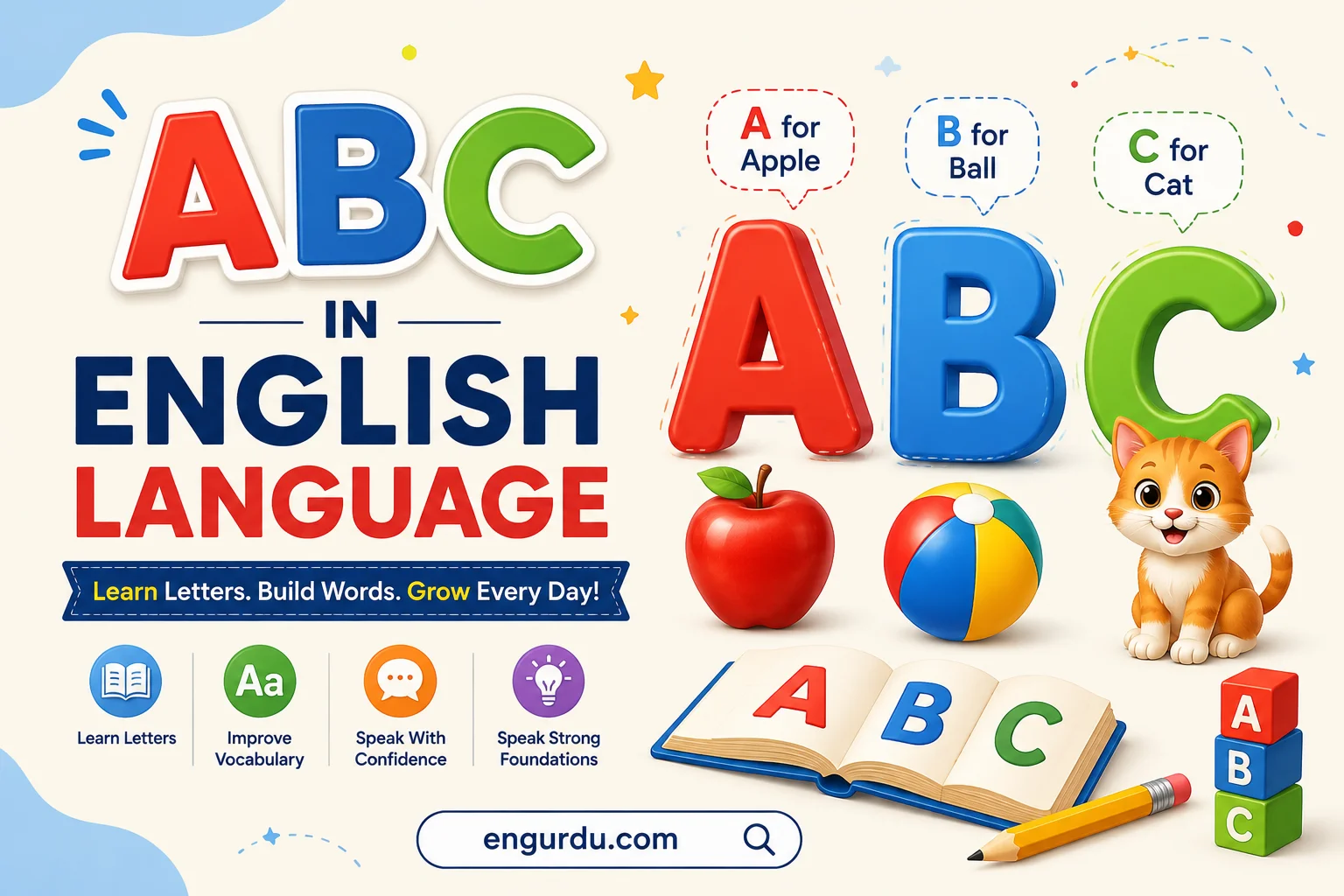

Looking for the ABC in English Language from A to Z? The English ABC refers to the 26 letters of the English alphabet, from A to Z. Each letter has an uppercase and lowercase form and can represent different sounds in English words.
Learning the ABC is one of the first steps in developing English reading, writing, spelling, pronunciation, and vocabulary. In this article, you will learn all 26 English alphabet letters, their names, common sounds, example words, and useful facts for English learners.
What Is ABC in English Language?
ABC in English Language commonly refers to the English alphabet from A to Z. The English alphabet has 26 letters.
These letters are used to form English words, sentences, names, and other written forms of communication.
The 26 letters are:
A B C D E F G H I J K L M N O P Q R S T U V W X Y Z
Each letter has two main written forms:
- Uppercase (capital): A, B, C
- Lowercase (small): a, b, c
For example:
| Uppercase | Lowercase | Example |
|---|---|---|
| A | a | Apple |
| B | b | Ball |
| C | c | Cat |
Learning both forms is important because English writing uses uppercase and lowercase letters for different purposes.
The English Alphabet: A to Z Chart
Here is the complete ABC in English from A to Z:
| Letter | Letter Name | Example Word |
|---|---|---|
| A | ay | Apple |
| B | bee | Ball |
| C | see | Cat |
| D | dee | Dog |
| E | ee | Elephant |
| F | ef | Fish |
| G | gee | Goat |
| H | aitch | Hat |
| I | eye | Ice |
| J | jay | Juice |
| K | kay | Kite |
| L | el | Lion |
| M | em | Mango |
| N | en | Nest |
| O | oh | Orange |
| P | pee | Pen |
| Q | cue | Queen |
| R | ar | Rabbit |
| S | ess | Sun |
| T | tee | Tiger |
| U | you | Umbrella |
| V | vee | Van |
| W | double-you | Watermelon |
| X | ex | Xylophone |
| Y | why | Yellow |
| Z | zee / zed | Zebra |
This A-to-Z sequence is the standard order of the English alphabet.
ABC in English: Capital and Small Letters
English letters can appear in capital letters and small letters.
Capital letters are also called uppercase letters. Small letters are called lowercase letters.
| Capital Letter | Small Letter |
|---|---|
| A | a |
| B | b |
| C | c |
| D | d |
| E | e |
| F | f |
| G | g |
| H | h |
| I | i |
| J | j |
| K | k |
| L | l |
| M | m |
| N | n |
| O | o |
| P | p |
| Q | q |
| R | r |
| S | s |
| T | t |
| U | u |
| V | v |
| W | w |
| X | x |
| Y | y |
| Z | z |
When are capital letters used?
Capital letters are commonly used:
- At the beginning of a sentence
- For people’s names
- For names of countries and cities
- For days and months
- For specific places and organizations
- For titles and other proper nouns
Examples:
- Ali lives in Pakistan.
- Monday is the first day of my school week.
- I visited London last year.
A to Z Alphabet for Kids with Examples
Learning one word with each letter makes the ABC easier to remember for kids.
A — Apple
A is for Apple.
Example: I ate an apple.
B — Ball
B is for Ball.
Example: The boy kicked the ball.
C — Cat
C is for Cat.
Example: The cat is sleeping.
D — Dog
D is for Dog.
Example: The dog is in the garden.
E — Elephant
E is for Elephant.
Example: The elephant is very large.
F — Fish
F is for Fish.
Example: The fish is swimming.
G — Goat
G is for Goat.
Example: The goat is eating grass.
H — Hat
H is for Hat.
Example: He is wearing a hat.
I — Ice
I is for Ice.
Example: The ice is cold.
J — Juice
J is for Juice.
Example: She drank orange juice.
K — Kite
K is for Kite.
Example: The kite is flying high.
L — Lion
L is for Lion.
Example: The lion lives in the wild.
M — Mango
M is for Mango.
Example: Mango is my favorite fruit.
N — Nest
N is for Nest.
Example: The bird built a nest.
O — Orange
O is for Orange.
Example: I have an orange.
P — Pen
P is for Pen.
Example: I wrote my name with a pen.
Q — Queen
Q is for Queen.
Example: The queen waved to the crowd.
R — Rabbit
R is for Rabbit.
Example: The rabbit is eating a carrot.
S — Sun
S is for Sun.
Example: The sun is bright today.
T — Tiger
T is for Tiger.
Example: The tiger is strong.
U — Umbrella
U is for Umbrella.
Example: I took an umbrella because it was raining.
V — Van
V is for Van.
Example: The van stopped outside the school.
W — Watermelon
W is for Watermelon.
Example: We ate a sweet watermelon.
X — Xylophone
X is for Xylophone.
Example: The child played the xylophone.
Y — Yellow
Y is for Yellow.
Example: She has a yellow dress.
Z — Zebra
Z is for Zebra.
Example: The zebra has black and white stripes.
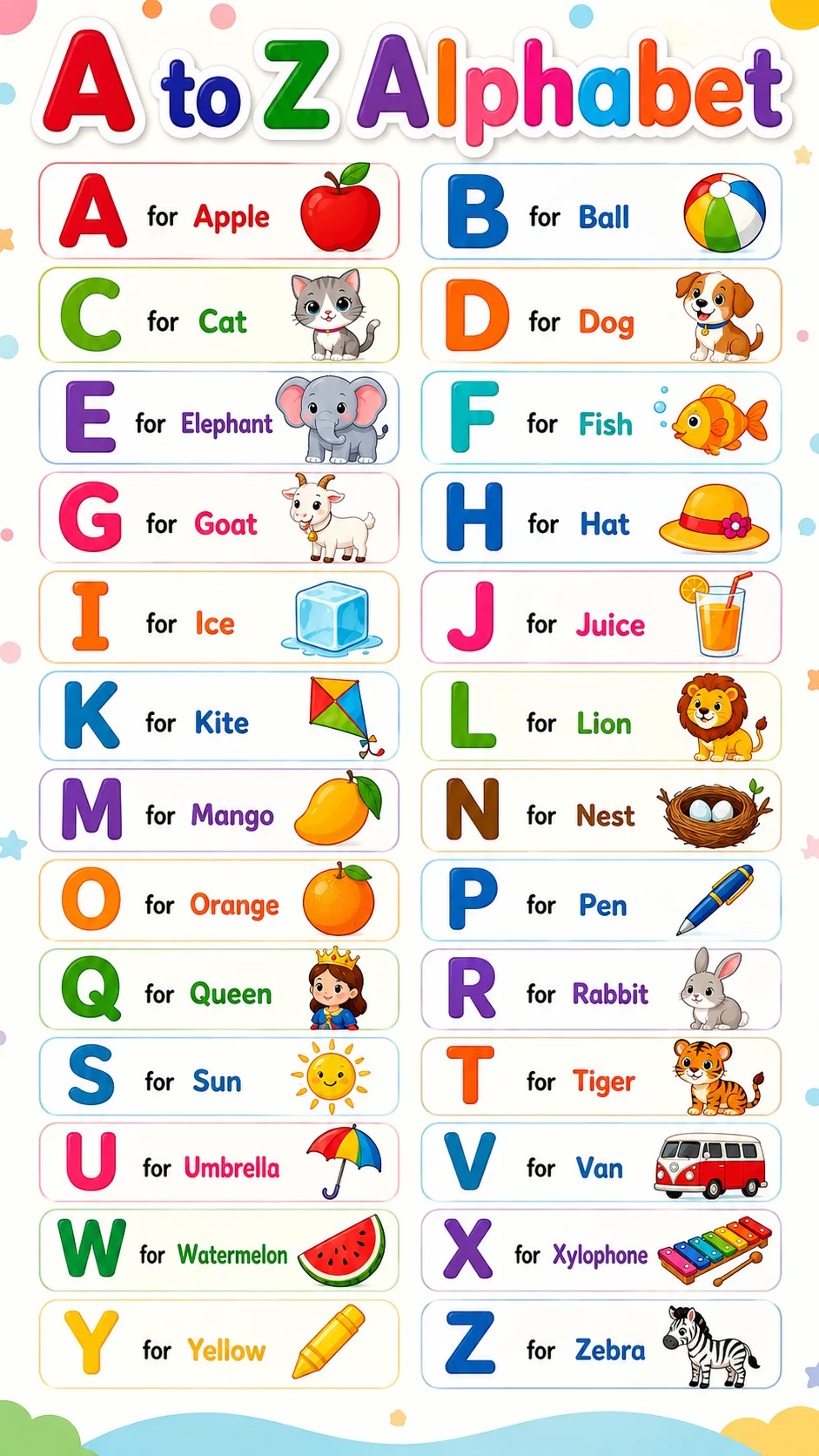
A to Z Alphabet Chart
English Alphabet Pronunciation
Knowing the letter names is an important part of learning the ABC.
| Letter | Common Letter Name |
|---|---|
| A | /eɪ/ |
| B | /biː/ |
| C | /siː/ |
| D | /diː/ |
| E | /iː/ |
| F | /ɛf/ |
| G | /dʒiː/ |
| H | /eɪtʃ/ |
| I | /aɪ/ |
| J | /dʒeɪ/ |
| K | /keɪ/ |
| L | /ɛl/ |
| M | /ɛm/ |
| N | /ɛn/ |
| O | /oʊ/ |
| P | /piː/ |
| Q | /kjuː/ |
| R | /ɑːr/ |
| S | /ɛs/ |
| T | /tiː/ |
| U | /juː/ |
| V | /viː/ |
| W | /ˈdʌbəljuː/ |
| X | /ɛks/ |
| Y | /waɪ/ |
| Z | /ziː/ or /zɛd/ |
Why does Z have two common pronunciations?
The letter Z is usually pronounced:
- “zee” in American English
- “zed” in British English and many other varieties of English
Both forms are correct.
Vowels and Consonants in the ABC
The 26 English letters are commonly divided into vowels and consonants.
Vowels
The five main vowel letters are:
A, E, I, O, U
The letter Y can sometimes act as a vowel, depending on the word.
Examples:
- A in apple
- E in egg
- I in ink
- O in orange
- U in umbrella
Consonants
The remaining letters are generally classified as consonants.
Examples include:
B, C, D, F, G, H, J, K, L, M, N, P, Q, R, S, T, V, W, X, Y, Z
However, English spelling and pronunciation are not always one-to-one. A letter can have different sounds in different words.
Why Are the ABCs Important in English?
The alphabet provides the foundation for written English.
Learners use letters to:
- Read words
- Spell names
- Write sentences
- Build vocabulary
- Search for words in dictionaries
- Organize words alphabetically
- Recognize written information
- Develop reading and writing skills
For example, learning C-A-T allows a learner to recognize and write the word cat.
How the English Alphabet Is Used
The ABC is not only learned as a sequence. The letters are used throughout written English.
Writing words
Letters combine to form words:
C + A + T = CAT
D + O + G = DOG
B + O + O + K = BOOK
Spelling names
People often spell names letter by letter.
Example:
“My name is Sara. S-A-R-A.”
Organizing information
Words can be arranged in alphabetical order.
For example:
Apple → Banana → Cat → Dog
This method is commonly used in dictionaries, indexes, lists, and directories.
ABC in English for Children and ESL Learners
Children and English learners often begin with the alphabet before moving into longer words and sentences.
Useful learning activities include:
- Singing the A-to-Z alphabet song
- Matching capital and lowercase letters
- Tracing letters
- Writing each letter repeatedly
- Matching letters with pictures
- Reading simple A-to-Z words
- Practicing letter sounds
- Spelling short words
For example:
A → Apple → /æ/
B → Ball → /b/
C → Cat → /k/
This connects the letter, sound, and word.
Alphabetical Order Explained
Alphabetical order means arranging words according to the order of the English alphabet.
The order begins:
A → B → C → D → E → F → G → H → I → J…
Example
Put these words in alphabetical order:
- Dog
- Apple
- Ball
- Cat
Correct order:
- Apple
- Ball
- Cat
- Dog
What if two words begin with the same letter?
Look at the next letter.
For example:
- Cat
- Car
- Can
They all begin with C, so compare the next letters:
Can → Car → Cat
Alphabetical order is useful when using dictionaries and organizing lists.
Letter Names vs. Letter Sounds
One of the most important ABC concepts for English learners is the difference between a letter name and a letter sound.
For example:
The letter B is named “bee”, but its common sound in words is /b/.
The letter A is named “ay”, but it can represent several sounds depending on the word.
Compare:
| Letter | Letter Name | Example | Sound in Example |
|---|---|---|---|
| A | “ay” | Apple | /æ/ |
| B | “bee” | Ball | /b/ |
| C | “see” | Cat | /k/ |
| D | “dee” | Dog | /d/ |
This distinction helps learners understand why spelling and pronunciation can sometimes be different.
Why Can One Letter Have Different Sounds?
English spelling can be complicated because one letter may represent different sounds in different words.
For example, C can sound like /k/ in:
cat, cup, cold
But it can sound like /s/ in:
city, cent, cycle
The letter G can also have different common sounds:
go, game, give
versus:
giant, giraffe, gym
This is why learning letter names alone is not enough. English learners also need to practice letter sounds, word patterns, and pronunciation.
Common ABC Mistakes and Confusions
- Confusing letter names with sounds: “B” is pronounced “bee” as a letter name, but its common sound is /b/.
- Mixing uppercase and lowercase letters: Learn A/a, B/b, C/c as pairs.
- Forgetting the alphabet order: Practice saying A to Z regularly.
- Assuming every letter has only one sound: English letters can represent different sounds in different words.
- Confusing ABC with only A, B, and C: In educational contexts, “ABC” commonly refers to the English alphabet from A to Z.
Easy Ways to Learn the English ABC
Learning the alphabet becomes easier when you combine reading, writing, listening, and speaking.
Practice A to Z every day
- Say the alphabet aloud from A to Z.
- Then try saying it without looking at the letters.
Match letters with words
Use one familiar word for each letter:
A — Apple
B — Ball
C — Cat
Continue through Z.
Practice uppercase and lowercase together
Write:
A a
B b
C c
D d
This helps learners recognize both forms.
Spell short words
Start with easy words:
- Cat
- Dog
- Pen
- Sun
- Book
Then move to longer words.
Practice difficult letters
Some learners find these letters or sounds harder:
G, H, J, Q, R, W, X, Y, Z
Spend extra time listening to and pronouncing them.
ABC Practice Exercises
Exercise 1: Complete the sequence
- A, B, ___, D, E
- H, I, ___, K, L
- M, N, ___, P, Q
- T, U, ___, W, X
- X, Y, ___
Exercise 2: Match the letter with the word
| Letter | Word |
|---|---|
| A | Zebra |
| B | Apple |
| C | Dog |
| D | Ball |
| E | Cat |
Exercise 3: Write the lowercase letter
- A → ___
- B → ___
- F → ___
- M → ___
- Z → ___
Exercise 4: Put the words in alphabetical order
Orange, Apple, Dog, Banana
Exercise 5: Identify the vowel
Which letter is a vowel?
- B
- E
- T
- R
Practice Answers
Exercise 1
- C
- J
- O
- V
- Z
Exercise 2
- A → Apple
- B → Ball
- C → Cat
- D → Dog
- E → Zebra
Exercise 3
- a
- b
- f
- m
- z
Exercise 4
Apple → Banana → Dog → Orange
Exercise 5
E
FAQs About ABC in English
What is ABC in English Language?
ABC in English usually refers to the English alphabet from A to Z, which contains 26 letters.
How many letters are in the English ABC?
The English alphabet has 26 letters, starting with A and ending with Z.
What are the ABC letters in English?
The ABC letters are the 26 English alphabet letters: A, B, C, D, E, F, G, H, I, J, K, L, M, N, O, P, Q, R, S, T, U, V, W, X, Y, Z.
What are the five vowels in the English alphabet?
The five main vowel letters are A, E, I, O, and U. Y can sometimes function as a vowel.
What is the difference between uppercase and lowercase letters?
Uppercase letters are capital forms such as A, B, C, while lowercase letters are small forms such as a, b, c.
What comes after Y in the English alphabet?
Z comes after Y and is the final letter of the English alphabet.
Is Z pronounced “zee” or “zed”?
Both are correct. “Zee” is common in American English, while “zed” is common in British English.
Why is learning ABC important for English learners?
Learning the alphabet helps learners develop reading, writing, spelling, pronunciation, and vocabulary skills.
Conclusion
The ABC in English Language refers to the 26-letter English alphabet from A to Z. These letters form the building blocks of English words and written communication.
To learn the ABC well, practice the A-to-Z sequence, uppercase and lowercase forms, letter names, sounds, spelling, and alphabetical order. Once these basics become familiar, reading, writing, and vocabulary practice become much easier.
A to Z is the foundation of English written language: learn the letters, learn their sounds, and then use them to build words and sentences.