

Weather affects our daily life, travel, farming, and safety. To study weather, scientists use weather instruments. These are special tools that measure temperature, wind, rain, and air pressure.
Learning weather instruments names helps English learners understand vocabulary related to science, nature, and daily life. When you learn the names of instruments like thermometer, barometer, and anemometer, you can read weather reports, understand science articles, and follow meteorology discussions.
What Are Weather Instruments?
Weather instruments are devices used to measure and record weather conditions. Scientists, meteorologists, and weather observers use them to study the environment.
Different instruments measure different weather factors. Some measure temperature, others measure rainfall, wind speed, or atmospheric pressure. Using these tools, people can forecast weather, plan activities, and respond to natural events like storms or heatwaves.
Why Learning Weather Instruments Names Is Important
Learning the names of weather instruments has several benefits:
- Improves science and weather vocabulary
- Helps learners understand weather forecasts
- Supports reading science articles and reports
- Improves speaking and writing when discussing weather
- Strengthens listening skills for news or educational videos
Understanding these terms allows learners to communicate effectively about weather and climate topics.
Common Weather Instruments Names and Uses
Here are some important weather instruments and their functions:
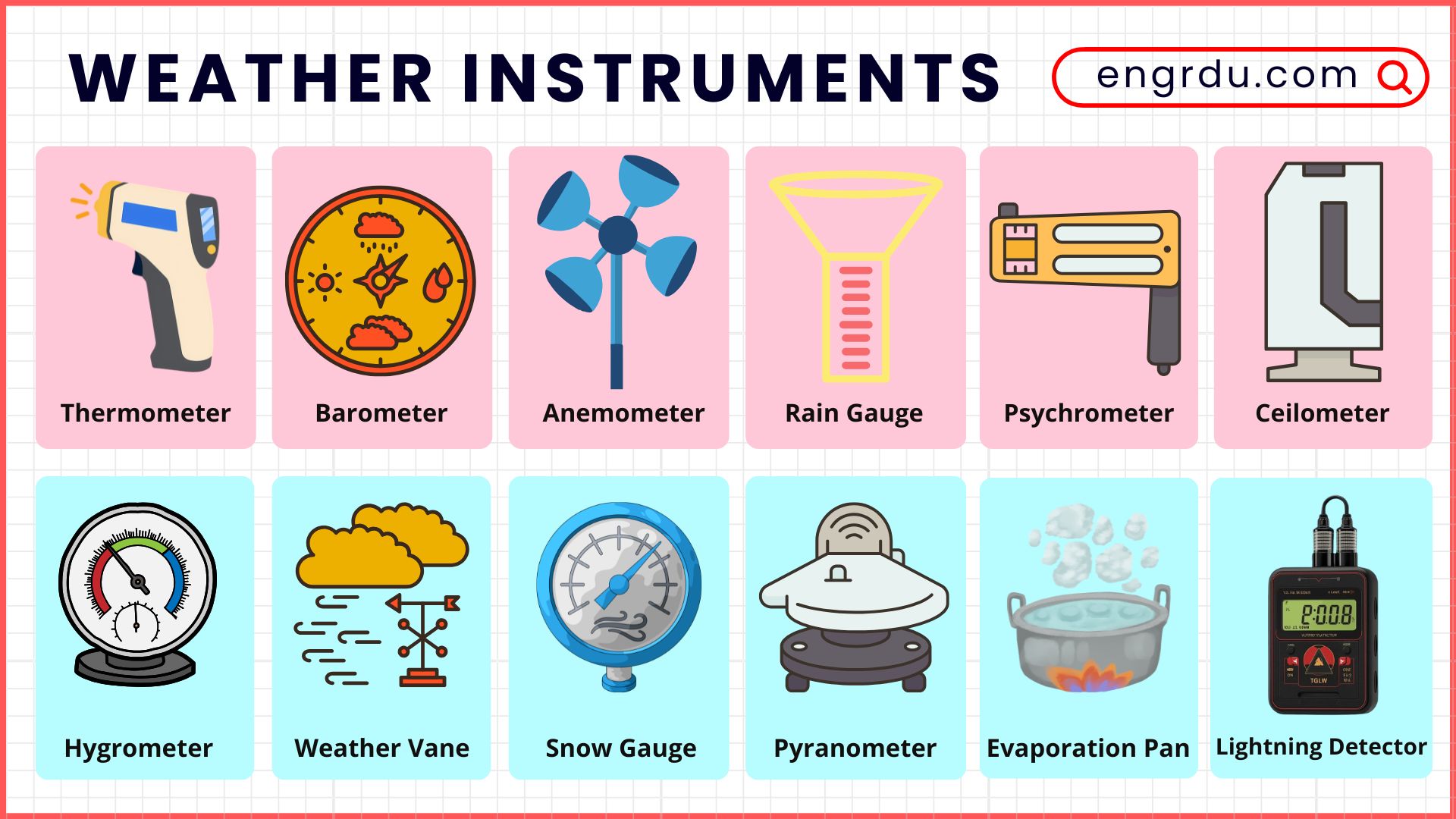
- Thermometer – Measures air temperature.
- Barometer – Measures atmospheric pressure to predict storms or clear weather.
- Anemometer – Measures wind speed.
- Rain Gauge – Measures the amount of rainfall.
- Hygrometer – Measures humidity in the air.
- Weather Vane (Wind Vane) – Shows wind direction.
- Snow Gauge – Measures snowfall amount.
- Pyranometer – Measures solar radiation.
- Psychrometer – Measures relative humidity using dry and wet bulbs.
- Ceilometer – Measures cloud height in the sky.
- Evaporation Pan – Measures water evaporation from a surface.
- Lightning Detector – Detects and measures lightning strikes.
- Weather Balloon Instruments – Collect data on pressure, temperature, and humidity at high altitudes.
- Tide Gauge – Measures sea level changes, important in coastal weather studies.
- Anemograph – Records wind speed over time.
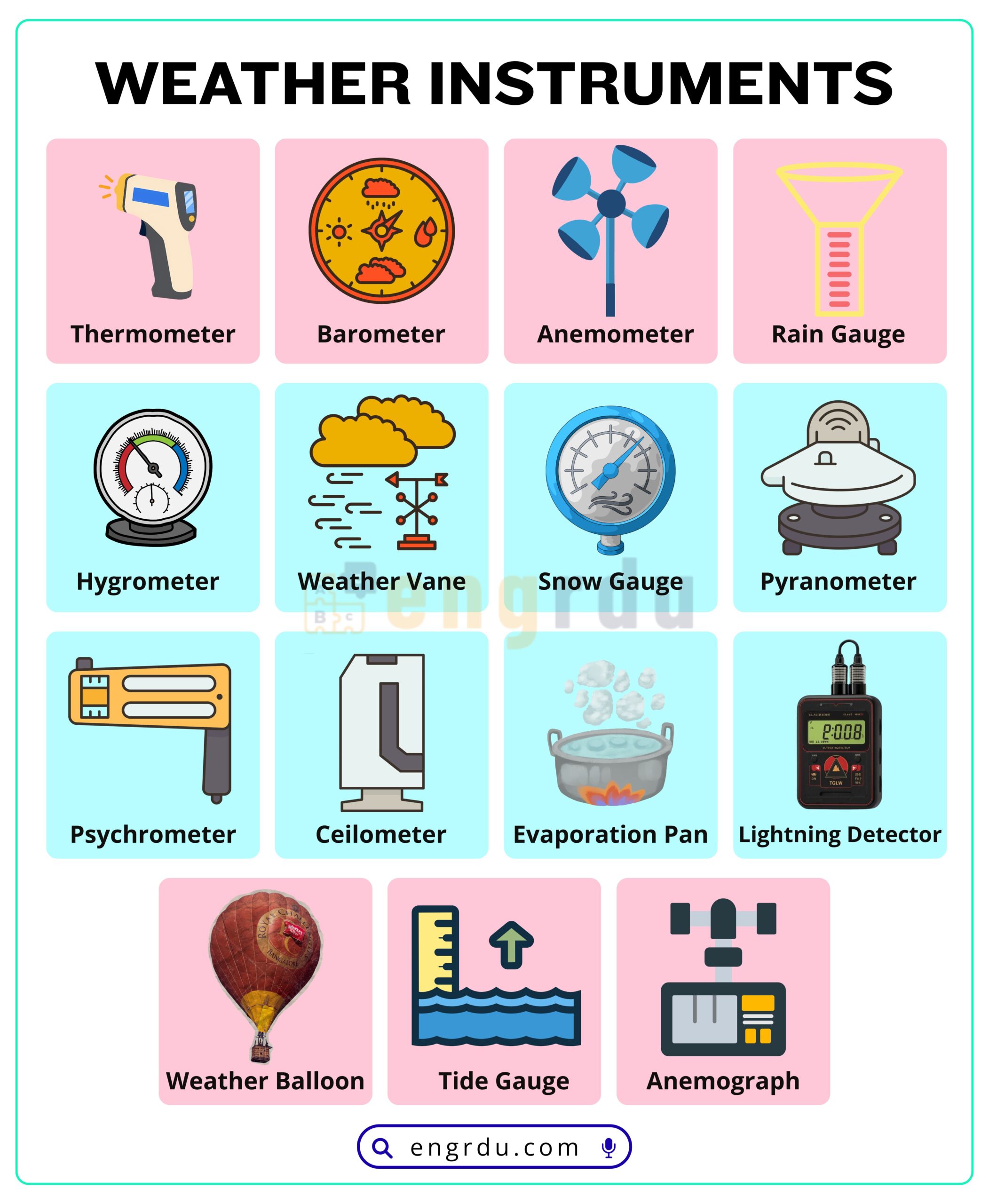
Weather Instruments Names with Pictures
Types of Weather Instruments
Weather instruments can be grouped by the factor they measure.
Temperature Instruments
- Thermometer
Pressure Instruments
- Barometer
Wind Instruments
- Anemometer
- Weather vane
- Anemograph
Humidity Instruments
- Hygrometer
- Psychrometer
Precipitation Instruments
- Rain gauge
- Snow gauge
Radiation Instruments
- Pyranometer
Specialized Instruments
- Ceilometer
- Weather balloon instruments
- Lightning detector
- Tide gauge
Frequently Used Weather-Instruments
Meteorologists commonly use these instruments:
- Thermometer
- Barometer
- Anemometer
- Rain gauge
- Hygrometer
- Weather vane
These tools help forecast weather and understand climate patterns effectively.
Tips to Remember Weather-Instrument Names
Use pictures
Visuals help learners connect names with instrument shapes.
Group by purpose
Learn temperature, wind, and precipitation instruments separately.
Practice sentences
Example: The meteorologist checked the thermometer to know the temperature.
Review regularly
Repetition helps store vocabulary in long-term memory.
Conclusion
Weather instruments are essential for studying the environment. Each tool measures a specific aspect of weather, such as temperature, wind, rain, or humidity.
Learning weather instruments names and uses helps English learners improve science vocabulary and understand meteorology. By recognizing these instruments, learners can read weather reports, follow forecasts, and discuss weather topics confidently.
FAQs
What are weather instruments?
Weather instruments are tools used to observe and measure conditions like temperature, wind, rainfall, and humidity. They help scientists understand and forecast the weather.
What is a thermometer and how is it used?
A thermometer measures air temperature. Meteorologists, farmers, and students use it to know if it is hot, cold, or mild outside.
What does a barometer do in weather observation?
A barometer measures air pressure. It helps predict weather changes, like storms, rain, or clear skies.
How is an anemometer used to measure wind?
An anemometer measures wind speed. It shows how fast the wind is blowing, which is important for weather forecasts and safety warnings.
What is a rain gauge and how does it work?
A rain gauge measures rainfall. It collects water during rain to show how much has fallen over a period of time.
What weather instrument measures air pressure?
A barometer measures air pressure. Meteorologists use it to predict weather changes like storms, rain, or clear skies.
What instruments can you use to gather information about weather?
To gather weather information, you can use a thermometer for temperature, anemometer for wind speed, rain gauge for rainfall, hygrometer for humidity, and a barometer for air pressure.
Related Articles:

Leave a Comment