
Personal Pronouns are words that refer to specific people or things, like I, you, he, she, and we. In this Grammar lesson, learning personal pronouns helps you speak and write without repeating names all the time. They make your English sentences smooth and natural. In this blog post, you will see 20 examples of personal pronouns in a sentence to practice using them correctly and confidently in daily communication.
What Are Personal Pronouns?
Personal pronouns are words that replace people’s names or things in a sentence. They show who is doing the action or whom the action is happening to.
Examples of personal pronouns include:
I, you, he, she, it, we, they, me, him, her, us, them.
Types of Personal Pronouns
| Type | Usage | Examples |
|---|---|---|
| Subject Pronouns | Used as the doer of the action | I, you, he, she, it, we, they |
| Object Pronouns | Used as the receiver of the action | me, you, him, her, it, us, them |
20 Examples of Personal Pronouns in Sentences
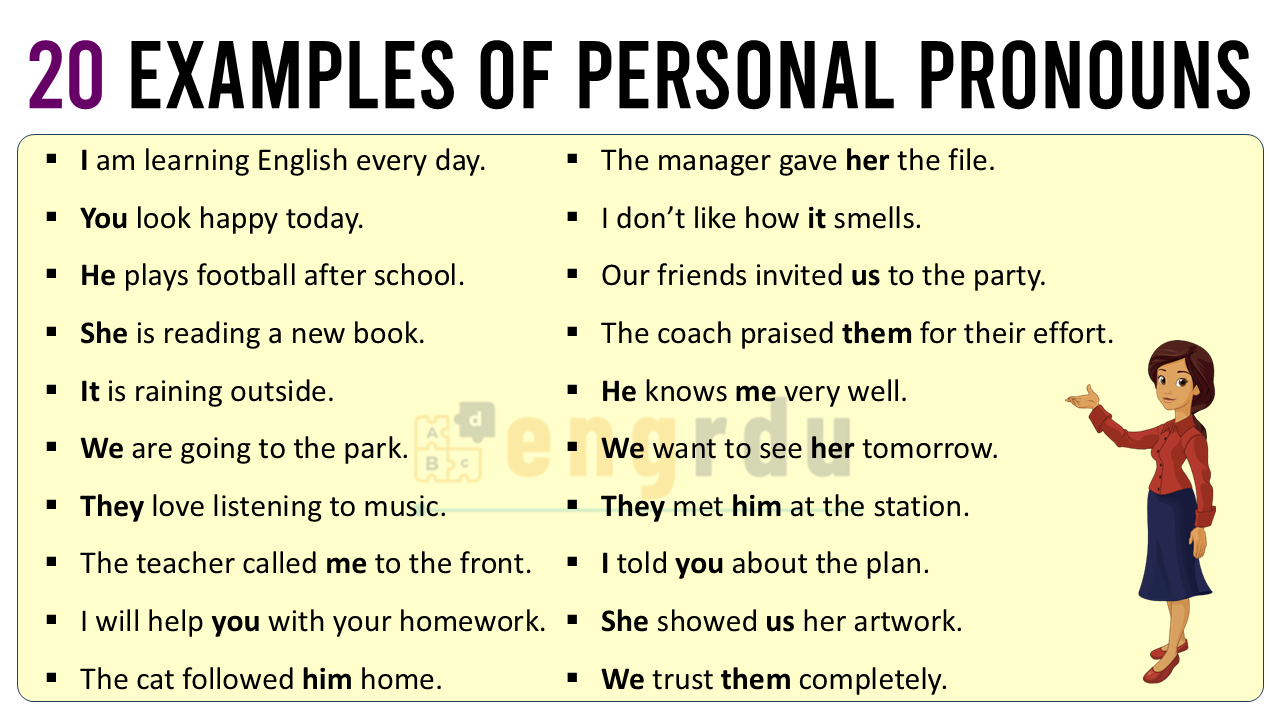
- I am learning English every day.
- You look happy today.
- He plays football after school.
- She is reading a new book.
- It is raining outside.
- We are going to the park.
- They love listening to music.
- The teacher called me to the front.
- I will help you with your homework.
- The cat followed him home.
- The manager gave her the file.
- I don’t like how it smells.
- Our friends invited us to the party.
- The coach praised them for their effort.
- He knows me very well.
- We want to see her tomorrow.
- They met him at the station.
- I told you about the plan.
- She showed us her artwork.
- We trust them completely.

How to Use Personal Pronouns Correctly
Use subject pronouns when the pronoun is the doer of the action.
She cooks dinner.Use object pronouns when the pronoun is the receiver of the action.
Tom helped her.
Personal Pronouns Chart
| Subject Pronouns | Object Pronouns |
|---|---|
| I | me |
| You | you |
| He | him |
| She | her |
| It | it |
| We | us |
| They | them |
Personal pronouns make English simple, clear, and natural. They help us avoid repetition and make communication easy to understand. Practise these 20 examples to master how personal pronouns work in real sentences.
FAQs about Personal Pronouns Example Sentences
What is a personal pronoun with an example?
A personal pronoun replaces a person or thing in a sentence. Example: She is reading a book.
What are 10 examples of personal pronouns?
Ten common personal pronouns are: I, you, he, she, it, we, they, me, him, her.
What are subject and object personal pronouns?
Subject pronouns do the action (e.g., He runs fast).
Object pronouns receive the action (e.g., The ball hit him).
How do you use personal pronouns in sentences?
Use personal pronouns to avoid repeating names and make sentences simple, e.g., Lisa loves her dog. She takes it for a walk daily.
Why are personal pronouns important in English?
They make communication clearer, shorter, and natural, helping speakers and writers express ideas smoothly without repetition.
Read More

1 Comment