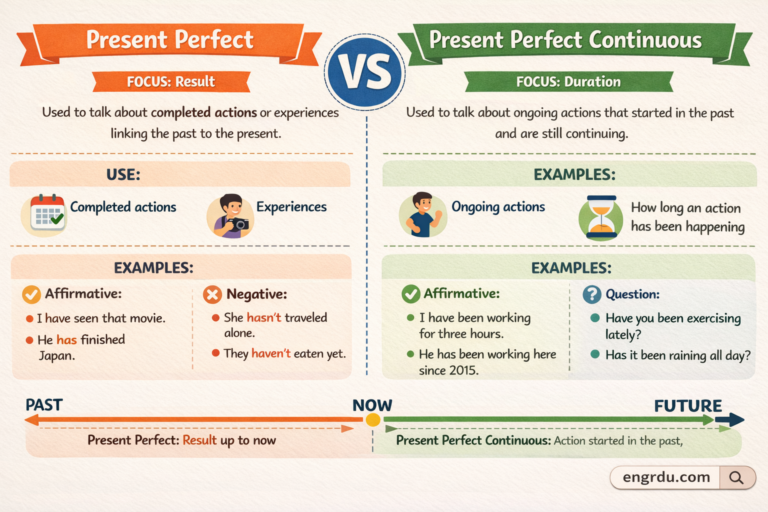

In this blog post, you will learn practice exercises for the present continuous tense in English. Knowing the present continuous tense helps you understand how to talk about actions happening right now or around the present time. It also improves your speaking and writing skills because you can form sentences correctly in questions, positive statements, and negative statements. By doing these exercises, you can practice using the tense confidently in daily conversations. Practicing the present continuous tense will make your English grammar stronger and easier to use.
These exercises will improve your ability to:
- Speak about what is happening now
- Ask and answer questions correctly
- Write Present Continuous sentences with confidence
Let’s start by reviewing the basic rules and structure of the present continuous tense.
Present Continuous Tense Practice Exercises
A. Fill in the blanks
Use the correct form of the verb in the present continuous tense.
- She ______ (cook) dinner.
- They ______ (play) in the park.
- I ______ (read) an English book.
- We ______ (watch) a movie.
- He ______ (write) a letter.
B. Fill in the blanks
Use the correct negative form in the present continuous tense.
- I ______ (not/sleep) now.
- He ______ (not/eat) breakfast.
- We ______ (not/go) to school.
- She ______ (not/talk) to him.
- They ______ (not/clean) the room.

C. Make Interrogative Sentences
Rearrange the words to form Present Continuous questions.
- (you / doing / what)
- (is / he / calling / you)
- (they / working / are / today)
- (reading / she / is / book / a)
- (I / listening / am / music / to)
D. WH-Questions in Present Continuous
Complete the sentences using WH-words (What, Where, Why, etc.)
______ are you going?
- ______ is he doing now?
- ______ are they watching on TV?
- ______ is she crying?
- ______ are we meeting?

Answers Section
A. Positive Sentences
- She is cooking dinner.
- They are playing in the park.
- I am reading an English book.
- We are watching a movie.
- He is writing a letter.
B. Negative Sentences
- I am not sleeping now.
- He is not eating breakfast.
- We are not going to school.
- She is not talking to him.
- They are not cleaning the room.
C. Interrogative Sentences
- What are you doing?
- Is he calling you?
- Are they working today?
- Is she reading a book?
- Am I listening to music?
D. WH-Questions
- Where are you going?
- What is he doing now?
- What are they watching on TV?
- Why is she crying?
- When are we meeting?
Learning and practicing the present continuous tense helps you speak about ongoing actions and have better daily conversations in English. The more you practice, the more fluent you will become. Start with these exercises and repeat them regularly for better results.
Read More