
In this blog post, you will learn the present continuous tense in English, including its definition, structure, and example sentences. Knowing the present continuous tense helps you understand how to talk about actions happening right now or around the present time. It also improves your speaking and writing skills because you can form sentences correctly in positive, negative, and question forms. By studying the structure and examples, you can practice using the tense confidently in daily conversations. Learning the present continuous tense will make your English grammar stronger and easier to use.
You can use the present continuous tense to:
- Talk about what you are doing right now
- Describe actions that are still going on
- Speak about future plans
At the end of this lesson, you will know how to make present continuous sentences and use them in daily English conversations.
What is the Present Continuous Tense?
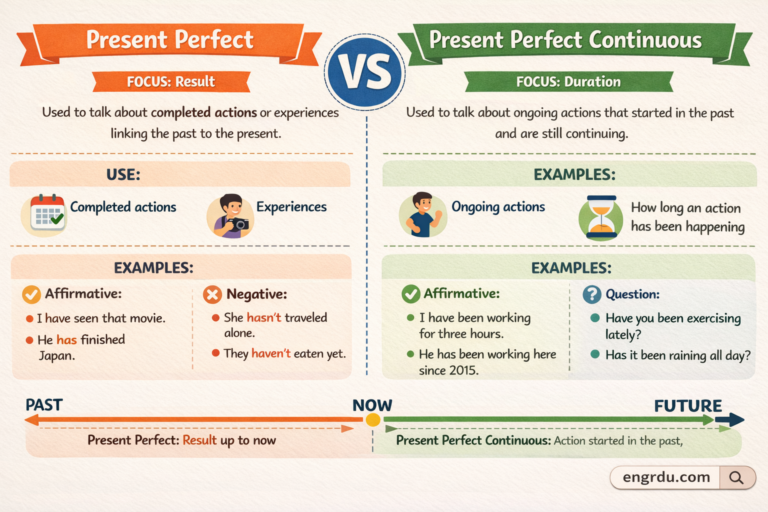
The present continuous tense is used to show an action that is happening now or is still going on at the present moment.
Structure of Present Continuous Tense
We use the helping verb “am/is/are” + verb with -ing.
Positive Sentences
Formula:
- Subject + am/is/are + Verb (ing) + Object
| Subject | Helping Verb | Verb + ing | Example |
|---|---|---|---|
| I | am | reading | I am reading a book. |
| He / She / It | is | eating | She is eating an apple. |
| We / You / They | are | playing | They are playing cricket. |
Negative Sentences
Formula:
- Subject + am/is/are + not + Verb (ing) + Object
| Subject | Helping Verb | not + Verb + ing | Example |
|---|---|---|---|
| I | am not | sleeping | I am not sleeping now. |
| He/She/It | is not | talking | He is not talking. |
| We / You / They | are not | running | We are not running today. |
Interrogative Sentences
Formula:
- Am/Is/Are + Subject + Verb (ing) + Object + ?
| Helping Verb | Subject | Verb + ing | Example |
|---|---|---|---|
| Am | I | writing | Am I writing clearly? |
| Is | he/she/it | going | Is she going to school? |
| Are | we/you/they | playing | Are they playing football? |
Usage of Present Continuous Tense
Use this tense to describe:
Actions happening now
→ She is studying right now.
Ongoing actions around this time
→ I am working on a new project.
Temporary actions
→ He is living in Lahore for a month.
Future plans (with time mentioned)
→ We are meeting the teacher tomorrow.

Examples of Present Continuous Sentences
Positive Sentences
- I am drinking tea.
- She is watching a movie.
- They are learning English.
- We are writing notes.
- He is cleaning the room.
Negative Sentences
- I am not watching TV.
- He is not coming today.
- They are not listening.
- She is not cooking.
- We are not going now.
Interrogative (Questions) Sentences
- Are you studying now?
- Is he calling you?
- Am I speaking too fast?
- Are we meeting later?
- Is she dancing?
Tips to Remember
- Always use “am” with I, “is” with he/she/it, and “are” with we/you/they.
- Add -ing to the base verb.
- For negatives, use am/is/are + not.
- In questions, move am/is/are to the start.
The present continuous tense is very useful in daily English speaking. It helps you describe what is happening now or what you are doing at the moment. Keep practicing this tense with different verbs and short sentences.
Read More