


Sometimes, you want to help someone, but the words do not come quickly. You may see a friend looking confused, a teacher carrying books, or a customer trying to find something. Saying “How can I help you?” is good, but English gives you many other simple ways to sound kind, polite, and natural.
In this lesson, you will learn easy phrases like “Do you need any help?”, “What can I do for you?”, and “Can I give you a hand?” You can use them at school, at home, in shops, and in everyday conversations.
Meaning of “How Can I Help You”
“How can I help you?” means:
“Tell me what you need, and I will try to help.”
You can use this phrase when you want to offer help. It works in many places, such as schools, shops, offices, hotels, homes, and online chats.
It is polite, simple, and common.
Why Learn Other Ways to Ask “How Can I Help You”?
If you always say the same phrase, your English may sound a little plain.
When you learn more phrases, you can choose the best one for each situation.
For example:
| Situation | Better Phrase |
|---|---|
| In a shop | What can I help you find? |
| With a friend | Need a hand? |
| With a teacher | How may I help you? |
| With a sad person | Is there anything I can do? |
| With a customer | How may I assist you? |
Small word changes can make your English sound more natural.
Sentence Structure of Help Phrases
Most help phrases follow simple patterns.
1. Question Pattern
These phrases ask the person what they need.
| Pattern | Example |
|---|---|
| Can I + verb…? | Can I help you? |
| Do you need…? | Do you need any help? |
| Would you like…? | Would you like some help? |
| Is there anything…? | Is there anything I can do? |
2. Polite Question Pattern
These phrases sound more respectful.
| Pattern | Example |
|---|---|
| May I + verb…? | May I help you? |
| How may I + verb…? | How may I assist you? |
| Would you like me to…? | Would you like me to carry that? |
3. Friendly Statement Pattern
These phrases do not ask a direct question. They show that you are ready to help.
| Pattern | Example |
|---|---|
| I’m here to… | I’m here to help. |
| Let me… | Let me help you. |
| Tell me… | Tell me what you need. |
20+ Other Ways to Ask “How Can I Help You”
Here is a clear list of useful phrases with simple meanings and real examples.
| Phrase | Meaning | Example Sentence |
|---|---|---|
| What can I do for you? | Tell me what you need. | Good morning. What can I do for you? |
| How may I help you? | A very polite way to offer help. | Welcome to our office. How may I help you? |
| May I help you? | Can I help you? | Hello. May I help you? |
| Can I help you? | Do you want help? | You look lost. Can I help you? |
| Do you need any help? | I can help if you want. | Do you need any help with your homework? |
| Would you like some help? | Do you want me to help? | Would you like some help carrying that bag? |
| Can I help you with something? | I think you may need help. | Can I help you with something on this form? |
| Is there anything I can do? | I want to help in some way. | You look upset. Is there anything I can do? |
| Can I do anything for you? | I am ready to help. | You seem busy. Can I do anything for you? |
| What do you need? | Tell me what you want. | I’m here now. What do you need? |
| What can I help you with? | Tell me the thing you need help with. | What can I help you with today? |
| How may I assist you? | A formal way to offer help. | Thank you for calling. How may I assist you? |
| Need a hand? | Do you need help? | Need a hand with those books? |
| Can I give you a hand? | Can I help you do this? | That chair looks heavy. Can I give you a hand? |
| How can I support you? | How can I help you feel better or do better? | I know this is hard. How can I support you? |
| What would you like me to do? | Tell me the action you want. | I can help. What would you like me to do? |
| Are you looking for something? | Do you want to find something? | Hi. Are you looking for something? |
| What can I help you find? | Tell me what item you need. | What can I help you find in the store? |
| I’m here to help. What do you need? | I am ready to help you. | Take your time. I’m here to help. What do you need? |
| Tell me how I can help. | Explain what you need from me. | Tell me how I can help, and we will start. |
| Are you having any trouble? | Is something difficult for you? | Are you having any trouble with the computer? |
| Is everything okay? | Do you need help or support? | You look worried. Is everything okay? |
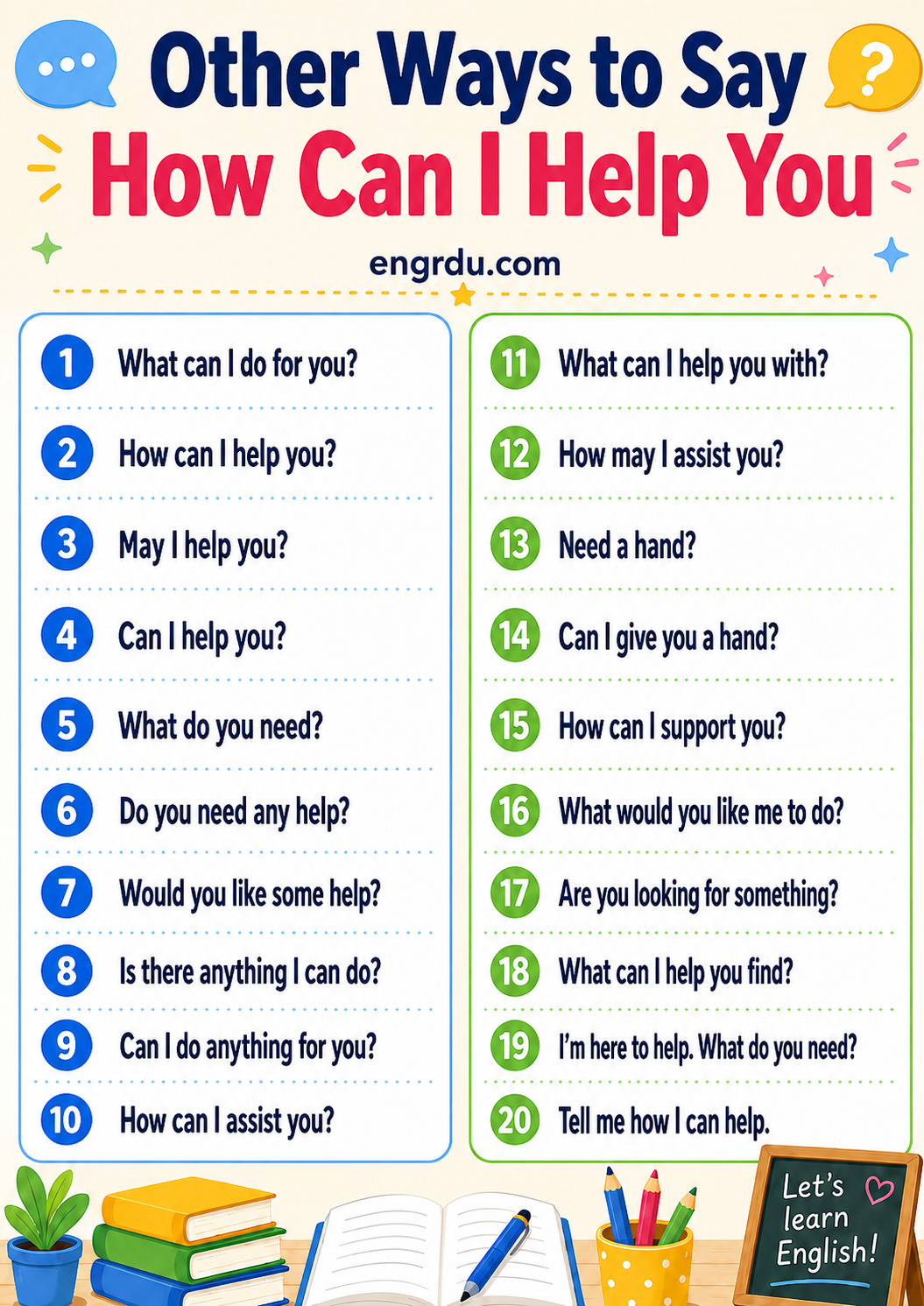
Other Ways to Say How Can I Help You
Direct Ways to Ask “How Can I Help You”
Direct phrases are clear. Use them when you can see that someone may need help.
| Phrase | Best Situation |
|---|---|
| Can I help you? | When someone looks confused |
| Do you need any help? | At school, home, or work |
| What can I do for you? | When someone asks for your attention |
| What do you need? | With friends or family |
| Are you having any trouble? | When someone is stuck |
Example:
Student: I can’t find my notebook.
Teacher: Do you need any help?
Indirect Ways to Offer Help
Indirect phrases are softer. Use them when you do not want to sound too direct.
| Phrase | Best Situation |
|---|---|
| Is everything okay? | When someone looks worried |
| Are you looking for something? | In a shop or library |
| Are you finding everything okay? | In a store |
| Is there anything I can do? | When someone seems upset |
| Let me know if you need anything. | When you want to offer help gently |
Example:
Shop worker: Are you finding everything okay?
Customer: Yes, thank you. I’m looking for a black notebook.
Formal Ways to Ask “How Can I Help You”
Formal phrases are good for customers, guests, teachers, managers, and people you do not know well.
| Phrase | Meaning | Example |
|---|---|---|
| How may I help you? | Very polite help offer. | Good afternoon. How may I help you? |
| How may I assist you? | Formal and professional. | Thank you for calling. How may I assist you? |
| May I help you? | Short and polite. | Welcome. May I help you? |
| What can I do for you? | Polite and clear. | Hello, sir. What can I do for you? |
| Is there anything I can assist you with? | Very polite and complete. | Is there anything I can assist you with today? |
Best Places to Use Formal Phrases:
- Hotels
- Offices
- Shops
- Customer service
- Schools
- Banks
- Phone calls
Informal Ways to Ask “How Can I Help You”
Informal phrases are good for friends, classmates, family, and close coworkers.
| Phrase | Meaning | Example |
|---|---|---|
| Need a hand? | Do you want help? | Need a hand with your bag? |
| Can I give you a hand? | Can I help you do that? | Can I give you a hand with the table? |
| Need help? | Short way to ask. | Need help with the game? |
| What’s wrong? | Tell me the problem. | You look sad. What’s wrong? |
| I’m here if you need me. | You can ask me for help. | Don’t worry. I’m here if you need me. |
Note for Learners:
Do not use very casual phrases with customers or teachers. For example, “Need a hand?” is friendly, but “How may I help you?” is better in formal places.
Phrases for Customer Service
Use these when you work in a shop, office, hotel, restaurant, or online support.
| Phrase | Example Situation |
|---|---|
| How may I help you today? | Phone support |
| What can I help you find? | Store or library |
| Are you looking for something specific? | Shop |
| Is there anything else I can get for you? | Restaurant |
| How may I assist you? | Office or hotel |
| What seems to be the problem? | Technical help |
Example Dialogue:
Worker: Hello. How may I help you today?
Customer: I need a new school bag.
Worker: Sure. What color would you like?
Phrases for School and Classroom
These phrases are useful for students and teachers.
| Phrase | Who Can Use It? | Example |
|---|---|---|
| Do you need any help? | Teacher or student | Do you need any help with this question? |
| Can I help you with that? | Student | Can I help you with your drawing? |
| What can I do for you? | Teacher | What can I do for you after class? |
| Are you having trouble? | Teacher | Are you having trouble reading this word? |
| Tell me what you need. | Teacher or friend | Tell me what you need, and I’ll try to help. |
Usage Rules and Tips
Use the right phrase for the right person.
| Rule | Simple Tip |
|---|---|
| Use polite words with new people. | Say “How may I help you?” |
| Use friendly words with friends. | Say “Need a hand?” |
| Use soft words with sad people. | Say “Is there anything I can do?” |
| Use clear words in shops. | Say “What can I help you find?” |
| Do not force help. | If they say no, say “Okay, no problem.” |
Common Mistakes to Avoid
English learners often make small errors with help phrases.
| Incorrect | Correct | Why |
|---|---|---|
| How I can help you? | How can I help you? | Use question word order. |
| Can I helping you? | Can I help you? | Use the base verb after “can.” |
| Do you needing help? | Do you need help? | Use the base verb after “do.” |
| May I assistance you? | May I assist you? | “Assist” is a verb. |
| How can I help to you? | How can I help you? | Do not use “to” after “help” here. |
| You need help? | Do you need help? | Add “do” for a full question. |
| I am here to helping. | I am here to help. | Say “to help,” not “to helping.” |
Practice Exercise
Choose the best phrase for each situation.
| Situation | Best Answer |
|---|---|
| A customer enters a shop. | How may I help you? |
| Your friend is carrying heavy books. | Can I give you a hand? |
| Your classmate looks confused. | Do you need any help? |
| A person is searching in a library. | Are you looking for something? |
| Your friend looks sad. | Is there anything I can do? |
| Someone cannot open a door. | Can I give you a hand? |
| A customer calls support. | How may I assist you? |
| Your teacher asks you to stay. | What can I do for you? |
Mini Dialogue Practice
1: In a Shop
Worker: Hello. What can I help you find?
Customer: I need a blue notebook.
Worker: Sure. They are on the second shelf.
2: With a Friend
Ali: This box is too heavy.
Sara: Need a hand?
Ali: Yes, please.
3: In Customer Service
Agent: Thank you for calling. How may I assist you?
Customer: I cannot log in to my account.
Agent: I can help you with that.
4: In Class
Teacher: You look confused. Do you need any help?
Student: Yes, I don’t understand this word.
Teacher: Let’s read it together.
Quick Comparison: “Can” vs “May”
| Phrase | Tone | Use |
|---|---|---|
| Can I help you? | Common and friendly | Daily English |
| May I help you? | More polite | Shops, offices, formal talk |
| How can I help you? | Natural and common | Most situations |
| How may I help you? | Polite and formal | Customer service |
Both “can” and “may” are correct here. The main difference is tone.
Best Phrases to Remember
If you are a beginner, start with these five:
- How can I help you?
- What can I do for you?
- Do you need any help?
- May I help you?
- Can I give you a hand?
These phrases are simple, useful, and safe in many real-life situations.
FAQs About “How Can I Help You?”
- Is “How can I help you?” always appropriate? Yes, it is usually fine. But if you use it again and again, it may sound a little cold. Try other phrases based on the person and situation.
- What’s the difference between “Can I help you?” and “May I help you?” “May I help you?” sounds more polite and formal. Use it with customers, guests, or people you do not know well. “Can I help you?” sounds more common and friendly.
- How do I offer help without being too direct? Use soft phrases like “Are you finding everything okay?” or “Is everything going well?” These let the person say yes or no easily.
- What should I say if someone says no to my help? Respect their answer. You can say, “Okay, no problem. Let me know if you need anything.”
- How can I make my offer sound more kind? Use a warm voice and kind words. Say something like “I’m here to help” or “Tell me how I can help.”
- Can I offer help if I am not sure I can fix the problem? Yes. You can still try to help. You may also say, “I can find someone who knows more about this.”
- Are there cultural rules when offering help? Yes. In some cultures, direct help may feel too personal. A softer phrase like “Let me know if you need anything” can sound better.
- How do I offer help to a very independent person? Use a gentle phrase. Say, “I’m here if you need me.” This shows support without making them feel weak.
Conclusion
Mastering alternative phrases for “How can I help you?” is a valuable skill for anyone seeking to improve their English communication. By understanding the different types of assistance phrases, usage rules, and common mistakes, you can communicate more effectively, empathetically, and appropriately in various situations.
