
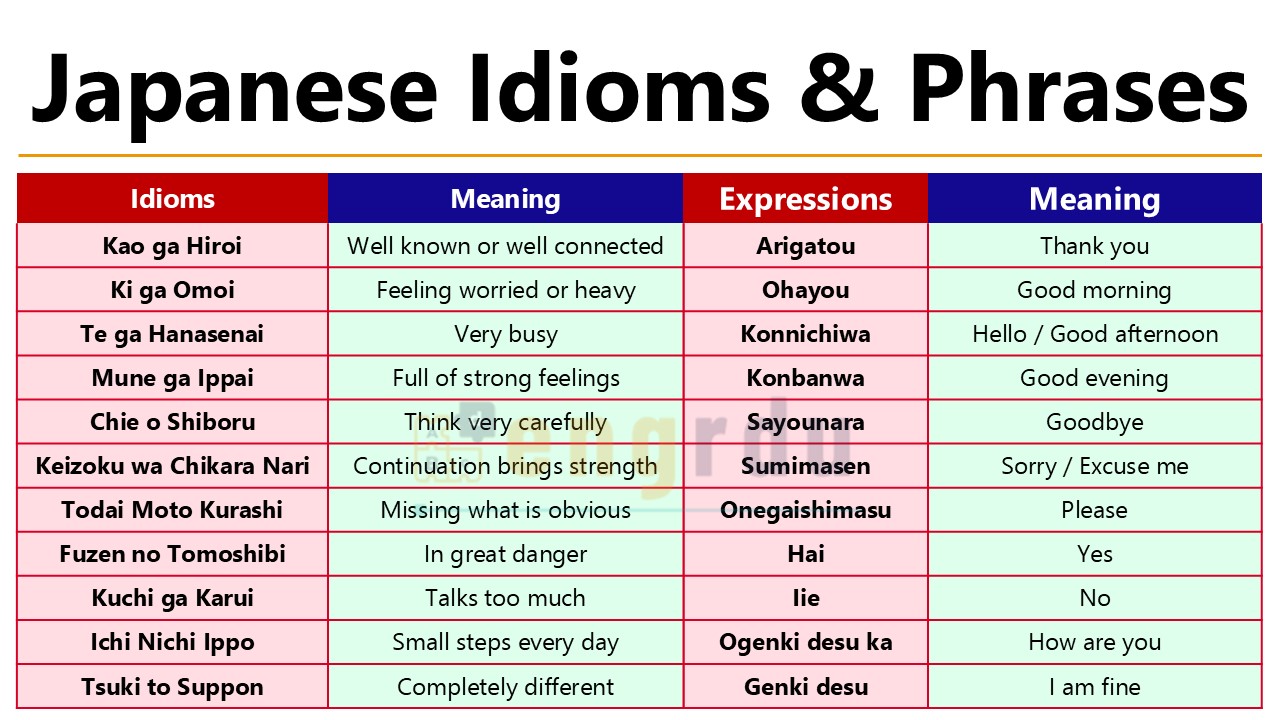

Japanese idioms and phrases are commonly used in daily conversations, media, and written communication. Learning these expressions can help you understand native speakers more easily and use Japanese more naturally. In this article, you’ll find popular Japanese idioms and phrases with their meanings, English translations, and example sentences.
What Are Japanese Idioms and Phrases?
Japanese idioms are fixed expressions whose meanings are different from the literal words. They often use animals, nature, body parts, or actions to express ideas.
Key features of Japanese idioms:
- Short
- Meaningful
- Cultural
- Used in daily life
Example:
猿も木から落ちる (Saru mo ki kara ochiru)
Literal meaning: Even monkeys fall from trees
Real meaning: Even experts make mistakes
Why Learning Japanese Idioms Is Important
Learning Japanese idioms helps you:
- Understand real Japanese conversations
- Improve reading and listening skills
- Learn culture and thinking style
- Speak more naturally and confidently
Idioms are commonly used in:
- Daily talk
- Stories
- News
- School lessons
List of Japanese Idioms with Meanings
| Japanese Idiom | Meaning in English |
|---|---|
| Ichigo Ichie | Treasure every meeting |
| Nanakorobi Yaoki | Never give up |
| Saru mo Ki kara Ochiru | Even experts make mistakes |
| Hana yori Dango | Choose practical things over beauty |
| Ishi no Ue ni mo San Nen | Patience brings success |
| Hyakubun wa Ikken ni Shikazu | Seeing is better than hearing |
| Ichi Nichi Ippo | Small steps every day |
| Tsuki to Suppon | Completely different |
| Ame Futte Ji Katamaru | Problems make people stronger |
| Oteage | To give up |
| Kao ga Hiroi | Well known or well connected |
| Ki ga Omoi | Feeling worried or heavy |
| Te ga Hanasenai | Very busy |
| Mune ga Ippai | Full of strong feelings |
| Chie o Shiboru | Think very carefully |
| Keizoku wa Chikara Nari | Continuation brings strength |
| Todai Moto Kurashi | Missing what is obvious |
| Fuzen no Tomoshibi | In great danger |
| Kuchi ga Karui | Talks too much |
| Ki ni Iru | To like something |
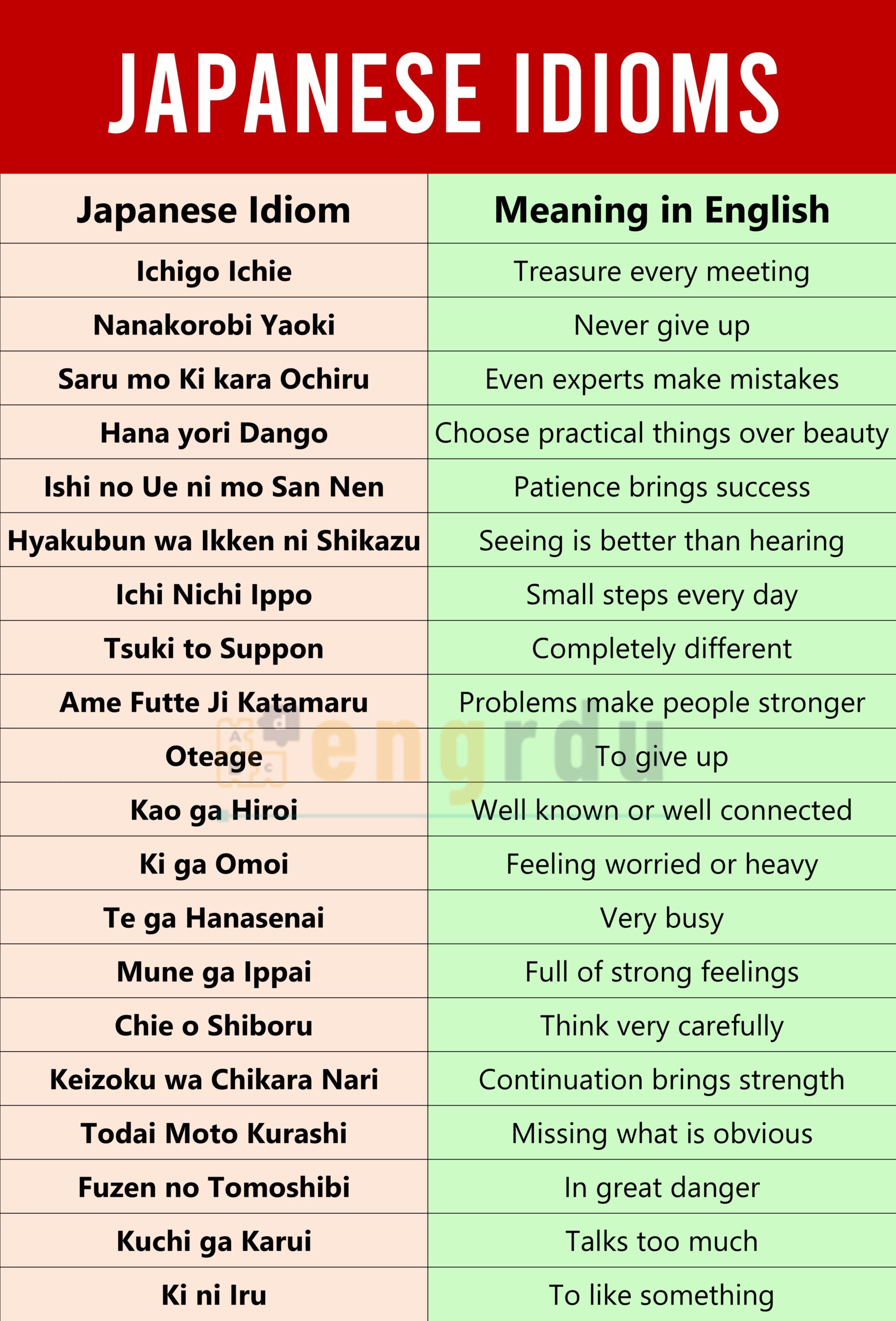
Japanese Idioms
List of Japanese Expressions and Phrases
| Japanese Expression/Phrase | Meaning in English |
|---|---|
| Arigatou | Thank you |
| Ohayou | Good morning |
| Konnichiwa | Hello / Good afternoon |
| Konbanwa | Good evening |
| Sayounara | Goodbye |
| Sumimasen | Sorry / Excuse me |
| Onegaishimasu | Please |
| Hai | Yes |
| Iie | No |
| Ogenki desu ka | How are you |
| Genki desu | I am fine |
| Otsukaresama | Thank you for your hard work |
| Gambatte | Do your best |
| Daijoubu | It is okay |
| Wakatta | I understand |
| Wakarimasen | I do not understand |
| Yoroshiku onegaishimasu | Nice to meet you |
| Chotto matte | Please wait a moment |
| Dou itashimashite | You are welcome |
| Itadakimasu | Said before eating |
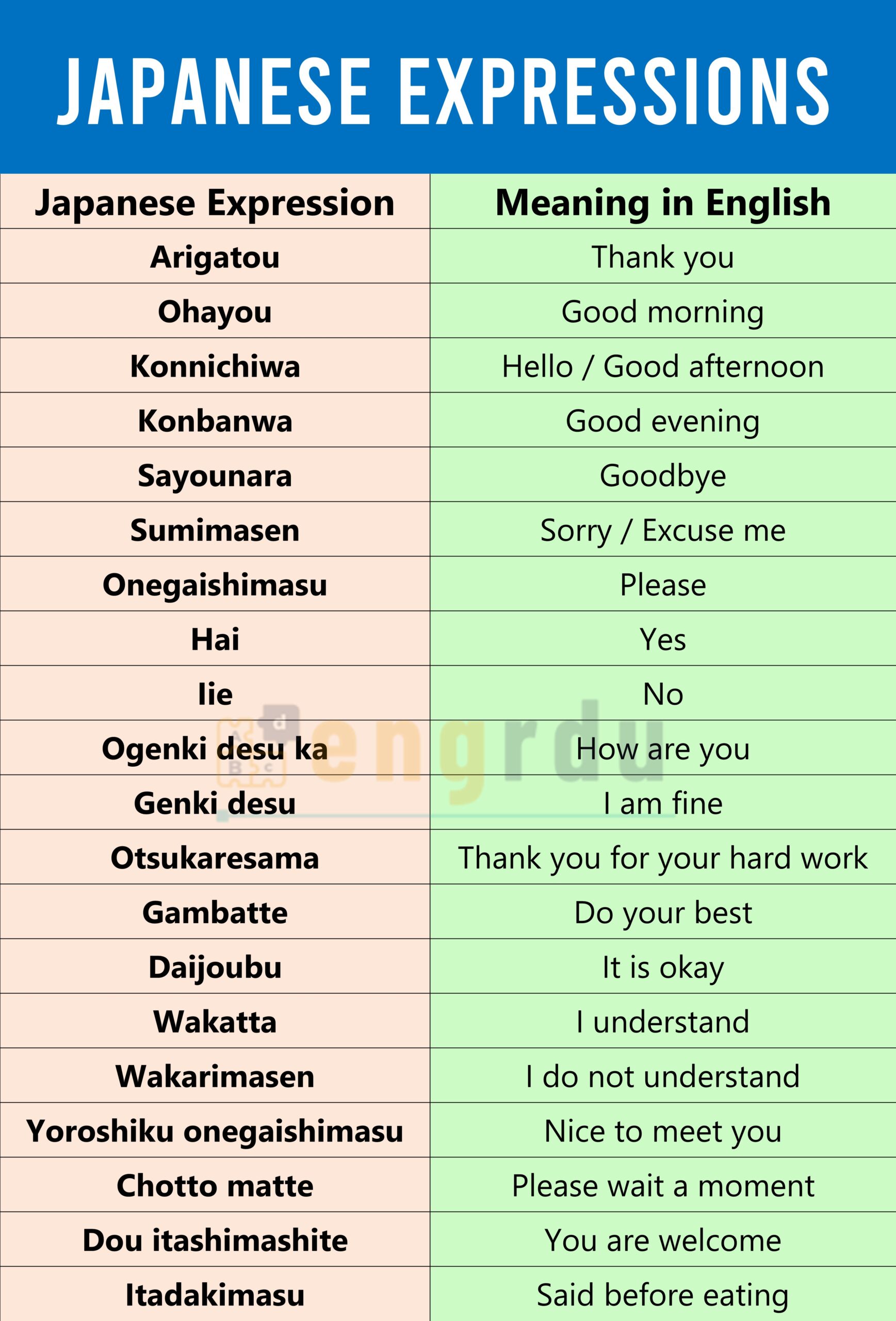
Japanese Expressions and Phrases
Common Japanese Idioms About Life
| Idiom | Meaning | Example Sentence |
|---|---|---|
| 一期一会 (Ichigo ichie) | Treasure every meeting | This moment is special. Remember ichigo ichie. |
| 七転び八起き (Nanakorobi yaoki) | Never give up | He failed many times, but lived by nanakorobi yaoki. |
| 明日は明日の風が吹く | Tomorrow will take care of itself | Do not worry too much. Tomorrow will be fine. |
| 雨降って地固まる | Problems make things stronger | After the argument, their bond grew stronger. |
Japanese Idioms Related to Hard Work and Effort
| Idiom | Meaning | Example |
|---|---|---|
| 石の上にも三年 | Patience brings success | Study hard. Even stone warms in three years. |
| 努力は裏切らない | Effort never fails | Her success proved effort never fails. |
| 継続は力なり | Continuation is power | Daily practice makes you better. |
| 一生懸命 | With full effort | He worked isshoukenmei for exams. |
Japanese Idioms About Feelings and Emotions
| Idiom | Meaning | Example |
|---|---|---|
| 顔が広い | Well connected | She knows many people in the city. |
| 頭が上がらない | Feel grateful or indebted | I owe him a lot for his help. |
| 胸がいっぱい | Full of emotion | She was full of joy and gratitude. |
| 気が重い | Feel worried | I feel uneasy about the test. |
Japanese Idioms About Wisdom and Learning
| Idiom | Meaning | Example |
|---|---|---|
| 百聞は一見にしかず | Seeing is better than hearing | Visit the place to understand it. |
| 知恵を絞る | Think deeply | We must think carefully for a solution. |
| 習うより慣れよ | Practice is better than study | Learn by doing. |
| 灯台下暗し | Obvious things are missed | The answer was right in front of us. |
Japanese Idioms Used in Daily Conversation
| Idiom | Meaning | Example |
|---|---|---|
| お手上げ | Give up | I cannot solve this problem. |
| 口が軽い | Talks too much | Do not tell him secrets. |
| 手が離せない | Very busy | I cannot talk now. |
| 気に入る | Like something | I really like this book. |
Nature-Based Japanese Idioms
| Idiom | Meaning | Example |
|---|---|---|
| 花より団子 | Practical over beauty | Choose usefulness over looks. |
| 月とすっぽん | Completely different | They are not alike at all. |
| 雲をつかむ | Unrealistic | His dream feels impossible. |
| 風前の灯火 | In danger | The plan is about to fail. |
Proverbs vs Idioms in Japanese
Idioms
- Used in daily speech
- Short expressions
- Often informal
Proverbs
- Teach life lessons
- Traditional sayings
- More formal
Both are useful for:
- Better speaking
- Cultural understanding
- Advanced learning
Japanese Idioms and Phrases PDF
Japanese Idioms and Phrases with Meaning in English
Read More:
- Japanese Slang Words in English
- 65+ Australian Slang Words with Meanings
- 55+ American Words Slang with Meanings
Tips to Learn Japanese Idioms Easily
- Learn 5 idioms a day
- Use them in simple sentences
- Connect them with real life
- Read short stories
- Revise regularly
Frequently Asked Questions
What are Japanese idioms?
Japanese idioms are expressions whose meanings go beyond the literal meanings of the individual words. They often reflect Japanese culture, traditions, and everyday experiences.
What is Ichigo Ichie meaning?
一期一会 (Ichigo Ichie) means treasure every meeting because it may happen only once in life. Example: Enjoy this moment together, remember ichigo ichie.
Why should I learn Japanese idioms and phrases?
Learning Japanese idioms and phrases helps you understand native speakers better, sound more natural in conversations, and gain deeper insight into Japanese culture.
Are Japanese idioms commonly used in daily conversations?
Yes. Many Japanese idioms and common phrases appear in everyday speech, movies, anime, books, social media, and workplace conversations.
What is the difference between a Japanese idiom and a Japanese phrase?
An idiom has a figurative meaning that cannot be understood word for word, while a phrase usually has a direct and literal meaning.
Can beginners learn Japanese idioms?
Absolutely. Beginners can start with common idioms and everyday expressions that are easy to remember and frequently used in real conversations.
How can I remember Japanese idioms more easily?
Practice idioms in context, create example sentences, and connect them with real situations. Seeing them used regularly makes them easier to remember.
Do Japanese idioms have English equivalents?
Many Japanese idioms express ideas similar to English idioms, but the wording and cultural references are often different. Some have direct equivalents, while others are unique to Japanese culture.
Conclusion
Japanese idioms and phrases are powerful tools for learning the language. They make your speech natural, your understanding deeper, and your vocabulary stronger. By learning these important and common idioms, English learners can improve quickly and enjoy the beauty of the Japanese language.


Leave a Comment